nanoFramework LoRa library Part4B

Transmit Basic Revisited

After finding some possible SPI library issues (April 2020) with my STM32F429 Discovery + Dragino LoRa shield for Arduino test rig I wanted to trial my code on another nanoFramework platform.

I had ordered a Sparkfun LoRa Gateway 1 Channel ESP32 for a LoRaWAN research project from a local supplier and an unexpected “bonus” was that the ESP32 WROOM platform is supported by the nanoFramework.

Sparkfun LoRa Gateway 1 Channel with wire antenna

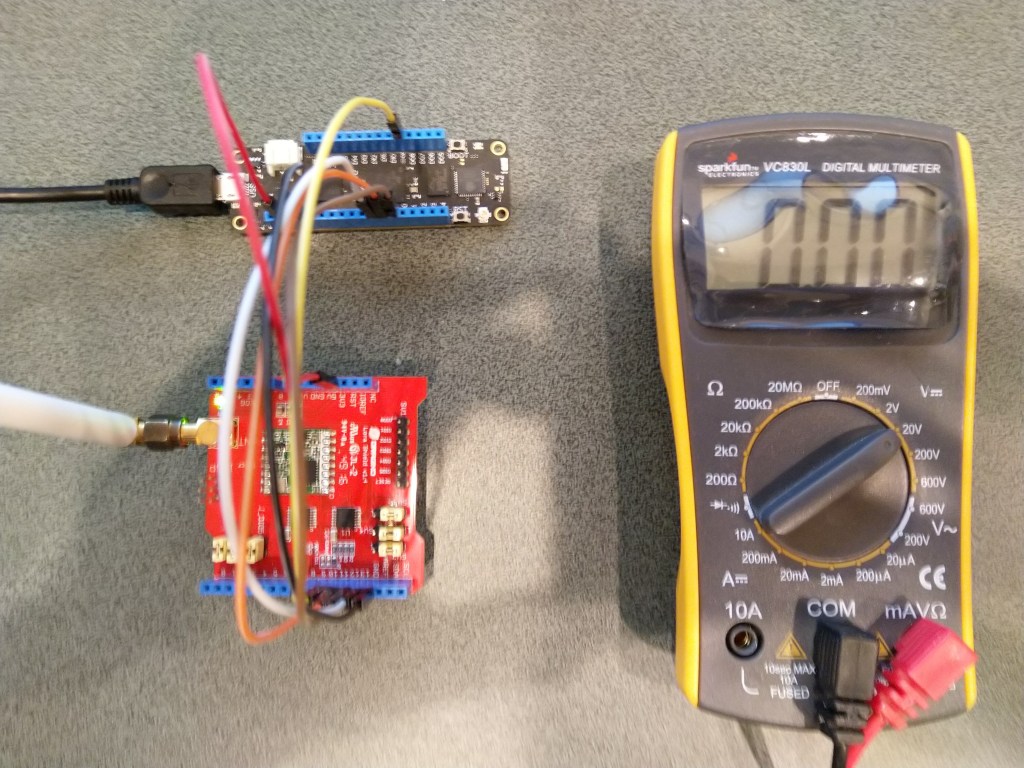
I am using this in conjunction with my Armtronix IA005 SX1276 loRa node and my STM32F429 Discovery + Dragino LoRa shield for Arduino test rig.

STM32F429 Discovery+ Dragino LoRa shield with Armtronix device

The code now works on STM32F429 Discovery and ESP32 WROOM platforms. (manual update nanoFramework.Hardware.Esp32 NuGet reference required)
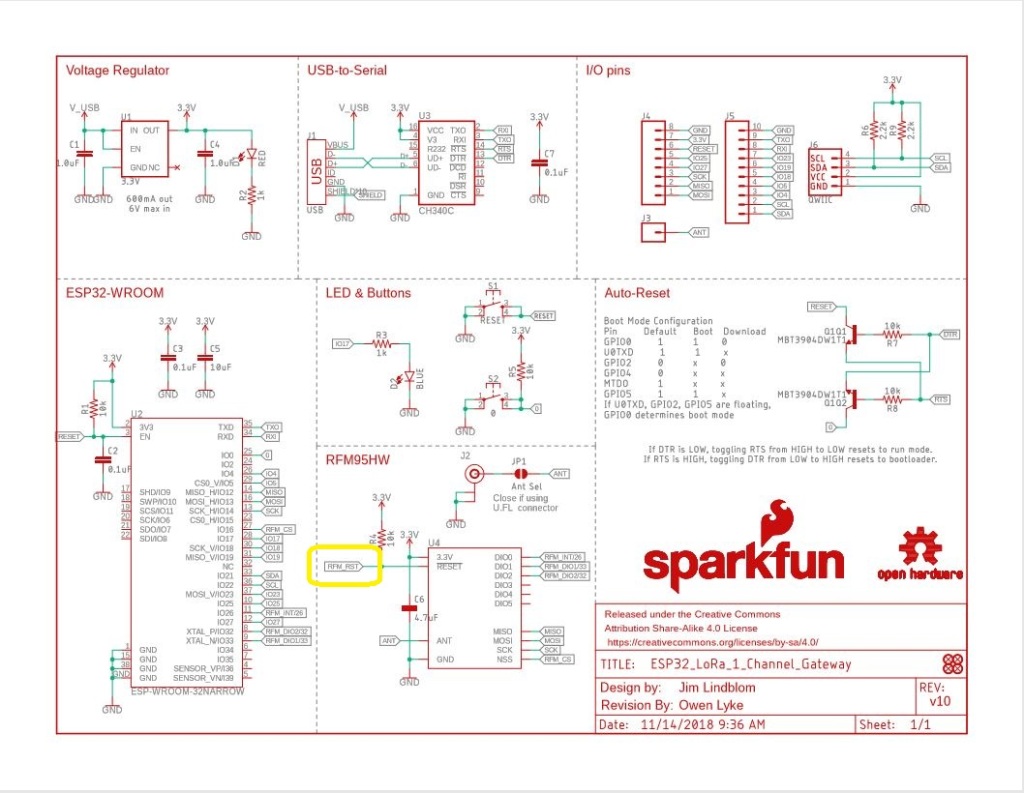
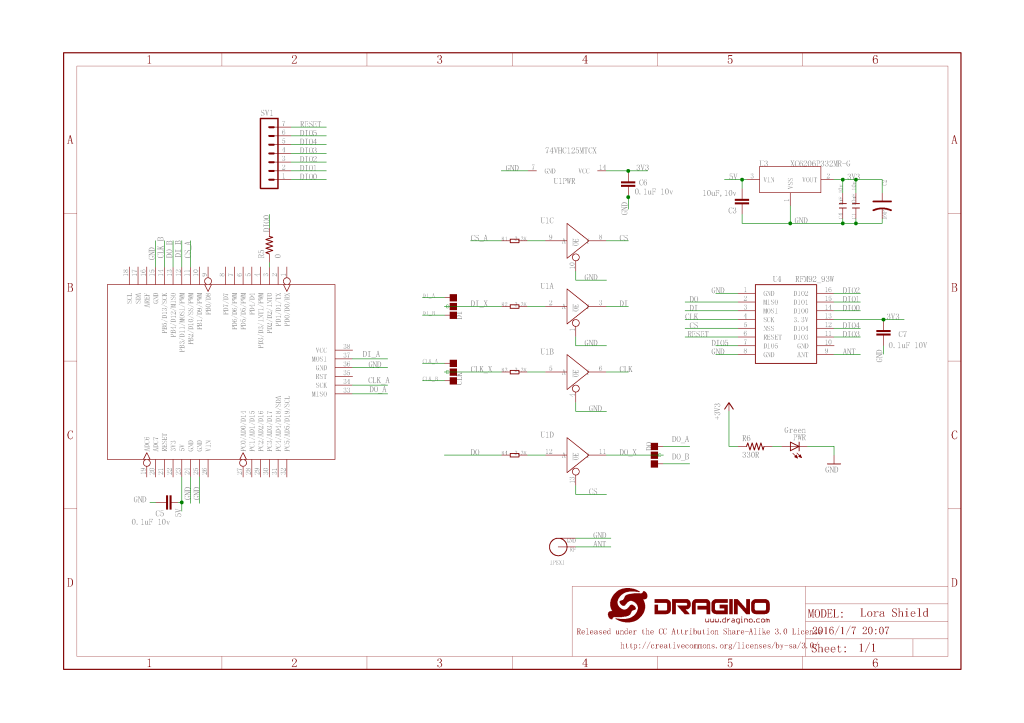
Sparkfun LoRa Gateway 1 Channel schematic

One disadvantage of the SparkFun device is that the reset pin on the SX127X doesn’t appear to be connected to the ESP32 so I can’t factory reset the device in code.

//#define ST_STM32F429I_DISCOVERY       //nanoff --target ST_STM32F429I_DISCOVERY --update
#define ESP32_WROOM_32_LORA_1_CHANNEL   //nanoff --target ESP32_WROOM_32 --serialport COM4 --update
namespace devMobile.IoT.Rfm9x.TransmitBasic
{
   using System;
   using System.Text;
   using System.Threading;

   using Windows.Devices.Gpio;
   using Windows.Devices.Spi;

#if ESP32_WROOM_32_LORA_1_CHANNEL
   using nanoFramework.Hardware.Esp32;
#endif

   public sealed class Rfm9XDevice
   {
      private SpiDevice rfm9XLoraModem;
      private const byte RegisterAddressReadMask = 0X7f;
      private const byte RegisterAddressWriteMask = 0x80;

      public Rfm9XDevice(string spiPort, int chipSelectPin, int resetPin)
      {
         var settings = new SpiConnectionSettings(chipSelectPin)
         {
            ClockFrequency = 1000000,
            //DataBitLength = 8,
            Mode = SpiMode.Mode0,// From SemTech docs pg 80 CPOL=0, CPHA=0
            SharingMode = SpiSharingMode.Shared,
         };

         rfm9XLoraModem = SpiDevice.FromId(spiPort, settings);

         // Factory reset pin configuration
         GpioController gpioController = GpioController.GetDefault();
         GpioPin resetGpioPin = gpioController.OpenPin(resetPin);
         resetGpioPin.SetDriveMode(GpioPinDriveMode.Output);
         resetGpioPin.Write(GpioPinValue.Low);
         Thread.Sleep(10);
         resetGpioPin.Write(GpioPinValue.High);
         Thread.Sleep(10);
      }

      public Rfm9XDevice(string spiPort, int chipSelectPin)
      {
         var settings = new SpiConnectionSettings(chipSelectPin)
         {
            ClockFrequency = 1000000,
            Mode = SpiMode.Mode0,// From SemTech docs pg 80 CPOL=0, CPHA=0
            SharingMode = SpiSharingMode.Shared,
         };

         rfm9XLoraModem = SpiDevice.FromId(spiPort, settings);
      }

      public Byte RegisterReadByte(byte registerAddress)
      {
         byte[] writeBuffer = new byte[] { registerAddress &= RegisterAddressReadMask, 0x0 };
         byte[] readBuffer = new byte[writeBuffer.Length];

         rfm9XLoraModem.TransferFullDuplex(writeBuffer, readBuffer);

         return readBuffer[1];
      }

      public ushort RegisterReadWord(byte address)
      {
         byte[] writeBuffer = new byte[] { address &= RegisterAddressReadMask, 0x0, 0x0 };
         byte[] readBuffer = new byte[writeBuffer.Length];

         rfm9XLoraModem.TransferFullDuplex(writeBuffer, readBuffer);

         return (ushort)(readBuffer[2] + (readBuffer[1] << 8));
      }

      public byte[] RegisterRead(byte address, int length)
      {
         byte[] writeBuffer = new byte[length + 1];
         byte[] readBuffer = new byte[writeBuffer.Length];
         byte[] repyBuffer = new byte[length];

         writeBuffer[0] = address &= RegisterAddressReadMask;

         rfm9XLoraModem.TransferFullDuplex(writeBuffer, readBuffer);

         Array.Copy(readBuffer, 1, repyBuffer, 0, length);

         return repyBuffer;
      }

      public void RegisterWriteByte(byte address, byte value)
      {
         byte[] writeBuffer = new byte[] { address |= RegisterAddressWriteMask, value };
         byte[] readBuffer = new byte[writeBuffer.Length];

         rfm9XLoraModem.TransferFullDuplex(writeBuffer, readBuffer);
      }

      public void RegisterWriteWord(byte address, ushort value)
      {
         byte[] valueBytes = BitConverter.GetBytes(value);
         byte[] writeBuffer = new byte[] { address |= RegisterAddressWriteMask, valueBytes[0], valueBytes[1] };
         byte[] readBuffer = new byte[writeBuffer.Length];

         rfm9XLoraModem.TransferFullDuplex(writeBuffer,readBuffer);
      }

      public void RegisterWrite(byte address, byte[] bytes)
      {
         byte[] writeBuffer = new byte[1 + bytes.Length];
         byte[] readBuffer = new byte[writeBuffer.Length];

         Array.Copy(bytes, 0, writeBuffer, 1, bytes.Length);
         writeBuffer[0] = address |= RegisterAddressWriteMask;

         rfm9XLoraModem.TransferFullDuplex(writeBuffer, readBuffer);
      }

      public void RegisterDump()
      {
         Console.WriteLine("Register dump");
         for (byte registerIndex = 0; registerIndex <= 0x42; registerIndex++)
         {
            byte registerValue = this.RegisterReadByte(registerIndex);

            Console.WriteLine($"Register 0x{registerIndex:x2} - Value 0X{registerValue:x2}");
         }
      }
   }

   class Program
   {
#if ST_STM32F429I_DISCOVERY
      private const string SpiBusId = "SPI5";
#endif
#if ESP32_WROOM_32_LORA_1_CHANNEL
      private const string SpiBusId = "SPI1";
#endif

      static void Main()
      {
         int SendCount = 0;
#if ST_STM32F429I_DISCOVERY
         int chipSelectPinNumber = PinNumber('C', 2);
         int resetPinNumber = PinNumber('C', 3);
#endif
#if ESP32_WROOM_32_LORA_1_CHANNEL
         int chipSelectPinNumber = Gpio.IO16;
#endif
         try
         {
#if ESP32_WROOM_32_LORA_1_CHANNEL
            Configuration.SetPinFunction(Gpio.IO12, DeviceFunction.SPI1_MISO);
            Configuration.SetPinFunction(Gpio.IO13, DeviceFunction.SPI1_MOSI);
            Configuration.SetPinFunction(Gpio.IO14, DeviceFunction.SPI1_CLOCK);
            Rfm9XDevice rfm9XDevice = new Rfm9XDevice(SpiBusId, chipSelectPinNumber);
#endif
#if ST_STM32F429I_DISCOVERY
            Rfm9XDevice rfm9XDevice = new Rfm9XDevice(SpiBusId, chipSelectPinNumber, resetPinNumber);
#endif
            Thread.Sleep(500);

            // Put device into LoRa + Standby mode
            rfm9XDevice.RegisterWriteByte(0x01, 0b10000001); // RegOpMode 

            // Set the frequency to 915MHz
            byte[] frequencyWriteBytes = { 0xE4, 0xC0, 0x00 }; // RegFrMsb, RegFrMid, RegFrLsb
            rfm9XDevice.RegisterWrite(0x06, frequencyWriteBytes);

            // More power PA Boost
            rfm9XDevice.RegisterWriteByte(0x09, 0b10000000); // RegPaConfig

            rfm9XDevice.RegisterDump();

            while (true)
            {
               rfm9XDevice.RegisterWriteByte(0x0E, 0x0); // RegFifoTxBaseAddress 

               // Set the Register Fifo address pointer
               rfm9XDevice.RegisterWriteByte(0x0D, 0x0); // RegFifoAddrPtr 

               string messageText = $"Hello LoRa {SendCount += 1}!";

               // load the message into the fifo
               byte[] messageBytes = UTF8Encoding.UTF8.GetBytes(messageText);
               rfm9XDevice.RegisterWrite(0x0, messageBytes); // RegFifo

               // Set the length of the message in the fifo
               rfm9XDevice.RegisterWriteByte(0x22, (byte)messageBytes.Length); // RegPayloadLength

               Console.WriteLine($"Sending {messageBytes.Length} bytes message {messageText}");
               /// Set the mode to LoRa + Transmit
               rfm9XDevice.RegisterWriteByte(0x01, 0b10000011); // RegOpMode 

               // Wait until send done, no timeouts in PoC
               Console.WriteLine("Send-wait");
               byte IrqFlags = rfm9XDevice.RegisterReadByte(0x12); // RegIrqFlags
               while ((IrqFlags & 0b00001000) == 0)  // wait until TxDone cleared
               {
                  Thread.Sleep(10);
                  IrqFlags = rfm9XDevice.RegisterReadByte(0x12); // RegIrqFlags
                  Console.WriteLine(".");
               }
               Console.WriteLine("");
               rfm9XDevice.RegisterWriteByte(0x12, 0b00001000); // clear TxDone bit
               Console.WriteLine("Send-Done");

               Thread.Sleep(10000);
            }
         }
         catch (Exception ex)
         {
            Console.WriteLine(ex.Message);
         }
      }

#if ST_STM32F429I_DISCOVERY
      static int PinNumber(char port, byte pin)
      {
         if (port < 'A' || port > 'J')
            throw new ArgumentException();

         return ((port - 'A') * 16) + pin;
      }
#endif
   }
}

When I initially ran the application in Visual Studio 2019 the text below was displayed in the output window.

Register dump
Register 0x00 - Value 0X00
Register 0x01 - Value 0X80
Register 0x02 - Value 0X1A
Register 0x03 - Value 0X0B
Register 0x04 - Value 0X00
…
Register 0x3E - Value 0X00
Register 0x3F - Value 0X00
Register 0x40 - Value 0X00
Register 0x41 - Value 0X00
Register 0x42 - Value 0X12
Sending 13 bytes message Hello LoRa 1!
Send-wait
.
.
.
.
.
Send-Done
Sending 13 bytes message Hello LoRa 2!
Send-wait
.
.
.
.
.
Send-Done

I could the see the messages arriving at the Armtronix device in the Arduino monitor.

18:21:46.299 -> Sending HeLoRa World! 188
18:21:48.700 -> Message: p8V⸮⸮⸮⸮⸮Kg
18:21:48.700 -> Length: 13
18:21:48.734 -> FirstChar: 112
18:21:48.734 -> RSSI: -70
18:21:48.734 -> Snr: 9.50
18:21:48.769 -> 
18:21:50.193 -> Message: Hello LoRa 10!
18:21:50.193 -> Length: 14
18:21:50.226 -> FirstChar: 72
18:21:50.226 -> RSSI: -49
18:21:50.226 -> Snr: 10.00
18:21:50.260 -> 
18:21:56.652 -> Sending HeLoRa World! 190
18:21:58.765 -> Message: Hello LoRa 2!
18:21:58.765 -> Length: 13
18:21:58.798 -> FirstChar: 72
18:21:58.798 -> RSSI: -71
18:21:58.798 -> Snr: 9.75
18:21:58.832 -> 
18:22:00.268 -> Message: Hello LoRa 11!
18:22:00.268 -> Length: 14
18:22:00.302 -> FirstChar: 72
18:22:00.302 -> RSSI: -49
18:22:00.302 -> Snr: 10.00
18:22:00.336 -> 

The first message was getting corrupted (only when running in the debugger) which after some trial and error I think was most probably due to my RegOpMode register mode configuration.
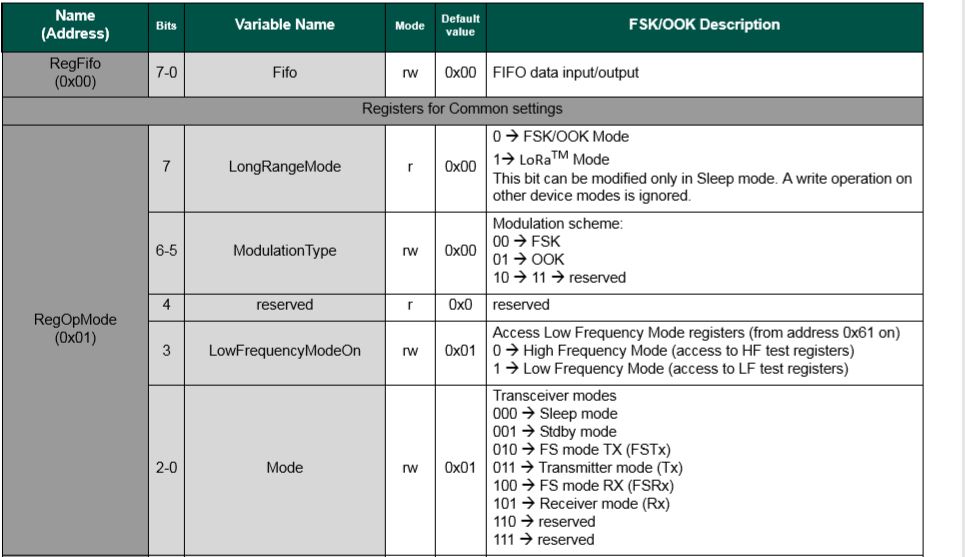
SX127X RegOpMode details
// Put device into LoRa + Sleep mode
rfm9XDevice.RegisterWriteByte(0x01, 0b10000000);

// Put device into LoRa + Standby mode
rfm9XDevice.RegisterWriteByte(0x01, 0b10000001); 

After a couple of years and half a dozen platform ports still finding bugs in my samples…
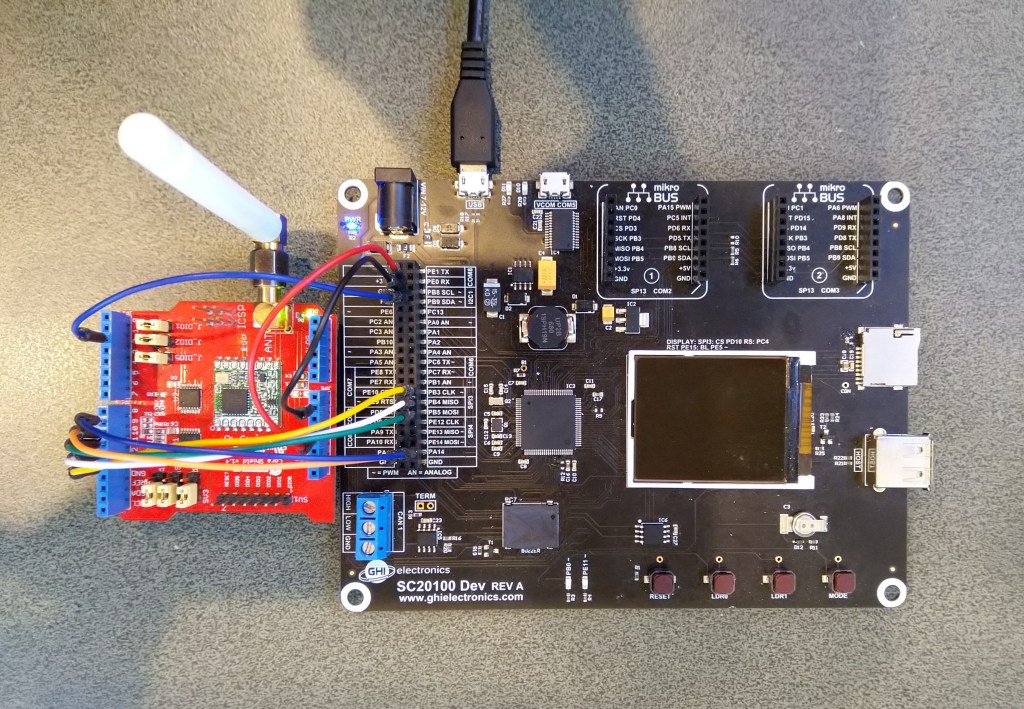
RFM9X.TinyCLR V2 on Github

The source code of my GHI Electronics TinyCLR-OS RFM9X/SX127X library is live on GitHub. The test harness uses a dragino technology LoRa shield for Arduino with some jumper wires. For a more robust solution I have some Casco Logix RFM95 LoRa MikroBUS Modules on order (May 2020)

SC20100 with Dragino shield

A sample application which shows how to send/receive address/un-addresses payloads

//---------------------------------------------------------------------------------
// Copyright (c) March/April 2020, devMobile Software
//
// Licensed under the Apache License, Version 2.0 (the "License");
// you may not use this file except in compliance with the License.
// You may obtain a copy of the License at
//
//     http://www.apache.org/licenses/LICENSE-2.0
//
// Unless required by applicable law or agreed to in writing, software
// distributed under the License is distributed on an "AS IS" BASIS,
// WITHOUT WARRANTIES OR CONDITIONS OF ANY KIND, either express or implied.
// See the License for the specific language governing permissions and
// limitations under the License.
//
//---------------------------------------------------------------------------------
namespace devMobile.IoT.Rfm9x.LoRaDeviceClient
{
	using System;
	using System.Diagnostics;
	using System.Text;
	using System.Threading;

	using GHIElectronics.TinyCLR.Pins;

	using devMobile.IoT.Rfm9x;

	class Program
   {
      static void Main()
      {
			//const string DeviceName = "SC20100LoRa";
			//const string HostName = "LoRaIoT1";
			const string DeviceName = "LoRaIoT1";
#if ADDRESSED_MESSAGES_PAYLOAD
			const string HostName = "LoRaIoT2";
#endif
			const double Frequency = 915000000.0;
			byte MessageCount = System.Byte.MaxValue;
			Rfm9XDevice rfm9XDevice = new Rfm9XDevice(SC20100.SpiBus.Spi3, SC20100.GpioPin.PA13, SC20100.GpioPin.PA14, SC20100.GpioPin.PE4);

			rfm9XDevice.Initialise(Frequency, paBoost: true, rxPayloadCrcOn: true);
#if DEBUG
			rfm9XDevice.RegisterDump();
#endif

			rfm9XDevice.OnReceive += Rfm9XDevice_OnReceive;
#if ADDRESSED_MESSAGES_PAYLOAD
			rfm9XDevice.Receive(UTF8Encoding.UTF8.GetBytes(DeviceName));
#else
			rfm9XDevice.Receive();
#endif
			rfm9XDevice.OnTransmit += Rfm9XDevice_OnTransmit;

			Thread.Sleep(10000);

			while (true)
			{
				string messageText = string.Format("Hello from {0} ! {1}", DeviceName, MessageCount);
				MessageCount -= 1;

				byte[] messageBytes = UTF8Encoding.UTF8.GetBytes(messageText);
				Debug.WriteLine($"{DateTime.Now:HH:mm:ss}-TX {messageBytes.Length} byte message {messageText}");
#if ADDRESSED_MESSAGES_PAYLOAD
				rfm9XDevice.Send(UTF8Encoding.UTF8.GetBytes(HostName), messageBytes);
#else
				rfm9XDevice.Send(messageBytes);
#endif
				Thread.Sleep(10000);
			}
		}

		private static void Rfm9XDevice_OnReceive(object sender, Rfm9XDevice.OnDataReceivedEventArgs e)
		{
			try
			{
				string messageText = UTF8Encoding.UTF8.GetString(e.Data);

#if ADDRESSED_MESSAGES_PAYLOAD
				string addressText = UTF8Encoding.UTF8.GetString(e.Address);

				Debug.WriteLine($@"{DateTime.Now:HH:mm:ss}-RX From {addressText} PacketSnr {e.PacketSnr} Packet RSSI {e.PacketRssi}dBm RSSI {e.Rssi}dBm = {e.Data.Length} byte message ""{messageText}""");
#else
				Debug.WriteLine($@"{DateTime.Now:HH:mm:ss}-RX PacketSnr {e.PacketSnr} Packet RSSI {e.PacketRssi}dBm RSSI {e.Rssi}dBm = {e.Data.Length} byte message ""{messageText}""");
#endif
			}
			catch (Exception ex)
			{
				Debug.WriteLine(ex.Message);
			}
		}

		private static void Rfm9XDevice_OnTransmit(object sender, Rfm9XDevice.OnDataTransmitedEventArgs e)
		{
			Debug.WriteLine($"{DateTime.Now:HH:mm:ss}-TX Done");
		}
	}
}

The addressing support is pretty basic as my goal was a library that I could extend with optional functionality like tamper detection via signing and privacy via payload encryption, mesh network support etc.

The library works but should be treated as late beta.

TinyCLR OS V2 LoRa library Part3

Transmit and Receive Basic

I had an Armtronix IA005 SX1276 loRa node sitting on my desk so used it running a modified version of the Arduino LoRa library LoRaSetSyncWord example to send messages to and receive messages from my SC20100 device.

Armtronix and SC20100 TinyCLR V2 testrig

The SC20100 transmit application configures the SX127X, sends a message, waits until transmission is completed, then repeats every 30 seconds.

   class Program
   {
      static void Main()
      {
         Rfm9XDevice rfm9XDevice = new Rfm9XDevice(SC20100.SpiBus.Spi3, SC20100.GpioPin.PA13, SC20100.GpioPin.PA14);

         int SendCount = 0;

         // Put device into LoRa + Sleep mode
         rfm9XDevice.RegisterWriteByte(0x01, 0b10000000); // RegOpMode 

         // Set the frequency to 915MHz
         byte[] frequencyWriteBytes = { 0xE4, 0xC0, 0x00 }; // RegFrMsb, RegFrMid, RegFrLsb
         rfm9XDevice.RegisterWrite(0x06, frequencyWriteBytes);

         // More power PA Boost
         rfm9XDevice.RegisterWriteByte(0x09, 0b10000000); // RegPaConfig

         //rfm9XDevice.RegisterDump();

         while (true)
         {
            rfm9XDevice.RegisterWriteByte(0x0E, 0x0); // RegFifoTxBaseAddress 

            // Set the Register Fifo address pointer
            rfm9XDevice.RegisterWriteByte(0x0D, 0x0); // RegFifoAddrPtr 

            string messageText = $"Hello LoRa {SendCount += 1}!";
               
            // load the message into the fifo
            byte[] messageBytes = UTF8Encoding.UTF8.GetBytes(messageText);
            rfm9XDevice.RegisterWrite(0x0, messageBytes); // RegFifo

            // Set the length of the message in the fifo
            rfm9XDevice.RegisterWriteByte(0x22, (byte)messageBytes.Length); // RegPayloadLength

            Debug.WriteLine($"Sending {messageBytes.Length} bytes message {messageText}");
            /// Set the mode to LoRa + Transmit
            rfm9XDevice.RegisterWriteByte(0x01, 0b10000011); // RegOpMode 

            // Wait until send done, no timeouts in PoC
            Debug.WriteLine("Send-wait");
            byte IrqFlags = rfm9XDevice.RegisterReadByte(0x12); // RegIrqFlags
            while ((IrqFlags & 0b00001000) == 0)  // wait until TxDone cleared
            {
               Thread.Sleep(10);
               IrqFlags = rfm9XDevice.RegisterReadByte(0x12); // RegIrqFlags
               Debug.WriteLine(".");
            }
            rfm9XDevice.RegisterWriteByte(0x12, 0b00001000); // clear TxDone bit
            Debug.WriteLine("Send-Done");

            Thread.Sleep(30000);
         }
      }
   }

When I ran the SC20100 application in Visual Studio

'GHIElectronics.TinyCLR.VisualStudio.ProjectSystem.dll' (Managed): Loaded 'C:\Users\BrynLewis\source\repos\RFM9X.TinyCLR\TransmitBasic\bin\Debug\pe\..\TransmitBasic.exe', Symbols loaded.
The thread '<No Name>' (0x2) has exited with code 0 (0x0).
Sending 13 bytes message Hello LoRa 1!
Send-wait
.
.
.
.
Send-Done
Sending 13 bytes message Hello LoRa 2!
Send-wait
.
.
.
.
Send-Done

I could the see the messages arriving at the Armtronix device in the Arduino monitor.

14:13:34.722 -> Message: Hello LoRa 1!
14:13:34.722 -> Length: 13
14:13:34.756 -> FirstChar: 72
14:13:34.756 -> RSSI: -48
14:13:34.756 -> Snr: 9.75
14:13:34.790 -> 
14:13:36.658 -> Sending HeLoRa World! 24
14:13:47.105 -> Sending HeLoRa World! 26
14:13:57.740 -> Sending HeLoRa World! 28
14:14:04.745 -> Message: Hello LoRa 2!
14:14:04.745 -> Length: 13
14:14:04.779 -> FirstChar: 72
14:14:04.779 -> RSSI: -49
14:14:04.779 -> Snr: 9.50
14:14:04.847 -> 

The SC20100 receive application configures the SX127X, polls a status register to looking to see if a message has arrived, displays it as text and then goes back to waiting.

   class Program
   {
      static void Main()
      {
         Rfm9XDevice rfm9XDevice = new Rfm9XDevice(SC20100.SpiBus.Spi3, SC20100.GpioPin.PA13, SC20100.GpioPin.PA14);

         // Put device into LoRa + Sleep mode
         rfm9XDevice.RegisterWriteByte(0x01, 0b10000000); // RegOpMode 

         // Set the frequency to 915MHz
         byte[] frequencyWriteBytes = { 0xE4, 0xC0, 0x00 }; // RegFrMsb, RegFrMid, RegFrLsb
         rfm9XDevice.RegisterWrite(0x06, frequencyWriteBytes);

         rfm9XDevice.RegisterWriteByte(0x0F, 0x0); // RegFifoRxBaseAddress 

         rfm9XDevice.RegisterWriteByte(0x01, 0b10000101); // RegOpMode set LoRa & RxContinuous

         while (true)
         {
            // Wait until a packet is received, no timeouts in PoC
            Debug.WriteLine("Receive-Wait");
            byte irqFlags = rfm9XDevice.RegisterReadByte(0x12); // RegIrqFlags
            while ((irqFlags & 0b01000000) == 0)  // wait until RxDone cleared
            {
               Thread.Sleep(100);
               irqFlags = rfm9XDevice.RegisterReadByte(0x12); // RegIrqFlags
               //Debug.Write(".");
            }
            Debug.WriteLine("");
            Debug.WriteLine($"RegIrqFlags 0X{irqFlags:X2}");
            Debug.WriteLine("Receive-Message");
            byte currentFifoAddress = rfm9XDevice.RegisterReadByte(0x10); // RegFifiRxCurrent
            rfm9XDevice.RegisterWriteByte(0x0d, currentFifoAddress); // RegFifoAddrPtr

            byte numberOfBytes = rfm9XDevice.RegisterReadByte(0x13); // RegRxNbBytes

            byte[] messageBytes = rfm9XDevice.RegisterRead(0x00, numberOfBytes); // RegFifo

            rfm9XDevice.RegisterWriteByte(0x0d, 0);
            rfm9XDevice.RegisterWriteByte(0x12, 0b11111111); // RegIrqFlags clear all the bits

            string messageText = UTF8Encoding.UTF8.GetString(messageBytes);
            Debug.WriteLine($"Received {messageBytes.Length} byte message {messageText}");

            Debug.WriteLine("Receive-Done");
         }
      }
   }

When I ran the SC20100 application in Visual Studio

'GHIElectronics.TinyCLR.VisualStudio.ProjectSystem.dll' (Managed): Loaded 'C:\Users\BrynLewis\source\repos\RFM9X.TinyCLR\ReceiveBasic\bin\Debug\pe\..\ReceiveBasic.exe', Symbols loaded.
The thread '<No Name>' (0x2) has exited with code 0 (0x0).
Receive-Wait

RegIrqFlags 0X50
Receive-Message
Received 16 byte message HeLoRa World! 74
Receive-Done
Receive-Wait

RegIrqFlags 0X50
Receive-Message
Received 59 byte message  �LoRaIoT1Maduino2at 64.6,ah 66,wsa 2,wsg 3,wd 37.13,r 0.00,
Receive-Done
Receive-Wait

RegIrqFlags 0X50
Receive-Message
Received 16 byte message HeLoRa World! 76
Receive-Done
Receive-Wait

RegIrqFlags 0X50
Receive-Message
Received 16 byte message HeLoRa World! 78
Receive-Done
Receive-Wait

I could the see the messages arriving at the Armtronix device in the Arduino monitor.

14:18:02.785 -> Sending HeLoRa World! 74
14:18:09.270 -> Message: ⸮LoRaIoT1Maduino2at 64.6,ah 66,wsa 2,wsg 3,wd 37.13,r 0.00,
14:18:09.339 -> Length: 59
14:18:09.339 -> FirstChar: 136
14:18:09.407 -> RSSI: -83
14:18:09.407 -> Snr: 9.75
14:18:09.407 -> 
14:18:13.249 -> Sending HeLoRa World! 76
14:18:23.416 -> Sending HeLoRa World! 78
14:18:33.582 -> Sending HeLoRa World! 80
14:18:43.883 -> Sending HeLoRa World! 82
14:18:54.136 -> Sending HeLoRa World! 84

I’ll merge the transmit and receive on interrupt samples in the next post as a final step before porting the core library modules.

nanoFramework LoRa library Part4A

Transmit Basic

I had a couple of Armtronix IA005 SX1276 loRa nodes sitting on my desk from a recent post so I used one of them running a modified version of the Arduino LoRa library LoRaSetSyncWord example to receive messages from my STM32F429 Discovery + Dragino LoRa shield for Arduino test rig.

STM32F429 Discovery+ Dragino LoRa shield with Armtronix device
/*
  LoRa Duplex communication with Sync Word
 
  Sends a message every half second, and polls continually
  for new incoming messages. Sets the LoRa radio's Sync Word.
 
  Spreading factor is basically the radio's network ID. Radios with different
  Sync Words will not receive each other's transmissions. This is one way you
  can filter out radios you want to ignore, without making an addressing scheme.
 
  See the Semtech datasheet, http://www.semtech.com/images/datasheet/sx1276.pdf
  for more on Sync Word.
 
  created 28 April 2017
  by Tom Igoe
*/
#include <stdlib.h>
#include <LoRa.h>
const int csPin = PA4;          // LoRa radio chip select
const int resetPin = PC13;       // LoRa radio reset
const int irqPin = PA11;         // change for your board; must be a hardware interrupt pin
 
byte msgCount = 0;            // count of outgoing messages
int interval = 2000;          // interval between sends
long lastSendTime = 0;        // time of last packet send
 
void setup() {
  Serial.begin(9600);                   // initialize serial
  while (!Serial);
 
  Serial.println("LoRa Duplex - Set sync word");
 
  // override the default CS, reset, and IRQ pins (optional)
  LoRa.setPins(csPin, resetPin, irqPin);// set CS, reset, IRQ pin
 
  if (!LoRa.begin(915E6)) {             // initialize ratio at 915 MHz
    Serial.println("LoRa init failed. Check your connections.");
    while (true);                       // if failed, do nothing
  }
 
  LoRa.setSyncWord(0x12);           // ranges from 0-0xFF, default 0x34, see API docs
 
  LoRa.dumpRegisters(Serial);
  Serial.println("LoRa init succeeded.");
}
 
void loop() {
  if (millis() - lastSendTime > interval) {
    String message = "HeLoRa World! ";   // send a message
    message += msgCount;
    sendMessage(message);
    Serial.println("Sending " + message);
    lastSendTime = millis();            // timestamp the message
    interval = random(1000) + 10000;    // 10-11 seconds
    msgCount++;
  }
 
  // parse for a packet, and call onReceive with the result:
  onReceive(LoRa.parsePacket());
}
 
void sendMessage(String outgoing) {
  LoRa.beginPacket();                   // start packet
  LoRa.print(outgoing);                 // add payload
  LoRa.endPacket();                     // finish packet and send it
  msgCount++;                           // increment message ID
}
 
void onReceive(int packetSize) {
  if (packetSize == 0) return;          // if there's no packet, return
 
  // read packet header bytes:
  String incoming = "";
 
  while (LoRa.available()) {
    incoming += (char)LoRa.read();
  }
 
  Serial.println("Message: " + incoming);
  Serial.println("RSSI: " + String(LoRa.packetRssi()));
  Serial.println("Snr: " + String(LoRa.packetSnr()));
  Serial.println();
}

The STM32F429 Discovery application

namespace devMobile.IoT.Rfm9x.TransmitBasic
{
   using System;
   using System.Text;
   using System.Threading;

   using Windows.Devices.Gpio;
   using Windows.Devices.Spi;

   public sealed class Rfm9XDevice
   {
      private SpiDevice rfm9XLoraModem;
      private GpioPin chipSelectGpioPin;
      private const byte RegisterAddressReadMask = 0X7f;
      private const byte RegisterAddressWriteMask = 0x80;

      public Rfm9XDevice(string spiPort, int chipSelectPin, int resetPin)
      {
         var settings = new SpiConnectionSettings(chipSelectPin)
         {
            ClockFrequency = 500000,
//            DataBitLength = 8,
            Mode = SpiMode.Mode0,// From SemTech docs pg 80 CPOL=0, CPHA=0
            SharingMode = SpiSharingMode.Shared,
         };

         rfm9XLoraModem = SpiDevice.FromId(spiPort, settings);

         GpioController gpioController = GpioController.GetDefault();

         // Chip select pin configuration
         chipSelectGpioPin = gpioController.OpenPin(chipSelectPin);
         chipSelectGpioPin.SetDriveMode(GpioPinDriveMode.Output);

         // Factory reset pin configuration
         GpioPin resetGpioPin = gpioController.OpenPin(resetPin);
         resetGpioPin.SetDriveMode(GpioPinDriveMode.Output);
         resetGpioPin.Write(GpioPinValue.Low);
         Thread.Sleep(10);
         resetGpioPin.Write(GpioPinValue.High);
         Thread.Sleep(10);
      }

      public Byte RegisterReadByte(byte registerAddress)
      {
         byte[] writeBuffer = new byte[] { registerAddress &= RegisterAddressReadMask, 0x0 };
         byte[] readBuffer = new byte[writeBuffer.Length];

         rfm9XLoraModem.TransferFullDuplex(writeBuffer, readBuffer);

         return readBuffer[1];
      }

      public ushort RegisterReadWord(byte address)
      {
         byte[] writeBuffer = new byte[] { address &= RegisterAddressReadMask, 0x0, 0x0 };
         byte[] readBuffer = new byte[writeBuffer.Length];

         rfm9XLoraModem.TransferFullDuplex(writeBuffer, readBuffer);

         return (ushort)(readBuffer[2] + (readBuffer[1] << 8));
      }

      public byte[] RegisterRead(byte address, int length)
      {
         byte[] writeBuffer = new byte[length + 1];
         byte[] readBuffer = new byte[length + 1];
         byte[] repyBuffer = new byte[length];

         writeBuffer[0] = address &= RegisterAddressReadMask;

         rfm9XLoraModem.TransferFullDuplex(writeBuffer, readBuffer);

         Array.Copy(readBuffer, 1, repyBuffer, 0, length);

         return repyBuffer;
      }

      public void RegisterWriteByte(byte address, byte value)
      {
         byte[] writeBuffer = new byte[] { address |= RegisterAddressWriteMask, value };

         rfm9XLoraModem.Write(writeBuffer);
      }

      public void RegisterWriteWord(byte address, ushort value)
      {
         byte[] valueBytes = BitConverter.GetBytes(value);
         byte[] writeBuffer = new byte[] { address |= RegisterAddressWriteMask, valueBytes[0], valueBytes[1] };

         rfm9XLoraModem.Write(writeBuffer);
      }

      public void RegisterWrite(byte address, byte[] bytes)
      {
         byte[] writeBuffer = new byte[1 + bytes.Length];

         Array.Copy(bytes, 0, writeBuffer, 1, bytes.Length);
         writeBuffer[0] = address |= RegisterAddressWriteMask;

         rfm9XLoraModem.Write(writeBuffer);
      }

      public void RegisterDump()
      {
         Console.WriteLine("Register dump");
         for (byte registerIndex = 0; registerIndex <= 0x42; registerIndex++)
         {
            byte registerValue = this.RegisterReadByte(registerIndex);

            Console.WriteLine($"Register 0x{registerIndex:x2} - Value 0X{registerValue:x2}");
         }
      }
   }

   class Program
   {
      static void Main()
      {
         Rfm9XDevice rfm9XDevice = new Rfm9XDevice("SPI5", PinNumber('C', 2), PinNumber('C', 3));
         int SendCount = 0;

         // Put device into LoRa + Sleep mode
         rfm9XDevice.RegisterWriteByte(0x01, 0b10000000); // RegOpMode 

         // Set the frequency to 915MHz
         byte[] frequencyWriteBytes = { 0xE4, 0xC0, 0x00 }; // RegFrMsb, RegFrMid, RegFrLsb
         rfm9XDevice.RegisterWrite(0x06, frequencyWriteBytes);

         // More power PA Boost
         rfm9XDevice.RegisterWriteByte(0x09, 0b10000000); // RegPaConfig

         rfm9XDevice.RegisterDump();

         while (true)
         {
            rfm9XDevice.RegisterWriteByte(0x0E, 0x0); // RegFifoTxBaseAddress 

            // Set the Register Fifo address pointer
            rfm9XDevice.RegisterWriteByte(0x0D, 0x0); // RegFifoAddrPtr 

            string messageText = $"Hello LoRa {SendCount += 1}!";

            // load the message into the fifo
            byte[] messageBytes = UTF8Encoding.UTF8.GetBytes(messageText);
            rfm9XDevice.RegisterWrite(0x0, messageBytes); // RegFifo

            // Set the length of the message in the fifo
            rfm9XDevice.RegisterWriteByte(0x22, (byte)messageBytes.Length); // RegPayloadLength

            Console.WriteLine($"Sending {messageBytes.Length} bytes message {messageText}");
            /// Set the mode to LoRa + Transmit
            rfm9XDevice.RegisterWriteByte(0x01, 0b10000011); // RegOpMode 

            // Wait until send done, no timeouts in PoC
            Console.WriteLine("Send-wait");
            byte IrqFlags = rfm9XDevice.RegisterReadByte(0x12); // RegIrqFlags
            while ((IrqFlags & 0b00001000) == 0)  // wait until TxDone cleared
            {
               Thread.Sleep(10);
               IrqFlags = rfm9XDevice.RegisterReadByte(0x12); // RegIrqFlags
               Console.WriteLine(".");
            }
            rfm9XDevice.RegisterWriteByte(0x12, 0b00001000); // clear TxDone bit
            Console.WriteLine("Send-Done");

            Thread.Sleep(10000);
         }
      }

      static int PinNumber(char port, byte pin)
      {
         if (port < 'A' || port > 'J')
            throw new ArgumentException();

         return ((port - 'A') * 16) + pin;
      }
   }

When I ran the nanoFramework application in Visual Studio 2019 the text below was displayed in the output window.

Sending 13 bytes message Hello LoRa 1!
Send-wait
.
.
.
.
.
Send-Done
Sending 13 bytes message Hello LoRa 2!
Send-wait
.
.
.
.
.
Send-Done

I could the see the messages arriving at the Armtronix device in the Arduino monitor.

10:48:31.215 -> Sending HeLoRa World! 202
10:48:40.870 -> Message: ⸮Hello LoRa 1
10:48:40.870 -> Length: 13
10:48:40.905 -> FirstChar: 143
10:48:40.905 -> RSSI: -41
10:48:40.905 -> Snr: 9.00
10:48:40.940 -> 
10:48:41.630 -> Sending HeLoRa World! 204
10:48:50.946 -> Message: ⸮Hello LoRa 2
10:48:50.946 -> Length: 13
10:48:50.981 -> FirstChar: 143
10:48:50.981 -> RSSI: -34
10:48:50.981 -> Snr: 9.25

This nano Frameowork proof of concept (PoC) code is not working as expected. There is a single byte containing 0X8F (the ⸮) prepended to each message.

I downloaded the nanoFramework Windows.Devices.Spi project, and removed the Nerdbank.GitVersioning library. I could then build, deploy and single step through the nanoFramework SPI library.

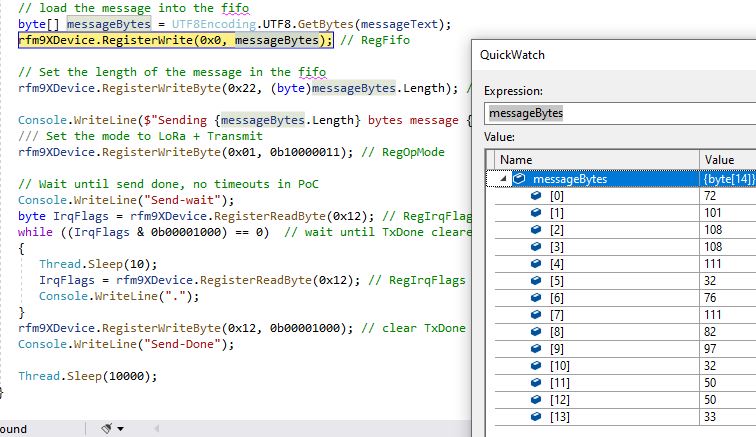
Bytes to be sent in the Transmit Basic code
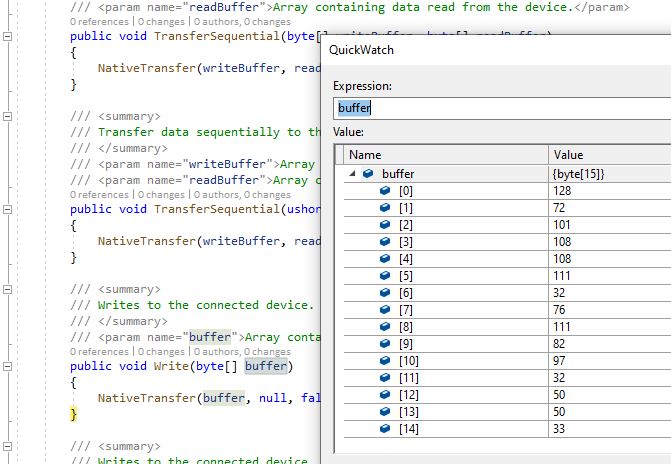
Bytes to be sent in the Windows.Devices.Spi library just before the firmware call

The extra byte prepended to the message is the write mask which is expected.

RFM9X.TinyCLR on Github

The source code of V1.0 of my GHI Electronics TinyCLR-OS RFM9X/SX127X library is on GitHub.

I initially started with a Dragino LoRa Shield for Arduino but have tested with an Elecrow RFM95 shield as well.

Dragino LoRa Shield for Arduino based test harness

A sample application which shows how to send/receive address/un-addresses payloads

//---------------------------------------------------------------------------------
// Copyright (c) March 2020, devMobile Software
//
// Licensed under the Apache License, Version 2.0 (the "License");
// you may not use this file except in compliance with the License.
// You may obtain a copy of the License at
//
//     http://www.apache.org/licenses/LICENSE-2.0
//
// Unless required by applicable law or agreed to in writing, software
// distributed under the License is distributed on an "AS IS" BASIS,
// WITHOUT WARRANTIES OR CONDITIONS OF ANY KIND, either express or implied.
// See the License for the specific language governing permissions and
// limitations under the License.
//
//---------------------------------------------------------------------------------
namespace devMobile.IoT.Rfm9x.LoRaDeviceClient
{
   using System;
   using System.Diagnostics;
   using System.Text;
   using System.Threading;

   using GHIElectronics.TinyCLR.Pins;

   using devMobile.IoT.Rfm9x;

   class Program
   {
      static void Main()
      {
			const string DeviceName = "FEZLoRa";
#if ADDRESSED_MESSAGES_PAYLOAD
			const string HostName = "LoRaIoT1";
#endif
			const double Frequency = 915000000.0;
			byte MessageCount = System.Byte.MaxValue;
			Rfm9XDevice rfm9XDevice = new Rfm9XDevice(FEZ.GpioPin.D10, FEZ.GpioPin.D9, FEZ.GpioPin.D2);

			rfm9XDevice.Initialise(Frequency, paBoost: true, rxPayloadCrcOn: true);
#if DEBUG
			rfm9XDevice.RegisterDump();
#endif

			rfm9XDevice.OnReceive += Rfm9XDevice_OnReceive;
#if ADDRESSED_MESSAGES_PAYLOAD
			rfm9XDevice.Receive(UTF8Encoding.UTF8.GetBytes(DeviceName));
#else
			rfm9XDevice.Receive();
#endif
			rfm9XDevice.OnTransmit += Rfm9XDevice_OnTransmit;

			Thread.Sleep(10000);

			while (true)
			{
				string messageText = string.Format("Hello from {0} ! {1}", DeviceName, MessageCount);
				MessageCount -= 1;

				byte[] messageBytes = UTF8Encoding.UTF8.GetBytes(messageText);
				Debug.WriteLine($"{DateTime.Now:HH:mm:ss}-TX {messageBytes.Length} byte message {messageText}");
#if ADDRESSED_MESSAGES_PAYLOAD
				rfm9XDevice.Send(UTF8Encoding.UTF8.GetBytes(HostName), messageBytes);
#else
				rfm9XDevice.Send(messageBytes);
#endif
				Thread.Sleep(10000);
			}
		}

		private static void Rfm9XDevice_OnReceive(object sender, Rfm9XDevice.OnDataReceivedEventArgs e)
		{
			try
			{
				string messageText = UTF8Encoding.UTF8.GetString(e.Data);

#if ADDRESSED_MESSAGES_PAYLOAD
				string addressText = UTF8Encoding.UTF8.GetString(e.Address);

				Debug.WriteLine($@"{DateTime.Now:HH:mm:ss}-RX From {addressText} PacketSnr {e.PacketSnr} Packet RSSI {e.PacketRssi}dBm RSSI {e.Rssi}dBm = {e.Data.Length} byte message ""{messageText}""");
#else
				Debug.WriteLine($@"{DateTime.Now:HH:mm:ss}-RX PacketSnr {e.PacketSnr} Packet RSSI {e.PacketRssi}dBm RSSI {e.Rssi}dBm = {e.Data.Length} byte message ""{messageText}""");
#endif
			}
			catch (Exception ex)
			{
				Debug.WriteLine(ex.Message);
			}
		}

		private static void Rfm9XDevice_OnTransmit(object sender, Rfm9XDevice.OnDataTransmitedEventArgs e)
		{
			Debug.WriteLine($"{DateTime.Now:HH:mm:ss}-TX Done");
		}
	}
}


The addressing support is pretty basic as my goal was a library that I could extend with optional functionality like tamper detection via signing and privacy via payload encryption, mesh network support etc.

The library works but should be treated as late beta.

TinyCLR OS LoRa library Part4

Transmit Basic

I had a couple of Armtronix IA005 SX1276 loRa nodes sitting on my desk from a recent post so I used one of them running a modified version of the Arduino LoRa library LoRaSetSyncWord example to receive messages from my device.

Armtronix and FEZT18-N TinyCLR testrig
/*
  LoRa Duplex communication with Sync Word
 
  Sends a message every half second, and polls continually
  for new incoming messages. Sets the LoRa radio's Sync Word.
 
  Spreading factor is basically the radio's network ID. Radios with different
  Sync Words will not receive each other's transmissions. This is one way you
  can filter out radios you want to ignore, without making an addressing scheme.
 
  See the Semtech datasheet, http://www.semtech.com/images/datasheet/sx1276.pdf
  for more on Sync Word.
 
  created 28 April 2017
  by Tom Igoe
*/
#include <stdlib.h>
#include <LoRa.h>
const int csPin = PA4;          // LoRa radio chip select
const int resetPin = PC13;       // LoRa radio reset
const int irqPin = PA11;         // change for your board; must be a hardware interrupt pin
 
byte msgCount = 0;            // count of outgoing messages
int interval = 2000;          // interval between sends
long lastSendTime = 0;        // time of last packet send
 
void setup() {
  Serial.begin(9600);                   // initialize serial
  while (!Serial);
 
  Serial.println("LoRa Duplex - Set sync word");
 
  // override the default CS, reset, and IRQ pins (optional)
  LoRa.setPins(csPin, resetPin, irqPin);// set CS, reset, IRQ pin
 
  if (!LoRa.begin(915E6)) {             // initialize ratio at 915 MHz
    Serial.println("LoRa init failed. Check your connections.");
    while (true);                       // if failed, do nothing
  }
 
  LoRa.setSyncWord(0x12);           // ranges from 0-0xFF, default 0x34, see API docs
 
  LoRa.dumpRegisters(Serial);
  Serial.println("LoRa init succeeded.");
}
 
void loop() {
  if (millis() - lastSendTime > interval) {
    String message = "HeLoRa World! ";   // send a message
    message += msgCount;
    sendMessage(message);
    Serial.println("Sending " + message);
    lastSendTime = millis();            // timestamp the message
    interval = random(1000) + 10000;    // 10-11 seconds
    msgCount++;
  }
 
  // parse for a packet, and call onReceive with the result:
  onReceive(LoRa.parsePacket());
}
 
void sendMessage(String outgoing) {
  LoRa.beginPacket();                   // start packet
  LoRa.print(outgoing);                 // add payload
  LoRa.endPacket();                     // finish packet and send it
  msgCount++;                           // increment message ID
}
 
void onReceive(int packetSize) {
  if (packetSize == 0) return;          // if there's no packet, return
 
  // read packet header bytes:
  String incoming = "";
 
  while (LoRa.available()) {
    incoming += (char)LoRa.read();
  }
 
  Serial.println("Message: " + incoming);
  Serial.println("RSSI: " + String(LoRa.packetRssi()));
  Serial.println("Snr: " + String(LoRa.packetSnr()));
  Serial.println();
}

The FEZT-18N application

   class Program
   {
      static void Main()
      {
         Rfm9XDevice rfm9XDevice = new Rfm9XDevice(FEZ.GpioPin.D10, FEZ.GpioPin.D9);
         int SendCount = 0;

         // Put device into LoRa + Sleep mode
         rfm9XDevice.RegisterWriteByte(0x01, 0b10000000); // RegOpMode 

         // Set the frequency to 915MHz
         byte[] frequencyWriteBytes = { 0xE4, 0xC0, 0x00 }; // RegFrMsb, RegFrMid, RegFrLsb
         rfm9XDevice.RegisterWrite(0x06, frequencyWriteBytes);

         // More power PA Boost
         rfm9XDevice.RegisterWriteByte(0x09, 0b10000000); // RegPaConfig

         while (true)
         {
            rfm9XDevice.RegisterWriteByte(0x0E, 0x0); // RegFifoTxBaseAddress 

            // Set the Register Fifo address pointer
            rfm9XDevice.RegisterWriteByte(0x0D, 0x0); // RegFifoAddrPtr 

            string messageText = $"Hello LoRa {SendCount += 1}!";
               
            // load the message into the fifo
            byte[] messageBytes = UTF8Encoding.UTF8.GetBytes(messageText);
            rfm9XDevice.RegisterWrite(0x0, messageBytes); // RegFifo

            // Set the length of the message in the fifo
            rfm9XDevice.RegisterWriteByte(0x22, (byte)messageBytes.Length); // RegPayloadLength

            Debug.WriteLine($"Sending {messageBytes.Length} bytes message {messageText}");
            /// Set the mode to LoRa + Transmit
            rfm9XDevice.RegisterWriteByte(0x01, 0b10000011); // RegOpMode 

            // Wait until send done, no timeouts in PoC
            Debug.WriteLine("Send-wait");
            byte IrqFlags = rfm9XDevice.RegisterReadByte(0x12); // RegIrqFlags
            while ((IrqFlags & 0b00001000) == 0)  // wait until TxDone cleared
            {
               Thread.Sleep(10);
               IrqFlags = rfm9XDevice.RegisterReadByte(0x12); // RegIrqFlags
               Debug.WriteLine(".");
            }
            rfm9XDevice.RegisterWriteByte(0x12, 0b00001000); // clear TxDone bit
            Debug.WriteLine("Send-Done");

            Thread.Sleep(30000);
         }
      }

When I ran the FEZ application in Visual Studio

'GHIElectronics.TinyCLR.VisualStudio.ProjectSystem.dll' (Managed): Loaded 'C:\Users\BrynLewis\source\repos\RFM9X.TinyCLR\TransmitBasic\bin\Debug\pe\..\GHIElectronics.TinyCLR.Native.dll'
'GHIElectronics.TinyCLR.VisualStudio.ProjectSystem.dll' (Managed): Loaded 'C:\Users\BrynLewis\source\repos\RFM9X.TinyCLR\TransmitBasic\bin\Debug\pe\..\GHIElectronics.TinyCLR.Devices.Gpio.dll'
'GHIElectronics.TinyCLR.VisualStudio.ProjectSystem.dll' (Managed): Loaded 'C:\Users\BrynLewis\source\repos\RFM9X.TinyCLR\TransmitBasic\bin\Debug\pe\..\GHIElectronics.TinyCLR.Devices.Spi.dll'
'GHIElectronics.TinyCLR.VisualStudio.ProjectSystem.dll' (Managed): Loaded 'C:\Users\BrynLewis\source\repos\RFM9X.TinyCLR\TransmitBasic\bin\Debug\pe\..\TransmitBasic.exe', Symbols loaded.
The thread '<No Name>' (0x2) has exited with code 0 (0x0).
Sending 13 bytes message Hello LoRa 1!
Send-wait
.
.
.
.
Send-Done
Sending 13 bytes message Hello LoRa 2!
Send-wait
.
.
.
.
Send-Done
Sending 13 bytes message Hello LoRa 3!
Send-wait
.
.
.
.
Send-Done
Sending 13 bytes message Hello LoRa 4!
Send-wait
.
.
.
.
Send-Done
Sending 13 bytes message Hello LoRa 5!
Send-wait
.
.
.
.
Send-Done

I could the see the messages arriving at the Armtronix device in the Arduino monitor.

19:22:28.445 -> Message: Hello LoRa 1!
19:22:28.445 -> RSSI: -36
19:22:28.479 -> Snr: 9.50
19:22:28.479 ->
19:22:29.362 -> Sending HeLoRa World! 48
19:22:40.390 -> Sending HeLoRa World! 50
19:22:50.654 -> Sending HeLoRa World! 52
19:22:58.484 -> Message: Hello LoRa 2!
19:22:58.484 -> RSSI: -36
19:22:58.553 -> Snr: 9.25
19:22:58.553 ->
19:23:01.254 -> Sending HeLoRa World! 54
19:23:11.873 -> Sending HeLoRa World! 56
19:23:22.103 -> Sending HeLoRa World! 58
19:23:28.558 -> Message: Hello LoRa 3!
19:23:28.558 -> RSSI: -31
19:23:28.592 -> Snr: 9.75
19:23:28.592 ->
19:23:32.307 -> Sending HeLoRa World! 60
19:23:42.929 -> Sending HeLoRa World! 62
19:23:53.392 -> Sending HeLoRa World! 64
19:23:58.622 -> Message: Hello LoRa 4!
19:23:58.622 -> RSSI: -36
19:23:58.655 -> Snr: 9.75
19:23:58.655 ->
19:24:03.629 -> Sending HeLoRa World! 66
19:24:14.299 -> Sending HeLoRa World! 68
19:24:24.989 -> Sending HeLoRa World! 70

This PoC code is getting a bit nasty with magic numbers and no error checking. The next step is getting a basic packet receive working…

RFM9X.Meadow on Github

After a month or so of posts the source code of V1.0 of my Wilderness Labs Meadow RFM9X/SX127X library is on GitHub. I included all of the source for my test harness and proof of concept(PoC) application so other people can follow along with “my meadow learning experience”.

I initially started with a Dragino LoRa Shield for Arduino and jumper cables. I did this so only the pins I was using on the shield were connected to the Meadow.

Dragino LoRa Shield for Arduino based test harness

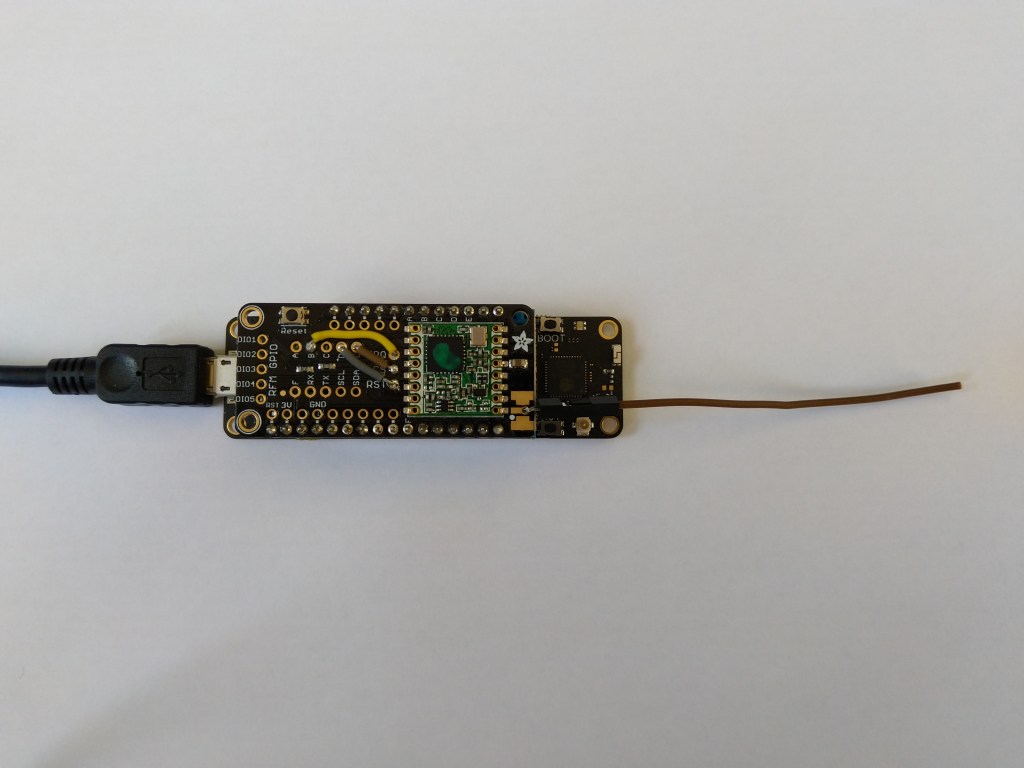
I then moved to an Adafruit LoRa Radio FeatherWing RFM95W 900MHz RadioFruit and Adafruit LoRa Radio FeatherWing – RFM95W 433 MHz – RadioFruit.

Adafruit FeatherWing based test harness

Using the jumper configuration above, the RFM9X constructor parameters are

  • Chip Select D9 (yellow wire)
  • Reset Pin D10 (grey wire)
  • Interrupt pin D12 (brown wire)
//---------------------------------------------------------------------------------
// Copyright (c) January 2020, devMobile Software
//
// Licensed under the Apache License, Version 2.0 (the "License");
// you may not use this file except in compliance with the License.
// You may obtain a copy of the License at
//
//     http://www.apache.org/licenses/LICENSE-2.0
//
// Unless required by applicable law or agreed to in writing, software
// distributed under the License is distributed on an "AS IS" BASIS,
// WITHOUT WARRANTIES OR CONDITIONS OF ANY KIND, either express or implied.
// See the License for the specific language governing permissions and
// limitations under the License.
//
//---------------------------------------------------------------------------------
namespace devMobile.IoT.Rfm9x.LoRaDeviceClient
{
   using System;
   using System.Diagnostics;
   using System.Text;
   using System.Threading.Tasks;

   using Meadow;
   using Meadow.Devices;
   using Meadow.Hardware;

   public class MeadowApp : App<F7Micro, MeadowApp>
   {
      private const double Frequency = 915000000.0;
      private byte MessageCount = Byte.MaxValue;
      private Rfm9XDevice rfm9XDevice;

      public MeadowApp()
      {
         try
         {
            ISpiBus spiBus = Device.CreateSpiBus(500);
            if (spiBus == null)
            {
               Console.WriteLine("spiBus == null");
            }
            rfm9XDevice = new Rfm9XDevice(Device, spiBus, Device.Pins.D09, Device.Pins.D10, Device.Pins.D12);

            rfm9XDevice.Initialise(Frequency, paBoost: true, rxPayloadCrcOn: true);
#if DEBUG
            rfm9XDevice.RegisterDump();
#endif

            rfm9XDevice.OnReceive += Rfm9XDevice_OnReceive;
#if ADDRESSED_MESSAGES_PAYLOAD
            rfm9XDevice.Receive(UTF8Encoding.UTF8.GetBytes("AddressHere"));
#else
            rfm9XDevice.Receive();
#endif
            rfm9XDevice.OnTransmit += Rfm9XDevice_OnTransmit;
         }
         catch (Exception ex)
         {
            Console.WriteLine(ex.Message);
         }

         Task.Delay(10000).Wait();

         while (true)
         {
            string messageText = string.Format("Hello from {0} ! {1}", Environment.MachineName, MessageCount);
            MessageCount -= 2;

            byte[] messageBytes = UTF8Encoding.UTF8.GetBytes(messageText);
            Console.WriteLine("{0:HH:mm:ss}-TX {1} byte message {2}", DateTime.Now, messageBytes.Length, messageText);
#if ADDRESSED_MESSAGES_PAYLOAD
            this.rfm9XDevice.Send(UTF8Encoding.UTF8.GetBytes("AddressHere"), messageBytes);
#else
            this.rfm9XDevice.Send(messageBytes);
#endif
            Task.Delay(10000).Wait();
         }
      }

      private void Rfm9XDevice_OnReceive(object sender, Rfm9XDevice.OnDataReceivedEventArgs e)
      {
         try
         {
            string messageText = UTF8Encoding.UTF8.GetString(e.Data);

#if ADDRESSED_MESSAGES_PAYLOAD
            string addressText = UTF8Encoding.UTF8.GetString(e.Address);

            Console.WriteLine(@"{0:HH:mm:ss}-RX From {1} PacketSnr {2:0.0} Packet RSSI {3}dBm RSSI {4}dBm = {5} byte message ""{6}""", DateTime.Now, addressText, e.PacketSnr, e.PacketRssi, e.Rssi, e.Data.Length, messageText);
#else
            Console.WriteLine(@"{0:HH:mm:ss}-RX PacketSnr {1:0.0} Packet RSSI {2}dBm RSSI {3}dBm = {4} byte message ""{5}""", DateTime.Now, e.PacketSnr, e.PacketRssi, e.Rssi, e.Data.Length, messageText);
#endif
         }
         catch (Exception ex)
         {
            Console.WriteLine(ex.Message);
         }
      }

      private void Rfm9XDevice_OnTransmit(object sender, Rfm9XDevice.OnDataTransmitedEventArgs e)
      {
         Console.WriteLine("{0:HH:mm:ss}-TX Done", DateTime.Now);
      }
   }
}

My library works but some issues (Dec 2019) with the Serial Peripheral Interface (SPI) ReadRegister method, Debug.WriteLine and Console.WriteLine mean it should be treated as late beta.

The wilderness labs developers are regularly releasing updates which I will test with as soon as they are available.

.Net Meadow RFM95/96/97/98 LoRa library Part4

Transmit Basic

I had a couple of Armtronix IA005 SX1276 loRa nodes sitting on my desk from a recent post so I used one of them running a modified version of the Arduino LoRa library LoRaSetSyncWord example to receive messages from my Meadow device.

/*
  LoRa Duplex communication with Sync Word
 
  Sends a message every half second, and polls continually
  for new incoming messages. Sets the LoRa radio's Sync Word.
 
  Spreading factor is basically the radio's network ID. Radios with different
  Sync Words will not receive each other's transmissions. This is one way you
  can filter out radios you want to ignore, without making an addressing scheme.
 
  See the Semtech datasheet, http://www.semtech.com/images/datasheet/sx1276.pdf
  for more on Sync Word.
 
  created 28 April 2017
  by Tom Igoe
*/
#include <stdlib.h>
#include <LoRa.h>
const int csPin = PA4;          // LoRa radio chip select
const int resetPin = PC13;       // LoRa radio reset
const int irqPin = PA11;         // change for your board; must be a hardware interrupt pin
 
byte msgCount = 0;            // count of outgoing messages
int interval = 2000;          // interval between sends
long lastSendTime = 0;        // time of last packet send
 
void setup() {
  Serial.begin(9600);                   // initialize serial
  while (!Serial);
 
  Serial.println("LoRa Duplex - Set sync word");
 
  // override the default CS, reset, and IRQ pins (optional)
  LoRa.setPins(csPin, resetPin, irqPin);// set CS, reset, IRQ pin
 
  if (!LoRa.begin(915E6)) {             // initialize ratio at 915 MHz
    Serial.println("LoRa init failed. Check your connections.");
    while (true);                       // if failed, do nothing
  }
 
  LoRa.setSyncWord(0x12);           // ranges from 0-0xFF, default 0x34, see API docs
 
  LoRa.dumpRegisters(Serial);
  Serial.println("LoRa init succeeded.");
}
 
void loop() {
  if (millis() - lastSendTime > interval) {
    String message = "HeLoRa World! ";   // send a message
    message += msgCount;
    sendMessage(message);
    Serial.println("Sending " + message);
    lastSendTime = millis();            // timestamp the message
    interval = random(1000) + 10000;    // 10-11 seconds
    msgCount++;
  }
 
  // parse for a packet, and call onReceive with the result:
  onReceive(LoRa.parsePacket());
}
 
void sendMessage(String outgoing) {
  LoRa.beginPacket();                   // start packet
  LoRa.print(outgoing);                 // add payload
  LoRa.endPacket();                     // finish packet and send it
  msgCount++;                           // increment message ID
}
 
void onReceive(int packetSize) {
  if (packetSize == 0) return;          // if there's no packet, return
 
  // read packet header bytes:
  String incoming = "";
 
  while (LoRa.available()) {
    incoming += (char)LoRa.read();
  }
 
  Serial.println("Message: " + incoming);
  Serial.println("RSSI: " + String(LoRa.packetRssi()));
  Serial.println("Snr: " + String(LoRa.packetSnr()));
  Serial.println();
}

The Meadow application

	public class MeadowApp : App<F7Micro, MeadowApp>
	{
		private Rfm9XDevice rfm9XDevice;

		public MeadowApp()
		{
			ISpiBus spiBus = Device.CreateSpiBus(500);
			if (spiBus == null)
			{
				Console.WriteLine("spiBus == null");
			}

			rfm9XDevice = new Rfm9XDevice(Device, spiBus, Device.Pins.D09, Device.Pins.D11);

			// Put device into LoRa + Sleep mode
			rfm9XDevice.RegisterWriteByte(0x01, 0b10000000); // RegOpMode 

			// Set the frequency to 915MHz
			byte[] frequencyWriteBytes = { 0xE4, 0xC0, 0x00 }; // RegFrMsb, RegFrMid, RegFrLsb
			rfm9XDevice.RegisterWrite(0x06, frequencyWriteBytes);

			// More power PA Boost
			rfm9XDevice.RegisterWriteByte(0x09, 0b10000000); // RegPaConfig

			while (true)
			{
				rfm9XDevice.RegisterWriteByte(0x0E, 0x0); // RegFifoTxBaseAddress 

				// Set the Register Fifo address pointer
				rfm9XDevice.RegisterWriteByte(0x0D, 0x0); // RegFifoAddrPtr 

				string messageText = "Hello LoRa!";

				// load the message into the fifo
				byte[] messageBytes = UTF8Encoding.UTF8.GetBytes(messageText);
				foreach (byte b in messageBytes)
				{
					rfm9XDevice.RegisterWriteByte(0x0, b); // RegFifo
				}

				// Set the length of the message in the fifo
				rfm9XDevice.RegisterWriteByte(0x22, (byte)messageBytes.Length); // RegPayloadLength

				Console.WriteLine("Sending {0} bytes message {1}", messageBytes.Length, messageText);
				/// Set the mode to LoRa + Transmit
				rfm9XDevice.RegisterWriteByte(0x01, 0b10000011); // RegOpMode 

				// Wait until send done, no timeouts in PoC
				Console.WriteLine("Send-wait");
				byte IrqFlags = rfm9XDevice.RegisterReadByte(0x12); // RegIrqFlags
				while ((IrqFlags & 0b00001000) == 0)  // wait until TxDone cleared
				{
					Task.Delay(10).Wait();
					IrqFlags = rfm9XDevice.RegisterReadByte(0x12); // RegIrqFlags
					Console.Write(".");
				}
				Console.WriteLine("");
				rfm9XDevice.RegisterWriteByte(0x12, 0b00001000); // clear TxDone bit
				Console.WriteLine("Send-Done");

				Task.Delay(30000).Wait();
			}
		}

When I ran the meadow application after some messing around with the jumper wires.

'App.exe' (CLR v4.0.30319: DefaultDomain): Loaded 'C:\WINDOWS\Microsoft.Net\assembly\GAC_64\mscorlib\v4.0_4.0.0.0__b77a5c561934e089\mscorlib.dll'. 
'App.exe' (CLR v4.0.30319: DefaultDomain): Loaded 'C:\Users\BrynLewis\source\repos\RFM9X.Meadow\TransmitBasic\bin\Debug\net472\App.exe'. Symbols loaded.
'App.exe' (CLR v4.0.30319: App.exe): Loaded 'C:\Users\BrynLewis\source\repos\RFM9X.Meadow\TransmitBasic\bin\Debug\net472\Meadow.dll'. 
The program '[37572] App.exe: Program Trace' has exited with code 0 (0x0).
The program '[37572] App.exe' has exited with code 0 (0x0).
.
.
DirectRegisterAccess = True
.
.
Sending 11 bytes message Hello LoRa!
Send-wait
Send-Done
Sending 11 bytes message Hello LoRa!
Send-wait
.
Send-Done

I could the see the messages arriving at the Armtronix device in the Arduino monitor (the other messages in the monitor are my solar powered weather station and soil moisture monitoring node).

12:47:55.198 -> Sending HeLoRa World! 10
12:48:05.745 -> Sending HeLoRa World! 12
12:48:06.663 -> Message: ⸮LoRaIoT1Maduino2at 85.8,ah 19,wsa 5,wsg 8,wd 123.38,r 0.00,
12:48:06.730 -> RSSI: -71
12:48:06.730 -> Snr: 10.00
12:48:06.730 ->
12:48:08.770 -> Message: Hello LoRa!
12:48:08.770 -> RSSI: -47
12:48:08.804 -> Snr: 9.00
12:48:08.804 ->
12:48:16.555 -> Sending HeLoRa World! 14
12:48:26.847 -> Sending HeLoRa World! 16
12:48:37.154 -> Sending HeLoRa World! 18
12:48:39.469 -> Message: Hello LoRa!
12:48:39.469 -> RSSI: -46
12:48:39.536 -> Snr: 9.00
12:48:39.536 ->
12:48:47.311 -> Sending HeLoRa World! 20
12:48:58.094 -> Sending HeLoRa World! 22
12:49:07.748 -> Message: ⸮LoRaIoT1Maduino2at 86.0,ah 19,wsa 5,wsg 15,wd 155.63,r 0.00,
12:49:07.817 -> RSSI: -71
12:49:07.817 -> Snr: 9.50
12:49:07.817 ->
12:49:08.464 -> Sending HeLoRa World! 24
12:49:10.097 -> Message: Hello LoRa!
12:49:10.097 -> RSSI: -46
12:49:10.130 -> Snr: 9.75
12:49:10.130 ->
12:49:19.373 -> Sending HeLoRa World! 26
12:49:30.125 -> Sending HeLoRa World! 28
12:49:40.262 -> Sending HeLoRa World! 30
12:49:40.671 -> Message: Hello LoRa!
12:49:40.671 -> RSSI: -46
12:49:40.705 -> Snr: 9.25
12:49:40.705 ->
12:49:50.725 -> Sending HeLoRa World! 32
12:50:01.081 -> Sending HeLoRa World! 34
12:50:08.800 -> Message: ⸮LoRaIoT1Maduino2at 85.6,ah 19,wsa 5,wsg 11,wd 159.00,r 0.00,
12:50:08.868 -> RSSI: -72
12:50:08.868 -> Snr: 10.00
12:50:08.868 ->
12:50:11.219 -> Message: Hello LoRa!
12:50:11.219 -> RSSI: -46
12:50:11.252 -> Snr: 9.25
12:50:11.252 ->
12:50:11.526 -> Sending HeLoRa World! 36
12:50:21.731 -> Sending HeLoRa World! 38
12:50:32.696 -> Sending HeLoRa World! 40
12:50:41.741 -> Message: Hello LoRa!
12:50:41.741 -> RSSI: -46
12:50:41.775 -> Snr: 9.25
12:50:41.775 ->
12:50:43.685 -> Sending HeLoRa World! 42
12:50:54.566 -> Sending HeLoRa World! 44
12:51:05.604 -> Sending HeLoRa World! 46
12:51:09.852 -> Message: ⸮LoRaIoT1Maduino2at 85.3,ah 19,wsa 2,wsg 8,wd 150.75,r 0.00,
12:51:09.954 -> RSSI: -71
12:51:09.954 -> Snr: 9.50
12:51:09.954 ->
12:51:12.400 -> Message: Hello LoRa!
12:51:12.400 -> RSSI: -46
12:51:12.433 -> Snr: 9.00
12:51:12.433 ->
12:51:16.511 -> Sending HeLoRa World! 48
12:51:27.530 -> Sending HeLoRa World! 50
12:51:37.796 -> Sending HeLoRa World! 52
12:51:42.968 -> Message: Hello LoRa!
12:51:42.968 -> RSSI: -45
12:51:43.003 -> Snr: 9.25
12:51:43.003 ->
12:51:48.389 -> Sending HeLoRa World! 54
12:51:59.052 -> Sending HeLoRa World! 56
12:52:09.251 -> Sending HeLoRa World! 58
12:52:10.912 -> Message: ⸮LoRaIoT1Maduino2at 85.1,ah 19,wsa 2,wsg 6,wd 84.00,r 0.00,
12:52:11.013 -> RSSI: -70
12:52:11.013 -> Snr: 9.75
12:52:11.013 ->
12:52:13.546 -> Message: Hello LoRa!
12:52:13.546 -> RSSI: -46
12:52:13.581 -> Snr: 9.75
12:52:13.581 ->

This PoC code is getting a bit nasty with magic numbers and no error checking. The next step is getting a basic packet receive working…

.Net Meadow RFM95/96/97/98 LoRa library Part1

After writing Windows 10 IoT Core & .NetMF RFM9X libraries I figured a port to a Wilderness Labs Meadow device shouldn’t be “rocket science”.

To get started I used a Dragino LoRa shield for Arduino which looked compatible with my Meadow device.

Dragino shield schematic

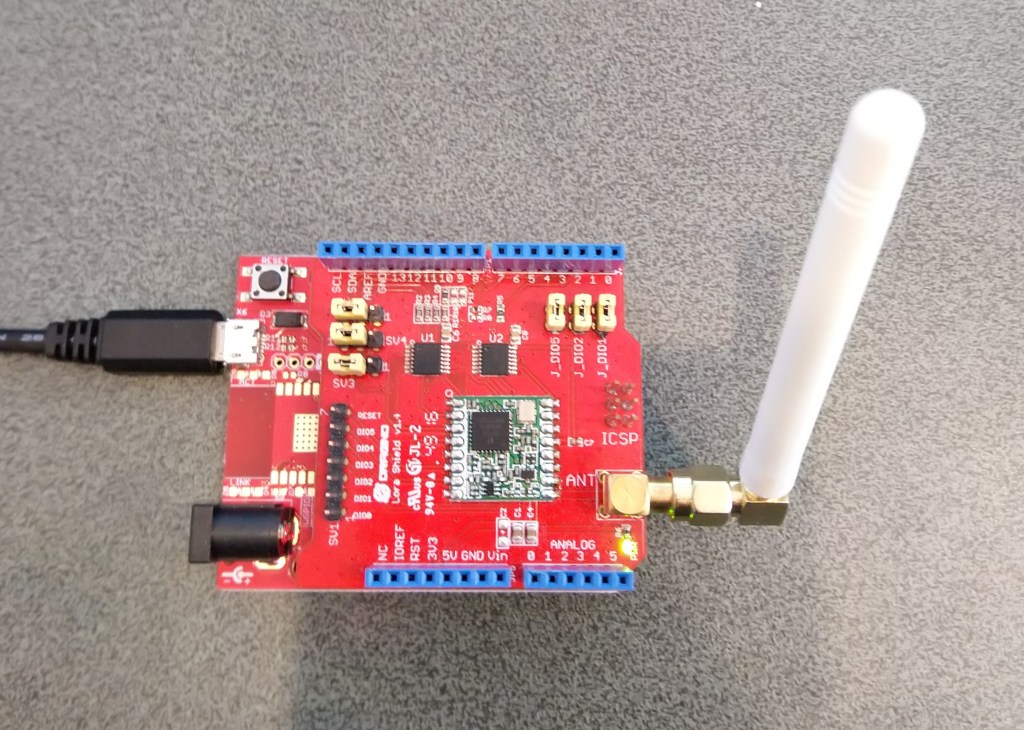
The shield ships with the SPI lines configured for ICSP so the three jumpers diagonally across the shield from the antenna connector need to be swapped to the side closest to the edge of the shield.

Dragino Arduino shield based test harness
//---------------------------------------------------------------------------------
// Copyright (c) Dec 2019, devMobile Software
//
// Licensed under the Apache License, Version 2.0 (the "License");
// you may not use this file except in compliance with the License.
// You may obtain a copy of the License at
//
//     http://www.apache.org/licenses/LICENSE-2.0
//
// Unless required by applicable law or agreed to in writing, software
// distributed under the License is distributed on an "AS IS" BASIS,
// WITHOUT WARRANTIES OR CONDITIONS OF ANY KIND, either express or implied.
// See the License for the specific language governing permissions and
// limitations under the License.
//
//---------------------------------------------------------------------------------
namespace devMobile.IoT.Rfm9x
{
   using System;
   using System.Threading.Tasks;
   using Meadow;
   using Meadow.Devices;
   using Meadow.Hardware;

   public class MeadowApp : App<F7Micro, MeadowApp>
   {
      const byte RegVersion = 0x42;
      ISpiBus spiBus;
      SpiPeripheral sx127xDevice;
      IDigitalOutputPort spiPeriphChipSelect;

      public MeadowApp()
      {
         ConfigureSpiPort();
         //ReadDeviceID();
         ReadDeviceIDDiy();
      }

      public void ConfigureSpiPort()
      {
         try
         {
            spiBus = Device.CreateSpiBus(500);
            if (spiBus == null)
            {
               Console.WriteLine("spiBus == null");
            }

            Console.WriteLine("Creating SPI NSS Port...");
            spiPeriphChipSelect = Device.CreateDigitalOutputPort(Device.Pins.D09);
            if (spiPeriphChipSelect == null)
            {
               Console.WriteLine("spiPeriphChipSelect == null");
            }
   
            Console.WriteLine("sx127xDevice Device...");
            sx127xDevice = new SpiPeripheral(spiBus, spiPeriphChipSelect);
            if (sx127xDevice == null)
            {
               Console.WriteLine("sx127xDevice == null");
            }

            Console.WriteLine("ConfigureSpiPort Done...");
         }
         catch (Exception ex)
         {
            Console.WriteLine("ConfigureSpiPort " + ex.Message);
         }
      }

      
      public void ReadDeviceID()
      {
         Task.Delay(500).Wait();

         while (true)
         {
            try
            {
               Console.WriteLine("sx127xDevice.ReadRegister...1");

               byte registerValue = sx127xDevice.ReadRegister(RegVersion);

               Console.WriteLine("sx127xDevice.ReadRegister...2");

               Console.WriteLine("Register 0x{0:x2} - Value 0X{1:x2} - Bits {2}", RegVersion, registerValue, Convert.ToString(registerValue, 2).PadLeft(8, '0'));
            }
            catch (Exception ex)
            {
               Console.WriteLine("ReadDeviceID " + ex.Message);
            }

            Task.Delay(10000).Wait();
         }
      }

      public void ReadDeviceIDDiy()
      {
         var txBuffer = new byte[2];
         var rxBuffer = new byte[2];

         Task.Delay(500).Wait();

         while (true)
         {
            try
            {
               Console.WriteLine("spiBus.ExchangeData...1");

               txBuffer[0] = RegVersion;

               spiBus.ExchangeData(spiPeriphChipSelect, ChipSelectMode.ActiveLow, txBuffer, rxBuffer, 2);

               Console.WriteLine("spiBus.ExchangeData...2");

               byte registerValue = rxBuffer[1];

               Console.WriteLine("Register 0x{0:x2} - Value 0X{1:x2} - Bits {2}", RegVersion, registerValue, Convert.ToString(registerValue, 2).PadLeft(8, '0'));
            }
            catch (Exception ex)
            {
               Console.WriteLine("ReadDeviceIDDiy " + ex.Message);
            }

            Task.Delay(10000).Wait();
         }
      }
   }
}

After some trial and error (using beta 3.6) I found that the ReadRegister method didn’t work as expected (possibly related to this issue) and I had to manually assemble the request to read the SX127X RegVersion register.

'App.exe' (CLR v4.0.30319: DefaultDomain): Loaded 'C:\WINDOWS\Microsoft.Net\assembly\GAC_64\mscorlib\v4.0_4.0.0.0__b77a5c561934e089\mscorlib.dll'. 
'App.exe' (CLR v4.0.30319: DefaultDomain): Loaded 'C:\Users\BrynLewis\source\repos\RFX9X.Meadow\FeatherWingSPI\bin\Debug\net472\App.exe'. Symbols loaded.
'App.exe' (CLR v4.0.30319: App.exe): Loaded 'C:\Users\BrynLewis\source\repos\RFX9X.Meadow\FeatherWingSPI\bin\Debug\net472\Meadow.dll'. 
The program '[22324] App.exe: Program Trace' has exited with code 0 (0x0).
The program '[22324] App.exe' has exited with code 0 (0x0).
.
.
DirectRegisterAccess = True
==========================================================
Ignore the exceptions generated by the DateTime call here.
==========================================================
.
Creating SPI NSS Port...
sx127xDevice Device...
ConfigureSpiPort Done...
spiBus.ExchangeData...1
spiBus.ExchangeData...2
Register 0x42 - Value 0X12 - Bits 00010010
spiBus.ExchangeData...1
spiBus.ExchangeData...2
Register 0x42 - Value 0X12 - Bits 00010010
spiBus.ExchangeData...1
spiBus.ExchangeData...2
Register 0x42 - Value 0X12 - Bits 00010010
spiBus.ExchangeData...1
spiBus.ExchangeData...2

Maduino LoRa Air Temperature and Soil Moisture

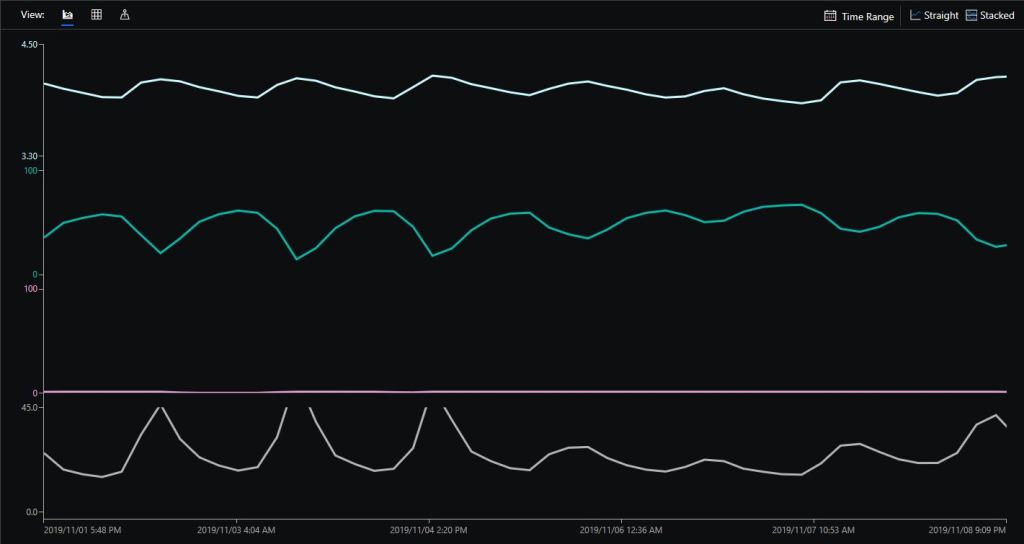
This is a demo MakerFabs Maduino LoRa Radio 868MHz client (based on Maduino LoRa 868MHz example) that uploads telemetry data to my Windows 10 IoT Core on Raspberry PI AdaFruit.IO and Azure IoT Hub field gateways.

The code is available on github

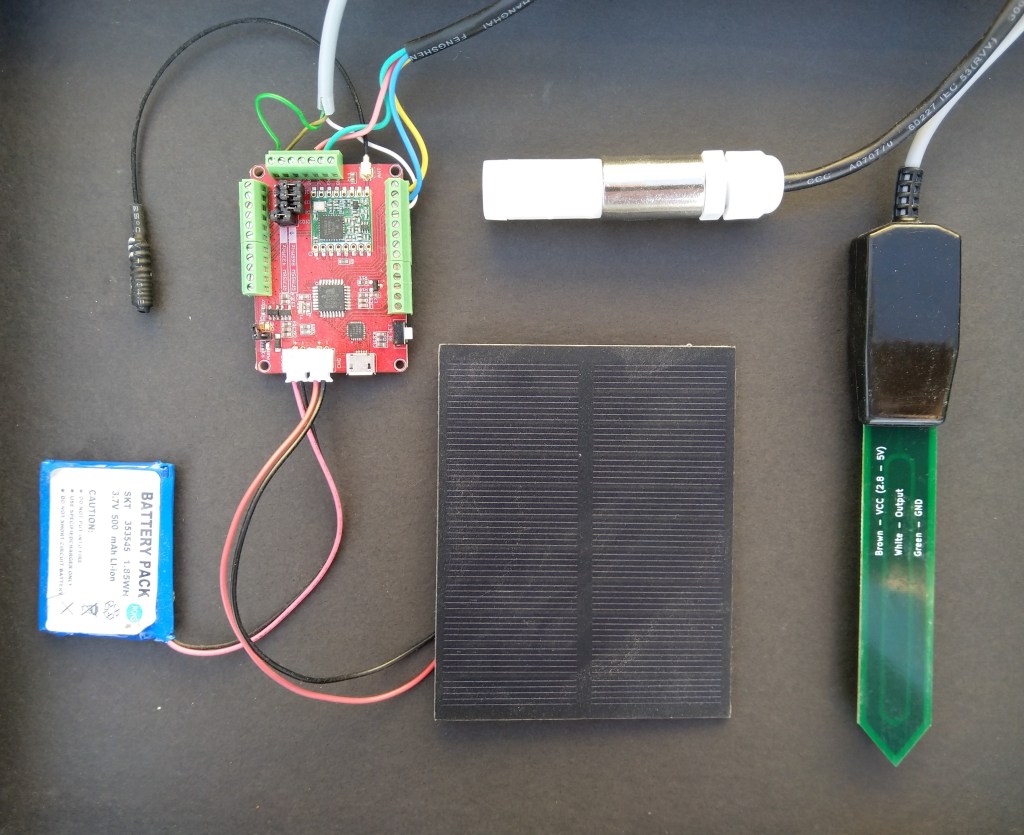
Sample hardware
Azure IoT Central data visualisation

The Maduino device in the picture is a custom version with an onboard Microchip ATSHA204 crypto and authentication chip (currently only use for the unique 72 bit serial number) and a voltage divider connected to the analog pin A6 to monitor the battery voltage.

There are compile time options ATSHA204 & BATTERY_VOLTAGE_MONITOR which can be used to selectively enable this functionality.

I use the Arduino lowpower library to aggressively sleep the device between measurements

// Adjust the delay so period is close to desired sec as possible, first do 8sec chunks. 
  int delayCounter = SensorUploadDelay / 8 ;
  for( int i = 0 ; i < delayCounter ; i++ )
  {
     LowPower.powerDown(SLEEP_8S, ADC_OFF, BOD_OFF);  
  }
  
  // Then to 4 sec chunk
  delayCounter =  ( SensorUploadDelay % 8 ) / 4;
  for( int i = 0 ; i < delayCounter ; i++ )
  {
     LowPower.powerDown(SLEEP_4S, ADC_OFF, BOD_OFF);  
  }

  // Then to 2 sec chunk
  delayCounter =  ( SensorUploadDelay % 4 ) / 2 ;
  for( int i = 0 ; i < delayCounter ; i++ )
  {
     LowPower.powerDown(SLEEP_2S, ADC_OFF, BOD_OFF);  
  }

  // Then to 1 sec chunk
  delayCounter =  ( SensorUploadDelay % 2 ) ;
  for( int i = 0 ; i < delayCounter ; i++ )
  {
     LowPower.powerDown(SLEEP_1S, ADC_OFF, BOD_OFF);  
  }
}

I use a spare digital PIN for powering the soil moisture probe so it can be powered down when not in use. I have included a short delay after powering up the device to allow the reading to settle.

  // Turn on soil mosture sensor, take reading then turn off to save power
  digitalWrite(SoilMoistureSensorEnablePin, HIGH);
  delay(SoilMoistureSensorEnableDelay);
  int soilMoistureADCValue = analogRead(SoilMoistureSensorPin);
  digitalWrite(SoilMoistureSensorEnablePin, LOW);
  int soilMoisture = map(soilMoistureADCValue,SoilMoistureSensorMinimum,SoilMoistureSensorMaximum, SoilMoistureValueMinimum, SoilMoistureValueMaximum); 
  PayloadAdd( "s", soilMoisture, false);

Bill of materials (Prices Nov 2019)

  • Maduino LoRa Radion (868MHz) 18.90
  • SHT20 I2C Temperature & Humidity Sensor (Waterproof Probe) USD22.50
  • Pinotech SoilWatch 10 – Soil moisture sensor USD23
  • Elecrow 1 Watt solar panel with wires USD3.80
  • 500 mAh LI-Ion battery

The software could easily be modified to support additional sensors.