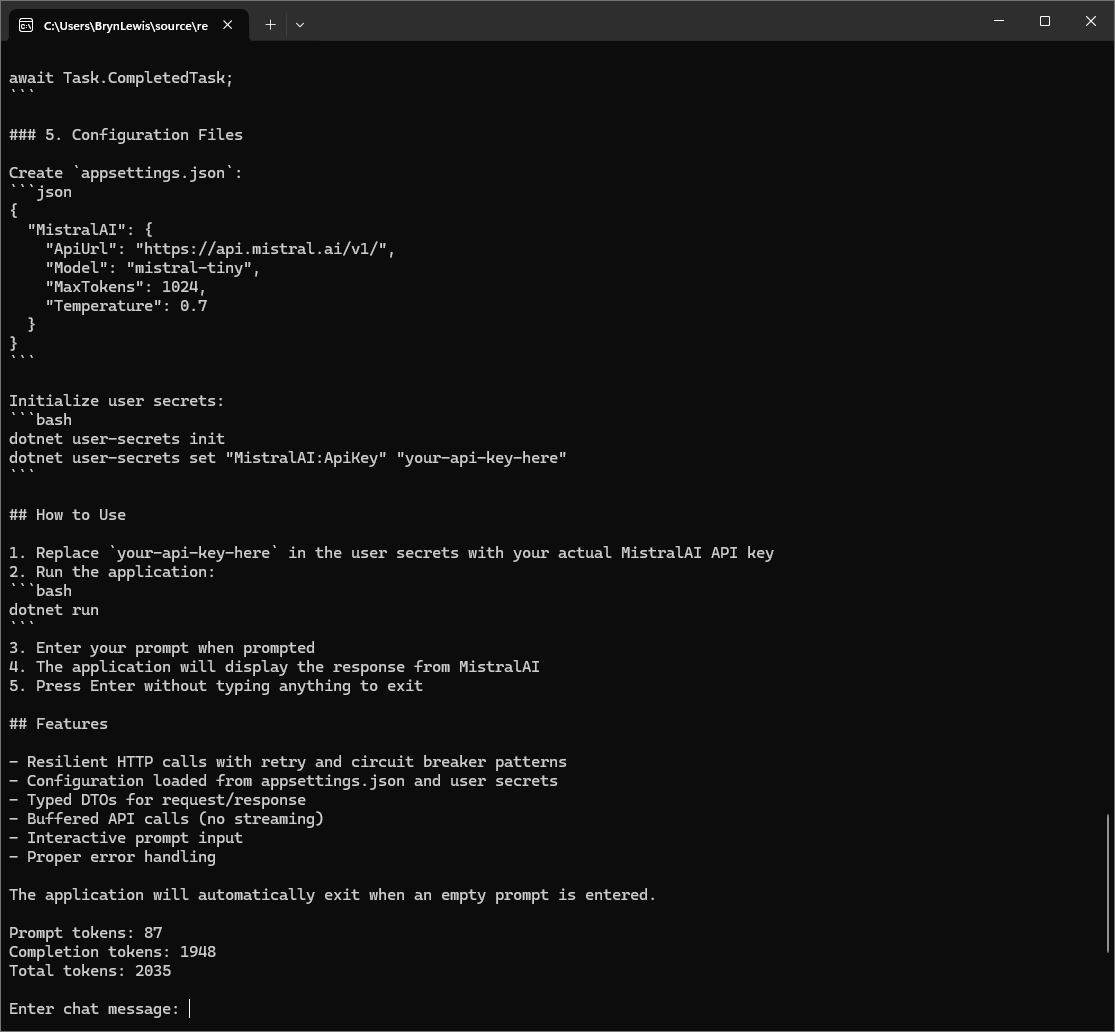
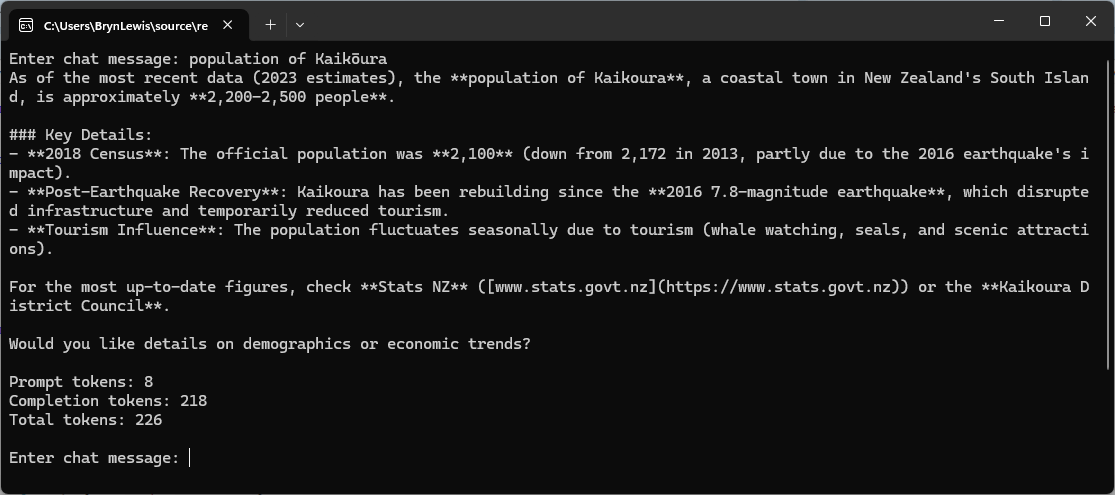
For this series of posts, I asked GitHub Copilot, Anthropic Claude Code, and Mistral Vibe Code to generate a Mistral Chat Completion client using the same prompt….
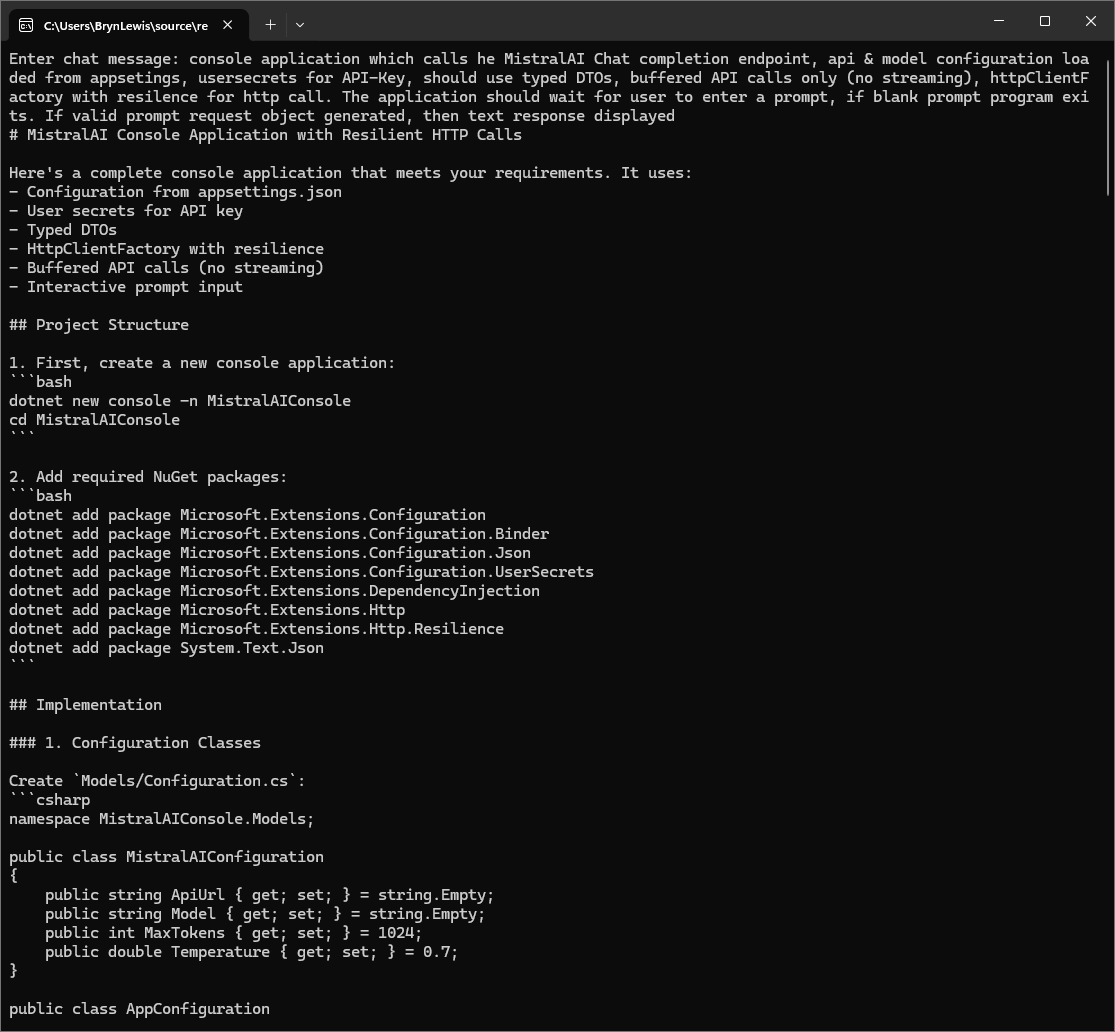
Generate C# DTOs and a ChatCompletionClient for https://docs.mistral.ai/api/endpoint/chat. The ChatCompletionClient should
use HttpClientFactory with resilience and should have async methods where suitable. The DTOs should be split up into files
for shared, buffered, and streaming.

Generate a console application which uses ChatCompletionClient
Then I took the initial implementation and prompted GitHub Copilot, Anthropic Claude Code, and Mistral Vibe Code to review them. The aim was to see how each tool thinks, what they prioritise, and then how their feedback differs when given identical code.
TL;DR – the code was fine.
Github Copilot
Overall the library is well-structured, cleanly documented, and follows familiar patterns (Options, IHttpClientFactory, Polly).
Anthropic Claude
The client is a small, focused wrapper around POST /v1/chat/completions, supporting both a buffered call (CompleteAsync) and an SSE streaming call (StreamAsync). Overall design is clean: immutable JsonSerializerOptions, an immutable record request type mutated via with, DI registration through IHttpClientFactory with a resilience pipeline, and polymorphic DTOs for messages/content/tools that mirror the Mistral (OpenAI-compatible) wire format. No correctness-blocking bugs were found; findings below are mostly design nits and a few things worth double-checking against real API behavior.
Mistral Vibe Code
Overall Rating: ⭐⭐⭐⭐☆ (4.2/5) – Production Ready with Minor Improvements
Github Copilot Review
:question:
Review MistralAI.Client.Copilot – ChatCompletionClient.cs and DTOs
GitHub Copilot
- Read ChatCompletionClient.cs, lines 165-514 :white_check_mark:
- Code search found relevant results :white_check_mark:
- Read ChatCompletionClient.cs, lines 294-514 :white_check_mark:
- Read BufferedDto.cs, lines 1-220 :white_check_mark:
- Read SharedDto.cs, lines 1-305 :white_check_mark:
- Read StreamingDto.cs, lines 1-420 :white_check_mark:
Code Review – ChatCompletionClient & DTOs
Overall the library is well-structured, cleanly documented, and follows familiar patterns (Options, IHttpClientFactory, Polly). Below are the concrete issues and improvements I’d action, roughly ordered by impact.
🔴 Correctness / bugs
- Streaming isn’t actually streaming. In
StreamCompletionAsyncyou call_httpClient.PostAsync(...), which buffers the whole response before returning. You must passHttpCompletionOption.ResponseHeadersRead, otherwise every “streamed” token arrives at once (and the retry policy will hold the full body in memory).
using var req = new HttpRequestMessage(HttpMethod.Post, requestUri) { Content = requestContent };
response = await _retryPolicy.ExecuteAsync(ct =>
    _httpClient.SendAsync(req, HttpCompletionOption.ResponseHeadersRead, ct), cancellationToken);
-
Retry policy + single
StringContentis broken.StringContentis disposed once sent, so any retry after the first attempt POSTs an empty/disposed body. TheHttpRequestMessage/content must be re-created inside theExecuteAsyncdelegate (or useHttpClientHandler-level Polly viaAddPolicyHandler, which handles this). -
IDisposable+IHttpClientFactoryconflict. The class implementsIDisposableand holds_disposed, implying it disposes_httpClient. HttpClients fromIHttpClientFactorymust not be disposed by the consumer — the factory owns the handler lifetime. Either:- drop
IDisposable, or - dispose only in the
HttpClient-injected overload and track ownership with a flag.
- drop
-
Mutating a factory-provided
HttpClientin the constructor. SettingTimeout,DefaultRequestHeaders.Authorization, andUser-AgentonhttpClientFactory.CreateClient()re-configures a shared/named client each time and, worse, appendingUser-AgentviaAdd(...)will throwInvalidOperationExceptionon second construction against the same named client. Configure this once throughservices.AddHttpClient(c => …)and remove it from the ctor. -
ReadLineAsynctreats SSE as line-oriented text. Real SSE:- allows
data:(no space) — yourSubstring(6)is off by one in that case, - allows multi-line
data:chunks concatenated per event, - has comment lines starting with
:(heartbeat/keep-alive) that must be ignored, - has
event:,id:,retry:fields. ConsiderSystem.Net.ServerSentEvents.SseParser(built-in) instead of hand-rolling.
- allows
-
Polymorphic streaming events. You deserialize into a single
CompletionEventtype, yetStreamingDto.csdefinesCompletionEventBasewithTextCompletionEvent,ToolCallEvent, … discriminated bytype. Without[JsonPolymorphic]/[JsonDerivedType]on the base, the derived data is lost. Either:- Add polymorphism attributes on
CompletionEventBaseand deserialize as the base, or - Keep a flat
CompletionEventDTO and drop the base/derived hierarchy — currently you have both, which is confusing.
- Add polymorphism attributes on
-
Fallback path assumes
Textexists onCompletionEvent.
new CompletionEvent { Type = "unknown", Text = line }implies a flat DTO; reconcile with issue #6. -
No
Retry-Afterhandling on 429. Polly’sWaitAndRetryAsyncuses only2^n. Mistral (like OpenAI) returnsRetry-After— honour it. -
response.Content.ReadAsStringAsync()/ReadAsStreamAsync()don’t take thecancellationToken. These overloads exist on .NET 8 — pass the token so hanging responses can be cancelled. -
HttpClient.Timeoutfights with cancellation. With Polly retries + streaming, a global 120 s timeout aborts long streams. UseHttpClient.Timeout = Timeout.InfiniteTimeSpanand enforce per-request timeout via a linkedCancellationTokenSource.
🟠 API / design
-
Massive DTO duplication.
ChatCompletionRequest(Buffered) andChatCompletionStreamRequest(Streaming) are byte-for-byte identical apart from the default ofStream. Introduce a shared base (or single DTO) inDTOs.Sharedand delete ~130 lines. TheStreamboolean is the only real difference and can be set by the client method. -
StopandToolChoicetyped asobject?. These serialize fine but deserialize poorly and lose IntelliSense. UseOneOf<string, List>, a small wrapper type, orJsonElement. -
MetadataisDictionary. Mistral’s schema isDictionary. -
MessageBase.Contentisstring?only. Mistral supports multimodal content (array of{type, text|image_url}parts) on user messages. Model asobject?orOneOf<string, List>to be forward-compatible. -
AssistantMessagemissingprefix/reasoning/tool_call_idvariants.ChatCompletionChoice.Prefixexists but not on the message itself, which is where the API places it for message replay. -
GuardrailConfigis an empty placeholder. Either implement it or omit the property so serializers don’t emit"guardrails": []. -
ResponseFormat.Schemashould beJsonElement/typed to avoid double serialization surprises viaobject. -
MistralAiException— add the three standardExceptionctors ((),(string),(string, Exception)), and consider a strongly typedMistralApiErrormodel (type,message,param,code) parsed from the body instead of the raw string. -
Validation.
MistralAiOptions.ApiKeydefaults to""; the constructor happily builds a client with no auth. AddIValidateOptionsor throw in the ctor. -
GetJsonOptions()(not shown) should be cached in astatic readonlyfield — creatingJsonSerializerOptionsper call is expensive and defeats the internal metadata cache. -
CreateRequest/CreateStreamRequestjust build DTOs. They add little overnew ChatCompletionRequest { … }and inflate the surface area. Consider removing, or make them extension methods. -
Second ctor mutates a caller-owned
HttpClient. Prefer treating an injectedHttpClientas read-only and route auth viaHttpRequestMessage.Headers.Authorizationon each request.
🟡 Style / minor
line.StartsWith("data: ", StringComparison.Ordinal)— add ordinal comparison; ditto for the[DONE]sentinel.- Use
_httpClient.DefaultRequestHeaders.UserAgent.Add(new ProductInfoHeaderValue("MistralAI.Client", "1.0"))instead ofAdd("User-Agent", …). - Consider
sealedonChatCompletionClient; extension is unlikely and it simplifiesIDisposable. MistralAiOptions.EnableStreamingis declared but never used.- XML doc for
CreateStreamRequestsaysstreamparam exists — it doesn’t. - Naming:
CompletionEventvsCompletionEventBasevsTextCompletionEvent— pick one convention (dropBase, since it’sabstract). - Consider
ArgumentNullException.ThrowIfNull(request)(.NET 8 idiom).
Suggested next steps
- Fix the streaming/retry correctness issues (#1, #2, #5, #6) — those change behaviour.
- Collapse the duplicated request DTOs (#11) — biggest maintenance win.
- Move
HttpClientconfiguration into DI registration and dropIDisposable(#3, #4). - Cache
JsonSerializerOptionsand switch to source-generated serialization if AOT/perf is a goal (#20).
Happy to draft any of these changes — tell me which to tackle first.
The next review was done with Anthropic’s Claude Code
Code Review: MistralAI.Client.Copilot — ChatCompletionClient.cs & DTOs
Scope: src/Copilot.PoC/MistralAI.Client.Copilot/
Files reviewed:
ChatCompletionClient.csIChatCompletionClient.csChatCompletionRequest.cs(request DTOs)ChatCompletionResponse.cs(response DTOs)Streaming/StreamingDTOs.csMistralClientOptions.cs,MistralServiceCollectionExtensions.cs(for context)
Summary
The client is a small, focused wrapper around POST /v1/chat/completions, supporting both a buffered call (CompleteAsync) and an SSE streaming call (StreamAsync). Overall design is clean: immutable JsonSerializerOptions, an immutable record request type mutated via with, DI registration through IHttpClientFactory with a resilience pipeline, and polymorphic DTOs for messages/content/tools that mirror the Mistral (OpenAI-compatible) wire format. No correctness-blocking bugs were found; findings below are mostly design nits and a few things worth double-checking against real API behavior.
ChatCompletionClient.cs
Strengths
JsonOptionsis a single static, cachedJsonSerializerOptionsinstance (line 18) — correct, since re-creatingJsonSerializerOptionsper call is a well-known perf trap withSystem.Text.Json.CompleteAsync/StreamAsyncboth null-checkrequestat the boundary (ArgumentNullException.ThrowIfNull), consistent with API-boundary validation.request with { Stream = false/true }cleanly forces the correct value regardless of what the caller set, without mutating the caller’s object.StreamAsyncusesHttpCompletionOption.ResponseHeadersReadso the response isn’t buffered before the SSE loop starts — necessary for real streaming.- Malformed SSE chunks are swallowed with a comment explaining why (
// Skip malformed chunks rather than aborting the whole stream.) — an intentional, documented tradeoff rather than silent-failure-by-accident. EnsureSuccessAsyncreads the error body only on failure, and wraps it intoHttpRequestExceptionwith the status code attached (statusCode: response.StatusCode) — good for callers that pattern-match onStatusCode.
Findings / things to double check
-
ChatCompletionRequest.Streamis public but always overwritten. The DTO exposes a settableStreamproperty, documented as"Overridden internally by the client depending on the method called."(ChatCompletionRequest.cs:26). Any value the caller sets is silently discarded by bothCompleteAsyncandStreamAsync. This isn’t a bug, but it’s a slightly surprising public API — a caller could reasonably expect settingStream = trueand callingCompleteAsyncto do something, when it’s actually a no-op. Consider either making the setterinternal/removing it from the public request shape, or asserting/ignoring rather than silently stomping it. -
Silent chunk-skip on
JsonExceptionhas no observability hook.StreamAsync(lines 104–113) catchesJsonExceptionandcontinues with no logging or counter. For a PoC this is fine, but if the wire format ever drifts (e.g., a new event type Mistral adds), failures will be invisible — chunks just quietly vanish. Consider at least aILoggerdebug-level log if one is easy to thread through, since this is the one place errors are deliberately suppressed rather than propagated. -
SSE parsing only recognizes
data:lines. The reader loop only reacts to lines starting withdata:and otherwisecontinues (lines 89–92), which correctly skips blank lines and SSE comment/event:lines. This matches Mistral’s OpenAI-compatible SSE format (each event is a singledata: {...}line), so it should be fine in practice — just flagging that it assumes single-line JSON payloads per event; a server that ever wrapped a JSON payload across multipledata:lines (some SSE producers do this) would need concatenation logic that isn’t present here. -
No cancellation-specific handling.
CancellationTokenis threaded through correctly (ConfigureAwait(false)+[EnumeratorCancellation]), but there’s no explicit catch/rethrow aroundOperationCanceledException— that’s actually correct behavior (let it propagate), just noting it was checked.
Request DTOs (ChatCompletionRequest.cs)
Strengths
ChatCompletionRequestis asealed recordwithrequiredmembers forModel/Messages, giving compile-time enforcement of the two truly mandatory fields.- Polymorphic
ChatMessage/ContentParthierarchies use[JsonPolymorphic]+[JsonDerivedType]correctly keyed offroleandtyperespectively, matching the API’s discriminator fields. MessageContentcleanly models the “string OR array of parts” duality the API allows, with implicit conversions (string,ContentPart[],List) making call sites ergonomic, and a customJsonConverterhandling both read and write shapes.GuardrailConfig.AdditionalPropertiesvia[JsonExtensionData]is a sensible forward-compatibility escape hatch for a field Mistral is likely to extend.
Findings
-
Naming collision:
ToolChoiceproperty vs.ToolChoicestatic helper class.ChatCompletionRequest.ToolChoice(anobject?property, line 41) and the top-levelpublic static class ToolChoice(line 239) share the identifierToolChoicein the same namespace (Mistral.Client.Shared). This compiles and works —new ChatCompletionRequest { ToolChoice = ToolChoice.Auto }resolves the right-hand side to the static class since object-initializer right-hand expressions aren’t evaluated in the initializer’s member scope — but it’s a readability trap: IntelliSense/go-to-definition onToolChoiceinside that expression can be momentarily ambiguous to a human reader, and a future refactor that moves code around could make this genuinely ambiguous or requireglobal::/qualification. Consider renaming the helper class (e.g.ToolChoiceValuesorToolChoices) to remove the shadow. -
ToolChoiceproperty typed asobject?. Reasonable given the API accepts either a string enum or an object literal, and theToolChoicehelper class exists specifically to build valid values — but it does mean nothing stops a caller from passing an arbitrary/invalid object that will only fail at the HTTP layer. Given this is a PoC and the alternative (a discriminated-union style type) is meaningfully more code, this looks like an acceptable, deliberate tradeoff rather than an oversight. -
MessageContentJsonConverter.WriteprefersTextoverPartsif both are set. Not reachable through the public implicit-conversion surface (only one ofText/Partsis ever set), but sinceMessageContenthas publicinitaccessors, nothing stops object-initializer code from setting both fields directly, at which pointPartswould be silently dropped on serialize. Low risk given current usage patterns, just noting the type doesn’t defensively guard against that state. -
Minor:
IReadOnlyListhas no implicit conversion, onlyContentPart[]andListdo (lines 122–124). Not a bug — just means a caller holding anIReadOnlyListfrom elsewhere has to materialize it to one of the two supported types first.
Response DTOs (ChatCompletionResponse.cs)
- Straightforward, mutable POCOs (
get; set;) matching typicalSystem.Text.Jsondeserialization targets — appropriately different from the request side (which is arecordbuilt by the caller) since these are populated by the deserializer, not constructed by consumers. ChatCompletionChoice.Messageis typed asAssistantMessage?(line 21), correctly narrowing the polymorphicChatMessagebase to the one concrete type a response choice can actually contain.Choicesand other list-typed members default to[]rather thannull(e.g.,ChatCompletionResponse.cs:12), which avoids null-checks for consumers even before deserialization overwrites them — good defensive default.- No
SystemFingerprint/LogProbs/similar fields are modeled. If Mistral’s response includes them and callers might want them, they’re currently unreachable (no[JsonExtensionData]catch-all on the response types, unlikeGuardrailConfigon the request side). Worth confirming this is an intentional scope decision for the PoC.
Streaming DTOs (Streaming/StreamingDTOs.cs)
ChatCompletionChunk/ChatCompletionChoiceChunk/DeltaMessagecorrectly mirror the non-streaming shapes where structurally identical (UsageInfo,MessageContent,ToolCallare reused rather than duplicated), which is good — no drift risk between streaming/non-streaming content models.- The XML doc on
DeltaMessage(lines 28–32) correctly documents the aggregation contract callers must implement (accumulateContent, mergeToolCallsbyIndex) — useful since the client itself provides no aggregation helper, so this is the only place that contract is written down. Worth keeping in sync with any future consumer-side aggregation utility. - Minor cosmetic:
namespace Mistral.Client.Shared.Streaming;(line 3) has a double space after thenamespacekeyword. Harmless, but worth a quick formatter pass.
Supporting types (context only)
MistralClientOptions/MistralServiceCollectionExtensions: registration wiresIChatCompletionClientas a singleton backed by a namedHttpClientwithTimeout = Timeout.InfiniteTimeSpanand delegates time-boxing to the standard resilience handler (AttemptTimeout90s,TotalRequestTimeout5m) — a sensible choice given long-running generations and streaming responses, and the comment explaining why the infinite client timeout is safe here is a good practice (explains a non-obvious decision rather than just stating what the code does).
Overall assessment
No functional bugs found. The code is well-structured for a PoC: immutable request model, cached serializer options, correct streaming/cancellation plumbing, and DTOs that faithfully mirror the API’s polymorphic wire format. The main things worth a follow-up decision are the ToolChoice naming collision (cosmetic but worth a rename) and whether the public, always-overridden Stream property on ChatCompletionRequest is intentional API surface or should be tightened.
The final review was done with Mistral’s Vibe Code
📊 MistralAI.Client.Copilot Code Review
> Project Type: .NET 10.0 Library | Purpose: Mistral AI Chat Completion API Client > Last Reviewed: 2026-07-20 | Reviewed By: Mistral Vibe
📁 Project Structure
MistralAI.Client.Copilot/
├── MistralAI.Client.Copilot.csproj         # Project configuration (net10.0)
├── IChatCompletionClient.cs               # Interface definition
├── ChatCompletionClient.cs                # Main client implementation
├── ChatCompletionRequest.cs               # Request DTOs & Message types
├── ChatCompletionResponse.cs              # Response DTOs
├── MistralClientOptions.cs                # Configuration options
├── MistralServiceCollectionExtensions.cs # DI registration
└── Streaming/
    └── StreamingDTOs.cs                   # Streaming response chunk DTOs
✅ Strengths
1. Clean Architecture
- ✅ Separation of Concerns: Clear separation between interfaces (
IChatCompletionClient), implementation (ChatCompletionClient), and DTOs - ✅ Dependency Injection: Proper use of
IHttpClientFactoryand DI container extensions - ✅ Modular Design: Streaming logic isolated in dedicated namespace
2. Modern C# Features
- ✅ Records: Extensive use of
recordtypes for immutable DTOs (ChatCompletionRequest,ChatCompletionResponse) - ✅ Pattern Matching: Effective use in
MessageContentJsonConverter.Read() - ✅ Async Streams: Proper implementation of
IAsyncEnumerablefor streaming - ✅ Init-only Properties: Consistent use of
initaccessors for immutable DTOs - ✅ File-scoped Namespaces: Clean namespace declarations
3. Robust Error Handling
- ✅ Argument Validation: Uses
ArgumentNullException.ThrowIfNull()for public method parameters - ✅ HTTP Error Handling:
EnsureSuccessAsync()provides detailed error messages with status codes and response bodies - ✅ Streaming Resilience: Gracefully handles malformed JSON chunks in streaming without breaking the entire stream
- ✅ Cancellation Support: Proper
CancellationTokenpropagation throughout async methods
4. API Design
- ✅ Interface-based: Client consumes
IChatCompletionClientinterface, enabling mocking - ✅ Flexible Configuration:
MistralClientOptionsallows custom base URLs and API keys - ✅ Resilience Pipeline: Built-in retry, circuit breaker, timeout, and rate limiting via
AddStandardResilienceHandler
5. JSON Serialization
- ✅ System.Text.Json: Uses modern, high-performance JSON serializer
- ✅ Polymorphic Deserialization: Proper use of
[JsonPolymorphic]and[JsonDerivedType]for message role discrimination - ✅ Custom Converters:
MessageContentJsonConverterhandles string vs array polymorphism - ✅ Snake Case Naming: Consistent JSON naming policy matching Mistral API conventions
- ✅ Null Handling: Proper
JsonIgnoreCondition.WhenWritingNullconfiguration
6. Streaming Implementation
- ✅ SSE Parsing: Correctly handles Server-Sent Events format (
data:prefix,[DONE]sentinel) - ✅ Memory Efficient: Uses
StreamReaderfor line-by-line processing - ✅ Chunk Validation: Skips malformed chunks instead of failing
7. Documentation
- ✅ XML Documentation: Comprehensive XML comments on public APIs
- ✅ Constants for Magic Strings:
FinishReason,ToolChoiceclasses for well-known values
🔍 DTO Analysis
Request DTOs (ChatCompletionRequest.cs)
| DTO | Purpose | Design Quality |
|---|---|---|
ChatCompletionRequest |
Main request body | ✅ Comprehensive, all Mistral API parameters covered |
ChatMessage (abstract) |
Base message type | ✅ Polymorphic with role discriminator |
SystemMessage, UserMessage, AssistantMessage, ToolMessage |
Message types | ✅ Proper inheritance hierarchy |
MessageContent |
Flexible content (string or parts) | ✅ Uses custom converter for polymorphism |
ContentPart (abstract) |
Content part types | ✅ Extensible with derived types |
TextContentPart, ImageUrlContentPart, etc. |
Specific content types | ✅ Covers all Mistral content types |
Tool, FunctionDefinition, ToolCall, FunctionCall |
Tool integration | ✅ Complete tool calling support |
ResponseFormat, JsonSchemaSpec |
Response formatting | ✅ JSON schema support |
UsageInfo |
Token usage tracking | ✅ Standard structure |
GuardrailConfig |
Guardrail configuration | ✅ Extensible with [JsonExtensionData] |
Prediction |
Prediction hints | ✅ Simple and effective |
Response DTOs
| DTO | File | Design Quality |
|---|---|---|
ChatCompletionResponse |
ChatCompletionResponse.cs |
✅ Matches Mistral API response structure |
ChatCompletionChoice |
ChatCompletionResponse.cs |
✅ Includes message and finish reason |
ChatCompletionChunk |
StreamingDTOs.cs |
✅ Streaming chunk with usage info |
ChatCompletionChoiceChunk |
StreamingDTOs.cs |
✅ Delta-based streaming |
DeltaMessage |
StreamingDTOs.cs |
✅ Incremental message content |
⚠️ Areas for Improvement
1. Namespace Organization
- ❌ Issue: Inconsistent namespace usage
IChatCompletionClientusesMistral.ClientChatCompletionClientusesMistral.Client.Shared- This creates confusion about which namespace to use
- 💡 Recommendation: Standardize on
Mistral.ClientorMistralAI.Clientthroughout
2. Nullability Annotations
- ⚠️ Issue: Incomplete nullability annotations
- Many DTO properties lack
?for nullable reference types - Example:
ChatCompletionRequest.Modelisrequired stringbut could benefit from explicit nullability
- Many DTO properties lack
- 💡 Recommendation: Add consistent nullability annotations, especially for optional fields
3. Record vs Class Usage
- ⚠️ Issue: Mixed use of
recordandclassfor DTOsChatCompletionRequestis arecord(good for immutability)- Message types (
SystemMessage,UserMessage) areclasswith setters
- 💡 Recommendation: Consider making all DTOs immutable
recordtypes for consistency
4. JSON Serialization Edge Cases
- ⚠️ Issue:
MessageContentJsonConverterdoesn’t handle all possible JSON scenarios- No validation that exactly one of
TextorPartsis set - Could throw on unexpected JSON structures
- No validation that exactly one of
- 💡 Recommendation: Add validation in converter to ensure data integrity
5. Error Handling in Streaming
- ⚠️ Issue: Silent skipping of malformed chunks
- Line 111-112:
continueonJsonException - No logging or telemetry for skipped chunks
- Line 111-112:
- 💡 Recommendation: Add optional logging/delegate for error handling
6. Configuration Validation
- ⚠️ Issue: Minimal validation in
MistralClientOptions- No validation that
ApiKeyis not empty when provided - No validation that
BaseAddressends with trailing slash (as documented)
- No validation that
- 💡 Recommendation: Add validation in property setters or use validation library
7. HTTP Client Configuration
- ⚠️ Issue: Hardcoded timeout values in resilience pipeline
- 90s attempt timeout, 180s sampling duration, 5min total timeout
- These may not be appropriate for all use cases
- 💡 Recommendation: Make timeouts configurable via
MistralClientOptions
8. Missing Features
- ⚠️ Missing: No support for custom headers
- ⚠️ Missing: No retry-after header handling
- ⚠️ Missing: No built-in rate limit detection
🐛 Potential Bugs
1. JSON Serialization Issue
File: ChatCompletionRequest.cs, Line 137
Parts = JsonSerializer.Deserialize<List>(ref reader, options),
Issue: If deserialization fails, this will throw JsonException which isn’t caught
Impact: Could break entire request parsing
Fix: Wrap in try-catch similar to streaming logic
2. Content Part Initialization
File: ChatCompletionRequest.cs, Line 137
Parts = JsonSerializer.Deserialize<List>(ref reader, options),
Issue: Creates mutable List but property expects IReadOnlyList
Impact: Type mismatch – should use ToList().AsReadOnly() or change property type
3. Usage Info in Streaming
File: StreamingDTOs.cs
Issue: UsageInfo appears on terminal chunk, but no validation that it’s only set once
Impact: Could lead to incorrect token counting if multiple usage objects received
Fix: Document this behavior or add validation
📈 Performance Considerations
| Aspect | Status | Notes |
|---|---|---|
| Async/Await | ✅ Excellent | Proper use throughout |
| Memory Usage | ✅ Good | Streaming implementation is memory-efficient |
| JSON Serialization | ✅ Good | Uses System.Text.Json |
| HTTP Client | ✅ Good | Uses IHttpClientFactory for connection pooling |
| Object Allocation | ⚠️ Minor | Could reduce allocations in hot paths |
Recommendation: Consider using ArrayPool for buffer management in high-throughput scenarios
🔧 Testing Recommendations
Unit Tests Needed
- ✅ Happy Path: Normal request/response flow
- ❌ Error Scenarios: HTTP 4xx/5xx responses
- ❌ Streaming: Chunk parsing, malformed JSON handling
- ❌ Serialization: All DTO serialization/deserialization
- ❌ Edge Cases: Empty messages, null values, boundary conditions
- ❌ Configuration: Invalid options, missing API key
- ❌ Resilience: Retry logic, circuit breaker behavior
Integration Tests Needed
- ❌ Real API Calls: Test against Mistral API (with test API key)
- ❌ Mock Server: Test with local mock server for controlled scenarios
📝 Code Style & Best Practices
Following .NET Best Practices
| Practice | Status |
|---|---|
Async method naming (Async suffix) |
✅ |
| Cancellation token support | ✅ |
| IDisposable pattern for resources | ✅ |
| Argument validation | ✅ |
| Nullable reference types enabled | ✅ (but needs more annotations) |
| Consistent naming conventions | ✅ |
| XML documentation | ✅ |
Style Issues
- ⚠️ Brace Style: Inconsistent – some files use same-line braces, others use new-line
- ⚠️ Indentation: Mostly consistent (4 spaces), but verify throughout
- ⚠️ Line Length: Some lines exceed typical 100-120 character limits
🛡️ Security Considerations
| Aspect | Status | Notes |
|---|---|---|
| API Key Handling | ✅ Good | Supports both configured and custom auth headers |
| HTTPS | ✅ Good | Defaults to https://api.mistral.ai/ |
| Input Validation | ✅ Good | Argument null checks |
| Error Messages | ⚠️ Caution | Error messages include response body (could expose sensitive data) |
| Rate Limiting | ✅ Good | Built-in via resilience pipeline |
Recommendation: Consider sanitizing error messages in production to avoid exposing sensitive API response data
🚀 Usage Example
// Configuration
var builder = WebApplication.CreateBuilder(args);

builder.Services.AddMistralChatClient(options =>
{
    options.ApiKey = "your-api-key";
    options.BaseAddress = new Uri("https://api.mistral.ai/");
});

// Usage
var client = serviceProvider.GetRequiredService();

// Non-streaming
var request = new ChatCompletionRequest
{
    Model = "mistral-large",
    Messages = new List
    {
        new UserMessage { Content = "Hello, how are you?" }
    }
};

var response = await client.CompleteAsync(request);

// Streaming
await foreach (var chunk in client.StreamAsync(request))
{
    if (chunk.Choices.FirstOrDefault()?.Delta?.Content is { } content)
    {
        Console.Write(content);
    }
}
📊 Summary & Rating
| Category | Score | Notes |
|---|---|---|
| Architecture | ⭐⭐⭐⭐⭐ | Excellent separation of concerns, DI-friendly |
| Code Quality | ⭐⭐⭐⭐☆ | Very good, minor inconsistencies |
| Error Handling | ⭐⭐⭐⭐☆ | Robust, could improve logging |
| Performance | ⭐⭐⭐⭐☆ | Good, streaming is efficient |
| Documentation | ⭐⭐⭐⭐☆ | Good XML docs, could use more examples |
| Testing | ⭐⭐☆☆☆ | Needs comprehensive test coverage |
| Security | ⭐⭐⭐⭐☆ | Good foundation, watch error messages |
Overall Rating: ⭐⭐⭐⭐☆ (4.2/5) – Production Ready with Minor Improvements
✅ Action Items
High Priority
- [P1] Fix namespace inconsistency between
Mistral.ClientandMistral.Client.Shared - [P1] Fix
MessageContentJsonConverterto handle all edge cases properly - [P1] Add validation for
MistralClientOptions.ApiKeyandBaseAddress
Medium Priority
- [P2] Add comprehensive unit tests
- [P2] Standardize all DTOs as immutable records
- [P2] Make resilience timeouts configurable
- [P2] Add nullability annotations to all properties
Low Priority
- [P3] Add logging for streaming errors
- [P3] Consider adding telemetry support
- [P3] Add integration tests with mock server
Review completed using Mistral Vibe | Generated: 2026-07-20