.Net Meadow nRF24L01 library Part2

After getting SPI connectivity going my next step porting the techfooninja nRF24L01P library to a Wilderness Labs Meadow was rewriting the SPI port initialisation, plus GetStatus and Execute methods.
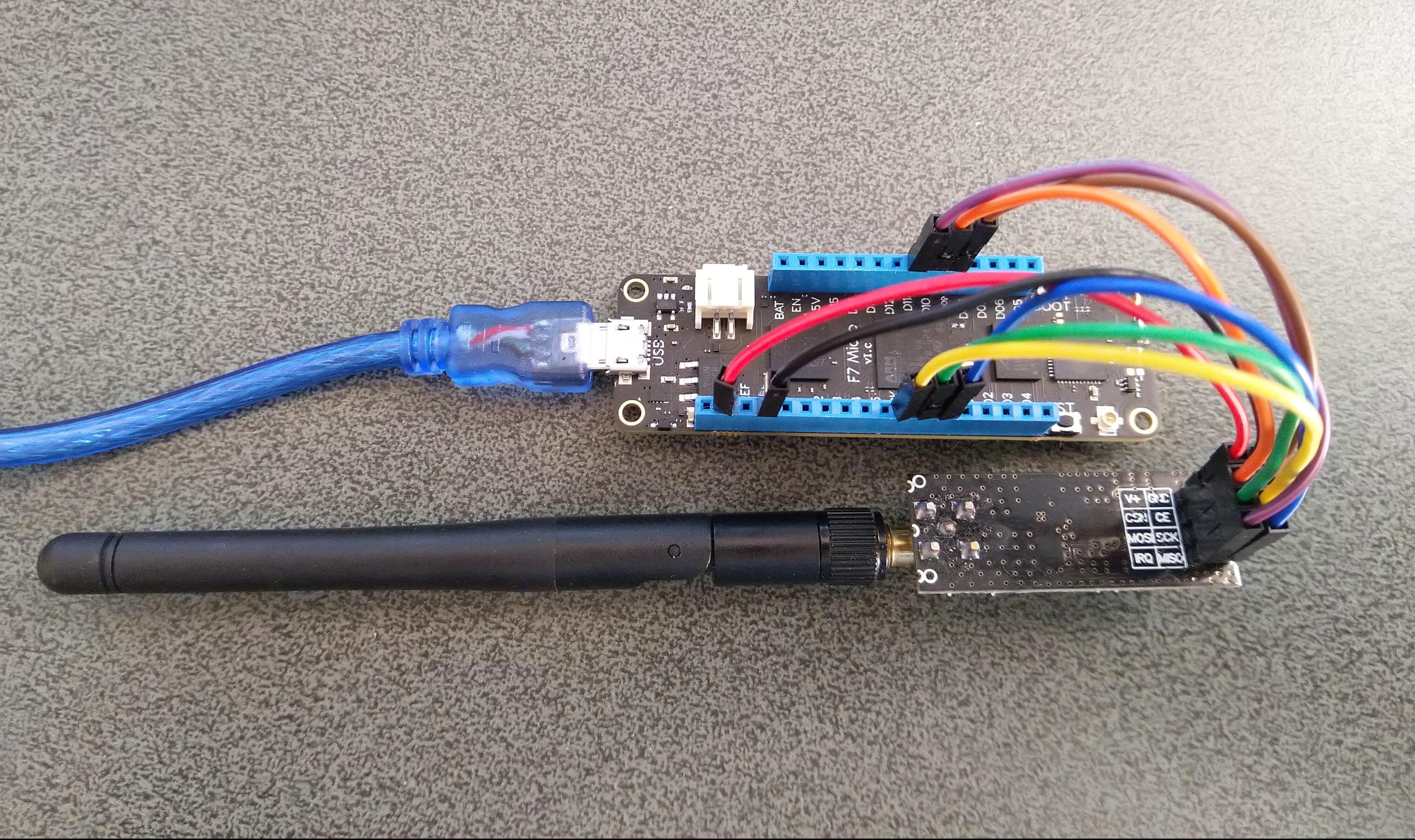
nRF24L01P Test Harness

I added a digital output port for the Chip Select and because I can specify the interrupt trigger edge I removed the test from the interrupt handler.

 public void Initialize(IIODevice device, ISpiBus spiBus, IPin chipEnablePin, IPin chipSelectLine, IPin interruptPin)
{
   _SpiBus = spiBus;

   _cePin = device.CreateDigitalOutputPort(chipEnablePin, false);

   _csPin = device.CreateDigitalOutputPort(chipSelectLine, false);

   _irqPin = device.CreateDigitalInputPort(interruptPin, InterruptMode.EdgeFalling, resistorMode: ResistorMode.PullUp);
   _irqPin.Changed += InterruptGpioPin_ValueChanged;

   // Module reset time
   Task.Delay(100).GetAwaiter().GetResult();

   IsInitialized = true;

   // Set reasonable default values
   Address = Encoding.UTF8.GetBytes("NRF1");
   DataRate = DataRate.DR2Mbps;
   IsDynamicPayload = true;
   IsAutoAcknowledge = true;

   FlushReceiveBuffer();
   FlushTransferBuffer();
   ClearIrqMasks();
   SetRetries(5, 60);

   // Setup, CRC enabled, Power Up, PRX
   SetReceiveMode();
}

The core of the Initialise method was moved to the Meadow application startup.

public MeadowApp()
{
   try
   {
		var config = new Meadow.Hardware.SpiClockConfiguration(
			2000,
			SpiClockConfiguration.Mode.Mode0);

		ISpiBus spiBus = Device.CreateSpiBus(
			Device.Pins.SCK,
			Device.Pins.MOSI,
			Device.Pins.MISO,config);

		Radio.OnDataReceived += Radio_OnDataReceived;
		Radio.OnTransmitFailed += Radio_OnTransmitFailed;
		Radio.OnTransmitSuccess += Radio_OnTransmitSuccess;

		Radio.Initialize(Device, spiBus, Device.Pins.D09, Device.Pins.D10, Device.Pins.D11);
		Radio.Address = Encoding.UTF8.GetBytes(DeviceAddress);

		Radio.Channel = nRF24Channel;
		Radio.PowerLevel = PowerLevel.High;
		Radio.DataRate = DataRate.DR250Kbps;
		Radio.IsEnabled = true;

		Radio.IsAutoAcknowledge = true;
		Radio.IsDyanmicAcknowledge = false;
		Radio.IsDynamicPayload = true;

		Console.WriteLine($"Address: {Encoding.UTF8.GetString(Radio.Address)}");
		Console.WriteLine($"PA: {Radio.PowerLevel}");
		Console.WriteLine($"IsAutoAcknowledge: {Radio.IsAutoAcknowledge}");
		Console.WriteLine($"Channel: {Radio.Channel}");
		Console.WriteLine($"DataRate: {Radio.DataRate}");
		Console.WriteLine($"Power: {Radio.PowerLevel}");
		Console.WriteLine($"IsDynamicAcknowledge: {Radio.IsDyanmicAcknowledge}");
		Console.WriteLine($"IsDynamicPayload: {Radio.IsDynamicPayload}");
		Console.WriteLine($"IsEnabled: {Radio.IsEnabled}");
		Console.WriteLine($"Frequency: {Radio.Frequency}");
		Console.WriteLine($"IsInitialized: {Radio.IsInitialized}");
		Console.WriteLine($"IsPowered: {Radio.IsPowered}");
	}
	catch (Exception ex)
	{
		Console.WriteLine(ex.Message);

		return;
	}

I modified the GetStatus and ExecuteMethods to use the ExchangeData method

   /// <summary>
      ///   Executes a command in NRF24L01+ (for details see module datasheet)
      /// </summary>
      /// <param name = "command">Command</param>
      /// <param name = "addres">Register to write to or read from</param>
      /// <param name = "data">Data to write or buffer to read to</param>
      /// <returns>Response byte array. First byte is the status register</returns>
      public byte[] Execute(byte command, byte addres, byte[] data)
      {
         CheckIsInitialized();

         // This command requires module to be in power down or standby mode
         if (command == Commands.W_REGISTER)
            IsEnabled = false;

         // Create SPI Buffers with Size of Data + 1 (For Command)
         var writeBuffer = new byte[data.Length + 1];
         var readBuffer = new byte[data.Length + 1];

         // Add command and address to SPI buffer
         writeBuffer[0] = (byte)(command | addres);

         // Add data to SPI buffer
         Array.Copy(data, 0, writeBuffer, 1, data.Length);

         // Do SPI Read/Write
         _SpiBus.ExchangeData(_csPin, ChipSelectMode.ActiveLow, writeBuffer, readBuffer);

         // Enable module back if it was disabled
         if (command == Commands.W_REGISTER && _enabled)
            IsEnabled = true;

         // Return ReadBuffer
         return readBuffer;
      }

      /// <summary>
      ///   Gets module basic status information
      /// </summary>
      /// <returns>Status object representing the current status of the radio</returns>
      public Status GetStatus()
      {
         CheckIsInitialized();

         var readBuffer = new byte[1];
         _SpiBus.ExchangeData(_csPin, ChipSelectMode.ActiveLow, new[] { Commands.NOP }, readBuffer);

         return new Status(readBuffer[0]);
      }

After these modifications I can send and receive messages but the PowerLevel doesn’t look right.

The program '[16720] App.exe' has exited with code 0 (0x0).
 IsPowered: True
 Address: Dev01
 PA: 15
 IsAutoAcknowledge: True
 Channel: 15
 DataRate: DR250Kbps
 Power: 15
 IsDynamicAcknowledge: False
 IsDynamicPayload: True
 IsEnabled: False
 Frequency: 2415
 IsInitialized: True
 IsPowered: True
 00:00:18-TX 8 byte message hello 17
 Data Sent!
00:00:18-TX Succeeded!
 00:00:48-TX 8 byte message hello 48
 Data Sent!

Time to dig into the nRF24L01P datasheet.

.Net Meadow nRF24L01 library Part1

After debugging Windows 10 IoT Core & .NetMF nRF24L01P libraries I figured a port to a Wilderness Labs Meadow device shouldn’t be “rocket science”.

I couldn’t source an nRF24L01 feather wing so built a test rig with jumpers

nRF24L01P Test Harness
//---------------------------------------------------------------------------------
// Copyright (c) Feb 2020, devMobile Software
//
// Licensed under the Apache License, Version 2.0 (the "License");
// you may not use this file except in compliance with the License.
// You may obtain a copy of the License at
//
//     http://www.apache.org/licenses/LICENSE-2.0
//
// Unless required by applicable law or agreed to in writing, software
// distributed under the License is distributed on an "AS IS" BASIS,
// WITHOUT WARRANTIES OR CONDITIONS OF ANY KIND, either express or implied.
// See the License for the specific language governing permissions and
// limitations under the License.
//
//---------------------------------------------------------------------------------
namespace devMobile.IoT.nRf24L01
{
   using System;
   using System.Text;
   using System.Threading;
   using Meadow;
   using Meadow.Devices;
   using Meadow.Hardware;

   public class MeadowApp : App<F7Micro, MeadowApp>
   {
      const byte SETUP_AW = 0x03;
      const byte RX_ADDR_P0 = 0x0A;
      const byte R_REGISTER = 0b00000000;
      const byte W_REGISTER = 0b00100000;
      ISpiBus spiBus;
      SpiPeripheral nrf24L01Device;
      IDigitalOutputPort spiPeriphChipSelect;
      IDigitalOutputPort ChipEnable;


      public MeadowApp()
      {
         ConfigureSpiPort();
         SetPipe0RxAddress("ZYXWV");
      }

      public void ConfigureSpiPort()
      {
         try
         {
            ChipEnable = Device.CreateDigitalOutputPort(Device.Pins.D09, initialState: false);
            if (ChipEnable == null)
            {
               Console.WriteLine("chipEnable == null");
            }

            var spiClockConfiguration = new SpiClockConfiguration(2000, SpiClockConfiguration.Mode.Mode0);
            spiBus = Device.CreateSpiBus(Device.Pins.SCK,
                                         Device.Pins.MOSI,
                                         Device.Pins.MISO,
                                         spiClockConfiguration);
            if (spiBus == null)
            {
               Console.WriteLine("spiBus == null");
            }

            Console.WriteLine("Creating SPI NSS Port...");
            spiPeriphChipSelect = Device.CreateDigitalOutputPort(Device.Pins.D10, initialState: true);
            if (spiPeriphChipSelect == null)
            {
               Console.WriteLine("spiPeriphChipSelect == null");
            }

            Console.WriteLine("nrf24L01Device Device...");
            nrf24L01Device = new SpiPeripheral(spiBus, spiPeriphChipSelect);
            if (nrf24L01Device == null)
            {
               Console.WriteLine("nrf24L01Device == null");
            }

            Thread.Sleep(100);

            Console.WriteLine("ConfigureSpiPort Done...");
         }
         catch (Exception ex)
         {
            Console.WriteLine("ConfigureSpiPort " + ex.Message);
         }
      }

      public void SetPipe0RxAddress(string address)
      {
         try
         {
            // Read the Address width
            byte[] txBuffer1 = new byte[] { SETUP_AW | R_REGISTER, 0x0 };
            Console.WriteLine(" txBuffer:" + BitConverter.ToString(txBuffer1));

            /*
            // Appears to work but not certain it does
            Console.WriteLine(" nrf24L01Device.WriteRead...SETUP_AW");
            byte[] rxBuffer1 = nrf24L01Device.WriteRead(txBuffer1, (ushort)txBuffer1.Length);
            Console.WriteLine(" nrf24L01Device.WriteRead...SETUP_AW");
            */

            byte[] rxBuffer1 = new byte[txBuffer1.Length];
            Console.WriteLine(" spiBus.ExchangeData...RX_ADDR_P0");
            spiBus.ExchangeData(spiPeriphChipSelect, ChipSelectMode.ActiveLow, txBuffer1, rxBuffer1);

            Console.WriteLine(" rxBuffer:" + BitConverter.ToString(rxBuffer1));

            // Extract then adjust the address width
            byte addressWidthValue = rxBuffer1[1];
            addressWidthValue &= 0b00000011;
            addressWidthValue += 2;
            Console.WriteLine("Address width 0x{0:x2} - Value 0X{1:x2} - Bits {2} Value adjusted {3}", SETUP_AW, rxBuffer1[1], Convert.ToString(rxBuffer1[1], 2).PadLeft(8, '0'), addressWidthValue);
            Console.WriteLine();

            // Write Pipe0 Receive address
            Console.WriteLine("Address write 1");
            byte[] txBuffer2 = new byte[addressWidthValue + 1];
            txBuffer2[0] = RX_ADDR_P0 | W_REGISTER;
            Array.Copy(Encoding.UTF8.GetBytes(address), 0, txBuffer2, 1, addressWidthValue);
            Console.WriteLine(" txBuffer:" + BitConverter.ToString(txBuffer2));

            Console.WriteLine(" nrf24L01Device.Write...RX_ADDR_P0");
            nrf24L01Device.WriteBytes(txBuffer2);
            Console.WriteLine();

            // Read Pipe0 Receive address
            Console.WriteLine("Address read 1");
            byte[] txBuffer3 = new byte[addressWidthValue + 1];
            txBuffer3[0] = RX_ADDR_P0 | R_REGISTER;
            Console.WriteLine(" txBuffer:" + BitConverter.ToString(txBuffer3));

            /*
            // Broken returns  Address 0x0a - RX Buffer 5A-5A-5A-5A-59-58 RX Address 5A-5A-5A-59-58 Address ZZZYX
            Console.WriteLine(" nrf24L01Device.WriteRead...RX_ADDR_P0");
            byte[] rxBuffer3 = nrf24L01Device.WriteRead(txBuffer3, (ushort)txBuffer3.Length);
            */

            byte[] rxBuffer3 = new byte[addressWidthValue + 1];
            Console.WriteLine(" spiBus.ExchangeData...RX_ADDR_P0");
            spiBus.ExchangeData(spiPeriphChipSelect, ChipSelectMode.ActiveLow, txBuffer3, rxBuffer3);

            Console.WriteLine("Address 0x{0:x2} - RX Buffer {1} RX Address {2} Address {3}", RX_ADDR_P0, BitConverter.ToString(rxBuffer3, 0), BitConverter.ToString(rxBuffer3, 1), UTF8Encoding.UTF8.GetString(rxBuffer3, 1, addressWidthValue));
         }
         catch (Exception ex)
         {
            Console.WriteLine("ReadDeviceIDDiy " + ex.Message);
         }
      }
   }
}

After lots of tinkering with SPI configuration options and trialing different methods (spiBus vs.SpiPeripheral) I can read and write my nRF24L01 device receive port address

 Creating SPI NSS Port...
 nrf24L01Device Device...
 ConfigureSpiPort Done...
  txBuffer:03-00
  spiBus.ExchangeData...RX_ADDR_P0
  rxBuffer:0E-03
 Address width 0x03 - Value 0X03 - Bits 00000011 Value adjusted 5
 
 Address write 1
  txBuffer:2A-5A-59-58-57-56
  nrf24L01Device.Write...RX_ADDR_P0
 
 Address read 1
  txBuffer:0A-00-00-00-00-00
  spiBus.ExchangeData...RX_ADDR_P0
 Address 0x0a - RX Buffer 0E-5A-59-58-57-56 RX Address 5A-59-58-57-56 Address ZYXWV

I need to investigate why the first byte of the buffer returned by nrf24L01Device.ReadBytes and nrf24L01Device.WriteRead is wrong.

AllThingsTalk with MQTTnet

As I’m testing my Message Queue Telemetry Transport(MQTT) LoRa gateway I’m building a proof of concept(PoC) .Net core console application for each IoT platform I would like to support.
This PoC was to confirm that I could connect to the AllThingsTalk MQTT API then format topics and payloads correctly.

MQTTNet Console Client

The AllThingsTalk MQTT broker, username, and device ID are required command line parameters.

namespace devmobile.Mqtt.TestClient.AllThingsTalk
{
	using System;
	using System.Diagnostics;
	using System.Threading;
	using System.Threading.Tasks;

	using MQTTnet;
	using MQTTnet.Client;
	using MQTTnet.Client.Disconnecting;
	using MQTTnet.Client.Options;
	using MQTTnet.Client.Receiving;

	using Newtonsoft.Json;
	using Newtonsoft.Json.Linq;

	class Program
	{
		private static IMqttClient mqttClient = null;
		private static IMqttClientOptions mqttOptions = null;
		private static string server;
		private static string username;
		private static string deviceID;

		static void Main(string[] args)
		{
			MqttFactory factory = new MqttFactory();
			mqttClient = factory.CreateMqttClient();

			if ((args.Length != 3))
			{
				Console.WriteLine("[MQTT Server] [UserName] [ClientID]");
				Console.WriteLine("Press <enter> to exit");
				Console.ReadLine();
				return;
			}

			server = args[0];
			username = args[1];
			deviceID = args[2];

			Console.WriteLine($"MQTT Server:{server} DeviceID:{deviceID}");

			// AllThingsTalk formatted device state update topic
			string topicD2C = $"device/{deviceID}/state";

			mqttOptions = new MqttClientOptionsBuilder()
				.WithTcpServer(server)
				.WithCredentials(username, "HighlySecurePassword")
				.WithClientId(deviceID)
				.WithTls()
				.Build();

			mqttClient.UseDisconnectedHandler(new MqttClientDisconnectedHandlerDelegate(e => MqttClient_Disconnected(e)));
			mqttClient.UseApplicationMessageReceivedHandler(new MqttApplicationMessageReceivedHandlerDelegate(e => MqttClient_ApplicationMessageReceived(e)));
			mqttClient.ConnectAsync(mqttOptions).Wait();

			// AllThingsTalk formatted device command with wildcard topic
			string topicC2D = $"device/{deviceID}/asset/+/command";

			mqttClient.SubscribeAsync(topicC2D, MQTTnet.Protocol.MqttQualityOfServiceLevel.AtLeastOnce).GetAwaiter().GetResult();

			while (true)
			{
				JObject payloadJObject = new JObject();

				double temperature = 22.0 + (DateTime.UtcNow.Millisecond / 1000.0);
				temperature = Math.Round( temperature, 1 );
				double humidity = 50 + (DateTime.UtcNow.Millisecond / 100.0);
				humidity = Math.Round(humidity, 1);

				JObject temperatureJObject = new JObject
				{
					{ "value", temperature }
				};
				payloadJObject.Add("Temperature", temperatureJObject);

				JObject humidityJObject = new JObject
				{
					{ "value", humidity }
				};
				payloadJObject.Add("Humidity", humidityJObject);

				string payload = JsonConvert.SerializeObject(payloadJObject);
				Console.WriteLine($"Topic:{topicD2C} Payload:{payload}");

				var message = new MqttApplicationMessageBuilder()
					.WithTopic(topicD2C)
					.WithPayload(payload)
					.WithAtMostOnceQoS()
//					.WithAtLeastOnceQoS()
					.Build();

				Console.WriteLine("PublishAsync start");
				mqttClient.PublishAsync(message).Wait();
				Console.WriteLine("PublishAsync finish");

				Thread.Sleep(15100);
			}
		}

		private static void MqttClient_ApplicationMessageReceived(MqttApplicationMessageReceivedEventArgs e)
		{
			Console.WriteLine($"ClientId:{e.ClientId} Topic:{e.ApplicationMessage.Topic} Payload:{e.ApplicationMessage.ConvertPayloadToString()}");
		}

		private static async void MqttClient_Disconnected(MqttClientDisconnectedEventArgs e)
		{
			Debug.WriteLine("Disconnected");
			await Task.Delay(TimeSpan.FromSeconds(5));

			try
			{
				await mqttClient.ConnectAsync(mqttOptions);
			}
			catch (Exception ex)
			{
				Debug.WriteLine("Reconnect failed {0}", ex.Message);
			}
		}
	}

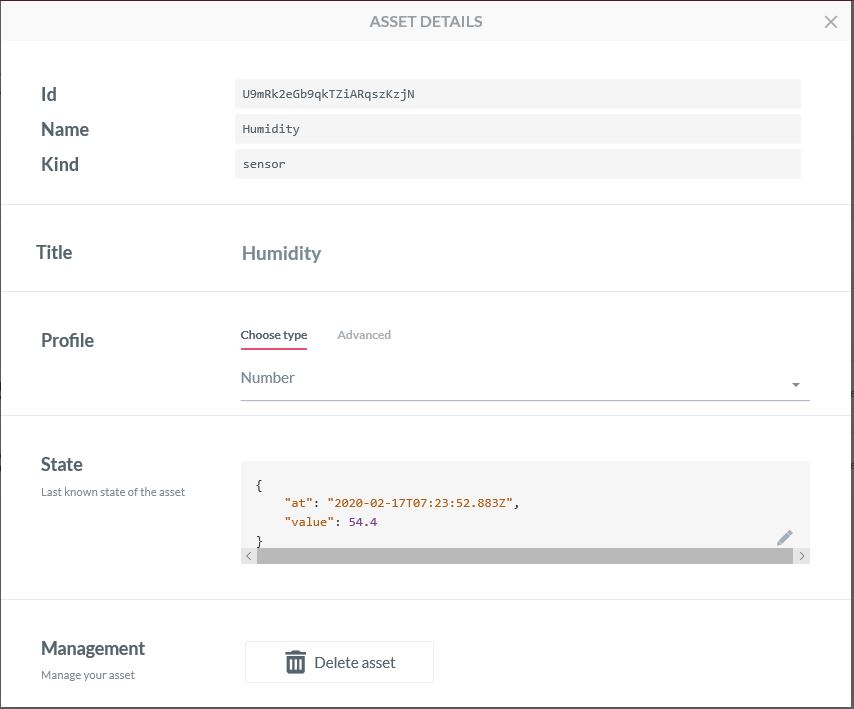
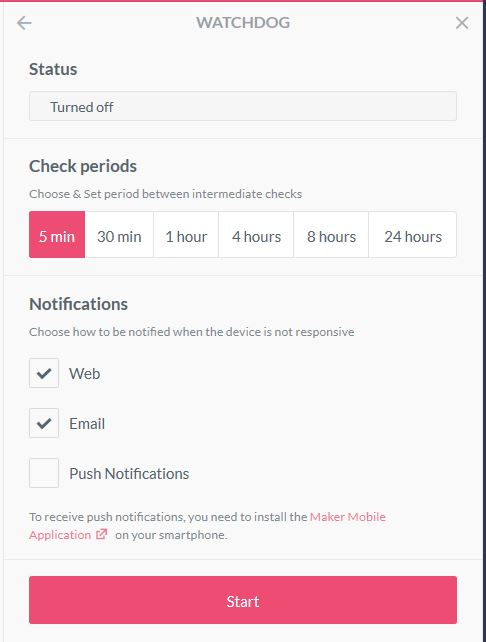
The AllThingsTalk device configuration was relatively easy but I need to investigate “Gateway” functionality and configuration further.

Configuring an Asset
Configuration a watchdog to check for sensor data
Sending a command to an actuator
Processing a command on the client

The ability to look at message payloads in the Debug tab would be very helpful when working out why a payload was not being processed as expected.

Asset debug information

Overall the AllThingsTalk configuration went fairly smoothly, though I need to investigate the “Gateway” configuration and functionality further. The way that assets are name by the system could make support in my MQTT Gateway more complex.

Azure IoT Hub, Event Grid to Application Insights

For a second Proof of Concept (PoC) I wanted to upload sensor data from my MQTT LoRa Telemetry Field Gateway to an Azure IoT Hub, then using Azure EventGrid subscribe to the stream of telemetry data events, logging the payloads in Azure Application Insights (the aim was minimal code so no database etc.).

The first step was to create and deploy a simple Azure Function for unpacking the telemetry event payload.

Azure IoT Hub Azure Function Handler

Then wire the Azure function to the Microsoft.Devices.Device.Telemetry Event Type

Azure IoT Hub Event Metrics

On the Windows 10 IoT Core device in the Event Tracing Window(ETW) logging on the device I could see LoRa messages arriving and being unpacked.

Windows 10 Device ETW showing message payload

Then in Application Insights after some mucking around with code I could see in a series of Trace statements the event payload as it was unpacked.

{"id":"29108ebf-e5d5-7b95-e739-7d9048209d53","topic":"/SUBSCRIPTIONS/12345678-9012-3456-7890-123456789012/RESOURCEGROUPS/AZUREIOTHUBEVENTGRIDAZUREFUNCTION/PROVIDERS/MICROSOFT.DEVICES/IOTHUBS/FIELDGATEWAYHUB",
"subject":"devices/MQTTNetClient",
"eventType":"Microsoft.Devices.DeviceTelemetry",
"eventTime":"2020-02-01T04:30:51.427Z",
"data":
{
 "properties":{},
"systemProperties":{"iothub-connection-device-id":"MQTTNetClient","iothub-connection-auth-method":"{\"scope\":\"device\",\"type\":\"sas\",\"issuer\":\"iothub\",\"acceptingIpFilterRule\":null}",
"iothub-connection-auth-generation-id":"637149890997219611",
"iothub-enqueuedtime":"2020-02-01T04:30:51.427Z",
"iothub-message-source":"Telemetry"
},
"body":"eyJPZmZpY2VUZW1wZXJhdHVyZSI6IjIyLjUiLCJPZmZpY2VIdW1pZGl0eSI6IjkyIn0="
},
"dataVersion":"",
"metadataVersion":"1"
}
Application Insights logging with message unpacking
Application Insights logging message payload

Then in the last log entry the decoded message payload

/*
    Copyright ® 2020 Feb devMobile Software, All Rights Reserved
 
    MIT License

    Permission is hereby granted, free of charge, to any person obtaining a copy
    of this software and associated documentation files (the "Software"), to deal
    in the Software without restriction, including without limitation the rights
    to use, copy, modify, merge, publish, distribute, sublicense, and/or sell
    copies of the Software, and to permit persons to whom the Software is
    furnished to do so, subject to the following conditions:

    The above copyright notice and this permission notice shall be included in all
    copies or substantial portions of the Software.

    THE SOFTWARE IS PROVIDED "AS IS", WITHOUT WARRANTY OF ANY KIND, EXPRESS OR
    IMPLIED, INCLUDING BUT NOT LIMITED TO THE WARRANTIES OF MERCHANTABILITY,
    FITNESS FOR A PARTICULAR PURPOSE AND NONINFRINGEMENT. IN NO EVENT SHALL THE
    AUTHORS OR COPYRIGHT HOLDERS BE LIABLE FOR ANY CLAIM, DAMAGES OR OTHER
    LIABILITY, WHETHER IN AN ACTION OF CONTRACT, TORT OR OTHERWISE, ARISING FROM,
    OUT OF OR IN CONNECTION WITH THE SOFTWARE OR THE USE OR OTHER DEALINGS IN THE
    SOFTWARE

    Default URL for triggering event grid function in the local environment.
    http://localhost:7071/runtime/webhooks/EventGrid?functionName=functionname
 */
namespace EventGridProcessorAzureIotHub
{
   using System;
   using System.IO;
   using System.Reflection;

   using Microsoft.Azure.WebJobs;
   using Microsoft.Azure.EventGrid.Models;
   using Microsoft.Azure.WebJobs.Extensions.EventGrid;

   using log4net;
   using log4net.Config;
   using Newtonsoft.Json;

   public static class Telemetry
    {
        [FunctionName("Telemetry")]
        public static void Run([EventGridTrigger]Microsoft.Azure.EventGrid.Models.EventGridEvent eventGridEvent, ExecutionContext executionContext )//, TelemetryClient telemetryClient)
        {
			ILog log = log4net.LogManager.GetLogger(System.Reflection.MethodBase.GetCurrentMethod().DeclaringType);

		   var logRepository = LogManager.GetRepository(Assembly.GetEntryAssembly());
			XmlConfigurator.Configure(logRepository, new FileInfo(Path.Combine(executionContext.FunctionAppDirectory, "log4net.config")));

         log.Info($"eventGridEvent.Data-{eventGridEvent}");

         log.Info($"eventGridEvent.Data.ToString()-{eventGridEvent.Data.ToString()}");

        IotHubDeviceTelemetryEventData iOThubDeviceTelemetryEventData = (IotHubDeviceTelemetryEventData)JsonConvert.DeserializeObject(eventGridEvent.Data.ToString(), typeof(IotHubDeviceTelemetryEventData));

         log.Info($"iOThubDeviceTelemetryEventData.Body.ToString()-{iOThubDeviceTelemetryEventData.Body.ToString()}");

         byte[] base64EncodedBytes = System.Convert.FromBase64String(iOThubDeviceTelemetryEventData.Body.ToString());

         log.Info($"System.Text.Encoding.UTF8.GetString(-{System.Text.Encoding.UTF8.GetString(base64EncodedBytes)}");
      }
	}
}

Overall it took roughly half a page of code (mainly generated by a tool) to unpack and log the contents of an Azure IoT Hub EventGrid payload to Application Insights.

.Net Meadow RFM95/96/97/98 LoRa library Part1

After writing Windows 10 IoT Core & .NetMF RFM9X libraries I figured a port to a Wilderness Labs Meadow device shouldn’t be “rocket science”.

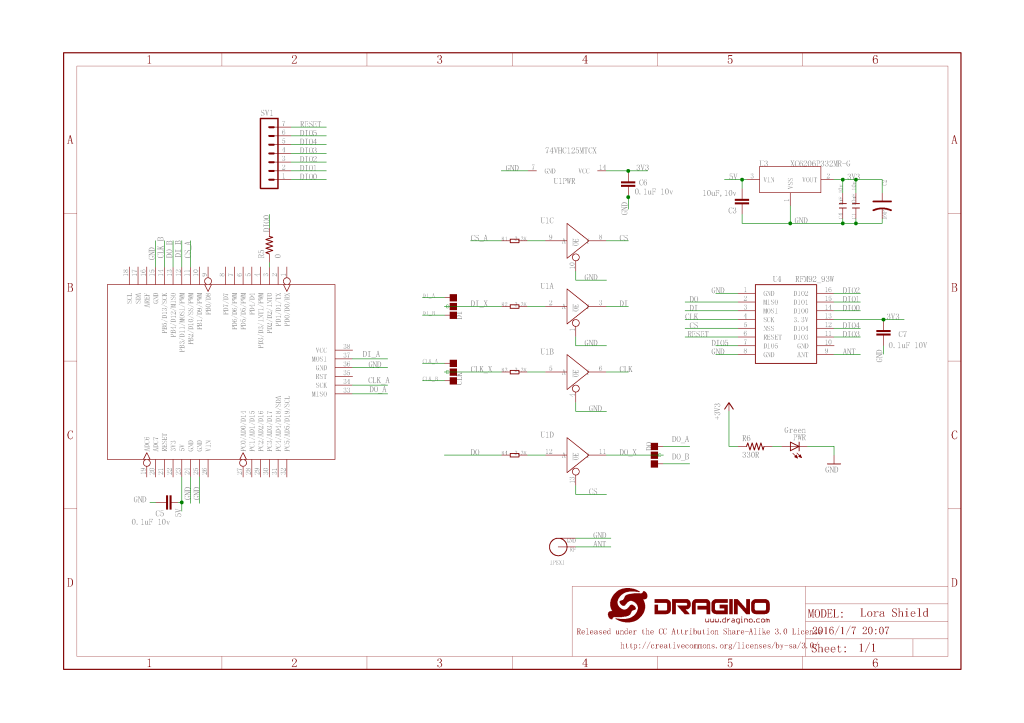
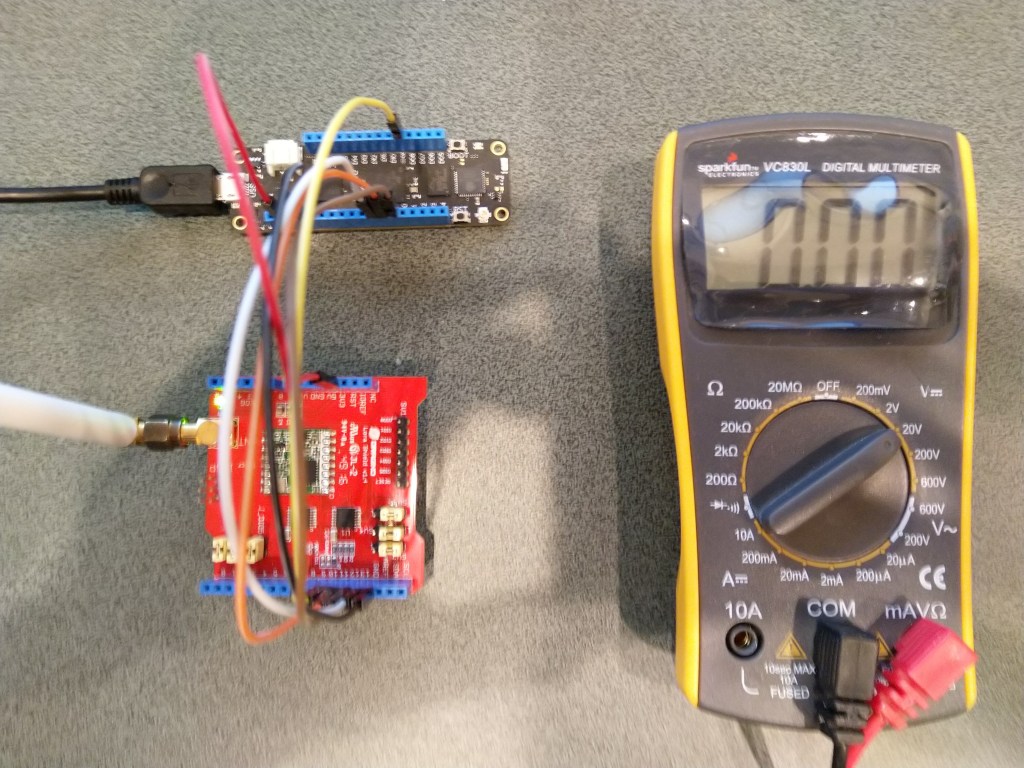
To get started I used a Dragino LoRa shield for Arduino which looked compatible with my Meadow device.

Dragino shield schematic

The shield ships with the SPI lines configured for ICSP so the three jumpers diagonally across the shield from the antenna connector need to be swapped to the side closest to the edge of the shield.

Dragino Arduino shield based test harness
//---------------------------------------------------------------------------------
// Copyright (c) Dec 2019, devMobile Software
//
// Licensed under the Apache License, Version 2.0 (the "License");
// you may not use this file except in compliance with the License.
// You may obtain a copy of the License at
//
//     http://www.apache.org/licenses/LICENSE-2.0
//
// Unless required by applicable law or agreed to in writing, software
// distributed under the License is distributed on an "AS IS" BASIS,
// WITHOUT WARRANTIES OR CONDITIONS OF ANY KIND, either express or implied.
// See the License for the specific language governing permissions and
// limitations under the License.
//
//---------------------------------------------------------------------------------
namespace devMobile.IoT.Rfm9x
{
   using System;
   using System.Threading.Tasks;
   using Meadow;
   using Meadow.Devices;
   using Meadow.Hardware;

   public class MeadowApp : App<F7Micro, MeadowApp>
   {
      const byte RegVersion = 0x42;
      ISpiBus spiBus;
      SpiPeripheral sx127xDevice;
      IDigitalOutputPort spiPeriphChipSelect;

      public MeadowApp()
      {
         ConfigureSpiPort();
         //ReadDeviceID();
         ReadDeviceIDDiy();
      }

      public void ConfigureSpiPort()
      {
         try
         {
            spiBus = Device.CreateSpiBus(500);
            if (spiBus == null)
            {
               Console.WriteLine("spiBus == null");
            }

            Console.WriteLine("Creating SPI NSS Port...");
            spiPeriphChipSelect = Device.CreateDigitalOutputPort(Device.Pins.D09);
            if (spiPeriphChipSelect == null)
            {
               Console.WriteLine("spiPeriphChipSelect == null");
            }
   
            Console.WriteLine("sx127xDevice Device...");
            sx127xDevice = new SpiPeripheral(spiBus, spiPeriphChipSelect);
            if (sx127xDevice == null)
            {
               Console.WriteLine("sx127xDevice == null");
            }

            Console.WriteLine("ConfigureSpiPort Done...");
         }
         catch (Exception ex)
         {
            Console.WriteLine("ConfigureSpiPort " + ex.Message);
         }
      }

      
      public void ReadDeviceID()
      {
         Task.Delay(500).Wait();

         while (true)
         {
            try
            {
               Console.WriteLine("sx127xDevice.ReadRegister...1");

               byte registerValue = sx127xDevice.ReadRegister(RegVersion);

               Console.WriteLine("sx127xDevice.ReadRegister...2");

               Console.WriteLine("Register 0x{0:x2} - Value 0X{1:x2} - Bits {2}", RegVersion, registerValue, Convert.ToString(registerValue, 2).PadLeft(8, '0'));
            }
            catch (Exception ex)
            {
               Console.WriteLine("ReadDeviceID " + ex.Message);
            }

            Task.Delay(10000).Wait();
         }
      }

      public void ReadDeviceIDDiy()
      {
         var txBuffer = new byte[2];
         var rxBuffer = new byte[2];

         Task.Delay(500).Wait();

         while (true)
         {
            try
            {
               Console.WriteLine("spiBus.ExchangeData...1");

               txBuffer[0] = RegVersion;

               spiBus.ExchangeData(spiPeriphChipSelect, ChipSelectMode.ActiveLow, txBuffer, rxBuffer, 2);

               Console.WriteLine("spiBus.ExchangeData...2");

               byte registerValue = rxBuffer[1];

               Console.WriteLine("Register 0x{0:x2} - Value 0X{1:x2} - Bits {2}", RegVersion, registerValue, Convert.ToString(registerValue, 2).PadLeft(8, '0'));
            }
            catch (Exception ex)
            {
               Console.WriteLine("ReadDeviceIDDiy " + ex.Message);
            }

            Task.Delay(10000).Wait();
         }
      }
   }
}

After some trial and error (using beta 3.6) I found that the ReadRegister method didn’t work as expected (possibly related to this issue) and I had to manually assemble the request to read the SX127X RegVersion register.

'App.exe' (CLR v4.0.30319: DefaultDomain): Loaded 'C:\WINDOWS\Microsoft.Net\assembly\GAC_64\mscorlib\v4.0_4.0.0.0__b77a5c561934e089\mscorlib.dll'. 
'App.exe' (CLR v4.0.30319: DefaultDomain): Loaded 'C:\Users\BrynLewis\source\repos\RFX9X.Meadow\FeatherWingSPI\bin\Debug\net472\App.exe'. Symbols loaded.
'App.exe' (CLR v4.0.30319: App.exe): Loaded 'C:\Users\BrynLewis\source\repos\RFX9X.Meadow\FeatherWingSPI\bin\Debug\net472\Meadow.dll'. 
The program '[22324] App.exe: Program Trace' has exited with code 0 (0x0).
The program '[22324] App.exe' has exited with code 0 (0x0).
.
.
DirectRegisterAccess = True
==========================================================
Ignore the exceptions generated by the DateTime call here.
==========================================================
.
Creating SPI NSS Port...
sx127xDevice Device...
ConfigureSpiPort Done...
spiBus.ExchangeData...1
spiBus.ExchangeData...2
Register 0x42 - Value 0X12 - Bits 00010010
spiBus.ExchangeData...1
spiBus.ExchangeData...2
Register 0x42 - Value 0X12 - Bits 00010010
spiBus.ExchangeData...1
spiBus.ExchangeData...2
Register 0x42 - Value 0X12 - Bits 00010010
spiBus.ExchangeData...1
spiBus.ExchangeData...2

Bosch IoT Suite with MQTTnet

As I’m testing my Message Queue Telemetry Transport(MQTT) LoRa gateway I’m building a proof of concept(PoC) .Net core console application for each IoT platform I would like to support.

This PoC was to confirm that I could connect to the Bosch IoT Suite MQTT API then format topics and payloads correctly.

MQTTNet Console Client

The Bosch IoT Hub MQTT broker, username, password, and clientID are the required command line parameters. For this PoC I ran out of time to get cloud to device (C2D) messaging or any presentation functionality working.

/*
    Copyright ® 2019 December devMobile Software, All Rights Reserved
 
    MIT License

    Permission is hereby granted, free of charge, to any person obtaining a copy
    of this software and associated documentation files (the "Software"), to deal
    in the Software without restriction, including without limitation the rights
    to use, copy, modify, merge, publish, distribute, sublicense, and/or sell
    copies of the Software, and to permit persons to whom the Software is
    furnished to do so, subject to the following conditions:

    The above copyright notice and this permission notice shall be included in all
    copies or substantial portions of the Software.

    THE SOFTWARE IS PROVIDED "AS IS", WITHOUT WARRANTY OF ANY KIND, EXPRESS OR
    IMPLIED, INCLUDING BUT NOT LIMITED TO THE WARRANTIES OF MERCHANTABILITY,
    FITNESS FOR A PARTICULAR PURPOSE AND NONINFRINGEMENT. IN NO EVENT SHALL THE
    AUTHORS OR COPYRIGHT HOLDERS BE LIABLE FOR ANY CLAIM, DAMAGES OR OTHER
    LIABILITY, WHETHER IN AN ACTION OF CONTRACT, TORT OR OTHERWISE, ARISING FROM,
    OUT OF OR IN CONNECTION WITH THE SOFTWARE OR THE USE OR OTHER DEALINGS IN THE
    SOFTWARE

	 A quick and dirty test client to explore how BoschIoT Suite MQTT connectivity works
 */
namespace devMobile.Mqtt.TestClient.BoschIoTSuite
{
   using System;
   using System.Diagnostics;
   using System.Threading;
   using System.Threading.Tasks;

   using MQTTnet;
   using MQTTnet.Client;
   using MQTTnet.Client.Disconnecting;
   using MQTTnet.Client.Options;
   using MQTTnet.Client.Receiving;
   using Newtonsoft.Json;
   using Newtonsoft.Json.Linq;

   class Program
   {
      private static IMqttClient mqttClient = null;
      private static IMqttClientOptions mqttOptions = null;
      private static string server;
      private static string username;
      private static string password;
      private static string clientId;

      static void Main(string[] args)
      {
         MqttFactory factory = new MqttFactory();
         mqttClient = factory.CreateMqttClient();

         if (args.Length != 4) 
         {
            Console.WriteLine("[MQTT Server] [UserName] [Password] [ClientID]");
            Console.WriteLine("Press <enter> to exit");
            Console.ReadLine();
            return;
         }

         server = args[0];
         username = args[1];
         password = args[2];
         clientId = args[3];

         mqttOptions = new MqttClientOptionsBuilder()
            .WithTcpServer(server)
            .WithCredentials(username, password)
            .WithClientId(clientId)
            .WithTls()
            .Build();

         mqttClient.UseDisconnectedHandler(new MqttClientDisconnectedHandlerDelegate(e => MqttClient_Disconnected(e)));
         mqttClient.UseApplicationMessageReceivedHandler(new MqttApplicationMessageReceivedHandlerDelegate(e => MqttClient_ApplicationMessageReceived(e)));
         mqttClient.ConnectAsync(mqttOptions).Wait();

         string topicD2C = "telemetry";

         while (true)
         {
            JObject payloadJObject = new JObject();

            payloadJObject.Add("OfficeTemperature", "22." + DateTime.UtcNow.Millisecond.ToString());
            payloadJObject.Add("OfficeHumidity", (DateTime.UtcNow.Second + 40).ToString());

            string payload = JsonConvert.SerializeObject(payloadJObject);
            Console.WriteLine($"Topic:{topicD2C} Payload:{payload}");

            var message = new MqttApplicationMessageBuilder()
               .WithTopic(topicD2C)
               .WithPayload(payload)
               .WithAtMostOnceQoS() // Anthing but this causes timeout
               .WithRetainFlag()
            .Build();

            Console.WriteLine("PublishAsync start");
            mqttClient.PublishAsync(message).Wait();
            Console.WriteLine("PublishAsync finish");

            Thread.Sleep(30100);
         }
      }

      private static void MqttClient_ApplicationMessageReceived(MqttApplicationMessageReceivedEventArgs e)
      {
         Console.WriteLine($"ClientId:{e.ClientId} Topic:{e.ApplicationMessage.Topic} Payload:{e.ApplicationMessage.ConvertPayloadToString()}");
      }

      private static async void MqttClient_Disconnected(MqttClientDisconnectedEventArgs e)
      {
         Debug.WriteLine("Disconnected");
         await Task.Delay(TimeSpan.FromSeconds(5));

         try
         {
            await mqttClient.ConnectAsync(mqttOptions);
         }
         catch (Exception ex)
         {
            Debug.WriteLine("Reconnect failed {0}", ex.Message);
         }
      }
   }
}

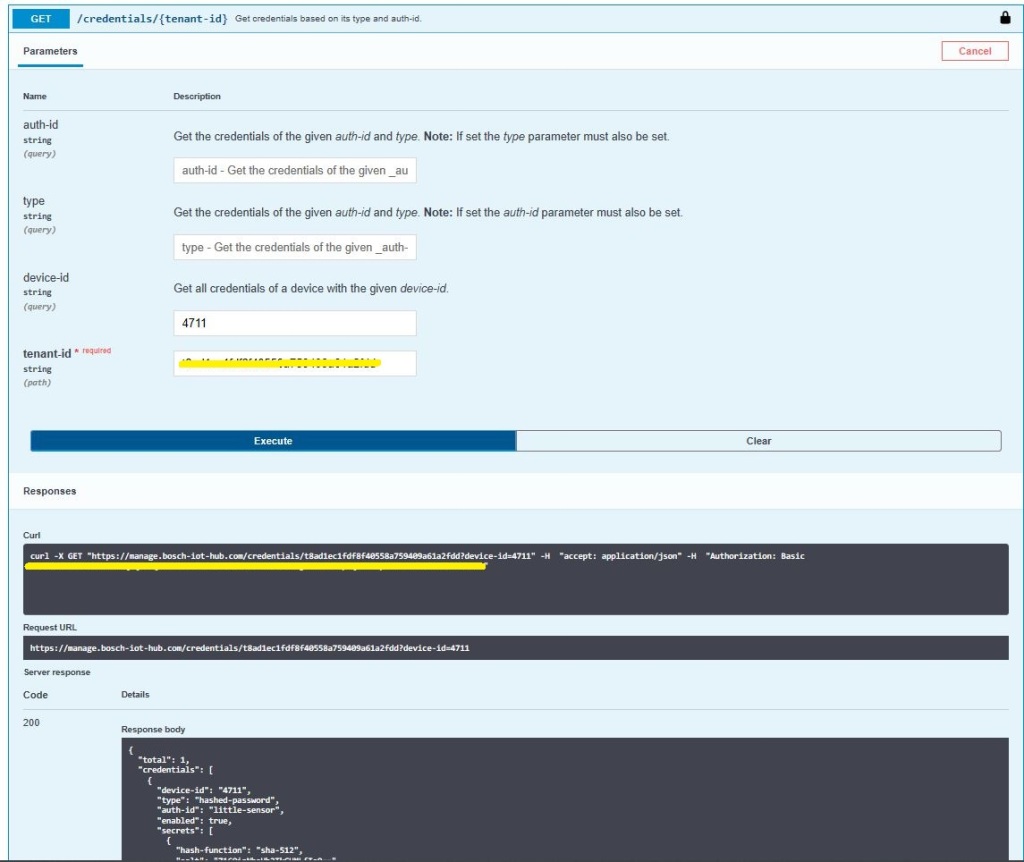
The bosch IoT Hub device configuration was via a swagger API but I need to spend some more time figuring out how to configure the data analysis and presentation tools.

I adapted the steps in the IoT Hub Documentation for Sending Device Data using MQTT. The first step was to create a free Hub subscription.

IoT Hub Subscription

Then using the device registry swagger UI page to add a new device.

Device Registry Swagger UI

After a couple of failed attempts I worked out the format of the Authorisation details (I think the username format in the online documentation might be wrong)

Swagger UI Authorisation form
Querying the available devices

Of the 10+ SaaS IoT services I have setup the Bosch IoT Suite was the hardest to get working. I think this was becuase it is meant to be managed via the API from a in-house application. In a future post I’ll get configure the cloud to device messaging, plus analysis and display functionality.

wolkabout with MQTTnet

As I’m testing my Message Queue Telemetry Transport(MQTT) LoRa gateway I’m building a proof of concept(PoC) .Net core console application for each IoT platform I would like to support.

This PoC was to confirm that I could connect to the walkabout MQTT API then format topics and payloads correctly.

MQTTNet Console Client

The walkabout MQTT broker, username, API Key, and device ID are the required command line parameters. For this PoC I couldn’t get cloud to device (C2D) or Transport Layer Security(TLS) working so will have to do some more research.

namespace devmobile.Mqtt.TestClient.WolkAbout
{
   using System;
   using System.Diagnostics;
   using System.Threading;
   using System.Threading.Tasks;

   using MQTTnet;
   using MQTTnet.Client;
   using MQTTnet.Client.Disconnecting;
   using MQTTnet.Client.Options;

   using Newtonsoft.Json;
   using Newtonsoft.Json.Linq;

   class Program
   {
      private static IMqttClient mqttClient = null;
      private static IMqttClientOptions mqttOptions = null;
      private static string server;
      private static string username;
      private static string apiKey;
      private static string clientID;

      static void Main(string[] args)
      {
         MqttFactory factory = new MqttFactory();
         mqttClient = factory.CreateMqttClient();

         if ((args.Length != 4) )
            {
            Console.WriteLine("[MQTT Server] [UserName] [APIKey] [ClientID]");
            Console.WriteLine("Press <enter> to exit");
            Console.ReadLine();
            return;
         }

         server = args[0];
         username = args[1];
         apiKey = args[2];
         clientID = args[3];

         Console.WriteLine($"MQTT Server:{server} Username:{username} ClientID:{clientID}");

         // wolkabout formatted client state update topic
         string topicD2C = $"readings/{username}/";

         mqttOptions = new MqttClientOptionsBuilder()
            .WithTcpServer(server)
            .WithCredentials(username, apiKey)
            .WithClientId(clientID)
            //.WithTls()
            .Build();

         mqttClient.UseDisconnectedHandler(new MqttClientDisconnectedHandlerDelegate(e => MqttClient_Disconnected(e)));
         mqttClient.ConnectAsync(mqttOptions).Wait();

         while (true)
         {
            JObject payloadJObject = new JObject();

            double temperature = 22.0 + (DateTime.UtcNow.Millisecond / 1000.0);
            double humidity = 50 + (DateTime.UtcNow.Millisecond / 100.0);

            payloadJObject.Add("Temperature", temperature);
            payloadJObject.Add("Humidity", humidity);

            string payload = JsonConvert.SerializeObject(payloadJObject);
            Console.WriteLine($"Topic:{topicD2C} Payload:{payload}");

            var message = new MqttApplicationMessageBuilder()
               .WithTopic(topicD2C)
               .WithPayload(payload)
               .WithAtLeastOnceQoS()
               .Build();

            Console.WriteLine("PublishAsync start");
            mqttClient.PublishAsync(message).Wait();
            Console.WriteLine("PublishAsync finish");

            Thread.Sleep(30100);
         }
      }

      private static async void MqttClient_Disconnected(MqttClientDisconnectedEventArgs e)
      {
         Debug.WriteLine("Disconnected");
         await Task.Delay(TimeSpan.FromSeconds(5));

         try
         {
            await mqttClient.ConnectAsync(mqttOptions);
         }
         catch (Exception ex)
         {
            Debug.WriteLine("Reconnect failed {0}", ex.Message);
         }
      }
   }

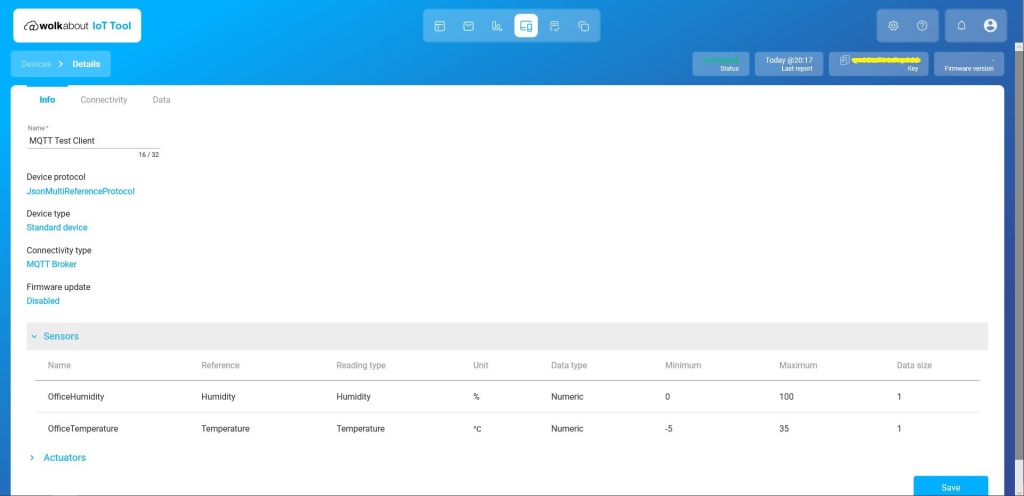
The walkabout device configuration was relatively easy but I need watch the instructional videos again to better understand the device and data semantics relationship.

Data semantics configuration
Devices setup
Device Setup
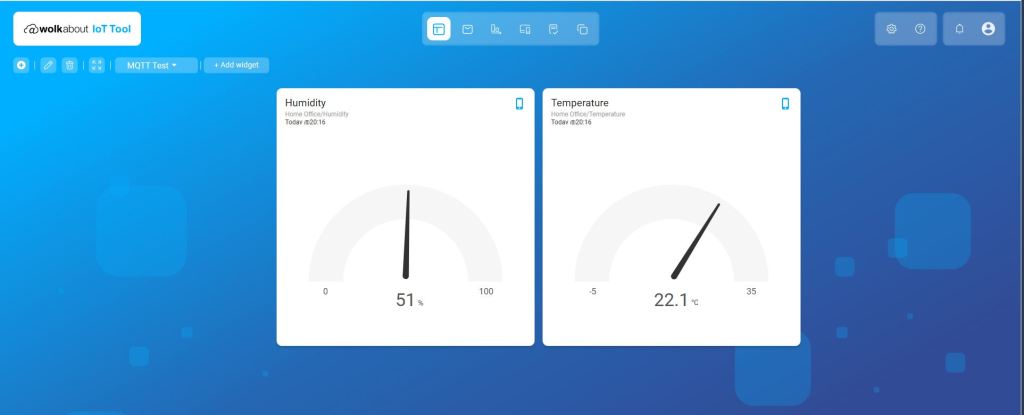
My first dashboard

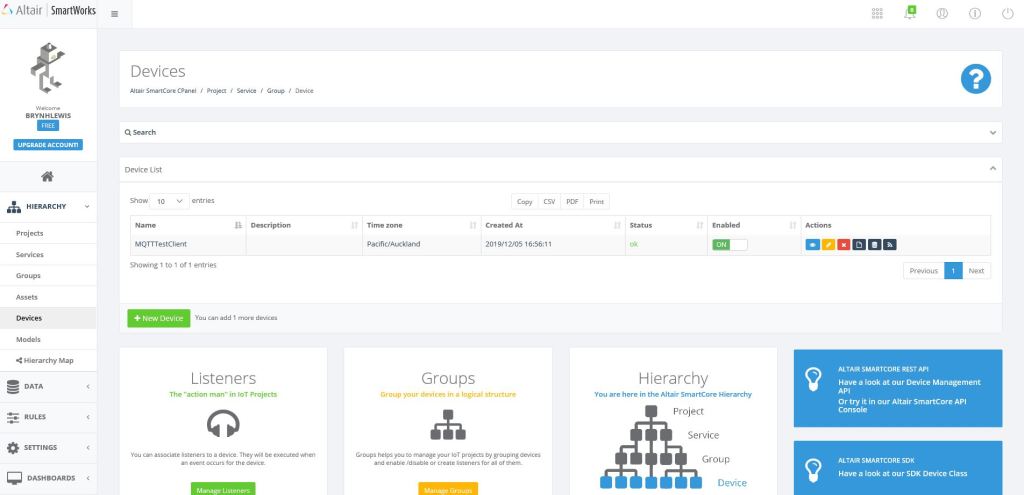
SmartWorks with MQTTnet

As I’m testing my Message Queue Telemetry Transport(MQTT) LoRa gateway I’m building a proof of concept(PoC) .Net core console application for each IoT platform I would like to support.

This PoC was to confirm that I could connect to the SmartWorks (formerly Carriots) MQTT API then format topics and payloads correctly.

MQTTNet Console Client

The SmartWorks MQTT broker, username, and device ID are the required command line parameters. I didn’t notice any configuration options for cloud to device (C2D) messaging which maybe due to my device configuration or the free trial I was using.

namespace devMobile.Mqtt.TestClient.SmartWorks
{
   using System;
   using System.Diagnostics;
   using System.Threading;
   using System.Threading.Tasks;

   using MQTTnet;
   using MQTTnet.Client;
   using MQTTnet.Client.Disconnecting;
   using MQTTnet.Client.Options;
   using MQTTnet.Client.Receiving;
   using Newtonsoft.Json;
   using Newtonsoft.Json.Linq;

   class Program
   {
      private static IMqttClient mqttClient = null;
      private static IMqttClientOptions mqttOptions = null;
      private static string server;
      private static string username;
      private static string clientId;
      private static string commandTopic;
      private static string groupname;
      private static string feedname;

      static void Main(string[] args)
      {
         MqttFactory factory = new MqttFactory();
         mqttClient = factory.CreateMqttClient();

         if (args.Length != 3) 
         {
            Console.WriteLine("[MQTT Server] [UserName] [ClientID]");
            Console.WriteLine("Press <enter> to exit");
            Console.ReadLine();
            return;
         }

         server = args[0];
         username = args[1];
         clientId = args[2];

         mqttOptions = new MqttClientOptionsBuilder()
            .WithTcpServer(server)
            .WithCredentials(username, "")
            .WithClientId(clientId)
            .WithTls()
            .Build();

         mqttClient.UseDisconnectedHandler(new MqttClientDisconnectedHandlerDelegate(e => MqttClient_Disconnected(e)));
         mqttClient.ConnectAsync(mqttOptions).Wait();

         // Adafruit.IO format for topics which are called feeds
         string topicD2C = $"{username}/streams";

         while (true)
         {
            JObject payloadJObject = new JObject();

            payloadJObject.Add("at", "now");
            payloadJObject.Add("device", clientId);
            payloadJObject.Add("protocol", "v2");

            double temperature = 22.0 + (DateTime.UtcNow.Millisecond / 1000.0);
            double humidity = 50 + (DateTime.UtcNow.Millisecond / 100.0);

            JObject dataJObject = new JObject();
            dataJObject.Add("OfficeTemperature", temperature);
            dataJObject.Add("OfficeHumidity", humidity);

            payloadJObject.Add("data", dataJObject);

            string payload = JsonConvert.SerializeObject(payloadJObject);
            Console.WriteLine($"Topic:{topicD2C} Payload:{payload}");

            var message = new MqttApplicationMessageBuilder()
               .WithTopic(topicD2C)
               .WithPayload(payload)
               .WithAtLeastOnceQoS()
            .Build();

            Console.WriteLine("PublishAsync start");
            mqttClient.PublishAsync(message).Wait();
            Console.WriteLine("PublishAsync finish");

            Thread.Sleep(30100);
         }
      }

      private static async void MqttClient_Disconnected(MqttClientDisconnectedEventArgs e)
      {
         Debug.WriteLine("Disconnected");
         await Task.Delay(TimeSpan.FromSeconds(5));

         try
         {
            await mqttClient.ConnectAsync(mqttOptions);
         }
         catch (Exception ex)
         {
            Debug.WriteLine("Reconnect failed {0}", ex.Message);
         }
      }
   }
}

The ThingsBoard device configuration was relatively easy with convenient buttons to copy the Device ID (Client ID in test client) and Access Token (UserName in test client). I need to revisit the Device and Group configuration to see if I can make the automatically generated names more user friendly.

Devices configuration

The Device configuration form has a tab which has a link for the “Data Streams” form which was useful for debugging.

Device configuration

I have emailed SmartWorks support about a free trial of their dashboard product as it is not available in the free trial.

Device data stream query form

Overall the initial configuration went smoothly but the lack of any dashboard functionality in the free trial was quite limiting.

ThingsBoard with MQTTnet

As I’m testing my Message Queue Telemetry Transport(MQTT) LoRa gateway I’m building a proof of concept(PoC) .Net core console application for each IoT platform I would like to support.

This PoC was to confirm that I could connect to the ThingsBoard MQTT API then format topics and payloads correctly.

MQTTNet Console Client

The ThingsBoard MQTT broker, username, and client ID are the minimum command line options required with the CommandTopic optional.

   class Program
   {
      private static IMqttClient mqttClient = null;
      private static IMqttClientOptions mqttOptions = null;
      private static string server;
      private static string username;
      private static string clientId;
      private const string telemetryTopic = "v1/devices/me/telemetry";
      private static string commandTopic;

      static void Main(string[] args)
      {
         MqttFactory factory = new MqttFactory();
         mqttClient = factory.CreateMqttClient();

         if ((args.Length != 3) && (args.Length != 4))
         {
            Console.WriteLine("[MQTT Server] [UserName] [ClientID]");
            Console.WriteLine("[MQTT Server] [UserName] [ClientID] [CommandTopic]");
            Console.WriteLine("Press <enter> to exit");
            Console.ReadLine();
            return;
         }

         server =  args[0];
         username = args[1];
         clientId =  args[2];
         
         if (args.Length == 3)
         {
            Console.WriteLine($"MQTT Server:{server} ClientID:{clientId}");
         }

         if (args.Length == 4)
         {
            commandTopic = args[3];
            Console.WriteLine($"MQTT Server:{server} ClientID:{clientId} CommandTopic:{commandTopic}");
         }

         mqttOptions = new MqttClientOptionsBuilder()
            .WithTcpServer(server)
            .WithCredentials(username, "")
            .WithClientId(clientId)
            //.WithTls() blows up if this enabled, need to do more research on certificate config.
            .Build();

         mqttClient.UseDisconnectedHandler(new MqttClientDisconnectedHandlerDelegate(e => MqttClient_Disconnected(e)));
         mqttClient.UseApplicationMessageReceivedHandler(new MqttApplicationMessageReceivedHandlerDelegate(e => MqttClient_ApplicationMessageReceived(e)));
         mqttClient.ConnectAsync(mqttOptions).Wait();

         if (args.Length == 4)
         {
            mqttClient.SubscribeAsync(commandTopic, MQTTnet.Protocol.MqttQualityOfServiceLevel.AtLeastOnce).GetAwaiter().GetResult();
         }

         while (true)
         {
            JObject payloadJObject = new JObject();

            payloadJObject.Add("OfficeTemperature", "22." + DateTime.UtcNow.Millisecond.ToString());
            payloadJObject.Add("OfficeHumidity", (DateTime.UtcNow.Second + 40).ToString());

            string payload = JsonConvert.SerializeObject(payloadJObject);
            Console.WriteLine($"Topic:{telemetryTopic} Payload:{payload}");

            var message = new MqttApplicationMessageBuilder()
               .WithTopic(telemetryTopic)
               .WithPayload(payload)
               .WithAtLeastOnceQoS()
            .Build();

            Console.WriteLine("PublishAsync start");
            mqttClient.PublishAsync(message).Wait();
            Console.WriteLine("PublishAsync finish");

            Thread.Sleep(30100);
         }
      }

      private static void MqttClient_ApplicationMessageReceived(MqttApplicationMessageReceivedEventArgs e)
      {
         Console.WriteLine($"ClientId:{e.ClientId} Topic:{e.ApplicationMessage.Topic} Payload:{e.ApplicationMessage.ConvertPayloadToString()}");
      }

      private static async void MqttClient_Disconnected(MqttClientDisconnectedEventArgs e)
      {
         Debug.WriteLine("Disconnected");
         await Task.Delay(TimeSpan.FromSeconds(5));

         try
         {
            await mqttClient.ConnectAsync(mqttOptions);
         }
         catch (Exception ex)
         {
            Debug.WriteLine("Reconnect failed {0}", ex.Message);
         }
      }

The ThingsBoard device configuration was relatively easy with convenient buttons to copy the Device ID (Client ID in test client) and Access Token (UserName in test client). After looking at the source code for some of the other samples I figured out the ThingsBoard MQTT setup does not use the password field.

Device setup

The Device configuration form has a tab which displays the last telemetry which was useful for debugging. (I need to investigate the MQTT API support for claiming devices)

Device Telemetry display

To get telemetry data displayed on my dashboard I “added” it to my dashboard from the Entity configuration form. (I need to spend some more time watching the video tutorials to understand this process).

Device Entity View Setup

The dashboard designer had a number of “widgets” and what appeared to be the ability to add custom ones. Most forms also had “customer” option which appeared to be for multi-tenant support.

Selecting a dashboard graph widget
Configuring the y Axis Range for graph widget
Dashboard display home office Humidity & Temperature Information

Overall the initial configuration went smoothly after I figured out that the password was not required, and that Transport Layer Security(TLS) required some additional configuration.

Azure IoT Hub with MQTTnet

As I’m testing my Message Queue Telemetry Transport(MQTT) LoRa gateway I’m building a proof of concept(PoC) .Net core console application for each IoT platform I would like to support.

This PoC was to confirm that my device could connect to the Microsoft Azure IoT Hub MQTT API then format topics and payloads correctly.

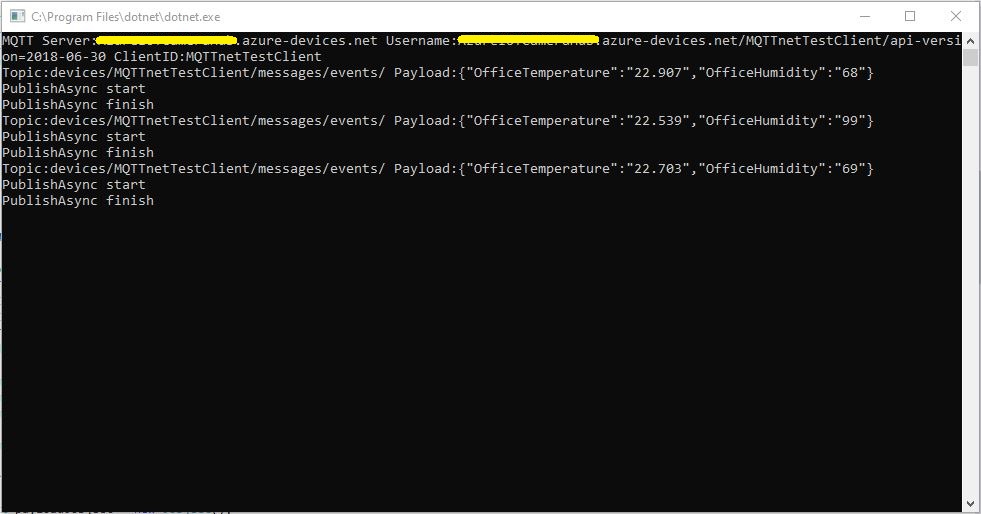
Azure IoT Hub MQTT Console Client

I had tried with a couple of different MQTT libraries from micro controllers and embedded devices without success. With the benefit of hindsight (plus this article) I think I had the SAS key format wrong.

The Azure IoT Hub MQTT broker requires only a server name (fully resolved CName), device ID and SAS Key.

   class Program
   {
      private static IMqttClient mqttClient = null;
      private static IMqttClientOptions mqttOptions = null;
      private static string server;
      private static string username;
      private static string password;
      private static string clientId;
      private static string topicD2C;
      private static string topicC2D;

      static void Main(string[] args)
      {
         MqttFactory factory = new MqttFactory();
         mqttClient = factory.CreateMqttClient();

         if (args.Length != 3)
         {
            Console.WriteLine("[AzureIoTHubHostName] [deviceID] [SASKey]");
            Console.WriteLine("Press <enter> to exit");
            Console.ReadLine();
            return;
         }

         server = args[0];
         clientId = args[1];
         sasKey= args[2];

         username = $"{server}/{clientId}/api-version=2018-06-30";
         topicD2C = $"devices/{clientId}/messages/events/";
         topicC2D = $"devices/{clientId}/messages/devicebound/#";

         Console.WriteLine($"MQTT Server:{server} Username:{username} ClientID:{clientId}");

         mqttOptions = new MqttClientOptionsBuilder()
            .WithTcpServer(server, 8883)
            .WithCredentials(username, sasKey)
            .WithClientId(clientId)
            .WithTls()
            .Build();

         mqttClient.UseDisconnectedHandler(new MqttClientDisconnectedHandlerDelegate(e => MqttClient_Disconnected(e)));
         mqttClient.UseApplicationMessageReceivedHandler(new MqttApplicationMessageReceivedHandlerDelegate(e => MqttClient_ApplicationMessageReceived(e)));
         mqttClient.ConnectAsync(mqttOptions).Wait();

         mqttClient.SubscribeAsync(topicC2D, MQTTnet.Protocol.MqttQualityOfServiceLevel.AtLeastOnce).GetAwaiter().GetResult();

         while (true)
         {
            JObject payloadJObject = new JObject();

            payloadJObject.Add("OfficeTemperature", "22." + DateTime.UtcNow.Millisecond.ToString());
            payloadJObject.Add("OfficeHumidity", (DateTime.UtcNow.Second + 40).ToString());

            string payload = JsonConvert.SerializeObject(payloadJObject);
            Console.WriteLine($"Topic:{topicD2C} Payload:{payload}");

            var message = new MqttApplicationMessageBuilder()
               .WithTopic(topicD2C)
               .WithPayload(payload)
               .WithAtLeastOnceQoS()
            .Build();

            Console.WriteLine("PublishAsync start");
            mqttClient.PublishAsync(message).Wait();
            Console.WriteLine("PublishAsync finish");

            Thread.Sleep(30100);
         }
      }

      private static void MqttClient_ApplicationMessageReceived(MqttApplicationMessageReceivedEventArgs e)
      {
         Console.WriteLine($"ClientId:{e.ClientId} Topic:{e.ApplicationMessage.Topic} Payload:{e.ApplicationMessage.ConvertPayloadToString()}");
      }

      private static async void MqttClient_Disconnected(MqttClientDisconnectedEventArgs e)
      {
         Debug.WriteLine("Disconnected");
         await Task.Delay(TimeSpan.FromSeconds(5));

         try
         {
            await mqttClient.ConnectAsync(mqttOptions);
         }
         catch (Exception ex)
         {
            Debug.WriteLine("Reconnect failed {0}", ex.Message);
         }
      }
   }

Overall the initial configuration went smoothly after I figured out the required Quality of Service (QoS) settings, and the SAS Key format.

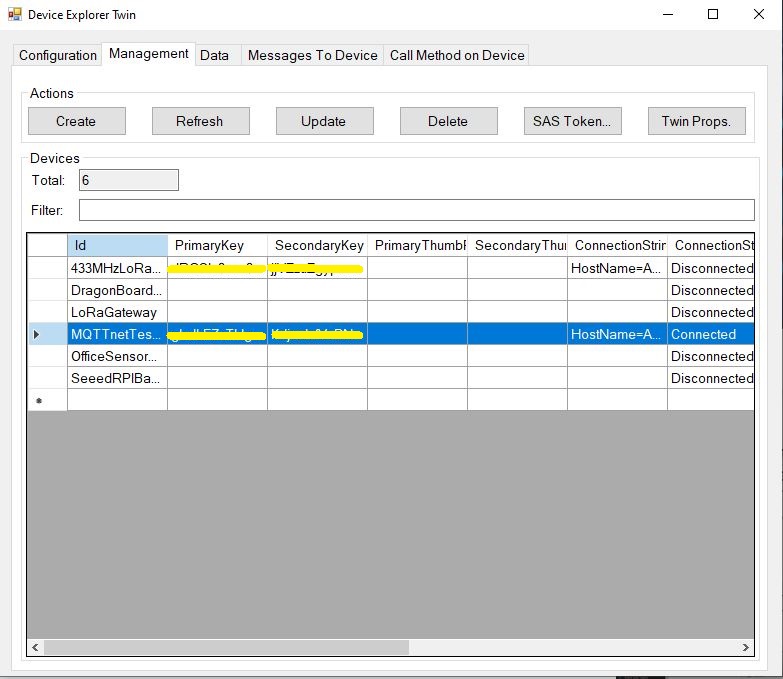
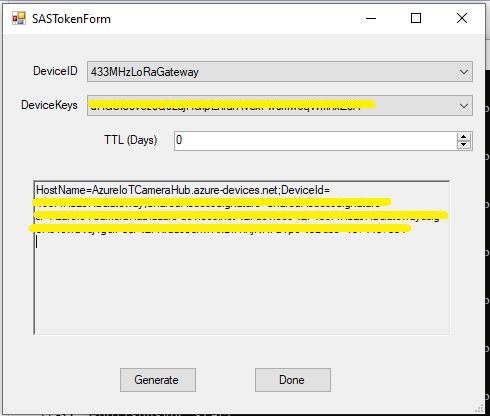
Using the approach described in the Microsoft documentation I manually generated the SAS Key.(In my Netduino samples I have code for generating a SAS Key in my HTTPS Azure IoT Hub Client)

Azure Device Explorer Device Management
Azure Device Explorer SAS Key Generator

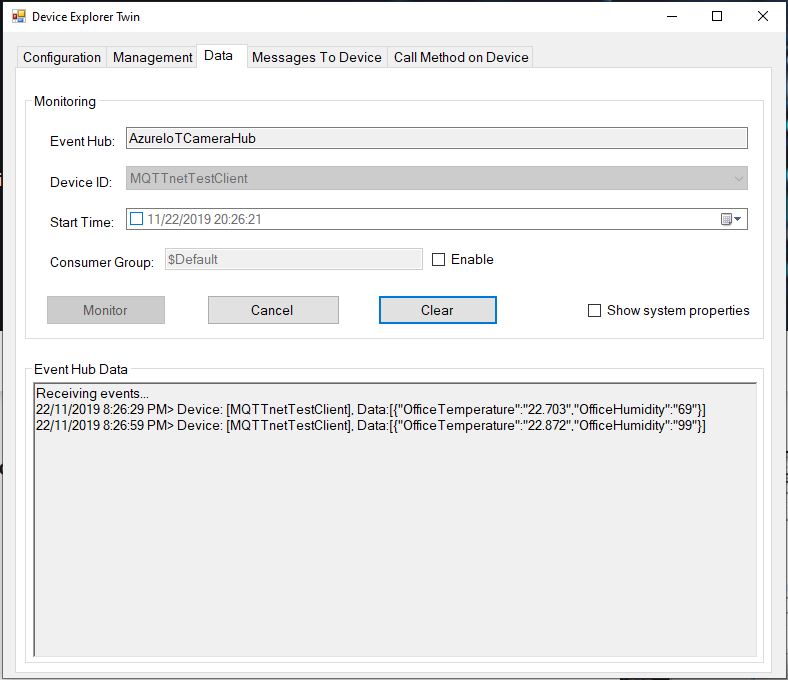
Once I had the configuration correct I could see telemetry from the device and send it messages.

Azure Device Explorer Data View

In a future post I will upload data to the Azure IoT Central for display. Then explore using a “module” attached to a device which maybe useful for my field gateway.