Random wanderings through Microsoft Azure esp. PaaS plumbing, the IoT bits, AI on Micro controllers, AI on Edge Devices, .NET nanoFramework, .NET Core on *nix and ML.NET+ONNX
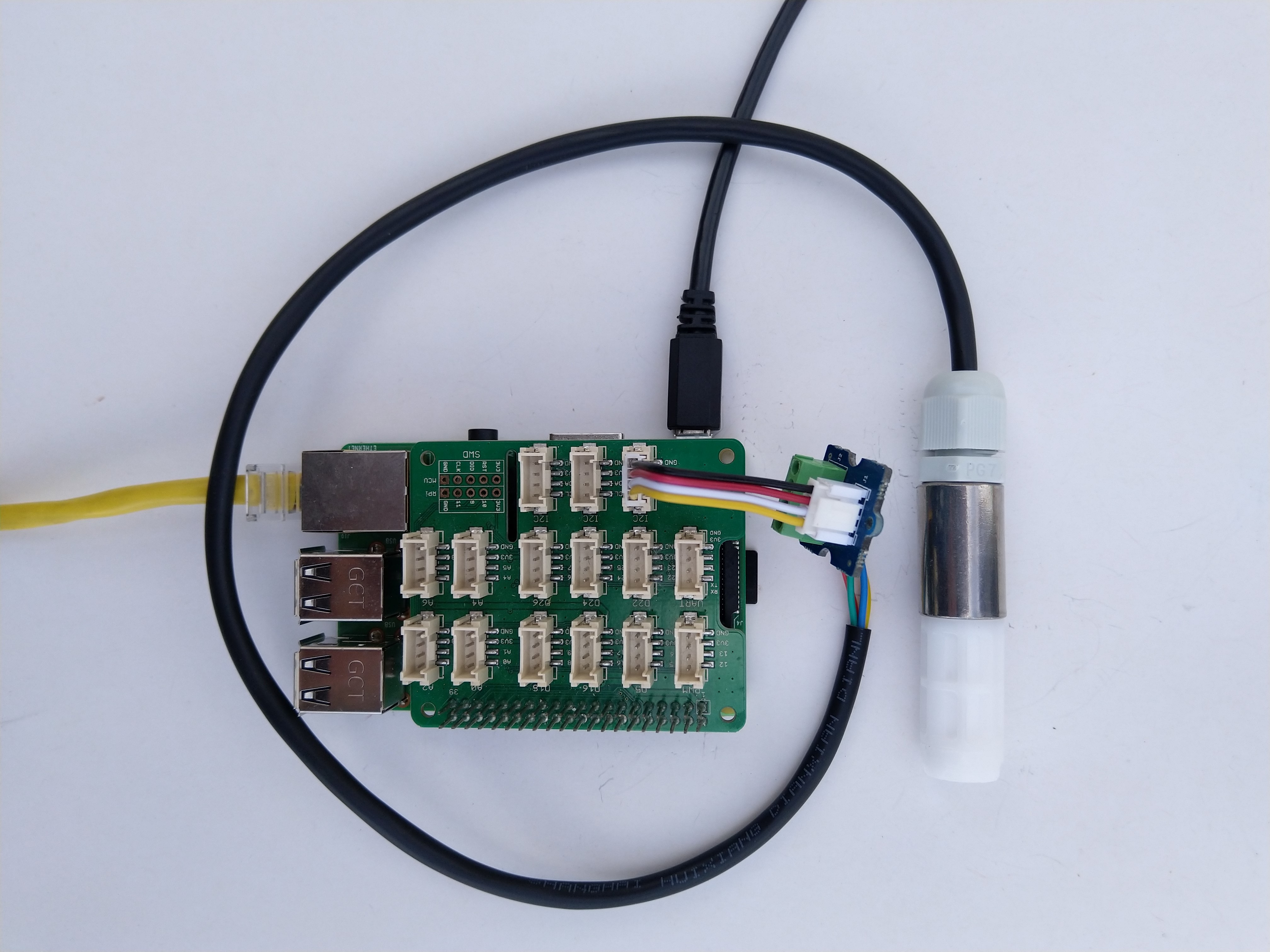
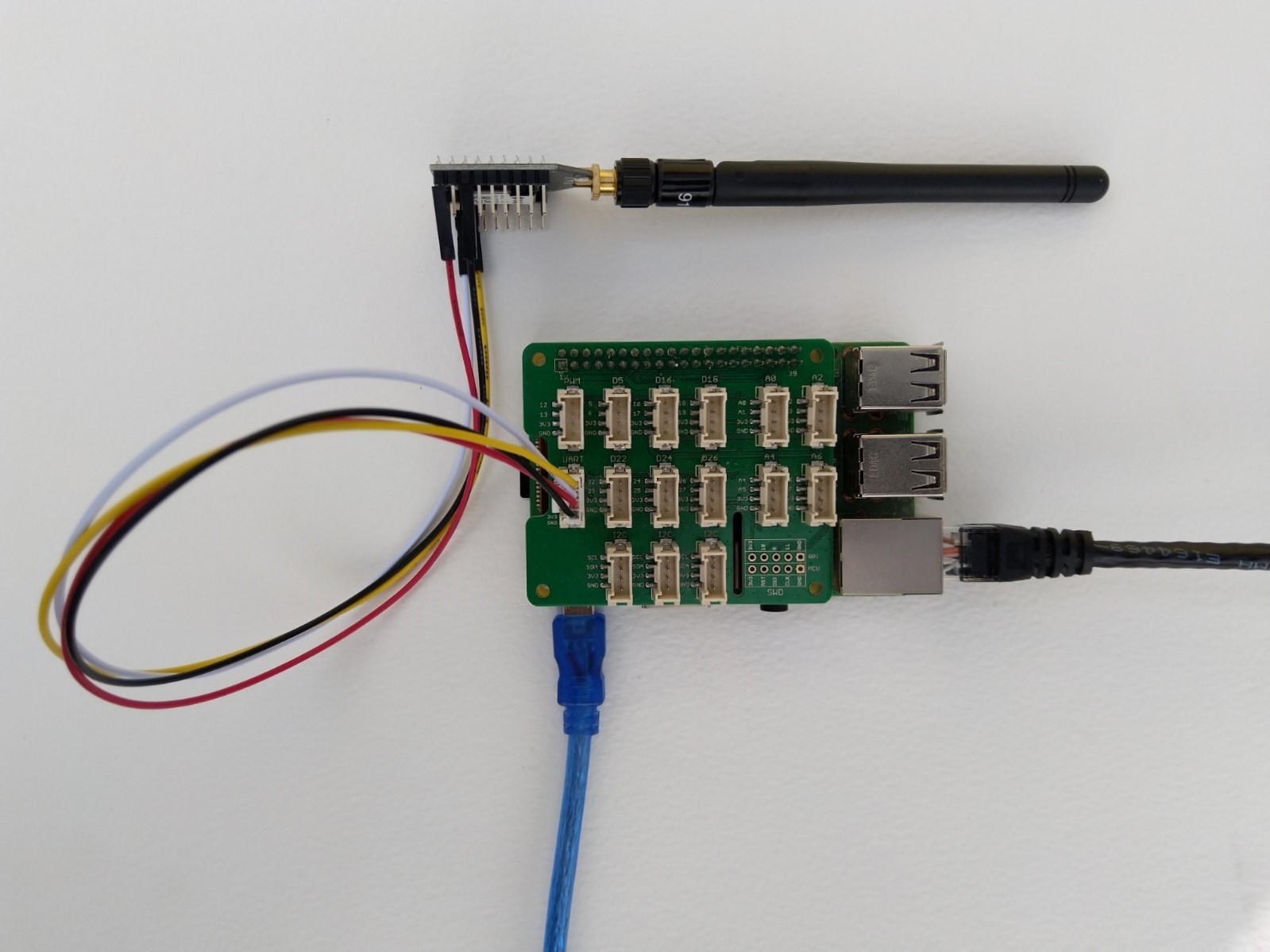
IoT LoRa Node pHAT for Raspberry Pi mounted on a Raspberry PI3
My Over the Air Activation (OTAA) implementation is very “nasty” I have assumed that there would be no timeouts or failures and I only send one BCD message “48656c6c6f204c6f526157414e” which is “hello LoRaWAN”.
The code just sequentially steps through the necessary configuration to join the TTN network with a suitable delay after each command is sent. I had some problems with re-opening the serial port if my application had previously failed with an uncaught exception. After some experimentation I added some code to ensure the port was closed when an exception occurred.
//---------------------------------------------------------------------------------
// Copyright (c) September 2021, devMobile Software
//
// Licensed under the Apache License, Version 2.0 (the "License");
// you may not use this file except in compliance with the License.
// You may obtain a copy of the License at
//
// http://www.apache.org/licenses/LICENSE-2.0
//
// Unless required by applicable law or agreed to in writing, software
// distributed under the License is distributed on an "AS IS" BASIS,
// WITHOUT WARRANTIES OR CONDITIONS OF ANY KIND, either express or implied.
// See the License for the specific language governing permissions and
// limitations under the License.
//
//---------------------------------------------------------------------------------
namespace devMobile.IoT.NetCore.Rak811.NetworkJoinOTAA
{
using System;
using System.Diagnostics;
using System.IO.Ports;
using System.Threading;
public class Program
{
private const string SerialPortId = "/dev/ttyS0";
private const string AppEui = "...";
private const string AppKey = "...";
private const byte MessagePort = 1;
private const string Payload = "A0EEE456D02AFF4AB8BAFD58101D2A2A"; // Hello LoRaWAN
public static void Main()
{
string response;
Debug.WriteLine("devMobile.IoT.NetCore.Rak811.NetworkJoinOTAA starting");
Debug.WriteLine(String.Join(",", SerialPort.GetPortNames()));
try
{
using (SerialPort serialPort = new SerialPort(SerialPortId))
{
// set parameters
serialPort.BaudRate = 9600;
serialPort.DataBits = 8;
serialPort.Parity = Parity.None;
serialPort.StopBits = StopBits.One;
serialPort.Handshake = Handshake.None;
serialPort.ReadTimeout = 5000;
serialPort.NewLine = "\r\n";
serialPort.Open();
// clear out the RX buffer
response = serialPort.ReadExisting();
Debug.WriteLine($"RX :{response.Trim()} bytes:{response.Length}");
Thread.Sleep(500);
// Set the Working mode to LoRaWAN
Console.WriteLine("Set Work mode");
serialPort.WriteLine("at+set_config=lora:work_mode:0");
Thread.Sleep(5000);
response = serialPort.ReadExisting();
response = response.Trim('\0');
Debug.WriteLine($"RX :{response.Trim()} bytes:{response.Length}");
// Set the Region to AS923
Console.WriteLine("Set Region");
serialPort.WriteLine("at+set_config=lora:region:AS923");
response = serialPort.ReadLine();
Debug.WriteLine($"RX :{response.Trim()} bytes:{response.Length}");
// Set the JoinMode
Console.WriteLine("Set Join mode");
serialPort.WriteLine("at+set_config=lora:join_mode:0");
response = serialPort.ReadLine();
Debug.WriteLine($"RX :{response.Trim()} bytes:{response.Length}");
// Set the appEUI
Console.WriteLine("Set App Eui");
serialPort.WriteLine($"at+set_config=lora:app_eui:{AppEui}");
response = serialPort.ReadLine();
Debug.WriteLine($"RX :{response.Trim()} bytes:{response.Length}");
// Set the appKey
Console.WriteLine("Set App Key");
serialPort.WriteLine($"at+set_config=lora:app_key:{AppKey}");
response = serialPort.ReadLine();
Debug.WriteLine($"RX :{response.Trim()} bytes:{response.Length}");
// Set the Confirm flag
Console.WriteLine("Set Confirm off");
serialPort.WriteLine("at+set_config=lora:confirm:0");
response = serialPort.ReadLine();
Debug.WriteLine($"RX :{response.Trim()} bytes:{response.Length}");
// Join the network
Console.WriteLine("Start Join");
serialPort.WriteLine("at+join");
Thread.Sleep(10000);
response = serialPort.ReadLine();
Debug.WriteLine($"RX :{response.Trim()} bytes:{response.Length}");
while (true)
{
Console.WriteLine("Sending");
serialPort.WriteLine($"at+send=lora:{MessagePort}:{Payload}");
Thread.Sleep(1000);
// The OK
Console.WriteLine("Send result");
response = serialPort.ReadLine();
Debug.WriteLine($"RX :{response.Trim()} bytes:{response.Length}");
// The Signal strength information etc.
Console.WriteLine("Network confirmation");
response = serialPort.ReadLine();
Debug.WriteLine($"RX :{response.Trim()} bytes:{response.Length}");
Thread.Sleep(20000);
}
}
}
catch (Exception ex)
{
Debug.WriteLine(ex.Message);
}
}
}
}
The code is not suitable for production but it confirmed my software and hardware configuration worked.
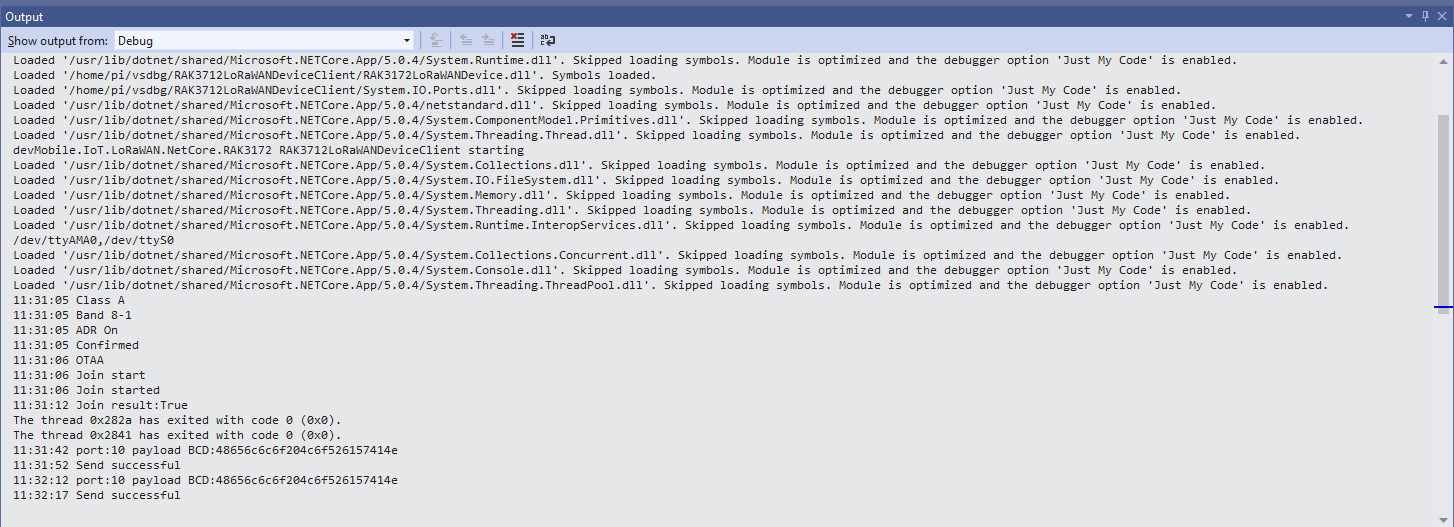
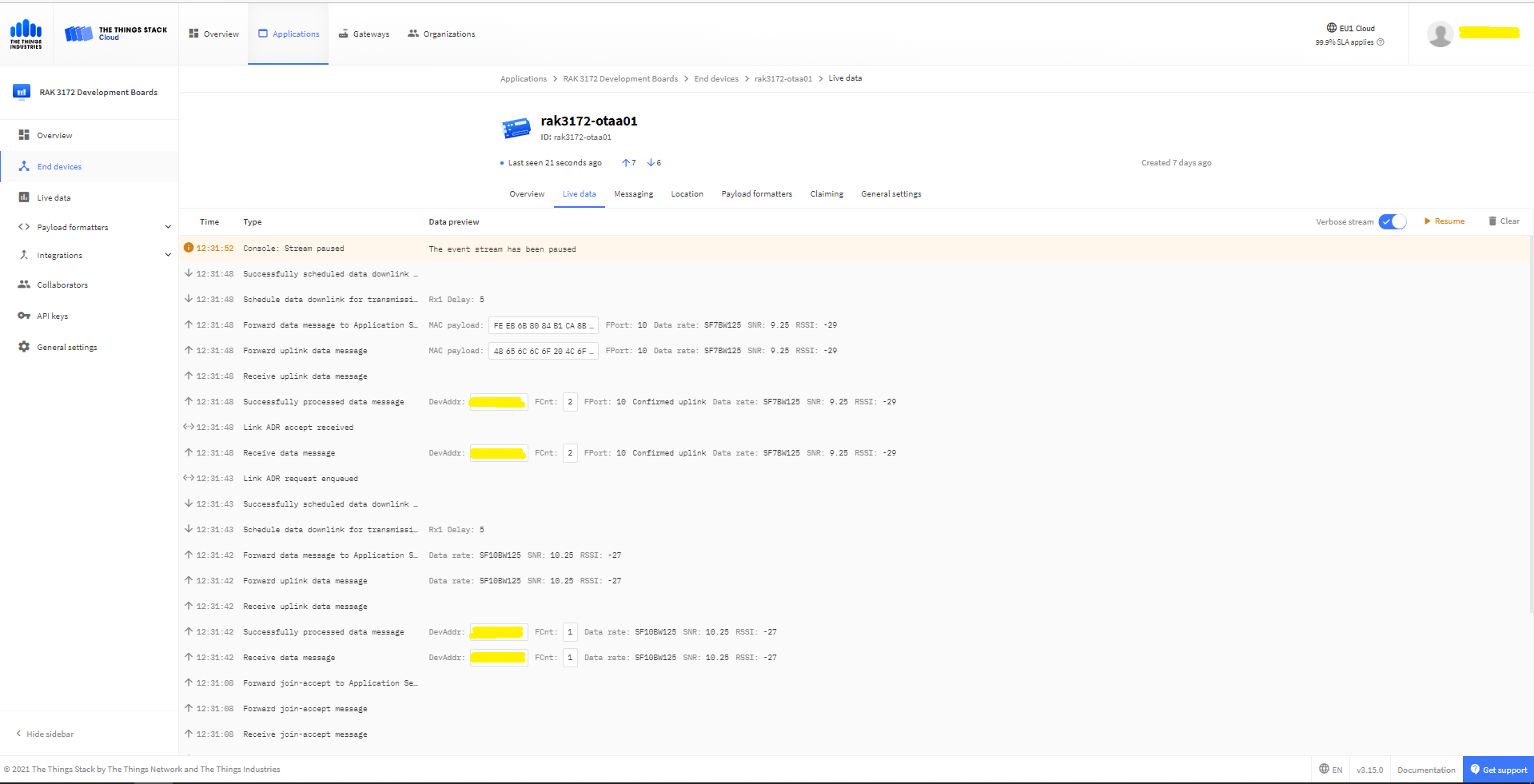
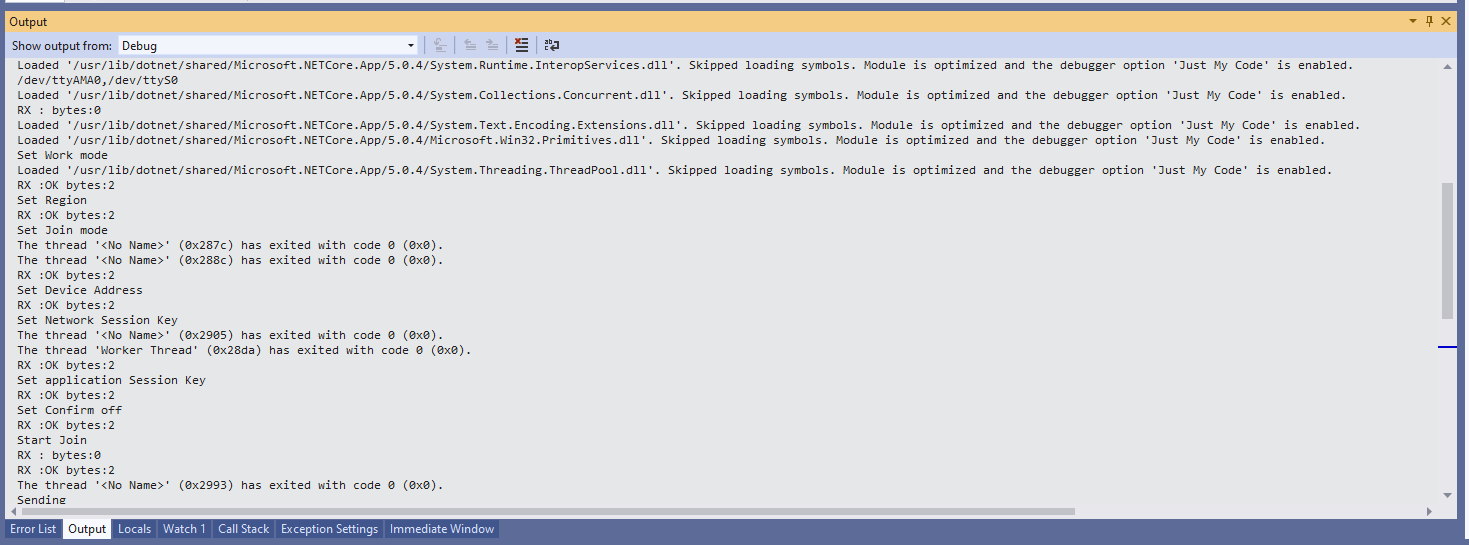
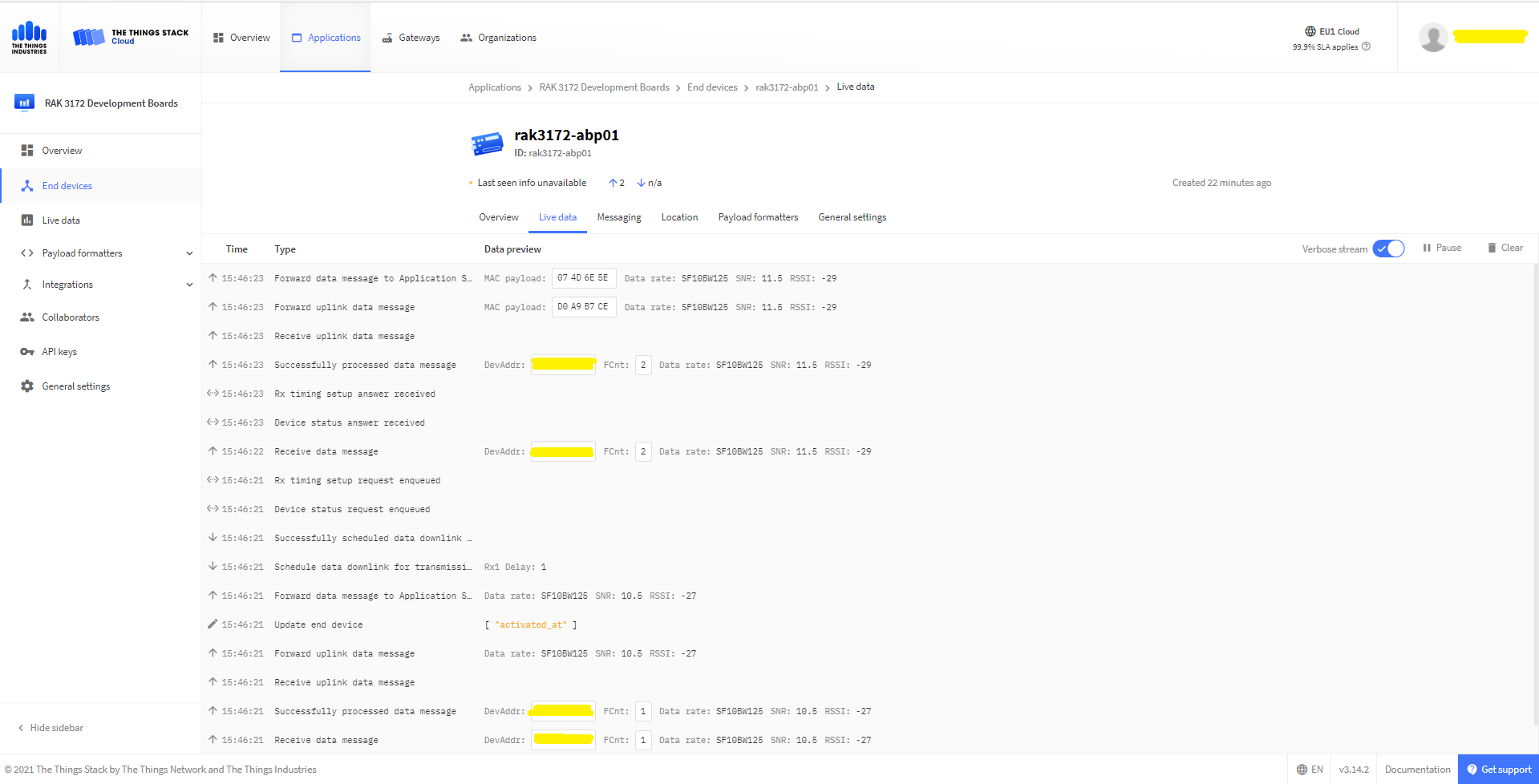
In the Visual Studio 2019 debug output I could see messages getting sent and then after a short delay they were visible in the TTN console.
The Things Industries Live Data Tab showing my device connecting and sending messages
RaspberyPI OS Software Configuration tool mains screen
RaspberryPI OS IO Serial Port configuration
Raspberry PI OS disabling remote serial login shell
RaspberryPI OS enabling serial port access
Once serial port access was enabled I could enumerate them with SerialPort.GetPortNames() which is in the System.IO.PortsNuGet package. The code has compile time options for synchronous and asynchronous operation.
//---------------------------------------------------------------------------------
// Copyright (c) September 2021, devMobile Software
//
// Licensed under the Apache License, Version 2.0 (the "License");
// you may not use this file except in compliance with the License.
// You may obtain a copy of the License at
//
// http://www.apache.org/licenses/LICENSE-2.0
//
// Unless required by applicable law or agreed to in writing, software
// distributed under the License is distributed on an "AS IS" BASIS,
// WITHOUT WARRANTIES OR CONDITIONS OF ANY KIND, either express or implied.
// See the License for the specific language governing permissions and
// limitations under the License.
//
//---------------------------------------------------------------------------------
namespace devMobile.IoT.NetCore.Rak811.pHatSerial
{
using System;
using System.Diagnostics;
using System.IO.Ports;
using System.Threading;
public class Program
{
private const string SerialPortId = "/dev/ttyS0";
public static void Main()
{
SerialPort serialPort;
Debug.WriteLine("devMobile.IoT.NetCore.Rak811.pHatSerial starting");
Debug.WriteLine(String.Join(",", SerialPort.GetPortNames()));
try
{
serialPort = new SerialPort(SerialPortId);
// set parameters
#if DEFAULT_BAUDRATE
serialDevice.BaudRate = 115200;
#else
serialPort.BaudRate = 9600;
#endif
serialPort.Parity = Parity.None;
serialPort.DataBits = 8;
serialPort.StopBits = StopBits.One;
serialPort.Handshake = Handshake.None;
serialPort.ReadTimeout = 1000;
serialPort.NewLine = "\r\n";
serialPort.Open();
#if DEFAULT_BAUDRATE
Debug.WriteLine("RAK811 baud rate set to 9600");
serialDevice.Write("at+set_config=device:uart:1:9600");
#endif
#if SERIAL_ASYNC_READ
serialPort.DataReceived += SerialDevice_DataReceived;
#endif
while (true)
{
serialPort.WriteLine("at+version");
#if SERIAL_SYNC_READ
string response = serialPort.ReadLine();
Debug.WriteLine($"RX:{response.Trim()} bytes:{response.Length}");
#endif
Thread.Sleep(20000);
}
}
catch (Exception ex)
{
Debug.WriteLine(ex.Message);
}
}
#if SERIAL_ASYNC_READ
private static void SerialDevice_DataReceived(object sender, SerialDataReceivedEventArgs e)
{
SerialPort serialPort = (SerialPort)sender;
switch (e.EventType)
{
case SerialData.Chars:
string response = serialPort.ReadExisting();
Debug.WriteLine($"RX:{response.Trim()} bytes:{response.Length}");
break;
case SerialData.Eof:
Debug.WriteLine("RX :EoF");
break;
default:
Debug.Assert(false, $"e.EventType {e.EventType} unknown");
break;
}
}
#endif
}
}
The first step was to change the RAK811 serial port speed from 115200 to 9600 baud.
Changing RAK811 serial port from 115200 to 9600 baud
Then I requested the RAK811 version information with the at+version command.
Synchronously reading characters from the RAK811 partial response
I had to add a short delay between sending the command and reading the response.
Synchronously reading characters from the RAK811 complete command responses
The asynchronous version of the application displays character(s) as they arrive so a response could be split across multiple SerialDataReceived events
Uniview IPC3635SB-ADZK-I0 Security camera test rig with Raspberry PI and PIR motion detector
I tried to keep the .Net Core 5 console applications as simple as possible, they download an image from the camera “snapshot” endpoint (In this case http://10.0.0.47:85/images/snapshot.jpg), save it to the local filesystem and then upload it.
The core of the two applications is the “upload” image method, which is called by a timer or GPIO pin EventHandler
private static async void ImageUpdateTimerCallback(object state)
{
CommandLineOptions options = (CommandLineOptions)state;
DateTime requestAtUtc = DateTime.UtcNow;
// Just incase - stop code being called while retrival of the photo already in progress
if (cameraBusy)
{
return;
}
cameraBusy = true;
Console.WriteLine($"{requestAtUtc:yy-MM-dd HH:mm:ss} Image up load start");
try
{
// First go and get the image file from the camera onto local file system
using (var client = new WebClient())
{
NetworkCredential networkCredential = new NetworkCredential()
{
UserName = options.UserName,
Password = options.Password
};
client.Credentials = networkCredential;
await client.DownloadFileTaskAsync(new Uri(options.CameraUrl), options.LocalFilename);
}
// Then open the file ready to stream ito upto storage account associated with Azuure IoT Hub
using (FileStream fileStreamSource = new FileStream(options.LocalFilename, FileMode.Open))
{
var fileUploadSasUriRequest = new FileUploadSasUriRequest
{
BlobName = string.Format("{0:yyMMdd}/{0:yyMMddHHmmss}.jpg", requestAtUtc)
};
// Get the plumbing sorted for where the file is going in Azure Storage
FileUploadSasUriResponse sasUri = await azureIoTCentralClient.GetFileUploadSasUriAsync(fileUploadSasUriRequest);
Uri uploadUri = sasUri.GetBlobUri();
try
{
var blockBlobClient = new BlockBlobClient(uploadUri);
var response = await blockBlobClient.UploadAsync(fileStreamSource, new BlobUploadOptions());
var successfulFileUploadCompletionNotification = new FileUploadCompletionNotification()
{
// Mandatory. Must be the same value as the correlation id returned in the sas uri response
CorrelationId = sasUri.CorrelationId,
// Mandatory. Will be present when service client receives this file upload notification
IsSuccess = true,
// Optional, user defined status code. Will be present when service client receives this file upload notification
StatusCode = 200,
// Optional, user-defined status description. Will be present when service client receives this file upload notification
StatusDescription = "Success"
};
await azureIoTCentralClient.CompleteFileUploadAsync(successfulFileUploadCompletionNotification);
}
catch (Exception ex)
{
Console.WriteLine($"Failed to upload file to Azure Storage using the Azure Storage SDK due to {ex}");
var failedFileUploadCompletionNotification = new FileUploadCompletionNotification
{
// Mandatory. Must be the same value as the correlation id returned in the sas uri response
CorrelationId = sasUri.CorrelationId,
// Mandatory. Will be present when service client receives this file upload notification
IsSuccess = false,
// Optional, user-defined status code. Will be present when service client receives this file upload notification
StatusCode = 500,
// Optional, user defined status description. Will be present when service client receives this file upload notification
StatusDescription = ex.Message
};
await azureIoTCentralClient.CompleteFileUploadAsync(failedFileUploadCompletionNotification);
}
}
TimeSpan uploadDuration = DateTime.UtcNow - requestAtUtc;
Console.WriteLine($"{requestAtUtc:yy-MM-dd HH:mm:ss} Image up load done. Duration:{uploadDuration.TotalMilliseconds:0.} mSec");
}
catch (Exception ex)
{
Console.WriteLine($"Camera image upload process failed {ex.Message}");
}
finally
{
cameraBusy = false;
}
}
The ONVIFspecification standardises the network interface (the network layer) of network video products. It defines a communication framework based on relevant IETF and Web Services standards including security and IP configuration requirements.
After discovering a device the next step was to query it to determine its capabilities. I had some issues with .Net Core 5 application configuring the Windows Communication Foundation(WCF) to use Digest authentication (RFC2617) credentials on all bar the device management service client.
This .Net Core 5 console application queries the device management service (ONVID application programmers guide) to get the capabilities of the device then calls the media, imaging and pan tilt zoom services and displays the results.
The Uniform Resource Locators(URL) and namespace prefixes for each generated service are configured in the ConnectedService.json file.
First step configuring a WCF Service
Initially I used a devMobile.IoT.SecurityCameraClient prefix but after some experimentation changed to OnvifServices.
Second step configuring a WCF Service
For testing I selected “Generated Synchronous Operations” as they are easier to use in a console application while exploring the available functionality.
Third step configuring a WCF Service
The WSDL generated a number of warnings so I inspected the WSDL to see if the were easy to fix. I did consider copying the WSDL to my development box but it didn’t appear to be worth the effort.
SVCUtil warning messages about invalid Onvif WSDL
For this application I’m using the CommandLineParser NuGet package to parse and validate the client, username and password configured in the debugger tab.
Required Nuget packages
private static async Task ApplicationCore(CommandLineOptions options)
{
Device deviceClient;
ImagingPortClient imagingPortClient;
MediaClient mediaClient;
PTZClient panTiltZoomClient;
var messageElement = new TextMessageEncodingBindingElement()
{
MessageVersion = MessageVersion.CreateVersion(EnvelopeVersion.Soap12, AddressingVersion.None),
WriteEncoding = Encoding.UTF8
};
HttpTransportBindingElement httpTransportNoPassword = new HttpTransportBindingElement();
CustomBinding bindingHttpNoPassword = new CustomBinding(messageElement, httpTransportNoPassword);
HttpTransportBindingElement httpTransport = new HttpTransportBindingElement()
{
AuthenticationScheme = AuthenticationSchemes.Digest
};
CustomBinding bindingHttpPassword = new CustomBinding(messageElement, httpTransport);
try
{
// Setup the imaging porting binding, use TLS, and ignore certificate errors
deviceClient = new DeviceClient(bindingHttpNoPassword, new EndpointAddress($"http://{options.CameraUrl}/onvif/devicemgmt"));
GetCapabilitiesResponse capabilitiesResponse = await deviceClient.GetCapabilitiesAsync(new GetCapabilitiesRequest(new CapabilityCategory[] { CapabilityCategory.All }));
Console.WriteLine("Device capabilities");
Console.WriteLine($" Device: {capabilitiesResponse.Capabilities.Device.XAddr}");
Console.WriteLine($" Events: {capabilitiesResponse.Capabilities.Events.XAddr}"); // Not interested in events for V1
Console.WriteLine($" Imaging: {capabilitiesResponse.Capabilities.Imaging.XAddr}");
Console.WriteLine($" Media: {capabilitiesResponse.Capabilities.Media.XAddr}");
Console.WriteLine($" Pan Tilt Zoom: {capabilitiesResponse.Capabilities.PTZ.XAddr}");
Console.WriteLine();
...
Console.WriteLine($"Video Source Configuration");
foreach (OnvifServices.Media.VideoSourceConfiguration videoSourceConfiguration in videoSourceConfigurations.Configurations)
{
Console.WriteLine($" Name: {videoSourceConfiguration.Name}");
Console.WriteLine($" Token: {videoSourceConfiguration.token}");
Console.WriteLine($" UseCount: {videoSourceConfiguration.UseCount}");
Console.WriteLine($" Bounds: {videoSourceConfiguration.Bounds.x}:{videoSourceConfiguration.Bounds.y} {videoSourceConfiguration.Bounds.width}:{videoSourceConfiguration.Bounds.height}");
Console.WriteLine($" View mode: {videoSourceConfiguration.ViewMode}");
}
}
catch (Exception ex)
{
Console.WriteLine(ex.Message);
}
Console.WriteLine();
Console.WriteLine("Press <enter> to exit");
Console.ReadLine();
}
I had to do a bit of “null checking” as often if a feature wasn’t supported the root node was null. I need to get a selection of cameras (especially one with pan/tilt/zoom) to check that I’m processing the responses from the device correctly.
Console application output showing capabilities of Uniview device
After confirming the program was working on my development box I used the excellent RaspberryDebugger to download the application and run it on a Raspberry PI 3 running the Raspberry PI OS.
The ONVIFspecification standardises the network interface (the network layer) of network video products. It defines a communication framework based on relevant IETF and Web Services standards including security and IP configuration requirements. ONVIF uses Web Services Dynamic Discovery (WS-Discovery) to locate devices on the local network which operates over UDP port 3702 and uses IP multicast address 239.255.255.250.
My .Net Core 5 console application enumerates the host device’s network interfaces, then sends a “probe” message and waits for responses. The ONVID application programmers guide specifies the format of the “probe” request and response messages (One of the namespace prefixes in the sample is wrong). The client device can return its name and details of it’s capabilities in the response. Currently I only need the IP addresses of the cameras but if more information was required I would use the XML Serialisation functionality of .Net Core to generate the requests and unpack the responses.
As part of a contract a customer sent me a UniviewIPC3635SB-ADZK-I0 Security camera for a proof of concept(PoC) project. Before the PoC I wanted to explore the camera functionality in more depth, especially how to retrieve individual images from the camera, remotely control it’s zoom, focus, pan, tilt etc.. I’m trying to source a couple of other vendors’ security cameras with remotely controllable pan and tilt for testing.
Uniview IPC3635SB-ADZK-I0 Security camera
It appears that many cameras support retrieving the latest image with an HyperText Transfer Protocol (HTTP) GET so that looked like a good place to start. For the next couple of posts the camera will be sitting on the bookcase in my office looking through the window at the backyard.
My .Net Core 5 console application is as simple possible, it just downloads an image from the camera “snapshot” endpoint (In this case http://10.0.0.47:85/images/snapshot.jpg) and saves it to the local filesystem.
Visual Studio 2019 Debug Output showing application download process
Once the application had finished running on the device I wanted to check that the file was on the local filesystem. I used Putty to connect to the Raspberry PI then searched for LatestImage.jpg.
Linux find utility displaying the location of the downloaded file
This post was about selecting the tooling I’m comfortable with and configuring my development environment so they work well together. The next step will be using Open Network Video Interface Forum (ONVIF) to discover, determine the capabilities of and then control the camera (for this device just zoom and focus).
The arduino-LoRa library LoRaDuplex sample is the basis for the last in this series of posts. The LoRaDuplex sample implements a basic protocol for addressed messages. The message payload starts with the destination address(byte), source address(byte), message counter(byte), payload length(byte), and then the payload(array of bytes).
LoRaDuplex
The sample code has configuration settings for the local address and destination (address).
#include <SPI.h> // include libraries
#include <LoRa.h>
const int csPin = 10; // LoRa radio chip select
const int resetPin = 9; // LoRa radio reset
const int irqPin = 2; // change for your board; must be a hardware interrupt pin
String outgoing; // outgoing message
byte msgCount = 0; // count of outgoing messages
byte localAddress = 0xAA; // address of this device
byte destination = 0x0; // destination to send to
long lastSendTime = 0; // last send time
int interval = 2000; // interval between sends
void setup() {
Serial.begin(9600); // initialize serial
while (!Serial);
Serial.println("LoRa Duplex");
// override the default CS, reset, and IRQ pins (optional)
LoRa.setPins(csPin, resetPin, irqPin);// set CS, reset, IRQ pin
if (!LoRa.begin(915E6)) { // initialize ratio at 915 MHz
Serial.println("LoRa init failed. Check your connections.");
while (true); // if failed, do nothing
}
LoRa.enableCrc();
Serial.println("LoRa init succeeded.");
}
void loop() {
if (millis() - lastSendTime > interval) {
String message = "HeLoRa World!"; // send a message
sendMessage(message);
Serial.println("Sending " + message);
lastSendTime = millis(); // timestamp the message
interval = random(2000) + 29000; // 2-3 seconds
}
// parse for a packet, and call onReceive with the result:
onReceive(LoRa.parsePacket());
}
void sendMessage(String outgoing) {
LoRa.beginPacket(); // start packet
LoRa.write(destination); // add destination address
LoRa.write(localAddress); // add sender address
LoRa.write(msgCount); // add message ID
LoRa.write(outgoing.length()); // add payload length
LoRa.print(outgoing); // add payload
LoRa.endPacket(); // finish packet and send it
msgCount++; // increment message ID
}
void onReceive(int packetSize) {
if (packetSize == 0) return; // if there's no packet, return
// read packet header bytes:
int recipient = LoRa.read(); // recipient address
byte sender = LoRa.read(); // sender address
byte incomingMsgId = LoRa.read(); // incoming msg ID
byte incomingLength = LoRa.read(); // incoming msg length
String incoming = "";
while (LoRa.available()) {
incoming += (char)LoRa.read();
}
if (incomingLength != incoming.length()) { // check length for error
Serial.println("error: message length does not match length");
return; // skip rest of function
}
// if the recipient isn't this device or broadcast,
if (recipient != localAddress && recipient != 0xFF) {
Serial.println("This message is not for me.");
return; // skip rest of function
}
// if message is for this device, or broadcast, print details:
Serial.println("Received from: 0x" + String(sender, HEX));
Serial.println("Sent to: 0x" + String(recipient, HEX));
Serial.println("Message ID: " + String(incomingMsgId));
Serial.println("Message length: " + String(incomingLength));
Serial.println("Message: " + incoming);
Serial.println("RSSI: " + String(LoRa.packetRssi()));
Serial.println("Snr: " + String(LoRa.packetSnr()));
Serial.println();
}
Arduino Monitor displaying information about the messages sent and received by the Duplex sample
static void Main(string[] args)
{
int messageCount = 1;
sX127XDevice.Initialise(
SX127XDevice.RegOpModeMode.ReceiveContinuous,
915000000.0,
powerAmplifier: SX127XDevice.PowerAmplifier.PABoost,
#if LORA_SENDER // From the Arduino point of view
rxDoneignoreIfCrcMissing: false
#endif
#if LORA_RECEIVER // From the Arduino point of view, don't actually need this as already inverted
invertIQTX: true
#endif
#if LORA_SET_SYNCWORD
syncWord: 0xF3,
invertIQTX: true,
rxDoneignoreIfCrcMissing: false
#endif
#if LORA_SET_SPREAD
spreadingFactor: SX127XDevice.RegModemConfig2SpreadingFactor._256ChipsPerSymbol,
invertIQTX: true,
rxDoneignoreIfCrcMissing: false
#endif
#if LORA_SIMPLE_NODE // From the Arduino point of view
invertIQTX: false,
rxDoneignoreIfCrcMissing: false
#endif
#if LORA_SIMPLE_GATEWAY // From the Arduino point of view
invertIQRX: true,
rxDoneignoreIfCrcMissing: false
#endif
#if LORA_DUPLEX
rxPayloadCrcOn: true
#endif
);
#if DEBUG
sX127XDevice.RegisterDump();
#endif
#if !LORA_RECEIVER
sX127XDevice.OnReceive += SX127XDevice_OnReceive;
sX127XDevice.Receive();
#endif
#if !LORA_SENDER
sX127XDevice.OnTransmit += SX127XDevice_OnTransmit;
#endif
#if LORA_SENDER
Thread.Sleep(-1);
#else
Thread.Sleep(5000);
#endif
while (true)
{
string messageText = "Hello LoRa from .NET Core! " + messageCount.ToString();
#if LORA_DUPLEX
byte[] messageBytes = new byte[messageText.Length+4];
messageBytes[0] = 0xaa;
messageBytes[1] = 0x00;
messageBytes[2] = (byte)messageCount;
messageBytes[3] = (byte)messageText.Length;
Array.Copy(UTF8Encoding.UTF8.GetBytes(messageText), 0, messageBytes, 4, messageBytes[3]);
Console.WriteLine($"{DateTime.Now:HH:mm:ss}-TX to 0x{messageBytes[0]:X2} from 0x{messageBytes[1]:X2} count {messageBytes[2]} length {messageBytes[3]} \"{messageText}\"");
#else
byte[] messageBytes = UTF8Encoding.UTF8.GetBytes(messageText);
Console.WriteLine($"{DateTime.Now:HH:mm:ss}- Length {messageBytes.Length} \"{messageText}\"");
#endif
messageCount += 1;
sX127XDevice.Send(messageBytes);
Thread.Sleep(10000);
}
}
private static void SX127XDevice_OnReceive(object sender, SX127XDevice.OnDataReceivedEventArgs e)
{
string messageText;
#if LORA_DUPLEX
if ((e.Data[0] != 0x00) && (e.Data[0] != 0xFF))
{
#if DEBUG
Console.WriteLine($"{DateTime.UtcNow:hh:mm:ss}-RX to 0x{e.Data[0]:X2} from 0x{e.Data[1]:X2} invalid address");
#endif
return;
}
// check payload not to long/short
if ((e.Data[3] + 4) != e.Data.Length)
{
Console.WriteLine($"{DateTime.UtcNow:hh:mm:ss}-RX Invalid payload");
return;
}
try
{
messageText = UTF8Encoding.UTF8.GetString(e.Data, 4, e.Data[3]);
Console.WriteLine($"{DateTime.Now:HH:mm:ss}-RX to 0x{e.Data[0]:X2} from 0x{e.Data[1]:X2} count {e.Data[2]} length {e.Data[3]} \"{messageText}\" snr {e.PacketSnr:0.0} packet rssi {e.PacketRssi}dBm rssi {e.Rssi}dBm ");
}
catch (Exception ex)
{
Console.WriteLine(ex.Message);
}
#else
try
{
messageText = UTF8Encoding.UTF8.GetString(e.Data);
Console.WriteLine($"{DateTime.Now:HH:mm:ss}-RX length {e.Data.Length} \"{messageText}\" snr {e.PacketSnr:0.0} packet rssi {e.PacketRssi}dBm rssi {e.Rssi}dBm ");
}
catch (Exception ex)
{
Console.WriteLine(ex.Message);
}
#endif
}
The inbound messages have to have a valid Cyclic Redundancy Check(CRC) and I ignore messages with an invalid payload length. The message protocol is insecure (but fine for demos) as the messages are sent as “plain text”, and the message headers/payload can be tampered with.
Summary
While testing the LoRaDuplex sample I found a problem with how my code managed the invertIQRX & invertIQTX flags in RegInvertIQ. I noticed the even though I was setting the InvertIQRX(bit6) and invertIQTX(bit0) flags correctly messages weren’t getting delivered.
Semtech SX127X data sheet RegInvertQ and RegInvertQ2 documetnation
After looking at my code I realised I wasn’t configuring the RegInvertIQ properly because bits 1-5 were getting set to 0x0 (initially I had byte regInvertIQValue = 0) rather than 0x13(regInvertIQValue = RegInvertIdDefault)
int messageCount = 1;
sX127XDevice.Initialise(
SX127XDevice.RegOpModeMode.ReceiveContinuous,
915000000.0,
powerAmplifier: SX127XDevice.PowerAmplifier.PABoost,
// outputPower: 5, outputPower: 20, outputPower:23,
//powerAmplifier: SX127XDevice.PowerAmplifier.Rfo,
//outputPower:-1, outputPower: 14,
#if LORA_SENDER // From the Arduino point of view
rxDoneignoreIfCrcMissing: false
#endif
#if LORA_RECEIVER // From the Arduino point of view, don't actually need this as already inverted
invertIQTX: true
#endif
#if LORA_SET_SYNCWORD
syncWord: 0xF3,
invertIQTX: true,
rxDoneignoreIfCrcMissing: false
#endif
#if LORA_SET_SPREAD
spreadingFactor: SX127XDevice.RegModemConfig2SpreadingFactor._256ChipsPerSymbol,
invertIQTX: true,
rxDoneignoreIfCrcMissing: false
#endif
#if LORA_SIMPLE_NODE // From the Arduino point of view
invertIQTX: false,
rxDoneignoreIfCrcMissing: false
#endif
#if LORA_SIMPLE_GATEWAY // From the Arduino point of view
invertIQRX: true,
rxDoneignoreIfCrcMissing: false
#endif
);
#if DEBUG
sX127XDevice.RegisterDump();
#endif
#if !LORA_RECEIVER
sX127XDevice.OnReceive += SX127XDevice_OnReceive;
sX127XDevice.Receive();
#endif
#if !LORA_SENDER
sX127XDevice.OnTransmit += SX127XDevice_OnTransmit;
#endif
#if LORA_SENDER
Thread.Sleep(-1);
#else
Thread.Sleep(5000);
#endif
while (true)
{
string messageText = "Hello LoRa from .NET Core! " + messageCount.ToString();
byte[] messageBytes = UTF8Encoding.UTF8.GetBytes(messageText);
Console.WriteLine($"{DateTime.Now:HH:mm:ss}- Length {messageBytes.Length} \"{messageText}\"");
messageCount += 1;
sX127XDevice.Send(messageBytes);
Thread.Sleep(10000);
}
}
Summary
While testing the LoRaReceiver sample I found a problem with how my code managed the transmit power by accidentally commenting out the “paBoost: true” parameter of the initialise method. When I did this the Seeeduino V4.2 and Dragino Shield stopped receiving messages.
I had assumed a user could configure the the output power using the initialise method but that was difficult/possible. After some digging I found that I needed to use RegPAConfigPADac and PABoost (I need to find a device which uses RFO for testing). So I removed several of the configuration parameters from the Intialise method and replaced them with one called outputPower. I then re-read the SX127X data sheet and had a look at some other libraries.
void RH_RF95::setTxPower(int8_t power, bool useRFO)
{
// Sigh, different behaviours depending on whther the module use PA_BOOST or the RFO pin
// for the transmitter output
if (useRFO)
{
if (power > 14)
power = 14;
if (power < -1)
power = -1;
spiWrite(RH_RF95_REG_09_PA_CONFIG, RH_RF95_MAX_POWER | (power + 1));
}
else
{
if (power > 23)
power = 23;
if (power < 5)
power = 5;
// For RH_RF95_PA_DAC_ENABLE, manual says '+20dBm on PA_BOOST when OutputPower=0xf'
// RH_RF95_PA_DAC_ENABLE actually adds about 3dBm to all power levels. We will us it
// for 21, 22 and 23dBm
if (power > 20)
{
spiWrite(RH_RF95_REG_4D_PA_DAC, RH_RF95_PA_DAC_ENABLE);
power -= 3;
}
else
{
spiWrite(RH_RF95_REG_4D_PA_DAC, RH_RF95_PA_DAC_DISABLE);
}
// RFM95/96/97/98 does not have RFO pins connected to anything. Only PA_BOOST
// pin is connected, so must use PA_BOOST
// Pout = 2 + OutputPower.
// The documentation is pretty confusing on this topic: PaSelect says the max power is 20dBm,
// but OutputPower claims it would be 17dBm.
// My measurements show 20dBm is correct
spiWrite(RH_RF95_REG_09_PA_CONFIG, RH_RF95_PA_SELECT | (power-5));
}
}
The LoRa Shield Arduino library has two methods setPower(char p) and setPowerNum(uint8_t pow)
/*
Function: Sets the signal power indicated as input to the module.
Returns: Integer that determines if there has been any error
state = 2 --> The command has not been executed
state = 1 --> There has been an error while executing the command
state = 0 --> The command has been executed with no errors
state = -1 --> Forbidden command for this protocol
Parameters:
pow: power option to set in configuration. The input value range is from
0 to 14 dBm.
*/
int8_t SX1278::setPowerNum(uint8_t pow)
{
byte st0;
int8_t state = 2;
byte value = 0x00;
#if (SX1278_debug_mode > 1)
Serial.println();
Serial.println(F("Starting 'setPower'"));
#endif
st0 = readRegister(REG_OP_MODE); // Save the previous status
if( _modem == LORA )
{ // LoRa Stdby mode to write in registers
writeRegister(REG_OP_MODE, LORA_STANDBY_MODE);
}
else
{ // FSK Stdby mode to write in registers
writeRegister(REG_OP_MODE, FSK_STANDBY_MODE);
}
if ( (pow >= 2) && (pow <= 20) )
{ // Pout= 17-(15-OutputPower) = OutputPower+2
if ( pow <= 17 ) {
writeRegister(REG_PA_DAC, 0x84);
pow = pow - 2;
} else { // Power > 17dbm -> Power = 20dbm
writeRegister(REG_PA_DAC, 0x87);
pow = 15;
}
_power = pow;
}
else
{
state = -1;
#if (SX1278_debug_mode > 1)
Serial.println(F("## Power value is not valid ##"));
Serial.println();
#endif
}
writeRegister(REG_PA_CONFIG, _power); // Setting output power value
value = readRegister(REG_PA_CONFIG);
if( value == _power )
{
state = 0;
#if (SX1278_debug_mode > 1)
Serial.println(F("## Output power has been successfully set ##"));
Serial.println();
#endif
}
else
{
state = 1;
}
writeRegister(REG_OP_MODE, st0); // Getting back to previous status
return state;
}
The SEMTECH library(V2.1.0) manages sleeping the device, reading the existing configuration and updating it as required which was a bit more functionality that I wanted.
All the of the examples I looked at were different and some had manual tweaks, others I have not included were just wrong. I have based my beta version on a hybrid of the Arduino-LoRa, RadioHead and Semtech libraries. I need to test my code and confirm that I have the limits and offsets correct for the PABoost and RFO modes.
// RegPaDac more power
[Flags]
public enum RegPaDac
{
Normal = 0b01010100,
Boost = 0b01010111,
}
private const byte RegPaDacPABoostThreshold = 20;
// Validate the OutputPower
if (powerAmplifier == PowerAmplifier.Rfo)
{
if ((outputPower < OutputPowerRfoMin) || (outputPower > OutputPowerRfoMax))
{
throw new ArgumentException($"outputPower must be between {OutputPowerRfoMin} and {OutputPowerRfoMax}", nameof(outputPower));
}
}
if (powerAmplifier == PowerAmplifier.PABoost)
{
if ((outputPower < OutputPowerPABoostMin) || (outputPower > OutputPowerPABoostMax))
{
throw new ArgumentException($"outputPower must be between {OutputPowerPABoostMin} and {OutputPowerPABoostMax}", nameof(outputPower));
}
}
if (( powerAmplifier != PowerAmplifierDefault) || (outputPower != OutputPowerDefault))
{
byte regPAConfigValue = RegPAConfigMaxPowerMax;
if (powerAmplifier == PowerAmplifier.Rfo)
{
regPAConfigValue |= RegPAConfigPASelectRfo;
regPAConfigValue |= (byte)(outputPower + 1);
this.WriteByte((byte)Registers.RegPAConfig, regPAConfigValue);
}
if (powerAmplifier == PowerAmplifier.PABoost)
{
regPAConfigValue |= RegPAConfigPASelectPABoost;
if (outputPower > RegPaDacPABoostThreshold)
{
this.WriteByte((byte)Registers.RegPaDac, (byte)RegPaDac.Boost);
regPAConfigValue |= (byte)(outputPower - 8);
this.WriteByte((byte)Registers.RegPAConfig, regPAConfigValue);
}
else
{
this.WriteByte((byte)Registers.RegPaDac, (byte)RegPaDac.Normal);
regPAConfigValue |= (byte)(outputPower - 5);
this.WriteByte((byte)Registers.RegPAConfig, regPAConfigValue);
}
}
}
The arduino-LoRa library comes with a number of samples showing how to use its functionality. The LoRaSender and LoRaReceiver samples show the bare minimum of code required to send and receive messages.
LoRaSender
This sample uses all default settings except for frequency
static void Main(string[] args)
{
int messageCount = 1;
sX127XDevice.Initialise(
SX127XDevice.RegOpModeMode.ReceiveContinuous,
915000000.0,
powerAmplifier: SX127XDevice.PowerAmplifier.PABoost,
#if LORA_SENDER // From the Arduino point of view
rxDoneignoreIfCrcMissing: false
#endif
#if LORA_RECEIVER // From the Arduino point of view, don't actually need this as already inverted
invertIQTX: true
#endif
#if LORA_SET_SYNCWORD
syncWord: 0xF3,
invertIQTX: true,
rxDoneignoreIfCrcMissing: false
#endif
#if LORA_SET_SPREAD
spreadingFactor: SX127XDevice.RegModemConfig2SpreadingFactor._256ChipsPerSymbol,
invertIQTX: true,
rxDoneignoreIfCrcMissing: false
#endif
);
#if DEBUG
sX127XDevice.RegisterDump();
#endif
#if LORA_SENDER
sX127XDevice.OnReceive += SX127XDevice_OnReceive;
sX127XDevice.Receive();
#endif
#if LORA_RECEIVER
sX127XDevice.OnTransmit += SX127XDevice_OnTransmit;
#endif
#if LORA_SENDER
Thread.Sleep(-1);
#else
Thread.Sleep(5000);
#endif
while (true)
{
string messageText = "Hello LoRa from .NET Core! " + messageCount.ToString();
byte[] messageBytes = UTF8Encoding.UTF8.GetBytes(messageText);
Console.WriteLine($"{DateTime.Now:HH:mm:ss}- Length {messageBytes.Length} \"{messageText}\"");
sX127XDevice.Send(messageBytes);
messageCount += 1;
Thread.Sleep(10000);
}
}
Summary
While testing the LoRaReceiver sample I found a problem with how my code managed the RegOpMode register LoRa status value. In previous versions of the code I used RegOpModeModeDefault to manage status when the ProcessTxDone(byte IrqFlags) method completed and Receive() was called.
I had assumed that that the device would always be set with SetMode(RegOpModeModeDefault) but RegOpModeModeDefault was always RegOpModeMode.Sleep.