.Net MicroFramework LoRa library Part4

Register Read and Write

For configuration and operation I extended the RegisterManager class with methods for reading/writing bytes, words and byte arrays.

//---------------------------------------------------------------------------------
// Copyright (c) August 2018, devMobile Software
//
// Licensed under the Apache License, Version 2.0 (the "License");
// you may not use this file except in compliance with the License.
// You may obtain a copy of the License at
//
//     http://www.apache.org/licenses/LICENSE-2.0
//
// Unless required by applicable law or agreed to in writing, software
// distributed under the License is distributed on an "AS IS" BASIS,
// WITHOUT WARRANTIES OR CONDITIONS OF ANY KIND, either express or implied.
// See the License for the specific language governing permissions and
// limitations under the License.
//
//---------------------------------------------------------------------------------
namespace devMobile.IoT.NetMF.Rfm9X.RegisterReadandWrite
{
   using System;
   using System.Threading;
   using Microsoft.SPOT;
   using Microsoft.SPOT.Hardware;
   using SecretLabs.NETMF.Hardware.Netduino;

   public sealed class Rfm9XDevice
   {
      private const byte RegisterAddressReadMask = 0X7f;
      private const byte RegisterAddressWriteMask = 0x80;

      private SPI Rfm9XLoraModem = null;
      private OutputPort ResetGpioPin = null;

      public Rfm9XDevice(Cpu.Pin chipSelect, Cpu.Pin reset)
      {
         // Factory reset pin configuration
         ResetGpioPin = new OutputPort(Pins.GPIO_PIN_D9, true);
         ResetGpioPin.Write(false);
         Thread.Sleep(10);
         ResetGpioPin.Write(true);
         Thread.Sleep(10);

         //this.Rfm9XLoraModem = new SPI(new SPI.Configuration(chipSelect, false, 0, 0, false, true, 2000, SPI.SPI_module.SPI1));
         this.Rfm9XLoraModem = new SPI(new SPI.Configuration(chipSelect, false, 0, 0, false, false, 2000, SPI.SPI_module.SPI1));

         Thread.Sleep(100);
      }

      public Byte RegisterReadByte(byte registerAddress)
      {
         byte[] writeBuffer = new byte[] { registerAddress };
         byte[] readBuffer = new byte[1];
         Debug.Assert(Rfm9XLoraModem != null);

         //Rfm9XLoraModem.WriteRead(writeBuffer, readBuffer, 1);
         Rfm9XLoraModem.WriteRead(writeBuffer, readBuffer, 1 );

         return readBuffer[0];
      }

      public ushort RegisterReadWord(byte address)
      {
         byte[] writeBuffer = new byte[] { address &= RegisterAddressReadMask };
         byte[] readBuffer = new byte[2];
         Debug.Assert(Rfm9XLoraModem != null);

         //Rfm9XLoraModem.WriteRead(readBuffer, writeBuffer, 4 ); // Check this

         readBuffer[0] = RegisterReadByte( address ) ;
         readBuffer[1] = RegisterReadByte(address+=1);

         return (ushort)(readBuffer[1] + (readBuffer[0] << 8));
      }

      public byte[] RegisterRead(byte address, int length)
      {
         byte[] writeBuffer = new byte[] { address &= RegisterAddressReadMask };
         byte[] readBuffer = new byte[length];
         Debug.Assert(Rfm9XLoraModem != null);

         //Rfm9XLoraModem.WriteRead(readBuffer, writeBuffer, 1); // Check this

         for (byte index = 0; index  4];

         // Mask off the upper 4 bits to get the rest of it.
         hexString += hexChars[singlebyte & 0x0F];

         return hexString;
      }

      private static string WordToHexString(ushort singleword)
      {
         string hexString = string.Empty;

         byte[] bytes = BitConverter.GetBytes(singleword);

         hexString += ByteToHexString(bytes[1]);

         hexString += ByteToHexString(bytes[0]);

         return hexString;
      }

   }
}

I had to add an extra "ToHexString" method so I could display the returned byte and word values

Read RegOpMode (read byte)
RegOpMode 0x09
Set LoRa mode and sleep mode (write byte)
Read the preamble (read word)
Preamble 0x0008
Set the preamble to 0x80 (write word)
Read the centre frequency (read byte array)
Frequency Msb 0x80 Mid 0x00 Lsb 0x4F
Set the centre frequency to 916MHz (write byte array)
—Registers 0x00 thru 0x42—
Register 0x00 – Value 0XF4
Register 0x01 – Value 0X80
Register 0x02 – Value 0X1A
Register 0x03 – Value 0X0B
Register 0x04 – Value 0X00
Register 0x05 – Value 0X52
Register 0x06 – Value 0XE4
Register 0x07 – Value 0XC0
Register 0x08 – Value 0X00
Register 0x09 – Value 0X4F
Register 0x0A – Value 0X09
Register 0x0B – Value 0X2B
Register 0x0C – Value 0X20
Register 0x0D – Value 0X01
Register 0x0E – Value 0X80
Register 0x0F – Value 0X00
Register 0x10 – Value 0X00
Register 0x11 – Value 0X00
Register 0x12 – Value 0X00
Register 0x13 – Value 0X00
Register 0x14 – Value 0X00
Register 0x15 – Value 0X00
Register 0x16 – Value 0X00
Register 0x17 – Value 0X00
Register 0x18 – Value 0X10
Register 0x19 – Value 0X00
Register 0x1A – Value 0X00
Register 0x1B – Value 0X00
Register 0x1C – Value 0X00
Register 0x1D – Value 0X72
Register 0x1E – Value 0X70
Register 0x1F – Value 0X64
Register 0x20 – Value 0X80
Register 0x21 – Value 0X00
Register 0x22 – Value 0X01
Register 0x23 – Value 0XFF
Register 0x24 – Value 0X00
Register 0x25 – Value 0X00
Register 0x26 – Value 0X04
Register 0x27 – Value 0X00
Register 0x28 – Value 0X00
Register 0x29 – Value 0X00
Register 0x2A – Value 0X00
Register 0x2B – Value 0X00
Register 0x2C – Value 0X00
Register 0x2D – Value 0X50
Register 0x2E – Value 0X14
Register 0x2F – Value 0X45
Register 0x30 – Value 0X55
Register 0x31 – Value 0XC3
Register 0x32 – Value 0X05
Register 0x33 – Value 0X27
Register 0x34 – Value 0X1C
Register 0x35 – Value 0X0A
Register 0x36 – Value 0X03
Register 0x37 – Value 0X0A
Register 0x38 – Value 0X42
Register 0x39 – Value 0X12
Register 0x3A – Value 0X49
Register 0x3B – Value 0X1D
Register 0x3C – Value 0X00
Register 0x3D – Value 0XAF
Register 0x3E – Value 0X00
Register 0x3F – Value 0X00
Register 0x40 – Value 0X00
Register 0x41 – Value 0X00
Register 0x42 – Value 0X12

The register dump shows the SX1276 is in LoRa+Sleep mode and the preamble is set to 0x80 etc.

The way I read words and arrays of bytes isn’t very efficient will need to revisit when I have more time and/or access to a digital storage scope.
.Net MicroFramework LoRa library Part3

Register Scan

Next step was to scan the Semtech SX127X registers and check the values were as expected

//---------------------------------------------------------------------------------
// Copyright (c) August 2018, devMobile Software
//
// Licensed under the Apache License, Version 2.0 (the "License");
// you may not use this file except in compliance with the License.
// You may obtain a copy of the License at
//
//     http://www.apache.org/licenses/LICENSE-2.0
//
// Unless required by applicable law or agreed to in writing, software
// distributed under the License is distributed on an "AS IS" BASIS,
// WITHOUT WARRANTIES OR CONDITIONS OF ANY KIND, either express or implied.
// See the License for the specific language governing permissions and
// limitations under the License.
//
//---------------------------------------------------------------------------------
namespace devMobile.IoT.NetMF.Rfm9X.RegisterScan
{
   using System;
   using System.Threading;
   using Microsoft.SPOT;
   using Microsoft.SPOT.Hardware;
   using SecretLabs.NETMF.Hardware.Netduino;

   public sealed class Rfm9XDevice
   {
      private SPI rfm9XLoraModem = null;

      public Rfm9XDevice(Cpu.Pin chipSelect)
      {
         this.rfm9XLoraModem = new SPI(new SPI.Configuration(chipSelect, false, 0, 0, false, true, 500, SPI.SPI_module.SPI1));

         Thread.Sleep(100);
      }

      public Byte RegisterReadByte(byte registerAddress)
      {
         byte[] writeBuffer = new byte[] { registerAddress };
         byte[] readBuffer = new byte[1];
         Debug.Assert(rfm9XLoraModem != null);

         rfm9XLoraModem.WriteRead(writeBuffer, readBuffer, 1);

         return readBuffer[0];
      }
   }

   public class Program
   {
      public static void Main()
      {
         Rfm9XDevice rfm9XDevice = new Rfm9XDevice(Pins.GPIO_PIN_D10);

         while (true)
         {
            Debug.Print("---Registers 0x00 thru 0x42---");
            for (byte registerIndex = 0; registerIndex > 4];

         // Mask off the upper 4 bits to get the rest of it.
         hexString += hexChars[singlebyte & 0x0F];

         return hexString;
      }
   }
}

On start-up the device is not in LoRa mode so some weren’t set up properly.

---Registers 0x00 thru 0x42---
Register 0x00 - Value 0X00
Register 0x01 - Value 0X09
Register 0x02 - Value 0X1A
Register 0x03 - Value 0X0B
Register 0x04 - Value 0X00
Register 0x05 - Value 0X52
Register 0x06 - Value 0X6C
Register 0x07 - Value 0X80
Register 0x08 - Value 0X00
Register 0x09 - Value 0X4F
Register 0x0A - Value 0X09
Register 0x0B - Value 0X2B
Register 0x0C - Value 0X20
Register 0x0D - Value 0X08
Register 0x0E - Value 0X02
Register 0x0F - Value 0X0A
Register 0x10 - Value 0XFF
Register 0x11 - Value 0X70
Register 0x12 - Value 0X15
Register 0x13 - Value 0X0B
Register 0x14 - Value 0X28
Register 0x15 - Value 0X0C
Register 0x16 - Value 0X12
Register 0x17 - Value 0X47
Register 0x18 - Value 0X32
Register 0x19 - Value 0X3E
Register 0x1A - Value 0X00
Register 0x1B - Value 0X00
Register 0x1C - Value 0X00
Register 0x1D - Value 0X00
Register 0x1E - Value 0X00
Register 0x1F - Value 0X40
Register 0x20 - Value 0X00
Register 0x21 - Value 0X00
Register 0x22 - Value 0X00
Register 0x23 - Value 0X00
Register 0x24 - Value 0X05
Register 0x25 - Value 0X00
Register 0x26 - Value 0X03
Register 0x27 - Value 0X93
Register 0x28 - Value 0X55
Register 0x29 - Value 0X55
Register 0x2A - Value 0X55
Register 0x2B - Value 0X55
Register 0x2C - Value 0X55
Register 0x2D - Value 0X55
Register 0x2E - Value 0X55
Register 0x2F - Value 0X55
Register 0x30 - Value 0X90
Register 0x31 - Value 0X40
Register 0x32 - Value 0X40
Register 0x33 - Value 0X00
Register 0x34 - Value 0X00
Register 0x35 - Value 0X0F
Register 0x36 - Value 0X00
Register 0x37 - Value 0X00
Register 0x38 - Value 0X00
Register 0x39 - Value 0XF5
Register 0x3A - Value 0X20
Register 0x3B - Value 0X82
Register 0x3C - Value 0X00
Register 0x3D - Value 0X02
Register 0x3E - Value 0X80
Register 0x3F - Value 0X40
Register 0x40 - Value 0X00
Register 0x41 - Value 0X00
Register 0x42 - Value 0X12

Next step reading & writing registers


.Net MicroFramework LoRa library Part2

Register Read

Getting this bit too work took a bit longer than expected. The code below works but isn’t super efficient. I must be reading the SX1276 SPI timing diagram wrong or I need to read the .NetMF SPI implementation code some more.

//---------------------------------------------------------------------------------
// Copyright (c) August 2018, devMobile Software
//
// Licensed under the Apache License, Version 2.0 (the "License");
// you may not use this file except in compliance with the License.
// You may obtain a copy of the License at
//
//     http://www.apache.org/licenses/LICENSE-2.0
//
// Unless required by applicable law or agreed to in writing, software
// distributed under the License is distributed on an "AS IS" BASIS,
// WITHOUT WARRANTIES OR CONDITIONS OF ANY KIND, either express or implied.
// See the License for the specific language governing permissions and
// limitations under the License.
//
//---------------------------------------------------------------------------------
namespace devMobile.NetMF.Rfm9X.RegisterRead
{
   using System;
   using System.Threading;
   using Microsoft.SPOT;
   using Microsoft.SPOT.Hardware;
   using SecretLabs.NETMF.Hardware;
   using SecretLabs.NETMF.Hardware.Netduino;

   public class Program
   {

      public static void Main()
      {
         //OutputPort reset = new OutputPort(Pins.GPIO_PIN_D9, true);
         OutputPort chipSelect = null;
         //chipSelect = new OutputPort(Pins.GPIO_PIN_D10, true);
         //SPI spiPort = new SPI(new SPI.Configuration(Pins.GPIO_NONE, false, 0, 0, true, true, 500, SPI.SPI_module.SPI1));
         SPI spiPort = new SPI(new SPI.Configuration(Pins.GPIO_PIN_D10, false, 0, 0, false, true, 500, SPI.SPI_module.SPI1));

         Thread.Sleep(100);

         while (true)
         {
            //byte[] writeBuffer = new byte[] { 0x42 }; // RegVersion exptecing 0x12
            byte[] writeBuffer = new byte[] { 0x06 }; // RegFreqMsb expecting 0x6C
            //byte[] writeBuffer = new byte[] { 0x07 }; // RegFreqMid expecting 0x80
            //byte[] writeBuffer = new byte[] { 0x08 }; // RegFreqLsb expecting 0x00
            byte[] readBuffer = new byte[1];

            if (chipSelect != null)
            {
               chipSelect.Write(false);
            }
            spiPort.WriteRead(writeBuffer, readBuffer, 1);
            if (chipSelect != null)
            {
               chipSelect.Write(true);
            }

            Debug.Print("Value = 0x" + BytesToHexString(readBuffer));

            Thread.Sleep(1000);
         }
      }

      private static string BytesToHexString(byte[] bytes)
      {
         string hexString = string.Empty;

         // Create a character array for hexidecimal conversion.
         const string hexChars = "0123456789ABCDEF";

         // Loop through the bytes.
         for (byte b = 0; b  0)
               hexString += "-";

            // Grab the top 4 bits and append the hex equivalent to the return string.
            hexString += hexChars[bytes[b] >> 4];

            // Mask off the upper 4 bits to get the rest of it.
            hexString += hexChars[bytes[b] & 0x0F];
         }

         return hexString;
      }
   }
}

The output indicated that I could success fully read the middle byte (of three) of the transmit frequency and it matched the default. There seems to be something odd about the chip select line/ sequencing

The thread '' (0x2) has exited with code 0 (0x0).
Value = 0xE4
Value = 0xE4
Value = 0xE4
Value = 0xE4
Value = 0xE4
Value = 0xE4

It’s late, so the next step will be scanning the SX1276 registers and starting to build out the register manager code to read+write byte values, word values and arrays.

Also noticed that setup seems to work a bit better on a Netduino3 device, have noticed this before with higher power consumption shields.

.Net MicroFramework LoRa library Part1

After getting my Windows 10 IoT Core RFM9X library well under way I figured that writing a library for .NetMF devices (like Netduino and Ingenuity Micro ones) shouldn’t be “rocket science”.

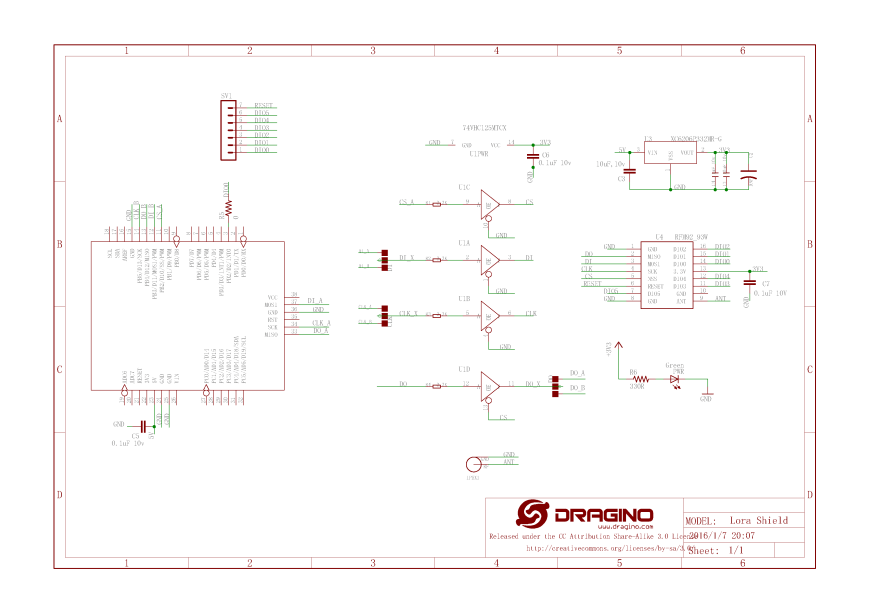
To get started I used a Dragino LoRa shield for Arduino which looked compatible with my Netduino devices. I was initially worried that the shield might not work with a 3v3 device but I tested it with a Seeeduino Lite (which has a switch to select 3v3 or 5v operation) and it worked fine.

The shield uses D10 for chip select, D2 for RFM9X DI0 interrupt and D9 for Reset.
Lora_sheild_sch
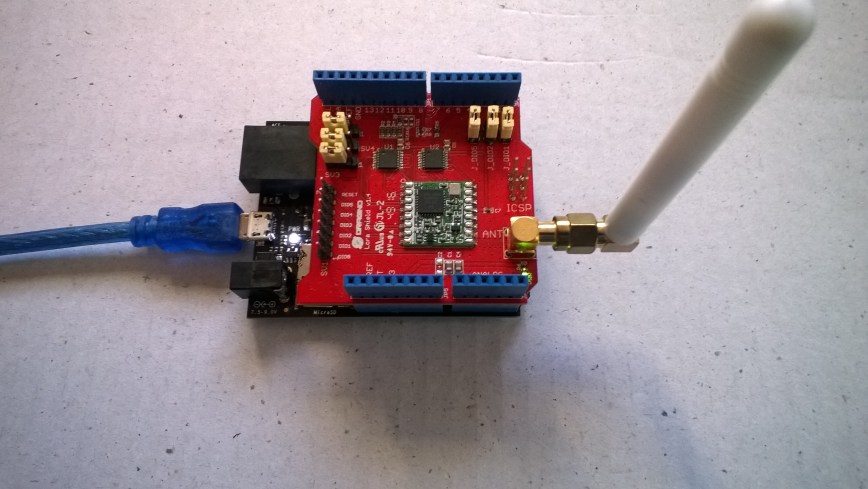
The shield ships with the SPI lines configured for ICSP so the three jumpers diagonally across the shield from the antenna connector need to be swapped to the side closest to the edge of the shield.
NetduinoDraginoShield
First step was to confirm I could (using the Netduino SPI interface and .NetMF library)read a couple of the Semtech SX1276 registers. I implemented both “automagic” and manual chip select operation in my test harness.

//---------------------------------------------------------------------------------
// Copyright (c) August 2018, devMobile Software
//
// Licensed under the Apache License, Version 2.0 (the "License");
// you may not use this file except in compliance with the License.
// You may obtain a copy of the License at
//
//     http://www.apache.org/licenses/LICENSE-2.0
//
// Unless required by applicable law or agreed to in writing, software
// distributed under the License is distributed on an "AS IS" BASIS,
// WITHOUT WARRANTIES OR CONDITIONS OF ANY KIND, either express or implied.
// See the License for the specific language governing permissions and
// limitations under the License.
//
//---------------------------------------------------------------------------------
namespace devMobile.NetMF.Rfm9X.DraginoShield
{
   using System;
   using System.Threading;
   using Microsoft.SPOT;
   using Microsoft.SPOT.Hardware;
   using SecretLabs.NETMF.Hardware;
   using SecretLabs.NETMF.Hardware.Netduino;

   public class Program
   {

      public static void Main()
      {
         //OutputPort reset = new OutputPort(Pins.GPIO_PIN_D9, true);
         OutputPort chipSelect = null;
         //chipSelect = new OutputPort(Pins.GPIO_PIN_D10, true);
         //SPI spiPort = new SPI(new SPI.Configuration(Pins.GPIO_NONE, false, 0, 0, true, true, 500, SPI.SPI_module.SPI1));
         SPI spiPort = new SPI(new SPI.Configuration(Pins.GPIO_PIN_D10, false, 0, 0, false, true, 500, SPI.SPI_module.SPI1));

         Thread.Sleep(100);

         while (true)
         {
            //byte[] writeBuffer = new byte[] { 0x42 }; // RegVersion exptecing 0x12
            byte[] writeBuffer = new byte[] { 0x06 }; // RegFreqMsb expecting 0x6C
            //byte[] writeBuffer = new byte[] { 0x07 }; // RegFreqMid expecting 0x80
            //byte[] writeBuffer = new byte[] { 0x08 }; // RegFreqLsb expecting 0x00
            byte[] readBuffer = new byte[1];

            if (chipSelect != null)
            {
               chipSelect.Write(false);
            }
            spiPort.WriteRead(writeBuffer, readBuffer,1);
            if (chipSelect != null)
            {
               chipSelect.Write(true);
            }

            Debug.Print("Value = 0x" + BytesToHexString(readBuffer));

            Thread.Sleep(1000);
         }
      }

      private static string BytesToHexString(byte[] bytes)
      {
         string hexString = string.Empty;

         // Create a character array for hexidecimal conversion.
         const string hexChars = "0123456789ABCDEF";

         // Loop through the bytes.
         for (byte b = 0; b  0)
               hexString += "-";

            // Grab the top 4 bits and append the hex equivalent to the return string.
            hexString += hexChars[bytes[b] >> 4];

            // Mask off the upper 4 bits to get the rest of it.
            hexString += hexChars[bytes[b] & 0x0F];
         }

         return hexString;
      }
   }
}

I could successfully read the RegVersion and default frequency values

'Microsoft.SPOT.Debugger.CorDebug.dll' (Managed): Loaded 'C:\Program Files (x86)\Secret Labs\Netduino SDK\Assemblies\v4.3\le\SecretLabs.NETMF.Hardware.dll', Symbols loaded.
The thread '' (0x2) has exited with code 0 (0x0).
Value = 0x6C
Value = 0x6C
Value = 0x6C
The program '[43] Micro Framework application: Managed' has exited with code 0 (0x0).


nRF24 Windows 10 IoT Core Background Task

First step is to build a basic Windows 10 IoT Core background task which can receive and display messages sent from a variety of devices across an nRF24L01 wireless link.

If you create a new “Windows IoT Core” “Background Application” project then copy this code into StartupTasks.cs the namespace has to be changed in the C# file, project properties\library\Default namespace and “Package.appxmanifest”\declarations\Entry Point.

/*

Copyright ® 2017 December devMobile Software, All Rights Reserved

THIS CODE AND INFORMATION IS PROVIDED "AS IS" WITHOUT WARRANTY OF ANY
KIND, EITHER EXPRESSED OR IMPLIED, INCLUDING BUT NOT LIMITED TO THE
IMPLIED WARRANTIES OF MERCHANTABILITY AND/OR FITNESS FOR A PARTICULAR
PURPOSE.

http://www.devmobile.co.nz

*/
using System;
using System.Diagnostics;
using System.Text;
using Radios.RF24;
using Windows.ApplicationModel.Background;

namespace devmobile.IoTCore.nRF24BackgroundTask
{
    public sealed class StartupTask : IBackgroundTask
    {
      private const byte ChipEnablePin = 25;
      private const byte ChipSelectPin = 0;
      private const byte nRF24InterruptPin = 17;
      private const string BaseStationAddress = "Base1";
      private const byte nRF24Channel = 10;
      private RF24 Radio = new RF24();
      private BackgroundTaskDeferral deferral;

      public void Run(IBackgroundTaskInstance taskInstance)
        {
         Radio.OnDataReceived += Radio_OnDataReceived;
         Radio.OnTransmitFailed += Radio_OnTransmitFailed;
         Radio.OnTransmitSuccess += Radio_OnTransmitSuccess;

         Radio.Initialize(ChipEnablePin, ChipSelectPin, nRF24InterruptPin);
         Radio.Address = Encoding.UTF8.GetBytes(BaseStationAddress);
         Radio.Channel = nRF24Channel;
         Radio.PowerLevel = PowerLevel.High;
         Radio.DataRate = DataRate.DR250Kbps;
         Radio.IsEnabled = true;

         Debug.WriteLine("Address: " + Encoding.UTF8.GetString(Radio.Address));
         Debug.WriteLine("PA: " + Radio.PowerLevel);
         Debug.WriteLine("IsAutoAcknowledge: " + Radio.IsAutoAcknowledge);
         Debug.WriteLine("Channel: " + Radio.Channel);
         Debug.WriteLine("DataRate: " + Radio.DataRate);
         Debug.WriteLine("IsDynamicAcknowledge: " + Radio.IsDyanmicAcknowledge);
         Debug.WriteLine("IsDynamicPayload: " + Radio.IsDynamicPayload);
         Debug.WriteLine("IsEnabled: " + Radio.IsEnabled);
         Debug.WriteLine("Frequency: " + Radio.Frequency);
         Debug.WriteLine("IsInitialized: " + Radio.IsInitialized);
         Debug.WriteLine("IsPowered: " + Radio.IsPowered);

         deferral = taskInstance.GetDeferral();

         Debug.WriteLine("Run completed");
      }

      private void Radio_OnDataReceived(byte[] data)
      {
         // Display as Unicode
         string unicodeText = Encoding.UTF8.GetString(data);
         Debug.WriteLine("Unicode - Payload Length {0} Unicode Length {1} Unicode text {2}", data.Length, unicodeText.Length, unicodeText);

         // display as hex
         Debug.WriteLine("Hex - Length {0} Payload {1}", data.Length, BitConverter.ToString(data));
      }

      private void Radio_OnTransmitSuccess()
      {
         Debug.WriteLine("Transmit Succeeded!");
      }

      private void Radio_OnTransmitFailed()
      {
         Debug.WriteLine("Transmit Failed!");
      }
   }
}

This was displayed in the output window of Visual Studio

Address: Base1
PA: 15
IsAutoAcknowledge: True
Channel: 10
DataRate: DR250Kbps
IsDynamicAcknowledge: False
IsDynamicPayload: True
IsEnabled: True
Frequency: 2410
IsInitialized: True
IsPowered: True
Run completed

Interrupt Triggered: FallingEdge
Unicode – Payload Length 19 Unicode Length 19 Unicode text T  23.8,H  73,V 3.26
Hex – Length 19 Payload 54-20-32-33-2E-38-2C-48-20-20-37-33-2C-56-20-33-2E-32-36
Interrupt Triggered: RisingEdge

Note the odd formatting of the Temperature and humidity values which is due to the way dtostrf function in the Atmel AVR library works.

Also noticed the techfooninja nRF24 library has configurable output power level which I will try to retrofit onto the Gralin NetMF library.

Next, several simple Arduino, devDuino V2.2, Seeeduino V4.2 and Netduino 2/3 clients (plus possibly some others)