Random wanderings through Microsoft Azure esp. PaaS plumbing, the IoT bits, AI on Micro controllers, AI on Edge Devices, .NET nanoFramework, .NET Core on *nix and ML.NET+ONNX
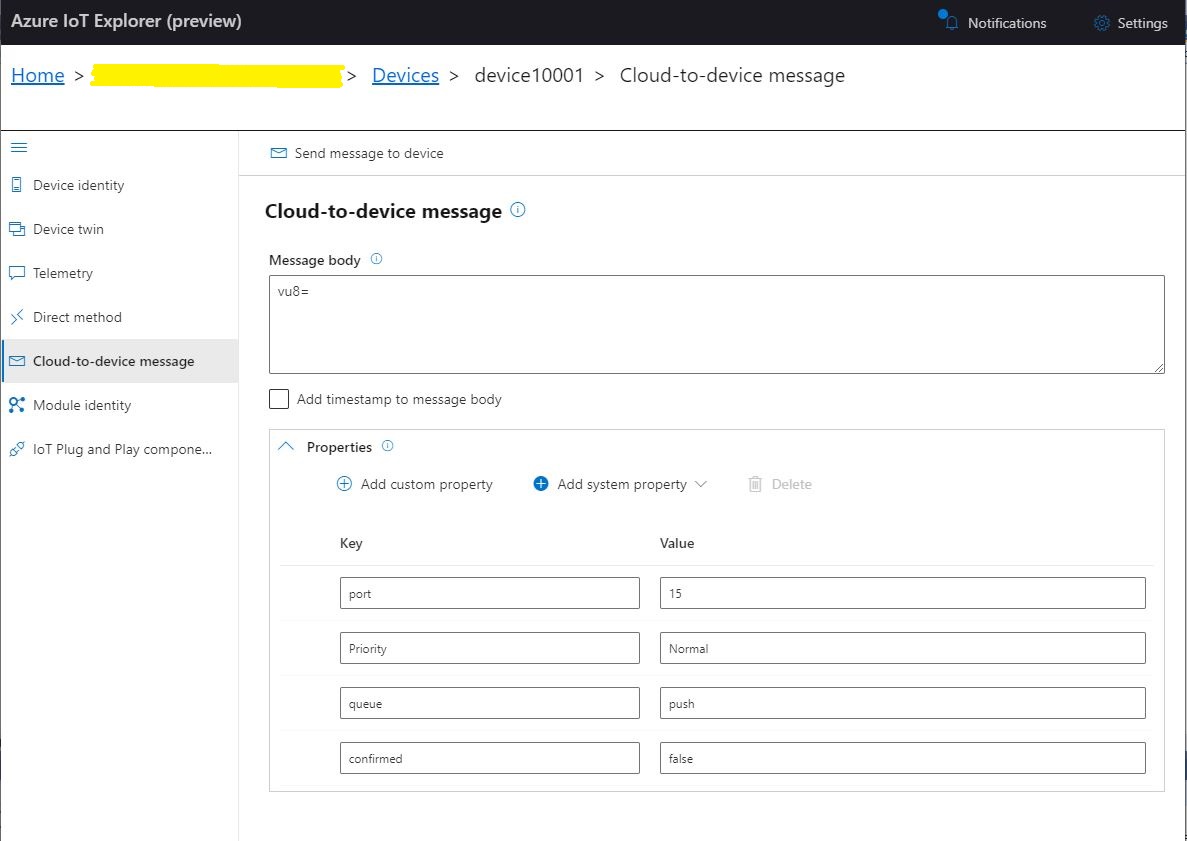
My Azure IoT Hub messages have properties for the LoRaWAN port (required), confirmed (which defaults to false), priority (which defaults to Normal) and queue(which defaults to Replace). The priority and queue enumerations are defined in TTNcommon.cs.
I used the enumeration for message priority in the JSON payload and MQTT downlink message topic.
Initially when I published a message it wasn’t sent and there was no error. It was a while before I noticed that the queue setting was being being converted to the text “Push” or “Replace” based on the enumeration value name (The priority value was in the JSON which is case insensitive). I did wonder if the tenantId and ApplicationId were also case sensitive so I ensured consistent capitalisation with ToLower();
The first step was to add the The Things Network(TTN)V3 Tennant ID to the context information as it is required for the downlink Message Queue Telemetry Transport (MQTT) publish topic.
namespace devMobile.TheThingsNetwork.Models
{
   public class AzureIoTHubReceiveMessageHandlerContext
   {
      public string TenantId { get; set; }
      public string DeviceId { get; set; }
      public string ApplicationId { get; set; }
   }
}
To send a message to a LoRaWAN device in addition to the payload, TTN needs the port number and optionally a confirmation required flag, message priority, queueing type and correlation ids.
With my implementation the confirmation required flag, message priority, and queueing type are Azure IoT Hub message properties and the messageid is used as a correlation id.
private async static Task AzureIoTHubClientReceiveMessageHandler(Message message, object userContext)
{
	bool confirmed;
	byte port;
	DownlinkPriority priority;
	string downlinktopic;

	try
	{
		AzureIoTHubReceiveMessageHandlerContext receiveMessageHandlerConext = (AzureIoTHubReceiveMessageHandlerContext)userContext;

		DeviceClient deviceClient = (DeviceClient)DeviceClients.Get(receiveMessageHandlerConext.DeviceId);
		if (deviceClient == null)
		{
			Console.WriteLine($" UplinkMessageReceived unknown DeviceID: {receiveMessageHandlerConext.DeviceId}");
			await deviceClient.RejectAsync(message);
			return;
		}

		using (message)
		{
			Console.WriteLine();
			Console.WriteLine();
			Console.WriteLine($"{DateTime.UtcNow:HH:mm:ss} Azure IoT Hub downlink message");
			Console.WriteLine($" ApplicationID: {receiveMessageHandlerConext.ApplicationId}");
			Console.WriteLine($" DeviceID: {receiveMessageHandlerConext.DeviceId}");
#if DIAGNOSTICS_AZURE_IOT_HUB
			Console.WriteLine($" Cached: {DeviceClients.Contains(receiveMessageHandlerConext.DeviceId)}");
			Console.WriteLine($" MessageID: {message.MessageId}");
			Console.WriteLine($" DeliveryCount: {message.DeliveryCount}");
			Console.WriteLine($" EnqueuedTimeUtc: {message.EnqueuedTimeUtc}");
			Console.WriteLine($" SequenceNumber: {message.SequenceNumber}");
			Console.WriteLine($" To: {message.To}");
#endif
			string messageBody = Encoding.UTF8.GetString(message.GetBytes());
			Console.WriteLine($" Body: {messageBody}");
#if DOWNLINK_MESSAGE_PROPERTIES_DISPLAY
			foreach (var property in message.Properties)
			{
				Console.WriteLine($"   Key:{property.Key} Value:{property.Value}");
			}
#endif
			if (!message.Properties.ContainsKey("Confirmed"))
			{
				Console.WriteLine(" UplinkMessageReceived missing confirmed property");
				await deviceClient.RejectAsync(message);
				return;
			}

			if (!bool.TryParse(message.Properties["Confirmed"], out confirmed))
			{
				Console.WriteLine(" UplinkMessageReceived confirmed property invalid");
				await deviceClient.RejectAsync(message);
				return;
			}

			if (!message.Properties.ContainsKey("Priority"))
			{
				Console.WriteLine(" UplinkMessageReceived missing priority property");
				await deviceClient.RejectAsync(message);
				return;
			}

			if (!Enum.TryParse(message.Properties["Priority"], true, out priority))
			{
				Console.WriteLine(" UplinkMessageReceived priority property invalid");
				await deviceClient.RejectAsync(message);
				return;
			}

			if (priority == DownlinkPriority.Undefined)
			{
				Console.WriteLine(" UplinkMessageReceived priority property undefined value invalid");
				await deviceClient.RejectAsync(message);
				return;
			}

			if (!message.Properties.ContainsKey("Port"))
			{
				Console.WriteLine(" UplinkMessageReceived missing port number property");
				await deviceClient.RejectAsync(message);
				return;
			}

			if (!byte.TryParse( message.Properties["Port"], out port))
			{
				Console.WriteLine(" UplinkMessageReceived port number property invalid");
				await deviceClient.RejectAsync(message);
				return;
			}

			if ((port < Constants.PortNumberMinimum) || port > (Constants.PortNumberMaximum))
			{
				Console.WriteLine($" UplinkMessageReceived port number property invalid value must be between {Constants.PortNumberMinimum} and {Constants.PortNumberMaximum}");
				await deviceClient.RejectAsync(message);
				return;
			}

			if (!message.Properties.ContainsKey("Queue"))
			{
				Console.WriteLine(" UplinkMessageReceived missing queue property");
				await deviceClient.RejectAsync(message);
				return;
			}

			switch(message.Properties["Queue"].ToLower())
			{
				case "push":
					downlinktopic = $"v3/{receiveMessageHandlerConext.ApplicationId}@{receiveMessageHandlerConext.TenantId}/devices/{receiveMessageHandlerConext.DeviceId}/down/push";
					break;
				case "replace":
					downlinktopic = $"v3/{receiveMessageHandlerConext.ApplicationId}@{receiveMessageHandlerConext.TenantId}/devices/{receiveMessageHandlerConext.DeviceId}/down/replace";
					break;
				default:
					Console.WriteLine(" UplinkMessageReceived missing queue property invalid value");
					await deviceClient.RejectAsync(message);
					return;
               }

			DownlinkPayload Payload = new DownlinkPayload()
			{
				Downlinks = new List<Downlink>()
				{
					new Downlink()
					{
						Confirmed = confirmed,
						PayloadRaw = messageBody,
						Priority = priority,
						Port = port,
						CorrelationIds = new List<string>()
						{
							message.MessageId
						}
					}
				}
			};

			var mqttMessage = new MqttApplicationMessageBuilder()
					.WithTopic(downlinktopic)
					.WithPayload(JsonConvert.SerializeObject(Payload))
					.WithAtLeastOnceQoS()
					.Build();

			await mqttClient.PublishAsync(mqttMessage);

			// Need to look at confirmation requirement ack, nack maybe failed & sent
			await deviceClient.CompleteAsync(message);

			Console.WriteLine();
		}
	}
	catch (Exception ex)
	{
		Debug.WriteLine("UplinkMessageReceived failed: {0}", ex.Message);
	}
}
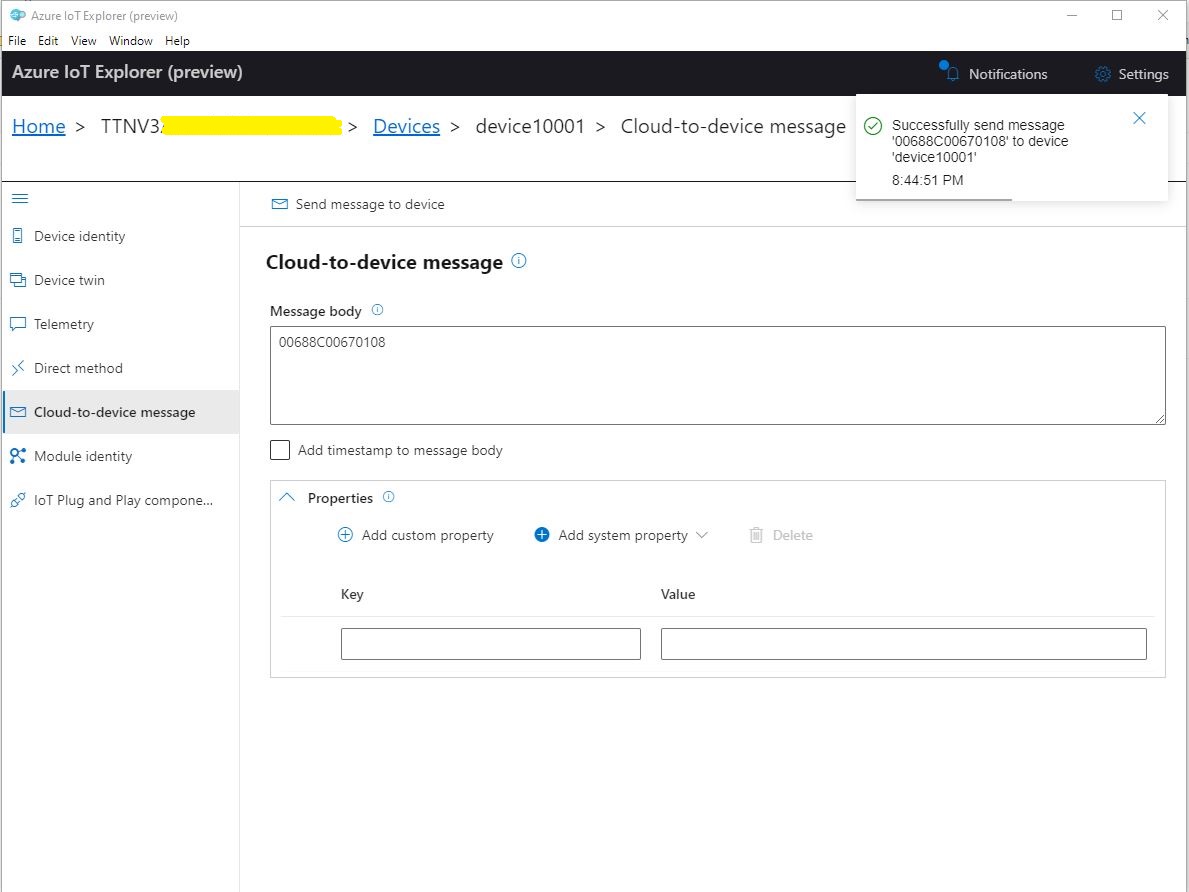
To “smoke test”” my implementation I used Azure IoT Explorer to send a C2D telemetry message
Azure IoT Hub Explorer send message form with payload and message properties
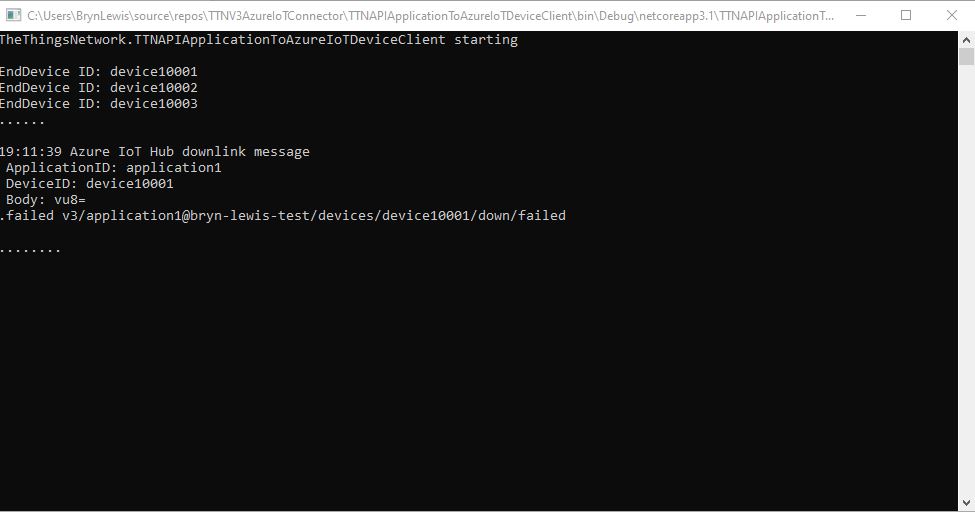
The PoC console application then forwarded the message to TTN using MQTT to be sent(which fails)
PoC application sending message then displaying result
The TTN live data display shows the message couldn’t be delivered because my test LoRaWAN device has not been activiated.
TTN Live Data display with message delivery failure
// At this point all the AzureIoT Hub deviceClients setup and ready to go so can enable MQTT receive
mqttClient.UseApplicationMessageReceivedHandler(new MqttApplicationMessageReceivedHandlerDelegate(e => MqttClientApplicationMessageReceived(e)));

// This may shift to individual device subscriptions
string uplinkTopic = $"v3/{options.MqttApplicationID}/devices/+/up";
await mqttClient.SubscribeAsync(uplinkTopic, MQTTnet.Protocol.MqttQualityOfServiceLevel.AtLeastOnce);

//string queuedTopic = $"v3/{options.MqttApplicationID}/devices/+/queued";
//await mqttClient.SubscribeAsync(queuedTopic, MQTTnet.Protocol.MqttQualityOfServiceLevel.AtLeastOnce);
The additional commented out subscriptions are for the processing of downlink messages
The MQTTNet received message handler uses the last segment of the topic to route messages to a method for processing
The UplinkMessageReceived method deserialises the message payload, retrieves device context information from the local ObjectCache, adds relevant uplink messages fields (including the raw payload), then if the message has been unpacked by a TTN Decoder, the message fields are added as well.
static async Task UplinkMessageReceived(MqttApplicationMessageReceivedEventArgs e)
{
	try
	{
		PayloadUplinkV3 payload = JsonConvert.DeserializeObject<PayloadUplinkV3>(e.ApplicationMessage.ConvertPayloadToString());
		string applicationId = payload.EndDeviceIds.ApplicationIds.ApplicationId;
		string deviceId = payload.EndDeviceIds.DeviceId;
		int port = payload.UplinkMessage.Port;
...
		DeviceClient deviceClient = (DeviceClient)DeviceClients.Get(deviceId);
		if (deviceClient == null)
		{
			Console.WriteLine($" UplinkMessageReceived unknown DeviceID: {deviceId}");
			return;
		}

		JObject telemetryEvent = new JObject();
		telemetryEvent.Add("DeviceID", deviceId);
		telemetryEvent.Add("ApplicationID", applicationId);
		telemetryEvent.Add("Port", port);
		telemetryEvent.Add("PayloadRaw", payload.UplinkMessage.PayloadRaw);

		// If the payload has been unpacked in TTN backend add fields to telemetry event payload
		if (payload.UplinkMessage.PayloadDecoded != null)
		{
			EnumerateChildren(telemetryEvent, payload.UplinkMessage.PayloadDecoded);
		}

		// Send the message to Azure IoT Hub/Azure IoT Central
		using (Message ioTHubmessage = new Message(Encoding.ASCII.GetBytes(JsonConvert.SerializeObject(telemetryEvent))))
		{
			// Ensure the displayed time is the acquired time rather than the uploaded time.
			//ioTHubmessage.Properties.Add("iothub-creation-time-utc", payloadObject.Metadata.ReceivedAtUtc.ToString("s", CultureInfo.InvariantCulture));
			ioTHubmessage.Properties.Add("ApplicationId", applicationId);
			ioTHubmessage.Properties.Add("DeviceId", deviceId);
			ioTHubmessage.Properties.Add("port", port.ToString());

			await deviceClient.SendEventAsync(ioTHubmessage);
		}
	}
	catch( Exception ex)
	{
		Debug.WriteLine("UplinkMessageReceived failed: {0}", ex.Message);
	}
}

private static void EnumerateChildren(JObject jobject, JToken token)
{
	if (token is JProperty property)
	{
		if (token.First is JValue)
		{
			// Temporary dirty hack for Azure IoT Central compatibility
			if (token.Parent is JObject possibleGpsProperty)
			{
				if (possibleGpsProperty.Path.StartsWith("GPS_", StringComparison.OrdinalIgnoreCase))
				{
					if (string.Compare(property.Name, "Latitude", true) == 0)
					{
						jobject.Add("lat", property.Value);
					}
					if (string.Compare(property.Name, "Longitude", true) == 0)
					{
						jobject.Add("lon", property.Value);
					}
					if (string.Compare(property.Name, "Altitude", true) == 0)
					{
						jobject.Add("alt", property.Value);
					}
				}
			}
			jobject.Add(property.Name, property.Value);
		}
		else
		{
			JObject parentObject = new JObject();
			foreach (JToken token2 in token.Children())
			{
				EnumerateChildren(parentObject, token2);
				jobject.Add(property.Name, parentObject);
			}
		}
	}
	else
	{
		foreach (JToken token2 in token.Children())
		{
			EnumerateChildren(jobject, token2);
		}
	}
}
There is also some basic reformatting of the messages for Azure IoT Central
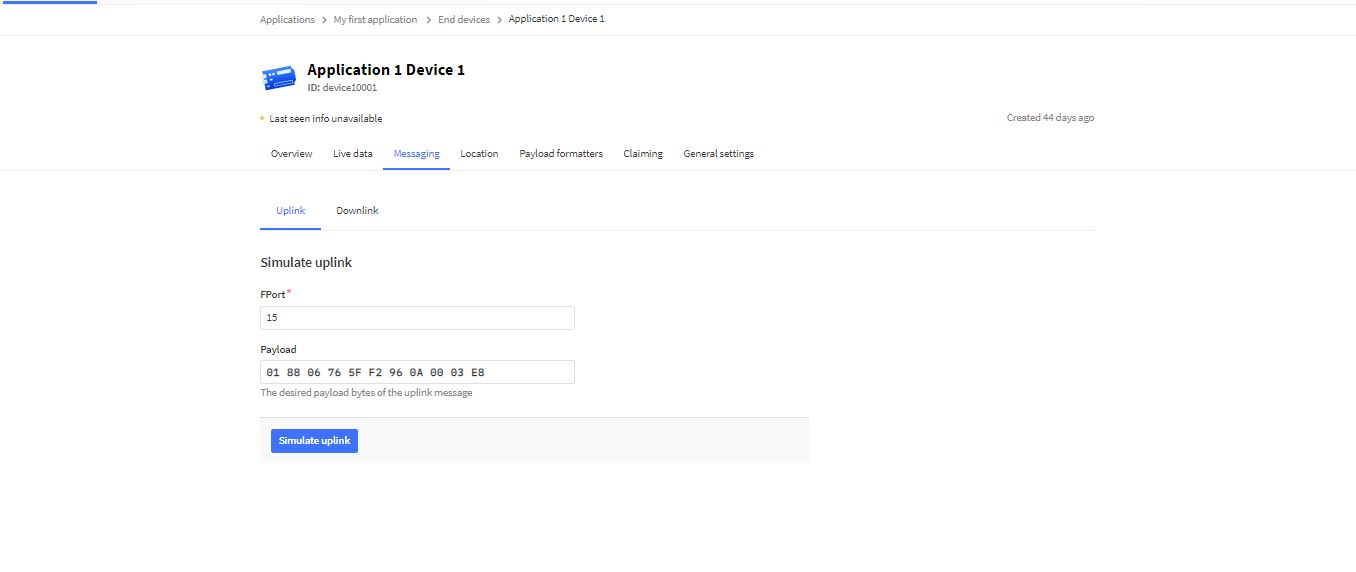
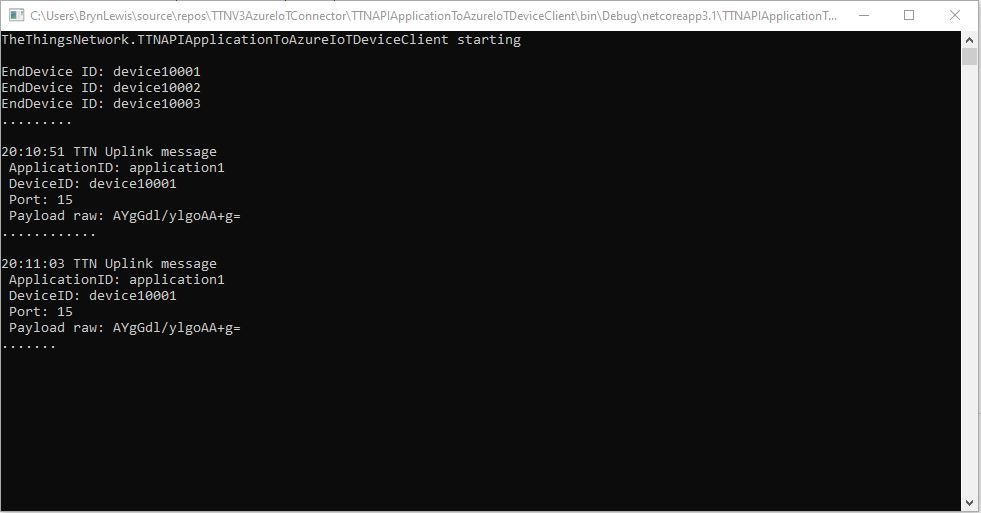
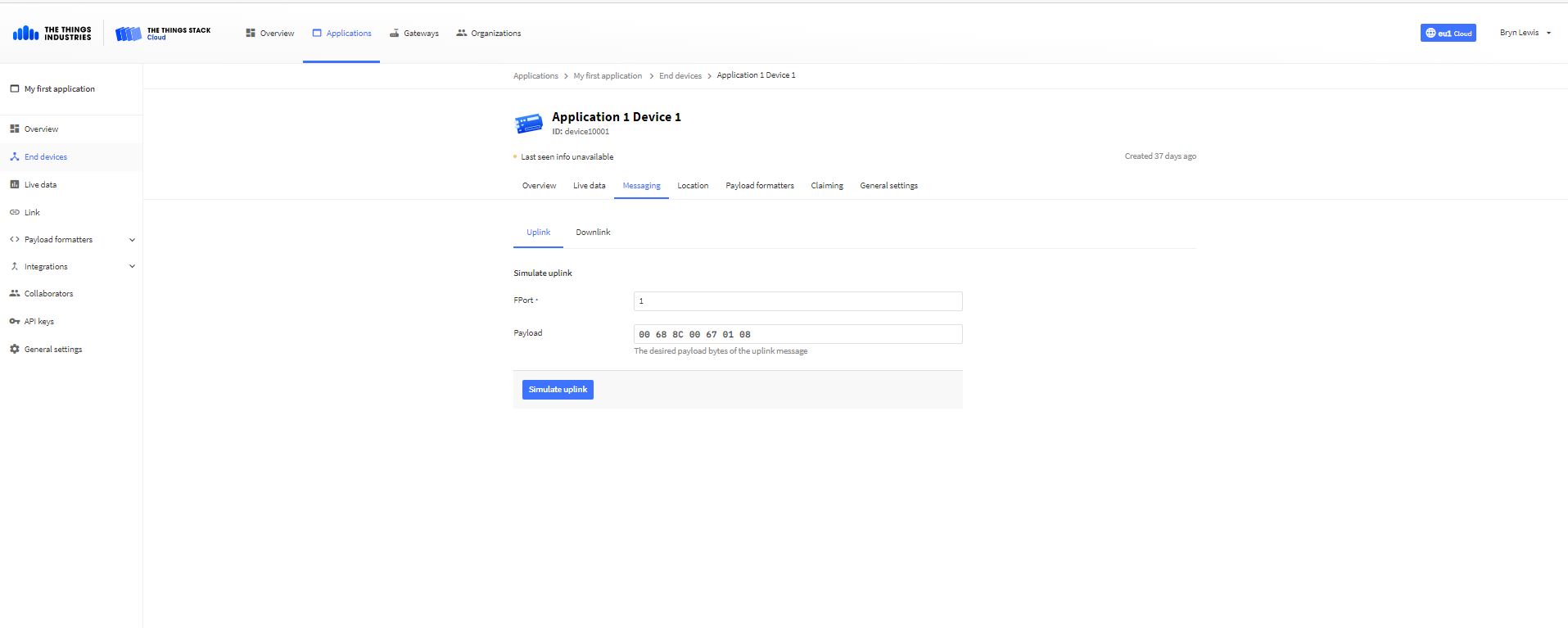
TTN Simulate uplink message with GPS location payload.Nasty console application processing uplink messageMessage from LoRaWAN device displayed in Azure IoT Explorer
While building these PoCs I have learnt a lot about the way that the TTN V3 RESTful and MQTT APIs work and this is the first in a series of posts about linking them together. My plan is to start with yet another .NetCore Console application which hosts both the MQTT and Azure IoT Hub DeviceClient (using the Advanced Message Queueing Protocol(AMQP)) client implementations. I’m using MQTTnet to build my data API client and used NSwag by Richo Suter to generate my RESTful client from the TTN provided swagger file.
In this PoC I’m using the commandlineParserNuGet package to the reduce the amount of code required to process command line parameters and make it more robust. This PoC has a lot of command line parameters which would have been painful to manually parse and validate.
public class CommandLineOptions
{
	[Option('u', "APIbaseURL", Required = false, HelpText = "TTN Restful API URL.")]
	public string ApiBaseUrl { get; set; }

	[Option('K', "APIKey", Required = true, HelpText = "TTN Restful API APIkey")]
	public string ApiKey { get; set; }

	[Option('P', "APIApplicationID", Required = true, HelpText = "TTN Restful API ApplicationID")]
	public string ApiApplicationID { get; set; }

	[Option('D', "DeviceListPageSize", Required = true, HelpText = "The size of the pages used to retrieve EndDevice configuration")]
	public int DevicePageSize { get; set; }

	[Option('S', "MQTTServerName", Required = true, HelpText = "TTN MQTT API server name")]
	public string MqttServerName { get; set; }

	[Option('A', "MQTTAccessKey", Required = true, HelpText = "TTN MQTT API access key")]
	public string MqttAccessKey { get; set; }

	[Option('Q', "MQTTApplicationID", Required = true, HelpText = "TTN MQTT API ApplicationID")]
	public string MqttApplicationID { get; set; }

	[Option('C', "MQTTClientName", Required = true, HelpText = "TTN MQTT API Client ID")]
	public string MqttClientID { get; set; }

	[Option('Z', "AzureIoTHubConnectionString", Required = true, HelpText = "Azure IoT Hub Connection string")]
	public string AzureIoTHubconnectionString { get; set; }
}
To keep things simple in this PoC I’m using an Azure IoT Hub specific (rather than a device specific connection string)
After some trial and error I found the order of execution was important
Open MQTTnet connection to TTN host (but don’t configure any subscriptions)
Configure connection to TTN RESTful API
Retrieve list of V3EndDevices (paginated), then for each V3EndDevice
Open connection to Azure IoT Hub using command line connection string + TTN Device ID
Call DeviceClient.SetReceiveMessageHandlerAsync to specify ReceiveMessageCallback and additional context information for processing Azure IoT Hub downlink messages.
Store DeviceClient instance in ObjectCache using DeviceID as key
Configure the MQTTnet recived message handler
Subscribe to uplink messages from all the V3EndDevices in the specified application.
private static async Task ApplicationCore(CommandLineOptions options)
{
	MqttFactory factory = new MqttFactory();
	mqttClient = factory.CreateMqttClient();

#if DIAGNOSTICS
	Console.WriteLine($"baseURL: {options.ApiBaseUrl}");
	Console.WriteLine($"APIKey: {options.ApiKey}");
	Console.WriteLine($"ApplicationID: {options.ApiApplicationID}");
	Console.WriteLine($"AazureIoTHubconnectionString: {options.AzureIoTHubconnectionString}");
	Console.WriteLine();
#endif

	try
	{
		// First configure MQTT, open connection and wire up disconnection handler.
		// Can't wire up MQTT received handler as at this stage AzureIoTHub devices not connected.
		mqttOptions = new MqttClientOptionsBuilder()
			.WithTcpServer(options.MqttServerName)
			.WithCredentials(options.MqttApplicationID, options.MqttAccessKey)
			.WithClientId(options.MqttClientID)
			.WithTls()
			.Build();

		mqttClient.UseDisconnectedHandler(new MqttClientDisconnectedHandlerDelegate(e => MqttClientDisconnected(e)));

		await mqttClient.ConnectAsync(mqttOptions);

		// Prepare the HTTP client to be used in the TTN device enumeration
		using (HttpClient httpClient = new HttpClient())
		{
			EndDeviceRegistryClient endDeviceRegistryClient = new EndDeviceRegistryClient(options.ApiBaseUrl, httpClient)
			{
				ApiKey = options.ApiKey
			};

			// Retrieve list of devices page by page
			V3EndDevices endDevices = await endDeviceRegistryClient.ListAsync(
				options.ApiApplicationID,
				field_mask_paths: DevicefieldMaskPaths,
				limit: options.DevicePageSize);
			if ((endDevices != null) && (endDevices.End_devices != null)) // If no devices returns null rather than empty list
			{
				foreach (V3EndDevice endDevice in endDevices.End_devices)
				{
					// Display the device info+attributes then connect device to Azure IoT Hub
#if DEVICE_FIELDS_MINIMUM
					Console.WriteLine($"EndDevice ID: {endDevice.Ids.Device_id}");
#else
					Console.WriteLine($"Device ID: {endDevice.Ids.Device_id} Name: {endDevice.Name} Description: {endDevice.Description}");
					Console.WriteLine($"  CreatedAt: {endDevice.Created_at:dd-MM-yy HH:mm:ss} UpdatedAt: {endDevice.Updated_at:dd-MM-yy HH:mm:ss}");
#endif

#if DEVICE_ATTRIBUTES_DISPLAY
					if (endDevice.Attributes != null)
					{
						Console.WriteLine("  EndDevice attributes");

						foreach (KeyValuePair<string, string> attribute in endDevice.Attributes)
						{
							Console.WriteLine($"    Key: {attribute.Key} Value: {attribute.Value}");
						}
					}
#endif
					try
					{
						DeviceClient deviceClient = DeviceClient.CreateFromConnectionString(
							options.AzureIoTHubconnectionString,
							endDevice.Ids.Device_id,
							TransportType.Amqp_Tcp_Only);

						await deviceClient.OpenAsync();

						await deviceClient.SetReceiveMessageHandlerAsync(
							AzureIoTHubClientReceiveMessageHandler,
							new AzureIoTHubReceiveMessageHandlerContext()
							{
								DeviceId = endDevice.Ids.Device_id,
								ApplicationId = endDevice.Ids.Application_ids.Application_id,
							});

						DeviceClients.Add(endDevice.Ids.Device_id, deviceClient, cacheItemPolicy);
					}
					catch( Exception ex)
					{
						Console.WriteLine($"Azure IoT Hub OpenAsync failed {ex.Message}");
					}
				}
			}
		}

		// At this point all the AzureIoT Hub deviceClients setup and ready to go so can enable MQTT receive
		mqttClient.UseApplicationMessageReceivedHandler(new MqttApplicationMessageReceivedHandlerDelegate(e => MqttClientApplicationMessageReceived(e)));

		// This may shift to individual device subscriptions
		string uplinktopic = $"v3/{options.MqttApplicationID}/devices/+/up";

		await mqttClient.SubscribeAsync(uplinktopic, MQTTnet.Protocol.MqttQualityOfServiceLevel.AtLeastOnce);
	}
	catch(Exception ex)
	{
		Console.WriteLine($"Main {ex.Message}");
		Console.WriteLine("Press any key to exit");
		Console.ReadLine();
		return;
	}

	while (!Console.KeyAvailable)
	{
		Console.Write(".");
		await Task.Delay(1000);
	}

	// Consider ways to mop up connections

	Console.WriteLine("Press any key to exit");
	Console.ReadLine();
}
When I was initially looking at Azure Deviceclient I would of had to have created a thread (which would have been blocked most of the time) for each device. This implementation issued was removed by the introduction of the DeviceClientSetReceiveMessageHandlerAsync method in release 1.33.0.
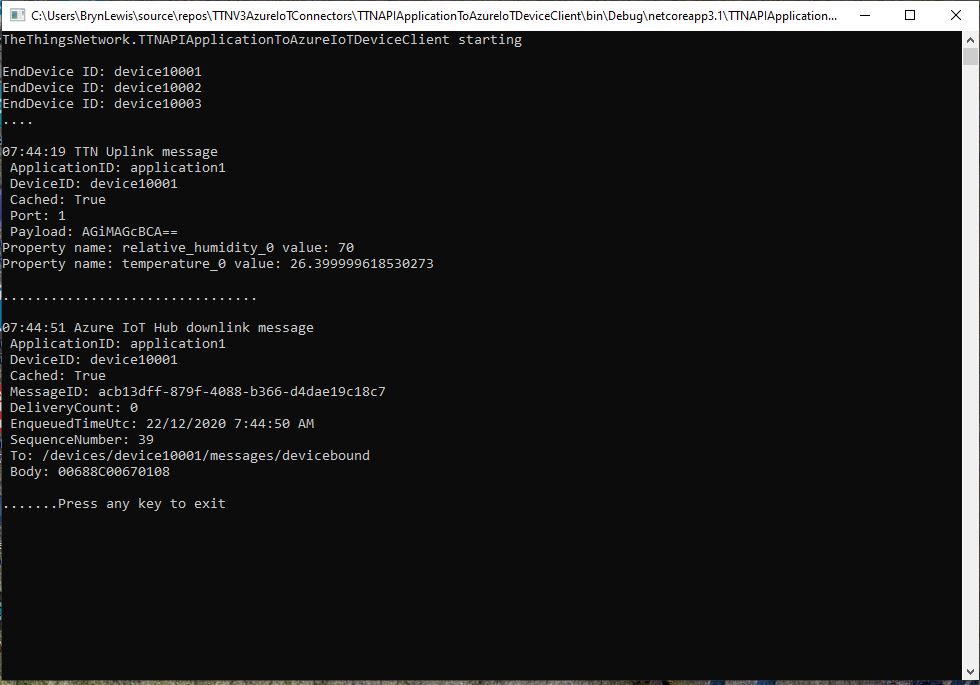
Currently the application just displays the Cloud to Device(C2D) message payload plus diagnostic information, and the CompleteAsync method is called so the message is dequeued.
Currently the application just displays the Cloud to Device(D2C) message payload plus diagnostic information, displaying the payload fields if the message format has been configured and successfully processed.
This code was written to solve a problem I had debugging and testing an application which processed data from sensors attached to The Things Network(TTN) and I figured others might find it useful.
As part of my series of TTN projects I wanted to verify that the data from a number of LoRaWAN sensors connected to TTN was reasonable and complete. I’m familiar with Microsoft SQL Server so I built a .Net Core console application which uses the TTN Message Queue Telemetry Transport(MQTT) Data API (so it can run alongside my existing TTN integration) to receive messages from the all devices in a TTN application and store them in a database for post processing.
The console application uses MQTTNet to connect to TTN MQTT Data API. It subscribes to an application device uplink topic, then uses a combination of Stackoverflow Dapper with Microsoft SQL Server tables and stored procedures to store the device data points. I re-generated the classes I had used in my other projects, added any obvious missing fields and fine tuned the data types by delving into the TTN V2GO code.
The core of the application is in the MQTTNet application message received handler.
private static void MqttClient_ApplicationMessageReceived(MqttApplicationMessageReceivedEventArgs e)
{
   PayloadUplinkV2 payload;

   log.InfoFormat($"Receive Start Topic:{e.ApplicationMessage.Topic}");

   string connectionString = configuration.GetSection("TTNDatabase").Value;

   try
   {
      payload = JsonConvert.DeserializeObject<PayloadUplinkV2>(e.ApplicationMessage.ConvertPayloadToString());
   }
   catch (Exception ex)
   {
      log.Error("DeserializeObject failed", ex);
      return;
   }

   try
   {
      if (payload.PayloadFields != null)
      {
         var parameters = new DynamicParameters();

         EnumerateChildren(parameters, payload.PayloadFields);

         log.Debug($"Parameters:{parameters.ParameterNames.Aggregate((i, j) => i + ',' + j)}");

         foreach (string storedProcedure in storedProcedureMappings.Keys)
         {
            if (Enumerable.SequenceEqual(parameters.ParameterNames, storedProcedureMappings[storedProcedure].Split(',', StringSplitOptions.RemoveEmptyEntries), StringComparer.InvariantCultureIgnoreCase))
            {
               log.Info($"Payload fields processing with:{storedProcedure}");

               using (SqlConnection db = new SqlConnection(connectionString))
               {
                  parameters.Add("@ReceivedAtUtc", payload.Metadata.ReceivedAtUtc);
                  parameters.Add("@DeviceID", payload.DeviceId);
                  parameters.Add("@DeviceEui", payload.DeviceEui);
                  parameters.Add("@ApplicationID", payload.ApplicationId);
                  parameters.Add("@IsConfirmed", payload.IsConfirmed);
                  parameters.Add("@IsRetry", payload.IsRetry);
                  parameters.Add("@Port", payload.Port);

                  db.Execute(sql: storedProcedure, param: parameters, commandType: CommandType.StoredProcedure);
               }
            }
         }
      }
      else
      {
         foreach (string storedProcedure in storedProcedureMappings.Keys)
         {
            if (string.Compare(storedProcedureMappings[storedProcedure], "payload_raw", true) == 0)
            {
               log.Info($"Payload raw processing with:{storedProcedure}");

               using (SqlConnection db = new SqlConnection(connectionString))
               {
                  var parameters = new DynamicParameters();

                  parameters.Add("@ReceivedAtUtc", payload.Metadata.ReceivedAtUtc);
                  parameters.Add("@DeviceID", payload.DeviceId);
                  parameters.Add("@DeviceEui", payload.DeviceEui);
                  parameters.Add("@ApplicationID", payload.ApplicationId);
                  parameters.Add("@IsConfirmed", payload.IsConfirmed);
                  parameters.Add("@IsRetry", payload.IsRetry);
                  parameters.Add("@Port", payload.Port);
                  parameters.Add("@Payload", payload.PayloadRaw);

                  db.Execute(sql: storedProcedure, param: parameters, commandType: CommandType.StoredProcedure);
               }
            }
         }
      }
   }
   catch (Exception ex)
   {
      log.Error("Message processing failed", ex);
   }
}
For messages with payload fields the code attempts to match the list of field names (there maybe more than one match) with the parameter list for stored procedures in the AppSettings.json file. The Enumerable.SequenceEqual uses a case insensitive comparison but order is important. I did consider sorting the two lists of parameters but wasn’t certain the added complexity was worth it.
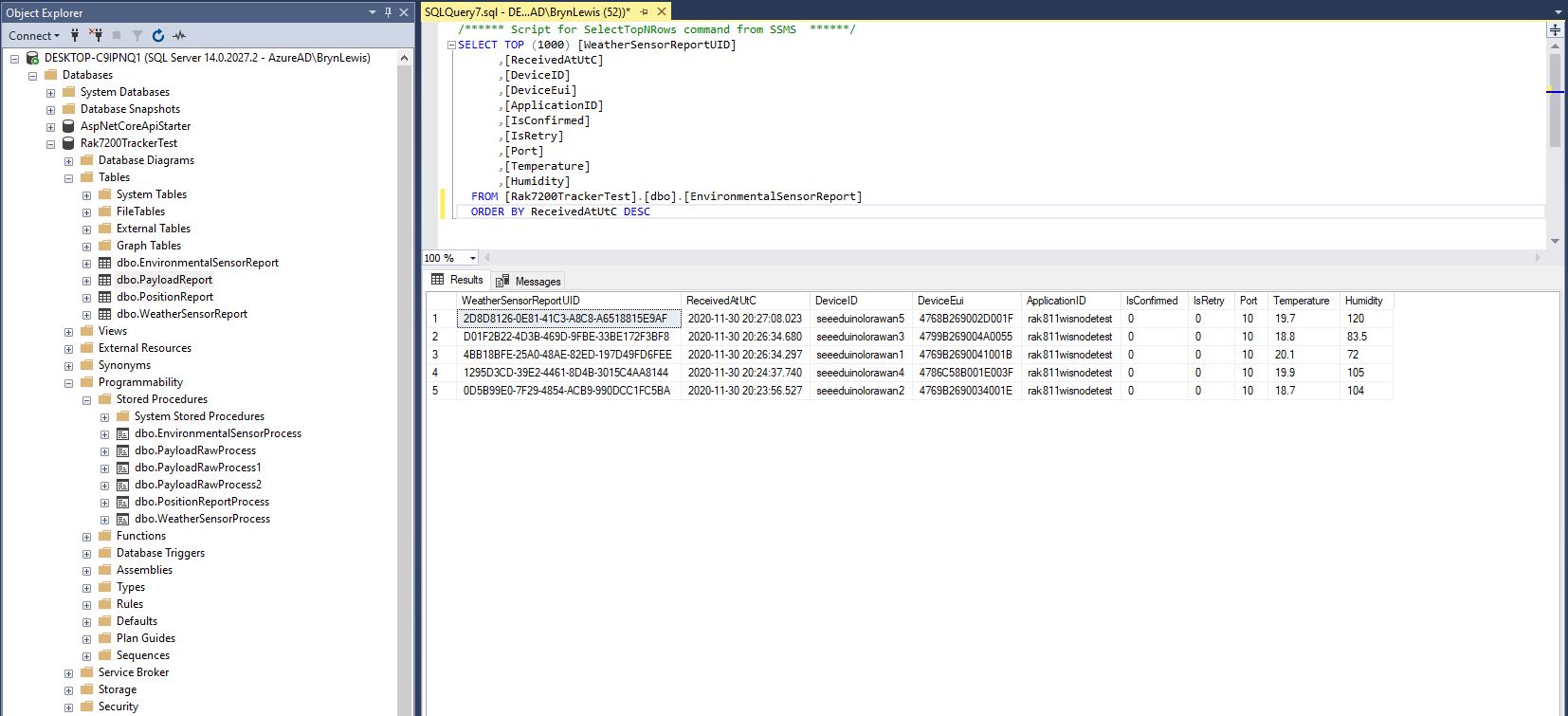
I created a database table to store the temperature and humidity values.
CREATE TABLE [dbo].[EnvironmentalSensorReport](
	[WeatherSensorReportUID] [UNIQUEIDENTIFIER] NOT NULL,
	[ReceivedAtUtC] [DATETIME] NOT NULL,
	[DeviceID] [NVARCHAR](32) NOT NULL,
	[DeviceEui] [NVARCHAR](32) NOT NULL,
	[ApplicationID] [NVARCHAR](32) NOT NULL,
	[IsConfirmed] [BIT] NOT NULL,
	[IsRetry] [BIT] NOT NULL,
	[Port] [SMALLINT] NOT NULL,
	[Temperature] [FLOAT] NOT NULL,
	[Humidity] [FLOAT] NOT NULL,
CONSTRAINT [PK_EnvironmentalSensorReport] PRIMARY KEY CLUSTERED
(
	[WeatherSensorReportUID] ASC
)WITH (PAD_INDEX = OFF, STATISTICS_NORECOMPUTE = OFF, IGNORE_DUP_KEY = OFF, ALLOW_ROW_LOCKS = ON, ALLOW_PAGE_LOCKS = ON) ON [PRIMARY]
) ON [PRIMARY]
GO

ALTER TABLE [dbo].[EnvironmentalSensorReport] ADD  CONSTRAINT [DF_EnvironmentalSensorReport_EnvironmentalSensorReporttUID]  DEFAULT (NEWID()) FOR [WeatherSensorReportUID]
GO
The stored procedure must have the parameters @ReceivedAtUtc, @DeviceID, @DeviceEui, @ApplicationID, @IsRetry, @IsConfirmed and @Port. In this example the payload specific fields generated by the Low Power Protocol(LPP) decoder are @Temperature_0 and @relative_humidity_0
CREATE PROCEDURE [dbo].[EnvironmentalSensorProcess]
   @ReceivedAtUtc AS DATETIME,
   @DeviceID AS NVARCHAR(32),
   @DeviceEui AS NVARCHAR(32),
   @ApplicationID AS NVARCHAR(32),
   @IsRetry AS BIT,
   @IsConfirmed AS BIT,
   @Port AS SMALLINT,
   @Temperature_0 AS FLOAT,
   @relative_humidity_0 AS FLOAT
AS
BEGIN
   SET NOCOUNT ON;

   INSERT INTO [dbo].[EnvironmentalSensorReport]
           ([PositionReportUID]
	   .[ReceivedAtUtc]
           ,[DeviceID]
           ,[DeviceEui]
           ,[ApplicationID]
           ,[IsConfirmed]
           ,[IsRetry]
           ,[Port]
	   ,Temperature
	   ,Humidity)
   VALUES
   (
      @ReceivedAtUtc,
      @DeviceID,
      @DeviceEui,
      @ApplicationID,
      @IsConfirmed,
      @IsRetry,
      @port,
      @Temperature_0,
      @relative_humidity_0)
END
Environmental sensor data displayed in SQL Server Management Studio(SSMS)
To store more complex nest payload fields (e.g. latitude, longitude and altitude values), I flattened the the hierarchy.
private static void EnumerateChildren(DynamicParameters parameters, JToken token, string prefix ="")
{
   if (token is JProperty)
      if (token.First is JValue)
      {
         JProperty property = (JProperty)token;
         parameters.Add($"@{prefix}{property.Name}", property.Value.ToString());
      }
      else
      {
         JProperty property = (JProperty)token;
         prefix += property.Name;
      }

   foreach (JToken token2 in token.Children())
   {
      EnumerateChildren(parameters,token2, prefix);
   }
}
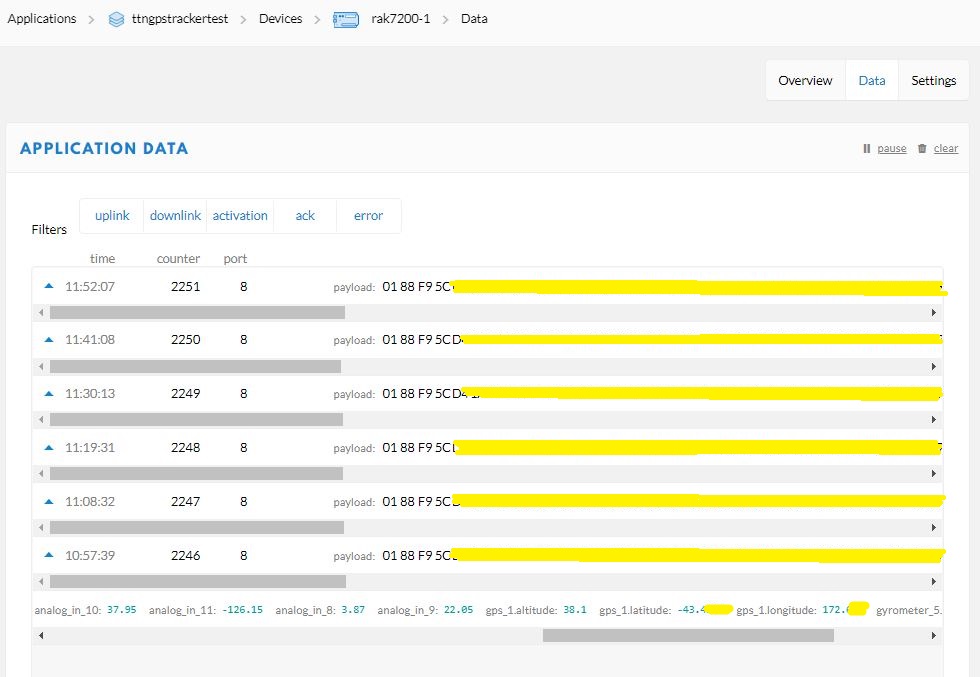
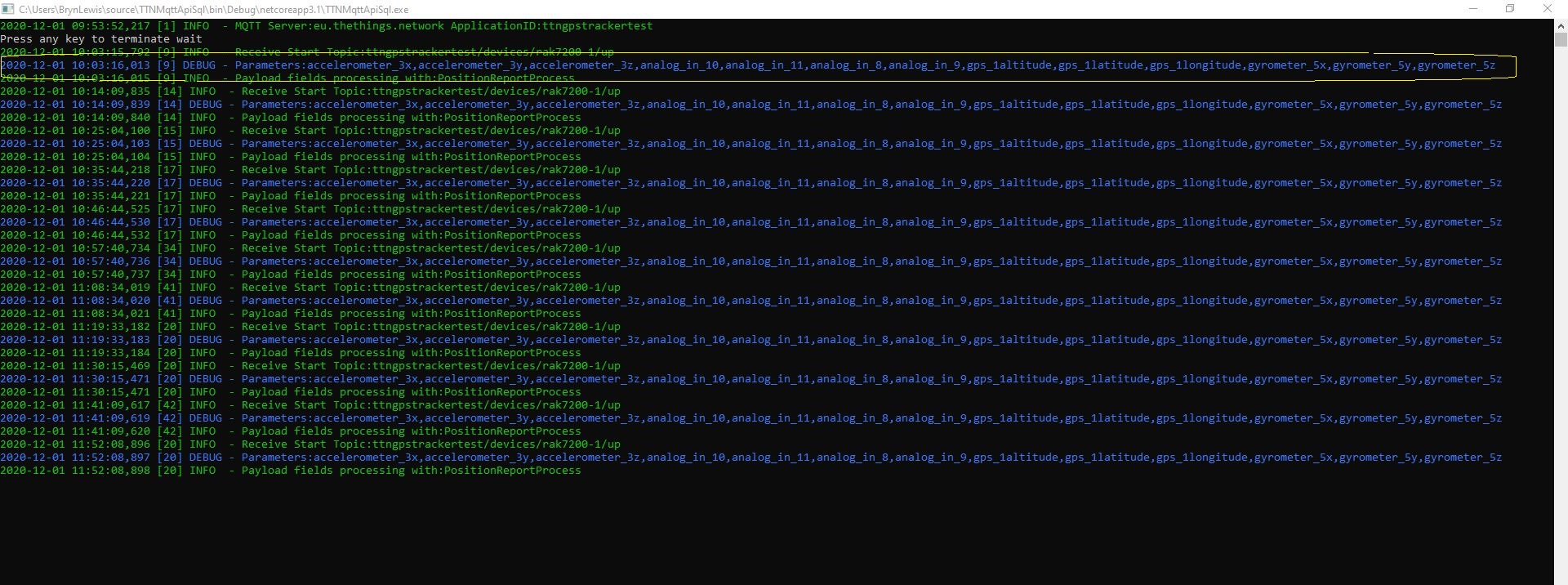
Unpacked LPP payload from GPS tracker displayed in TTN application data viewFlattened location, acceleration and rotation information
CREATE TABLE [dbo].[PositionReport](
      [PositionReportUID] [UNIQUEIDENTIFIER] NOT NULL,
      [ReceivedAtUtC] [DATETIME] NOT NULL,
      [DeviceID] [NVARCHAR](32) NOT NULL,
      [DeviceEui] [NVARCHAR](32) NOT NULL,
      [ApplicationID] [NVARCHAR](32) NOT NULL,
      [IsConfirmed] [BIT] NOT NULL,
      [IsRetry] [BIT] NOT NULL,
      [Port] [SMALLINT] NOT NULL,
      [Latitude] [FLOAT] NOT NULL,
      [Longitude] [FLOAT] NOT NULL,
      [Altitude] [FLOAT] NOT NULL,
 CONSTRAINT [PK_PositionReport] PRIMARY KEY CLUSTERED
(
	[PositionReportUID] ASC
)WITH (PAD_INDEX = OFF, STATISTICS_NORECOMPUTE = OFF, IGNORE_DUP_KEY = OFF, ALLOW_ROW_LOCKS = ON, ALLOW_PAGE_LOCKS = ON) ON [PRIMARY]
) ON [PRIMARY]
GO
I created a database table to store values of only the fields I cared about.
CREATE PROCEDURE [dbo].[PositionReportProcess]
      @ReceivedAtUtc AS DATETIME,
      @DeviceID AS NVARCHAR(32),
      @DeviceEui AS NVARCHAR(32),
      @ApplicationID AS NVARCHAR(32),
      @IsRetry AS Bit,
      @IsConfirmed AS BIT,
      @Port AS SMALLINT,
      @accelerometer_3x AS FLOAT,
      @accelerometer_3y AS FLOAT,
      @accelerometer_3z AS FLOAT,
      @analog_in_8 AS FLOAT,
      @analog_in_9 AS FLOAT,
      @analog_in_10 AS FLOAT,
      @analog_in_11 AS FLOAT,
      @gps_1Latitude AS FLOAT,
      @gps_1Longitude AS FLOAT,
      @gps_1Altitude AS FLOAT,
      @gyrometer_5x  AS FLOAT,
      @gyrometer_5y  AS FLOAT,
      @gyrometer_5z  AS FLOAT
AS
BEGIN
   SET NOCOUNT ON;

   INSERT INTO [dbo].[PositionReport]
      ([PositionReportUID]
      .[ReceivedAtUtc]
      ,[DeviceID]
      ,[DeviceEui]
      ,[ApplicationID]
      ,[IsConfirmed]
      ,[IsRetry]
      ,[Port]
      ,Latitude
      ,Longitude
      ,Altitude)
   VALUES
   (
      @ReceivedAtUtc,
      @DeviceID,
      @DeviceEui,
      @ApplicationID,
      @IsConfirmed,
      @IsRetry,
      @port,
      @gps_1Latitude,
      @gps_1Longitude,
      @gps_1Altitude)
END
The stored procedure for storing the GPS tracker payload has to have parameters matching each payload field but some of the fields are not used.
Location data displayed in SQL Server Management Studio(SSMS)
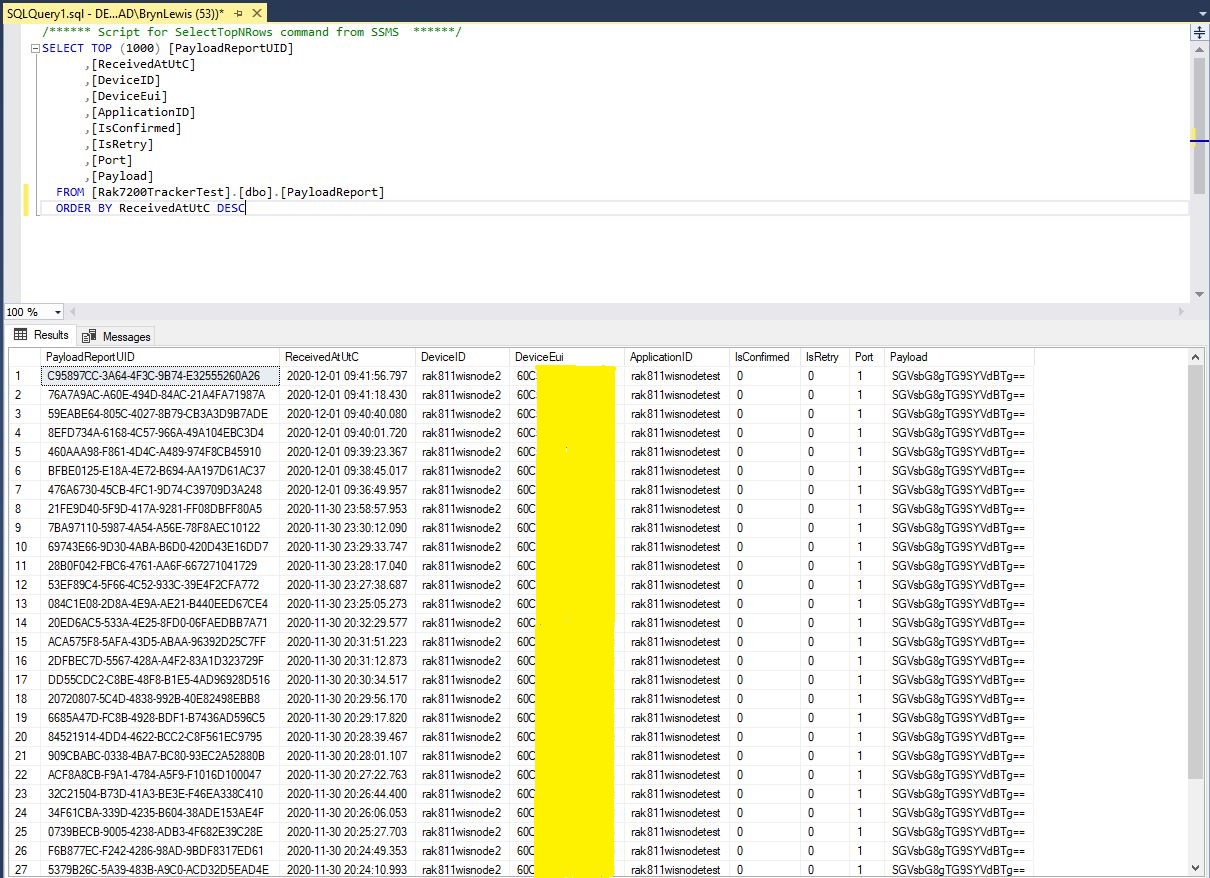
For uplink messages with no payload fields the message processor looks for a stored procedure with a single parameter called “payload_raw”.(there maybe more than one match)
CREATE TABLE [dbo].[PayloadReport](
      [PayloadReportUID] [UNIQUEIDENTIFIER] NOT NULL,
      [ReceivedAtUtC] [DATETIME] NOT NULL,
      [DeviceID] [NVARCHAR](32) NOT NULL,
      [DeviceEui] [NVARCHAR](32) NOT NULL,
      [ApplicationID] [NVARCHAR](32) NOT NULL,
      [IsConfirmed] [BIT] NOT NULL,
      [IsRetry] [BIT] NOT NULL,
      [Port] [SMALLINT] NOT NULL,
      [Payload] [NVARCHAR](128) NOT NULL,
CONSTRAINT [PK_PayloadReport] PRIMARY KEY CLUSTERED
(
      [PayloadReportUID] ASC
)WITH (PAD_INDEX = OFF, STATISTICS_NORECOMPUTE = OFF, IGNORE_DUP_KEY = OFF, ALLOW_ROW_LOCKS = ON, ALLOW_PAGE_LOCKS = ON) ON [PRIMARY]
) ON [PRIMARY]
GO

ALTER TABLE [dbo].[PayloadReport] ADD  CONSTRAINT [DF_PayloadReport_PositionReportUID]  DEFAULT (NEWID()) FOR [PayloadReportUID]
GO
ALTER PROCEDURE [dbo].[PayloadRawProcess]
      @ReceivedAtUtc AS DATETIME,
      @DeviceID AS NVARCHAR(32),
      @DeviceEui AS NVARCHAR(32),
      @ApplicationID AS NVARCHAR(32),
      @IsRetry AS Bit,
      @IsConfirmed AS BIT,
      @Port AS SMALLINT,
      @Payload AS NVARCHAR(128)
AS
BEGIN
      SET NOCOUNT ON;

      INSERT INTO [dbo].[PayloadReport]
         ([PositionReportUID]
         .[ReceivedAtUtc]
         ,[DeviceID]
         ,[DeviceEui]
         ,[ApplicationID]
         ,[IsConfirmed]
         ,[IsRetry]
         ,[Port]
         ,[Payload])
     VALUES(@ReceivedAtUtc,
         @DeviceID,
         @DeviceEui,
         @ApplicationID,
         @IsConfirmed,
         @IsRetry,
         @port,
         @Payload)
END
Raw payload data displayed in SQL Server Management Studio(SSMS)
Initially the application just used Console.Writeline for logging, then I added Log4Net because it would be useful to persist information about failures and so I could copy n paste parameter lists to the appSettings.json file.
The console application uses MQTTNet to connect to TTN. It subscribes to to the TTN application device uplink topic (did try subscribing to the uplink messages for all the devices in the application, and the downlink message scheduled, sent and acknowledged topics.
I tried a lot of topic formats with and without wildcards to see which worked best
I generated new classes from the ones provided in the documentation then added any obvious missing fields and fine tuned the data types by delving into the TTN V3GO code.
The new messages payloads have significant differences to the V2 ones. I have refactored the generated classes to reduce the duplication of code and fix up datatypes e.g. int32 vs. ulong where JSON2Charp couldn’t infer the size of the number.
namespace devMobile.TheThingsNetwork.Models
{
   public class ApplicationIds
   {
      public string application_id { get; set; }
   }

   public class EndDeviceIds
   {
      public string device_id { get; set; }
      public ApplicationIds application_ids { get; set; }
      public string dev_eui { get; set; }
      public string join_eui { get; set; }
      public string dev_addr { get; set; }
   }
}
I wonder about the naming of the applicationIds class as it appears that it could only ever contain single applicationId.
I installed the tooling for GO support into Visual Studio Code and went looking for the uplink message definition which I think is in messages.pb.go (still learning go and how the TTN GO source is structured).
type ApplicationUplink struct {
	// Join Server issued identifier for the session keys used by this uplink.
	SessionKeyID []byte `protobuf:"bytes,1,opt,name=session_key_id,json=sessionKeyId,proto3" json:"session_key_id,omitempty"`
	FPort        uint32 `protobuf:"varint,2,opt,name=f_port,json=fPort,proto3" json:"f_port,omitempty"`
	FCnt         uint32 `protobuf:"varint,3,opt,name=f_cnt,json=fCnt,proto3" json:"f_cnt,omitempty"`
	// The frame payload of the uplink message.
	// The payload is still encrypted if the skip_payload_crypto field of the EndDevice
	// is true, which is indicated by the presence of the app_s_key field.
	FRMPayload []byte `protobuf:"bytes,4,opt,name=frm_payload,json=frmPayload,proto3" json:"frm_payload,omitempty"`
	// The decoded frame payload of the uplink message.
	// This field is set by the message processor that is configured for the end device (see formatters) or application (see default_formatters).
	DecodedPayload *types.Struct `protobuf:"bytes,5,opt,name=decoded_payload,json=decodedPayload,proto3" json:"decoded_payload,omitempty"`
	// Warnings generated by the message processor while decoding the frm_payload.
	DecodedPayloadWarnings []string `protobuf:"bytes,12,rep,name=decoded_payload_warnings,json=decodedPayloadWarnings,proto3" json:"decoded_payload_warnings,omitempty"`
	// A list of metadata for each antenna of each gateway that received this message.
	RxMetadata []*RxMetadata `protobuf:"bytes,6,rep,name=rx_metadata,json=rxMetadata,proto3" json:"rx_metadata,omitempty"`
	// Settings for the transmission.
	Settings TxSettings `protobuf:"bytes,7,opt,name=settings,proto3" json:"settings"`
	// Server time when the Network Server received the message.
	ReceivedAt time.Time `protobuf:"bytes,8,opt,name=received_at,json=receivedAt,proto3,stdtime" json:"received_at"`
	// The AppSKey of the current session.
	// This field is only present if the skip_payload_crypto field of the EndDevice
	// is true.
	// Can be used to decrypt uplink payloads and encrypt downlink payloads.
	AppSKey *KeyEnvelope `protobuf:"bytes,9,opt,name=app_s_key,json=appSKey,proto3" json:"app_s_key,omitempty"`
	// The last AFCntDown of the current session.
	// This field is only present if the skip_payload_crypto field of the EndDevice
	// is true.
	// Can be used with app_s_key to encrypt downlink payloads.
	LastAFCntDown uint32 `protobuf:"varint,10,opt,name=last_a_f_cnt_down,json=lastAFCntDown,proto3" json:"last_a_f_cnt_down,omitempty"`
	Confirmed     bool   `protobuf:"varint,11,opt,name=confirmed,proto3" json:"confirmed,omitempty"`
	// Consumed airtime for the transmission of the uplink message. Calculated by Network Server using the RawPayload size and the transmission settings.
	ConsumedAirtime *time.Duration `protobuf:"bytes,13,opt,name=consumed_airtime,json=consumedAirtime,proto3,stdduration" json:"consumed_airtime,omitempty"`
	// End device location metadata, set by the Application Server while handling the message.
	Locations            map[string]*Location `protobuf:"bytes,14,rep,name=locations,proto3" json:"locations,omitempty" protobuf_key:"bytes,1,opt,name=key,proto3" protobuf_val:"bytes,2,opt,name=value,proto3"`
	XXX_NoUnkeyedLiteral struct{}             `json:"-"`
	XXX_sizecache        int32                `json:"-"`
}
I also need to deploy some more gateways and devices to check that I haven’t missed any fields available in more realistic environments.
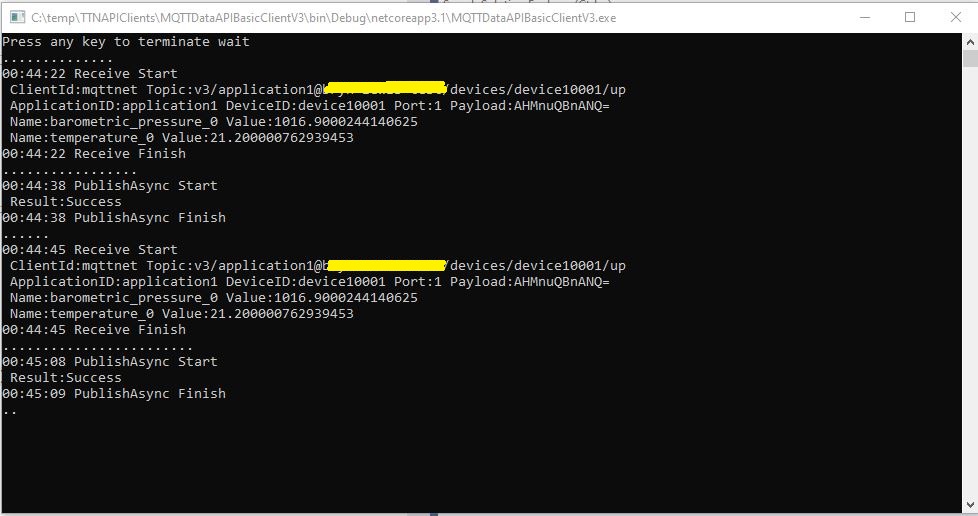
TTN V3 MQTT Console client
In the TTN Device data tab I could see messages being sent, to and received from from the simulated device.
TTN V3 MQTT Device Live Data
The next step is to get downlink messages working, then connect up a couple of gateways and trial with some real devices.
The console application uses MQTTNet to connect to TTN. It subscribes to to the TTN application device uplink topic (did try subscribing to the uplink messages for all the devices in the application but this was to noisy), and the downlink message scheduled, sent and acknowledged topics. To send messages to the device I published them on the device downlink topic.
As I’m testing my Message Queue Telemetry Transport(MQTT) LoRa gateway I’m building a proof of concept(PoC) .Net core console application for each IoT platform I would like to support.
This PoC was to confirm that I could connect to the AllThingsTalkMQTT API then format topics and payloads correctly.
MQTTNet Console Client
The AllThingsTalk MQTT broker, username, and device ID are required command line parameters.
namespace devmobile.Mqtt.TestClient.AllThingsTalk
{
	using System;
	using System.Diagnostics;
	using System.Threading;
	using System.Threading.Tasks;

	using MQTTnet;
	using MQTTnet.Client;
	using MQTTnet.Client.Disconnecting;
	using MQTTnet.Client.Options;
	using MQTTnet.Client.Receiving;

	using Newtonsoft.Json;
	using Newtonsoft.Json.Linq;

	class Program
	{
		private static IMqttClient mqttClient = null;
		private static IMqttClientOptions mqttOptions = null;
		private static string server;
		private static string username;
		private static string deviceID;

		static void Main(string[] args)
		{
			MqttFactory factory = new MqttFactory();
			mqttClient = factory.CreateMqttClient();

			if ((args.Length != 3))
			{
				Console.WriteLine("[MQTT Server] [UserName] [ClientID]");
				Console.WriteLine("Press <enter> to exit");
				Console.ReadLine();
				return;
			}

			server = args[0];
			username = args[1];
			deviceID = args[2];

			Console.WriteLine($"MQTT Server:{server} DeviceID:{deviceID}");

			// AllThingsTalk formatted device state update topic
			string topicD2C = $"device/{deviceID}/state";

			mqttOptions = new MqttClientOptionsBuilder()
				.WithTcpServer(server)
				.WithCredentials(username, "HighlySecurePassword")
				.WithClientId(deviceID)
				.WithTls()
				.Build();

			mqttClient.UseDisconnectedHandler(new MqttClientDisconnectedHandlerDelegate(e => MqttClient_Disconnected(e)));
			mqttClient.UseApplicationMessageReceivedHandler(new MqttApplicationMessageReceivedHandlerDelegate(e => MqttClient_ApplicationMessageReceived(e)));
			mqttClient.ConnectAsync(mqttOptions).Wait();

			// AllThingsTalk formatted device command with wildcard topic
			string topicC2D = $"device/{deviceID}/asset/+/command";

			mqttClient.SubscribeAsync(topicC2D, MQTTnet.Protocol.MqttQualityOfServiceLevel.AtLeastOnce).GetAwaiter().GetResult();

			while (true)
			{
				JObject payloadJObject = new JObject();

				double temperature = 22.0 + (DateTime.UtcNow.Millisecond / 1000.0);
				temperature = Math.Round( temperature, 1 );
				double humidity = 50 + (DateTime.UtcNow.Millisecond / 100.0);
				humidity = Math.Round(humidity, 1);

				JObject temperatureJObject = new JObject
				{
					{ "value", temperature }
				};
				payloadJObject.Add("Temperature", temperatureJObject);

				JObject humidityJObject = new JObject
				{
					{ "value", humidity }
				};
				payloadJObject.Add("Humidity", humidityJObject);

				string payload = JsonConvert.SerializeObject(payloadJObject);
				Console.WriteLine($"Topic:{topicD2C} Payload:{payload}");

				var message = new MqttApplicationMessageBuilder()
					.WithTopic(topicD2C)
					.WithPayload(payload)
					.WithAtMostOnceQoS()
//					.WithAtLeastOnceQoS()
					.Build();

				Console.WriteLine("PublishAsync start");
				mqttClient.PublishAsync(message).Wait();
				Console.WriteLine("PublishAsync finish");

				Thread.Sleep(15100);
			}
		}

		private static void MqttClient_ApplicationMessageReceived(MqttApplicationMessageReceivedEventArgs e)
		{
			Console.WriteLine($"ClientId:{e.ClientId} Topic:{e.ApplicationMessage.Topic} Payload:{e.ApplicationMessage.ConvertPayloadToString()}");
		}

		private static async void MqttClient_Disconnected(MqttClientDisconnectedEventArgs e)
		{
			Debug.WriteLine("Disconnected");
			await Task.Delay(TimeSpan.FromSeconds(5));

			try
			{
				await mqttClient.ConnectAsync(mqttOptions);
			}
			catch (Exception ex)
			{
				Debug.WriteLine("Reconnect failed {0}", ex.Message);
			}
		}
	}
The AllThingsTalk device configuration was relatively easy but I need to investigate “Gateway” functionality and configuration further.
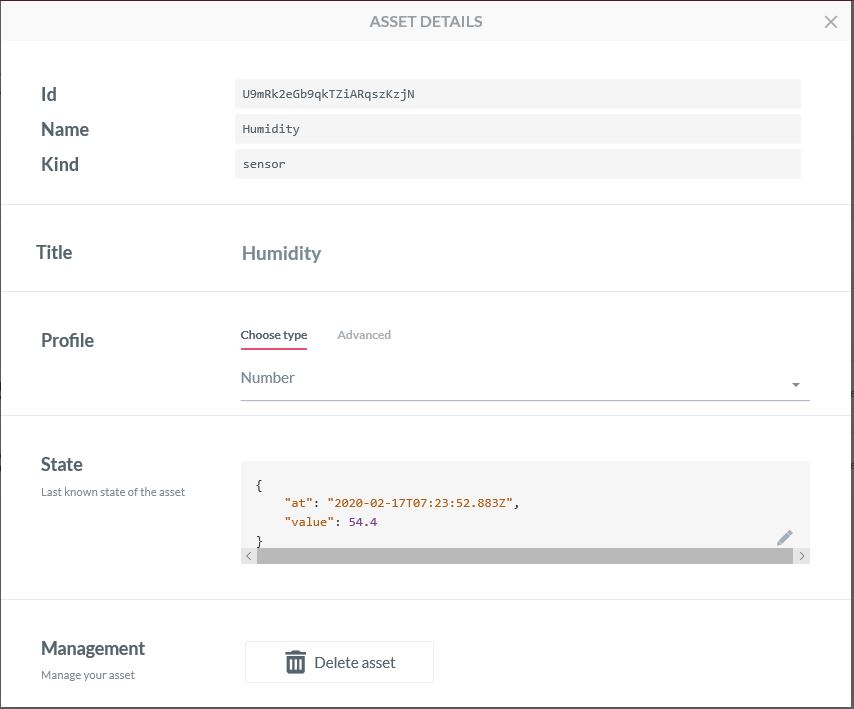
Configuring an Asset
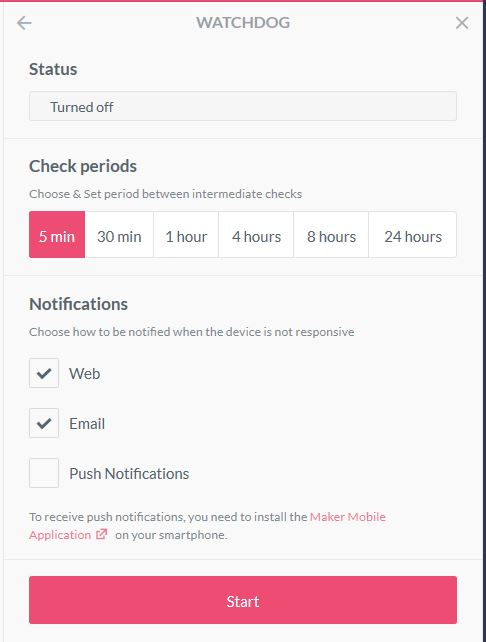
Configuration a watchdog to check for sensor data
Sending a command to an actuatorProcessing a command on the client
The ability to look at message payloads in the Debug tab would be very helpful when working out why a payload was not being processed as expected.
Asset debug information
Overall the AllThingsTalk configuration went fairly smoothly, though I need to investigate the “Gateway” configuration and functionality further. The way that assets are name by the system could make support in my MQTT Gateway more complex.
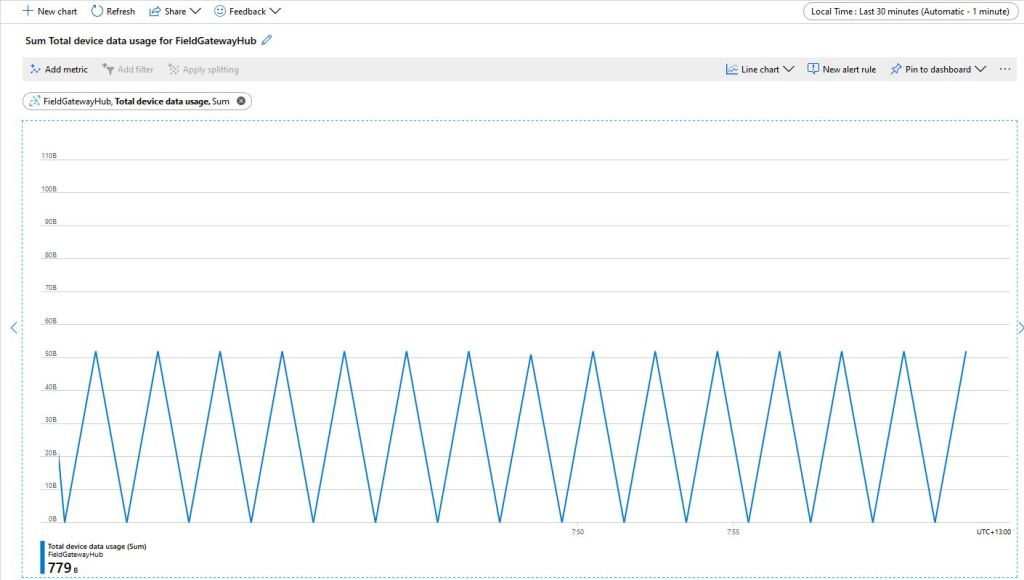
The size of the packets sent and the total device data appeared to map pretty well but I was also interested in the Transport Layer Security (TLS) and Messaging Queuing Telemetry Transport (MQTT) overheads.
Azure IoT Hub Metrics
To get an idea of the overheads I fired up LiveTcpUdpWatch by Nirsoft and noted down the traffic measure on port 8883.
Conenction LiveTcpUdpWatch main screen
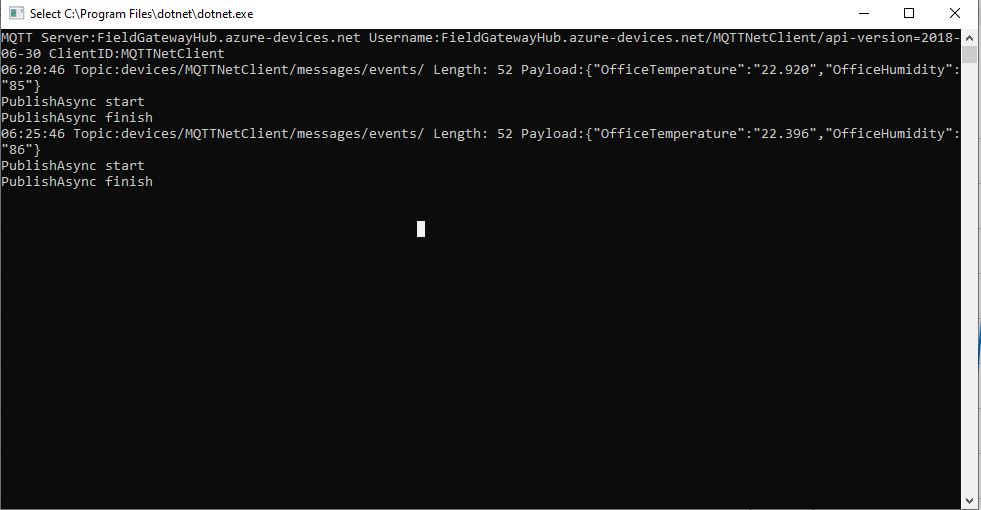
Launching the MQTTNet client sending every 30 seconds resulted in traffic like this
So it looks like my very rough numbers are close to the numbers discussed in the above article. I need to explore the impact of keep-alive messages and other background operations.
As I’m testing my Message Queue Telemetry Transport(MQTT) LoRa gateway I’m building a proof of concept(PoC) .Net core console application for each IoT platform I would like to support.
This PoC was to confirm that I could connect to the Bosch IoT SuiteMQTT API then format topics and payloads correctly.
MQTTNet Console Client
The Bosch IoT Hub MQTT broker, username, password, and clientID are the required command line parameters. For this PoC I ran out of time to get cloud to device (C2D) messaging or any presentation functionality working.
/*
    Copyright ® 2019 December devMobile Software, All Rights Reserved

    MIT License

    Permission is hereby granted, free of charge, to any person obtaining a copy
    of this software and associated documentation files (the "Software"), to deal
    in the Software without restriction, including without limitation the rights
    to use, copy, modify, merge, publish, distribute, sublicense, and/or sell
    copies of the Software, and to permit persons to whom the Software is
    furnished to do so, subject to the following conditions:

    The above copyright notice and this permission notice shall be included in all
    copies or substantial portions of the Software.

    THE SOFTWARE IS PROVIDED "AS IS", WITHOUT WARRANTY OF ANY KIND, EXPRESS OR
    IMPLIED, INCLUDING BUT NOT LIMITED TO THE WARRANTIES OF MERCHANTABILITY,
    FITNESS FOR A PARTICULAR PURPOSE AND NONINFRINGEMENT. IN NO EVENT SHALL THE
    AUTHORS OR COPYRIGHT HOLDERS BE LIABLE FOR ANY CLAIM, DAMAGES OR OTHER
    LIABILITY, WHETHER IN AN ACTION OF CONTRACT, TORT OR OTHERWISE, ARISING FROM,
    OUT OF OR IN CONNECTION WITH THE SOFTWARE OR THE USE OR OTHER DEALINGS IN THE
    SOFTWARE

	 A quick and dirty test client to explore how BoschIoT Suite MQTT connectivity works
 */
namespace devMobile.Mqtt.TestClient.BoschIoTSuite
{
   using System;
   using System.Diagnostics;
   using System.Threading;
   using System.Threading.Tasks;

   using MQTTnet;
   using MQTTnet.Client;
   using MQTTnet.Client.Disconnecting;
   using MQTTnet.Client.Options;
   using MQTTnet.Client.Receiving;
   using Newtonsoft.Json;
   using Newtonsoft.Json.Linq;

   class Program
   {
      private static IMqttClient mqttClient = null;
      private static IMqttClientOptions mqttOptions = null;
      private static string server;
      private static string username;
      private static string password;
      private static string clientId;

      static void Main(string[] args)
      {
         MqttFactory factory = new MqttFactory();
         mqttClient = factory.CreateMqttClient();

         if (args.Length != 4)
         {
            Console.WriteLine("[MQTT Server] [UserName] [Password] [ClientID]");
            Console.WriteLine("Press <enter> to exit");
            Console.ReadLine();
            return;
         }

         server = args[0];
         username = args[1];
         password = args[2];
         clientId = args[3];

         mqttOptions = new MqttClientOptionsBuilder()
            .WithTcpServer(server)
            .WithCredentials(username, password)
            .WithClientId(clientId)
            .WithTls()
            .Build();

         mqttClient.UseDisconnectedHandler(new MqttClientDisconnectedHandlerDelegate(e => MqttClient_Disconnected(e)));
         mqttClient.UseApplicationMessageReceivedHandler(new MqttApplicationMessageReceivedHandlerDelegate(e => MqttClient_ApplicationMessageReceived(e)));
         mqttClient.ConnectAsync(mqttOptions).Wait();

         string topicD2C = "telemetry";

         while (true)
         {
            JObject payloadJObject = new JObject();

            payloadJObject.Add("OfficeTemperature", "22." + DateTime.UtcNow.Millisecond.ToString());
            payloadJObject.Add("OfficeHumidity", (DateTime.UtcNow.Second + 40).ToString());

            string payload = JsonConvert.SerializeObject(payloadJObject);
            Console.WriteLine($"Topic:{topicD2C} Payload:{payload}");

            var message = new MqttApplicationMessageBuilder()
               .WithTopic(topicD2C)
               .WithPayload(payload)
               .WithAtMostOnceQoS() // Anthing but this causes timeout
               .WithRetainFlag()
            .Build();

            Console.WriteLine("PublishAsync start");
            mqttClient.PublishAsync(message).Wait();
            Console.WriteLine("PublishAsync finish");

            Thread.Sleep(30100);
         }
      }

      private static void MqttClient_ApplicationMessageReceived(MqttApplicationMessageReceivedEventArgs e)
      {
         Console.WriteLine($"ClientId:{e.ClientId} Topic:{e.ApplicationMessage.Topic} Payload:{e.ApplicationMessage.ConvertPayloadToString()}");
      }

      private static async void MqttClient_Disconnected(MqttClientDisconnectedEventArgs e)
      {
         Debug.WriteLine("Disconnected");
         await Task.Delay(TimeSpan.FromSeconds(5));

         try
         {
            await mqttClient.ConnectAsync(mqttOptions);
         }
         catch (Exception ex)
         {
            Debug.WriteLine("Reconnect failed {0}", ex.Message);
         }
      }
   }
}
The bosch IoT Hub device configuration was via a swagger API but I need to spend some more time figuring out how to configure the data analysis and presentation tools.
I adapted the steps in the IoT Hub Documentation for Sending Device Data using MQTT. The first step was to create a free Hub subscription.
IoT Hub Subscription
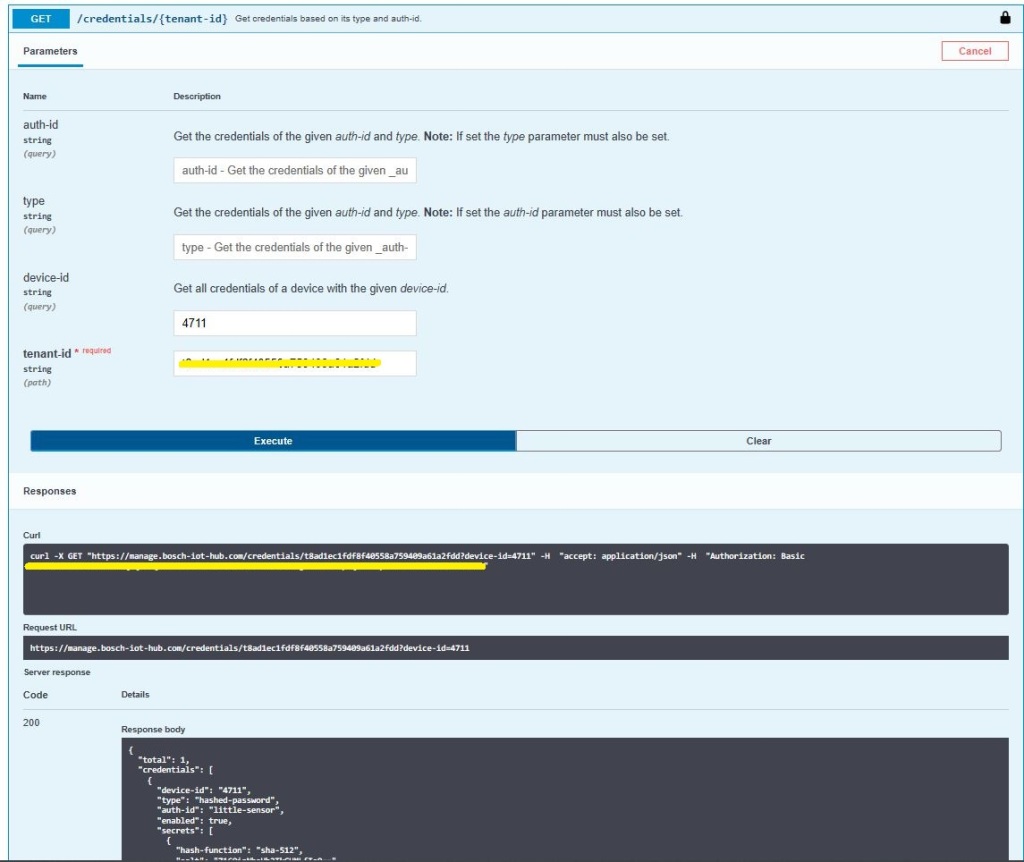
Then using the device registry swagger UI page to add a new device.
Device Registry Swagger UI
After a couple of failed attempts I worked out the format of the Authorisation details (I think the username format in the online documentation might be wrong)
Swagger UI Authorisation formQuerying the available devices
Of the 10+ SaaS IoT services I have setup the Bosch IoT Suite was the hardest to get working. I think this was becuase it is meant to be managed via the API from a in-house application. In a future post I’ll get configure the cloud to device messaging, plus analysis and display functionality.











 devMobile's blog