Rfm9xLoRaDevice NetMF Payload CRCs

To ensure I was only handling messages with valid contents I added code to appended a cyclic redundancy check(CRC) onto outbound messages and validate the CRC on inbound messages.

First step was to update the initialise method parameter list (the parameter list is huge but for most scenarios the defaults are fine)

public void Initialise(RegOpModeMode regOpModeAfterInitialise, // RegOpMode
         double frequency = FrequencyDefault, // RegFrMsb, RegFrMid, RegFrLsb
         bool rxDoneignoreIfCrcMissing = true, bool rxDoneignoreIfCrcInvalid = true,
         bool paBoost = false, byte maxPower = RegPAConfigMaxPowerDefault, byte outputPower = RegPAConfigOutputPowerDefault, // RegPaConfig
         bool ocpOn = true, byte ocpTrim = RegOcpOcpTrimDefault, // RegOcp
         RegLnaLnaGain lnaGain = LnaGainDefault, bool lnaBoost = false, // RegLna
         RegModemConfigBandwidth bandwidth = RegModemConfigBandwidthDefault, RegModemConfigCodingRate codingRate = RegModemConfigCodingRateDefault, RegModemConfigImplicitHeaderModeOn implicitHeaderModeOn = RegModemConfigImplicitHeaderModeOnDefault, //RegModemConfig1
         RegModemConfig2SpreadingFactor spreadingFactor = RegModemConfig2SpreadingFactorDefault, bool txContinuousMode = false, bool rxPayloadCrcOn = false,
         ushort symbolTimeout = SymbolTimeoutDefault,
         ushort preambleLength = PreambleLengthDefault,
         byte payloadLength = PayloadLengthDefault,
         byte payloadMaxLength = PayloadMaxLengthDefault,
         byte freqHoppingPeriod = FreqHoppingPeriodDefault,
         bool lowDataRateOptimize = false, bool agcAutoOn = false,
         byte ppmCorrection = ppmCorrectionDefault,
         RegDetectOptimizeDectionOptimize detectionOptimize = RegDetectOptimizeDectionOptimizeDefault,
         bool invertIQ = false,
         RegisterDetectionThreshold detectionThreshold = RegisterDetectionThresholdDefault,
         byte syncWord = RegSyncWordDefault)

The rxPayloadCrcOn needs to be set to True for outbound messages to have a CRC.

Then in the RxDone interrupt handler the CRC is checked (regHopChannel & regIrqFlagsMask) if this feature is enabled. Any messages with missing\invalid CRCs will currently be silently discarded and I’m not certain this is a good idea.

 // Check to see if payload has CRC
         if (RxDoneIgnoreIfCrcMissing)
         {
            byte regHopChannel = this.Rfm9XLoraModem.ReadByte((byte)Registers.RegHopChannel);
            if ((regHopChannel & (byte)RegHopChannelFlags.CrcOnPayload) != (byte)RegHopChannelFlags.CrcOnPayload)
            {
               return;
            }
         }

         // Check to see if payload CRC is valid
         if (RxDoneIgnoreIfCrcInvalid)
         {
            if (((byte)IrqFlags & (byte)RegIrqFlagsMask.PayLoadCrcErrorMask) == (byte)RegIrqFlagsMask.PayLoadCrcErrorMask)
            {
               return;
            }
         }

The conversion of the payload from an array of bytes to a string for display stopped failing with an exception. When I had a number of clients running up to 10% of the messages were getting corrupted.

Rfm9xLoRaDevice NetMF SNR and RSSI

The signal to noise Ratio (SNR) and Received Signal Strength Indication(RSSI) for inbound messages required reading values from three registers
•RegPktSnrValue
•RegPktRssiValue
•RegRssiValue

I had to modify the OnDataRecievedHandler method signature so the values could be returned

 public delegate void OnDataRecievedHandler(float packetSnr, int packetRssi, int rssi, byte[] data);

I was inspired by the RSSI adjustment approach used in the Arduino-LoRa library

// Get the RSSI HF vs. LF port adjustment section 5.5.5 RSSI and SNR in LoRa Mode
float packetSnr = this.Rfm9XLoraModem.ReadByte((byte)Registers.RegPktSnrValue) * 0.25f;

int rssi = this.Rfm9XLoraModem.ReadByte((byte)Registers.RegRssiValue);
if (Frequency > RFMidBandThreshold)
{
  rssi = RssiAdjustmentHF + rssi;
}
else
{
  rssi = RssiAdjustmentLF + rssi;
}

int packetRssi = this.Rfm9XLoraModem.ReadByte((byte)Registers.RegPktRssiValue);
if (Frequency > RFMidBandThreshold)
{
  packetRssi = RssiAdjustmentHF + packetRssi;
}
else
{
  packetRssi = RssiAdjustmentLF + packetRssi;
}

OnDataReceived?.Invoke( packetSnr, packetRssi, rssi, messageBytes);

The values displayed in the Rfm9xLoRaDeviceClient application looked reasonable, but will need further checking

00:06:14-Rfm9X PacketSnr 9.8 Packet RSSI -47dBm RSSI -111dBm = 28 byte message "Hello W10 IoT Core LoRa! 182"
Sending 20 bytes message Hello NetMF LoRa! 38
Transmit-Done
00:06:24-Rfm9X PacketSnr 9.8 Packet RSSI -48dBm RSSI -111dBm = 28 byte message "Hello W10 IoT Core LoRa! 181"
Sending 20 bytes message Hello NetMF LoRa! 39
Transmit-Done
00:06:34-Rfm9X PacketSnr 9.8 Packet RSSI -47dBm RSSI -112dBm = 28 byte message "Hello W10 IoT Core LoRa! 180"
Sending 20 bytes message Hello NetMF LoRa! 40
Transmit-Done
00:06:44-Rfm9X PacketSnr 10.0 Packet RSSI -48dBm RSSI -111dBm = 28 byte message "Hello W10 IoT Core LoRa! 179"


RFM9X.NetMF on Github

After a month of posts the source code of V0.9 of my RFM9X/SX127X library is on GitHub. I included all of the source for my test harness and proof of concept(PoC) applications so other people can follow along with “my learning experience”.

I need to trial with some more hardware, frequency bands, variety of clients, initialisation configurations and backport the last round of fixes from my .Net library.

The simplest possible application .NetMF using the new library

/---------------------------------------------------------------------------------
// Copyright (c) August 2018, devMobile Software
//
// Licensed under the Apache License, Version 2.0 (the "License");
// you may not use this file except in compliance with the License.
// You may obtain a copy of the License at
//
//     http://www.apache.org/licenses/LICENSE-2.0
//
// Unless required by applicable law or agreed to in writing, software
// distributed under the License is distributed on an "AS IS" BASIS,
// WITHOUT WARRANTIES OR CONDITIONS OF ANY KIND, either express or implied.
// See the License for the specific language governing permissions and
// limitations under the License.
//
//---------------------------------------------------------------------------------
namespace devMobile.IoT.NetMF.Rfm9X.Client
{
using System;
using System.Text;
using System.Threading;
using devMobile.IoT.NetMF.ISM;
using Microsoft.SPOT;
using SecretLabs.NETMF.Hardware.Netduino;

public class Program
{
public static void Main()
{
Rfm9XDevice rfm9XDevice = new Rfm9XDevice(Pins.GPIO_PIN_D10, Pins.GPIO_PIN_D9, Pins.GPIO_PIN_D2);
byte MessageCount = Byte.MinValue;

rfm9XDevice.Initialise( Rfm9XDevice.RegOpModeMode.ReceiveContinuous, 915000000, paBoost: true, rxPayloadCrcOn: true);
rfm9XDevice.OnDataReceived += rfm9XDevice_OnDataReceived;
rfm9XDevice.OnTransmit += rfm9XDevice_OnTransmit;

while (true)
{
string messageText = "Hello NetMF LoRa! " + MessageCount.ToString();
MessageCount += 1;
byte[] messageBytes = UTF8Encoding.UTF8.GetBytes(messageText);
Debug.Print("Sending " + messageBytes.Length + " bytes message " + messageText);
rfm9XDevice.SendMessage(messageBytes);

Thread.Sleep(10000);
}
}

static void rfm9XDevice_OnTransmit()
{
Debug.Print("Transmit-Done");
}

static void rfm9XDevice_OnDataReceived(byte[] data)
{
try
{
string messageText = new string(UTF8Encoding.UTF8.GetChars(data));

Debug.Print("Received " + data.Length.ToString() + " byte message " + messageText);
}
catch (Exception ex)
{
Debug.Print(ex.Message);
}
}
}
}

// Dirty hack for Rosyln
namespace System.Diagnostics
{
public enum DebuggerBrowsableState
{
Never = 0,
Collapsed = 2,
RootHidden = 3
}
}

I need to do more testing (especially of the initialisation options) and will add basic device addressing soon so my field gateway will only see messages which it is interested in.

Re-reading the SX1276 datasheet

I sat down and read the Semtech SX1276 datasheet paying close attention to any references to CRCs and headers. Then to test some ideas I modified my Receive Basic test harness to see if I could reliably reproduce the problem with my stress test harness.LoRaStress2

public sealed class StartupTask : IBackgroundTask
	{
		private const int ChipSelectLine = 25;
		private const int ResetLine = 17;
		private Rfm9XDevice rfm9XDevice = new Rfm9XDevice(ChipSelectLine, ResetLine);

		public void Run(IBackgroundTaskInstance taskInstance)
		{
			// Put device into LoRa + Sleep mode
			rfm9XDevice.RegisterWriteByte(0x01, 0b10000000); // RegOpMode 

			// Set the frequency to 915MHz
			byte[] frequencyWriteBytes = { 0xE4, 0xC0, 0x00 }; // RegFrMsb, RegFrMid, RegFrLsb
			rfm9XDevice.RegisterWrite(0x06, frequencyWriteBytes);

			rfm9XDevice.RegisterWriteByte(0x0F, 0x0); // RegFifoRxBaseAddress 

			rfm9XDevice.RegisterWriteByte(0x01, 0b10000101); // RegOpMode set LoRa & RxContinuous

			while (true)
			{
				// Wait until a packet is received, no timeouts in PoC
				Debug.WriteLine("Receive-Wait");
				byte IrqFlags = rfm9XDevice.RegisterReadByte(0x12); // RegIrqFlags
				while ((IrqFlags & 0b01000000) == 0)  // wait until RxDone cleared
				{
					Task.Delay(20).Wait();
					IrqFlags = rfm9XDevice.RegisterReadByte(0x12); // RegIrqFlags
					Debug.Write(".");
				}
				Debug.WriteLine("");

				if ((IrqFlags & 0b00100000) == 0b00100000)
				{
					Debug.WriteLine("Payload CRC error");
				}

				byte regHopChannel = rfm9XDevice.RegisterReadByte(0x1C);
				Debug.WriteLine(string.Format("regHopChannel {0}", Convert.ToString((byte)regHopChannel, 2).PadLeft(8, '0')));

				byte currentFifoAddress = rfm9XDevice.RegisterReadByte(0x10); // RegFifiRxCurrent
				rfm9XDevice.RegisterWriteByte(0x0d, currentFifoAddress); // RegFifoAddrPtr*
				byte numberOfBytes = rfm9XDevice.RegisterReadByte(0x13); // RegRxNbBytes

				// Allocate buffer for message
				byte[] messageBytes = new byte[numberOfBytes];

				for (int i = 0; i < numberOfBytes; i++)
				{
					messageBytes[i] = rfm9XDevice.RegisterReadByte(0x00); // RegFifo
				}
				rfm9XDevice.RegisterWriteByte(0x12, 0xff); // RegIrqFlags clear all the bits

				string messageText = UTF8Encoding.UTF8.GetString(messageBytes);
				Debug.WriteLine("Received {0} byte message {1}", messageBytes.Length, messageText);
				Debug.WriteLine(string.Format("RegIrqFlags {0}", Convert.ToString((byte)IrqFlags, 2).PadLeft(8, '0')));
				Debug.WriteLine("Receive-Done");
			}
		}
	}

The RegHopChannel register has a flag indicating whether there was a CRC extracted from the packet header.

regHopChannel 00000000
Received 23 byte message 1 Hello Arduino LoRa! 1
RegIrqFlags 01010000
Receive-Done
Receive-Wait
…………………………..
regHopChannel 00000000
Received 23 byte message 1 Hello Arduino LoRa! 2
RegIrqFlags 01010000
Receive-Done
Receive-Wait
……………………………
regHopChannel 00000000
Received 23 byte message 1 Hello Arduino LoRa! 3
RegIrqFlags 01010000
Receive-Done
Receive-Wait

I then modified my Arduino-LoRa library based client to include a CRC

void setup() {
  Serial.begin(9600);                   // initialize serial
  while (!Serial);

  Serial.println("LoRa Duplex - Set sync word");

  // override the default CS, reset, and IRQ pins (optional)
  LoRa.setPins(csPin, resetPin, irqPin);// set CS, reset, IRQ pin

  if (!LoRa.begin(915E6)) {             // initialize ratio at 915 MHz
    Serial.println("LoRa init failed. Check your connections.");
    while (true);                       // if failed, do nothing
  }

  LoRa.enableCrc();  // BHL This was my change

  LoRa.setSyncWord(0x12);           // ranges from 0-0xFF, default 0x34, see API docs

  LoRa.dumpRegisters(Serial);
  Serial.println("LoRa init succeeded.");
}

void loop() {
  if (millis() - lastSendTime > interval) {
    String message = "5 Hello Arduino LoRa! ";   // send a message
    message += msgCount;
    sendMessage(message);
    Serial.println("Sending " + message);
    lastSendTime = millis();            // timestamp the message
    //interval = random(2000) + 1000;    // 2-3 seconds
    interval = 1000;
  }

  // parse for a packet, and call onReceive with the result:
  onReceive(LoRa.parsePacket());
}

void sendMessage(String outgoing) {
  LoRa.beginPacket();                   // start packet
  LoRa.print(outgoing);                 // add payload
  LoRa.endPacket();                     // finish packet and send it
  msgCount++;                           // increment message ID
}

void onReceive(int packetSize) {
  if (packetSize == 0) return;          // if there's no packet, return

  // read packet header bytes:
  String incoming = "";

  while (LoRa.available()) {
    incoming += (char)LoRa.read();
  }

  Serial.println("Message: " + incoming);
  Serial.println("RSSI: " + String(LoRa.packetRssi()));
  Serial.println("Snr: " + String(LoRa.packetSnr()));
  Serial.println();
}

When I powered up a single client and the payload had a CRC

...............................
regHopChannel 01000000
Received 23 byte message 6 Hello Arduino LoRa! 6
RegIrqFlags 01010000
Receive-Done
Receive-Wait
.................................
regHopChannel 01000000
Received 23 byte message 6 Hello Arduino LoRa! 7
RegIrqFlags 01010000
Receive-Done
Receive-Wait
.................................
regHopChannel 01000000
Received 23 byte message 6 Hello Arduino LoRa! 8
RegIrqFlags 01010000
Receive-Done
Receive-Wait
...............................

Then when I increased the number of clients I started getting corrupted messages with CRC errors.

Received 24 byte message 6 Hello Arduino LoRa! 32
RegIrqFlags 01010000
Receive-Done
Receive-Wait
...............
regHopChannel 01000001
Received 25 byte message 8 Hello Arduino LoRa! 114
RegIrqFlags 01010000
Receive-Done
Receive-Wait
Payload CRC error
regHopChannel 01000000
Received 24 byte message s��=��(��p�^j�\ʏ�����
RegIrqFlags 01100000
Receive-Done
Receive-Wait
.............
regHopChannel 01000000
Received 24 byte message 6 Hello Arduino LoRa! 33
RegIrqFlags 01010000
Receive-Done
Receive-Wait
...............
regHopChannel 01000001
Received 25 byte message 8 Hello Arduino LoRa! 115
RegIrqFlags 01010000
Receive-Done
Receive-Wait

I need to do some more testing but now I think the problem was the RegIrqFlags PayloadCRCError flag was never going to get set because there was no CRC on the payload.

.Net MicroFramework LoRa library Part9

Receive and Transmit Interrupts

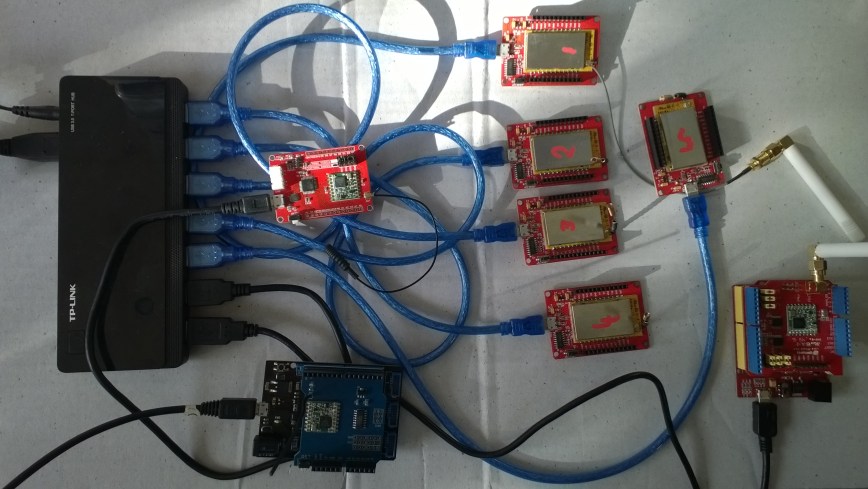
For the second to last development iteration of my RFM9X LoRa NetMF library client I have got the interrupt handler working for transmitting and receiving messages. My code sends a message every 10 seconds then goes back to waiting in receive mode .

//---------------------------------------------------------------------------------
// Copyright (c) August 2018, devMobile Software
//
// Licensed under the Apache License, Version 2.0 (the "License");
// you may not use this file except in compliance with the License.
// You may obtain a copy of the License at
//
//     http://www.apache.org/licenses/LICENSE-2.0
//
// Unless required by applicable law or agreed to in writing, software
// distributed under the License is distributed on an "AS IS" BASIS,
// WITHOUT WARRANTIES OR CONDITIONS OF ANY KIND, either express or implied.
// See the License for the specific language governing permissions and
// limitations under the License.
//
//---------------------------------------------------------------------------------
namespace devMobile.IoT.NetMF.Rfm9X.ReceiveTransmitInterrupt
{
   using System;
   using System.Text;
   using System.Threading;
   using Microsoft.SPOT;
   using Microsoft.SPOT.Hardware;
   using SecretLabs.NETMF.Hardware.Netduino;

   public sealed class Rfm9XDevice
   {
      private const byte RegisterAddressReadMask = 0X7f;
      private const byte RegisterAddressWriteMask = 0x80;

      private SPI Rfm9XLoraModem = null;
      private OutputPort ResetGpioPin = null;
      private InterruptPort InterruptPin = null;

      public Rfm9XDevice(Cpu.Pin chipSelect, Cpu.Pin resetPin, Cpu.Pin interruptPin)
      {
         // Factory reset pin configuration
         ResetGpioPin = new OutputPort(Pins.GPIO_PIN_D9, true);
         ResetGpioPin.Write(false);
         Thread.Sleep(10);
         ResetGpioPin.Write(true);
         Thread.Sleep(10);

         this.Rfm9XLoraModem = new SPI(new SPI.Configuration(chipSelect, false, 0, 0, false, false, 2000, SPI.SPI_module.SPI1));

         InterruptPin = new InterruptPort(interruptPin, false, Port.ResistorMode.Disabled, Port.InterruptMode.InterruptEdgeHigh);

         InterruptPin.OnInterrupt += InterruptPin_OnInterrupt;

         Thread.Sleep(100);
      }

      public Rfm9XDevice(Cpu.Pin chipSelect, Cpu.Pin reset)
      {
         // Factory reset pin configuration
         ResetGpioPin = new OutputPort(Pins.GPIO_PIN_D9, true);
         ResetGpioPin.Write(false);
         Thread.Sleep(10);
         ResetGpioPin.Write(true);
         Thread.Sleep(10);

         this.Rfm9XLoraModem = new SPI(new SPI.Configuration(chipSelect, false, 0, 0, false, false, 2000, SPI.SPI_module.SPI1));

         Thread.Sleep(100);
      }

      public Byte RegisterReadByte(byte registerAddress)
      {
         byte[] writeBuffer = new byte[] { registerAddress };
         byte[] readBuffer = new byte[1];
         Debug.Assert(Rfm9XLoraModem != null);

         Rfm9XLoraModem.WriteRead(writeBuffer, readBuffer, 1);

         return readBuffer[0];
      }

      public ushort RegisterReadWord(byte address)
      {
         byte[] writeBuffer = new byte[] { address &= RegisterAddressReadMask };
         byte[] readBuffer = new byte[2];
         Debug.Assert(Rfm9XLoraModem != null);

         readBuffer[0] = RegisterReadByte(address);
         readBuffer[1] = RegisterReadByte(address += 1);

         return (ushort)(readBuffer[1] + (readBuffer[0] << 8));
      }

      public byte[] RegisterRead(byte address, int length)
      {
         byte[] writeBuffer = new byte[] { address &= RegisterAddressReadMask };
         byte[] readBuffer = new byte[length];
         Debug.Assert(Rfm9XLoraModem != null);

         for (byte index = 0; index < length; index++)
         {
            readBuffer[index] = RegisterReadByte(address += 1);
         }

         return readBuffer;
      }

      public void RegisterWriteByte(byte address, byte value)
      {
         byte[] writeBuffer = new byte[] { address |= RegisterAddressWriteMask, value };
         Debug.Assert(Rfm9XLoraModem != null);

         Rfm9XLoraModem.Write(writeBuffer);
      }

      public void RegisterWriteWord(byte address, ushort value)
      {
         byte[] valueBytes = BitConverter.GetBytes(value);
         byte[] writeBuffer = new byte[] { address |= RegisterAddressWriteMask, valueBytes[0], valueBytes[1] };
         Debug.Assert(Rfm9XLoraModem != null);

         Rfm9XLoraModem.Write(writeBuffer);
      }

      public void RegisterWrite(byte address, byte[] bytes)
      {
         byte[] writeBuffer = new byte[1 + bytes.Length];
         Debug.Assert(Rfm9XLoraModem != null);

         Array.Copy(bytes, 0, writeBuffer, 1, bytes.Length);
         writeBuffer[0] = address |= RegisterAddressWriteMask;

         Rfm9XLoraModem.Write(writeBuffer);
      }

      public void RegisterDump()
      {
         Debug.Print("---Registers 0x00 thru 0x42---");
         for (byte registerIndex = 0; registerIndex  4];

         // Mask off the upper 4 bits to get the rest of it.
         hexString += hexChars[singlebyte & 0x0F];

         return hexString;
      }

      private static string WordToHexString(ushort singleword)
      {
         string hexString = string.Empty;

         byte[] bytes = BitConverter.GetBytes(singleword);

         hexString += ByteToHexString(bytes[1]);

         hexString += ByteToHexString(bytes[0]);

         return hexString;
      }

      public class Program
      {
         public static void Main()
         {
            Rfm9XDevice rfm9XDevice = new Rfm9XDevice(Pins.GPIO_PIN_D10, Pins.GPIO_PIN_D9, Pins.GPIO_PIN_D2);
            byte MessageCount = Byte.MinValue;

            // Put device into LoRa + Sleep mode
            rfm9XDevice.RegisterWriteByte(0x01, 0x80); // RegOpMode 

            // Set the frequency to 915MHz
            byte[] frequencyWriteBytes = { 0xE4, 0xC0, 0x00 }; // RegFrMsb, RegFrMid, RegFrLsb
            rfm9XDevice.RegisterWrite(0x06, frequencyWriteBytes);

            rfm9XDevice.RegisterWriteByte(0x0F, 0x0); // RegFifoRxBaseAddress 

            // More power - PA_BOOST
            rfm9XDevice.RegisterWriteByte(0x09, 0x80); // RegPaConfig

            //rfm9XDevice.RegisterWriteByte(0x40, 0x0);

            rfm9XDevice.RegisterWriteByte(0x01, 0x85); // RegOpMode set LoRa & RxContinuous

            while (true)
            {
               rfm9XDevice.RegisterWriteByte(0x0E, 0x0); // RegFifoTxBaseAddress 

               // Set the Register Fifo address pointer
               rfm9XDevice.RegisterWriteByte(0x0D, 0x0); // RegFifoAddrPtr 

               string messageText = "Hello NetMF LoRa! " + MessageCount.ToString() ;
               MessageCount += 1;

               // load the message into the fifo
               byte[] messageBytes = UTF8Encoding.UTF8.GetBytes(messageText);
               foreach (byte b in messageBytes)
               {
                  rfm9XDevice.RegisterWriteByte(0x0, b); // RegFifo
               }

               // Set the length of the message in the fifo
               rfm9XDevice.RegisterWriteByte(0x22, (byte)messageBytes.Length); // RegPayloadLength

               rfm9XDevice.RegisterWriteByte(0x40, 0x40); // RegDioMapping1 

               /// Set the mode to LoRa + Transmit
               rfm9XDevice.RegisterWriteByte(0x01, 0x83); // RegOpMode
               Debug.Print("Sending " + messageBytes.Length + " bytes message " + messageText);

               Thread.Sleep(10000);
            }
         }
      }
   }
}

On the Netduino3 device messages were being sent and received

The thread '' (0x2) has exited with code 0 (0x0).
Sending 19 bytes message Hello NetMF LoRa! 0
RegIrqFlags 08
Transmit-Done
Sending 19 bytes message Hello NetMF LoRa! 1
RegIrqFlags 08
Transmit-Done
Sending 19 bytes message Hello NetMF LoRa! 2
RegIrqFlags 08
Transmit-Done
Sending 19 bytes message Hello NetMF LoRa! 3
RegIrqFlags 08
Transmit-Done
RegIrqFlags 50
Receive-Message
Received 15 byte message HeLoRa World! 0
RegIrqFlags 50
Receive-Message
Received 15 byte message HeLoRa World! 2
Sending 19 bytes message Hello NetMF LoRa! 4
RegIrqFlags 08
Transmit-Done
RegIrqFlags 50
Receive-Message

On my Windows 10 Core device I could see messages arriving

RegIrqFlags 01010000
RX-Done
Received 19 byte message Hello NetMF LoRa! 1
The thread 0x168 has exited with code 0 (0x0).
RegIrqFlags 01010000
RX-Done
Received 19 byte message Hello NetMF LoRa! 2
The thread 0x8 has exited with code 0 (0x0).
RegIrqFlags 01010000
RX-Done

This library is going to be quite a bit smaller/lighter than my Windows 10 IoT Core one so the next so next step event handlers and refactoring.
.Net MicroFramework LoRa library Part8

Receive Interrupt

After getting interrupts to work for outbound messages I changed the interrupt pin D10 mapping and the interrupt mask.

Getting this working with my RPI meant the process went relatively smoothly.

//---------------------------------------------------------------------------------
// Copyright (c) August 2018, devMobile Software
//
// Licensed under the Apache License, Version 2.0 (the "License");
// you may not use this file except in compliance with the License.
// You may obtain a copy of the License at
//
//     http://www.apache.org/licenses/LICENSE-2.0
//
// Unless required by applicable law or agreed to in writing, software
// distributed under the License is distributed on an "AS IS" BASIS,
// WITHOUT WARRANTIES OR CONDITIONS OF ANY KIND, either express or implied.
// See the License for the specific language governing permissions and
// limitations under the License.
//
//---------------------------------------------------------------------------------
namespace devMobile.IoT.NetMF.Rfm9X.ReceiveInterrupt
{
   using System;
   using System.Text;
   using System.Threading;
   using Microsoft.SPOT;
   using Microsoft.SPOT.Hardware;
   using SecretLabs.NETMF.Hardware.Netduino;

   public sealed class Rfm9XDevice
   {
      private const byte RegisterAddressReadMask = 0X7f;
      private const byte RegisterAddressWriteMask = 0x80;

      private SPI Rfm9XLoraModem = null;
      private OutputPort ResetGpioPin = null;
      private InterruptPort InterruptPin = null;

      public Rfm9XDevice(Cpu.Pin chipSelect, Cpu.Pin resetPin, Cpu.Pin interruptPin)
      {
         // Factory reset pin configuration
         ResetGpioPin = new OutputPort(Pins.GPIO_PIN_D9, true);
         ResetGpioPin.Write(false);
         Thread.Sleep(10);
         ResetGpioPin.Write(true);
         Thread.Sleep(10);

         this.Rfm9XLoraModem = new SPI(new SPI.Configuration(chipSelect, false, 0, 0, false, false, 2000, SPI.SPI_module.SPI1));

         InterruptPin = new InterruptPort(interruptPin, false, Port.ResistorMode.Disabled, Port.InterruptMode.InterruptEdgeHigh);

         InterruptPin.OnInterrupt += InterruptPin_OnInterrupt;

         Thread.Sleep(100);
      }

      public Rfm9XDevice(Cpu.Pin chipSelect, Cpu.Pin reset)
      {
         // Factory reset pin configuration
         ResetGpioPin = new OutputPort(Pins.GPIO_PIN_D9, true);
         ResetGpioPin.Write(false);
         Thread.Sleep(10);
         ResetGpioPin.Write(true);
         Thread.Sleep(10);

         this.Rfm9XLoraModem = new SPI(new SPI.Configuration(chipSelect, false, 0, 0, false, false, 2000, SPI.SPI_module.SPI1));

         Thread.Sleep(100);
      }

      public Byte RegisterReadByte(byte registerAddress)
      {
         byte[] writeBuffer = new byte[] { registerAddress };
         byte[] readBuffer = new byte[1];
         Debug.Assert(Rfm9XLoraModem != null);

         Rfm9XLoraModem.WriteRead(writeBuffer, readBuffer, 1);

         return readBuffer[0];
      }

      public ushort RegisterReadWord(byte address)
      {
         byte[] writeBuffer = new byte[] { address &= RegisterAddressReadMask };
         byte[] readBuffer = new byte[2];
         Debug.Assert(Rfm9XLoraModem != null);

         readBuffer[0] = RegisterReadByte(address);
         readBuffer[1] = RegisterReadByte(address += 1);

         return (ushort)(readBuffer[1] + (readBuffer[0] << 8));
      }

      public byte[] RegisterRead(byte address, int length)
      {
         byte[] writeBuffer = new byte[] { address &= RegisterAddressReadMask };
         byte[] readBuffer = new byte[length];
         Debug.Assert(Rfm9XLoraModem != null);

         for (byte index = 0; index < length; index++)
         {
            readBuffer[index] = RegisterReadByte(address += 1);
         }

         return readBuffer;
      }

      public void RegisterWriteByte(byte address, byte value)
      {
         byte[] writeBuffer = new byte[] { address |= RegisterAddressWriteMask, value };
         Debug.Assert(Rfm9XLoraModem != null);

         Rfm9XLoraModem.Write(writeBuffer);
      }

      public void RegisterWriteWord(byte address, ushort value)
      {
         byte[] valueBytes = BitConverter.GetBytes(value);
         byte[] writeBuffer = new byte[] { address |= RegisterAddressWriteMask, valueBytes[0], valueBytes[1] };
         Debug.Assert(Rfm9XLoraModem != null);

         Rfm9XLoraModem.Write(writeBuffer);
      }

      public void RegisterWrite(byte address, byte[] bytes)
      {
         byte[] writeBuffer = new byte[1 + bytes.Length];
         Debug.Assert(Rfm9XLoraModem != null);

         Array.Copy(bytes, 0, writeBuffer, 1, bytes.Length);
         writeBuffer[0] = address |= RegisterAddressWriteMask;

         Rfm9XLoraModem.Write(writeBuffer);
      }

      public void RegisterDump()
      {
         Debug.Print("---Registers 0x00 thru 0x42---");
         for (byte registerIndex = 0; registerIndex  4];

         // Mask off the upper 4 bits to get the rest of it.
         hexString += hexChars[singlebyte & 0x0F];

         return hexString;
      }

      private static string WordToHexString(ushort singleword)
      {
         string hexString = string.Empty;

         byte[] bytes = BitConverter.GetBytes(singleword);

         hexString += ByteToHexString(bytes[1]);

         hexString += ByteToHexString(bytes[0]);

         return hexString;
      }

      public class Program
      {
         public static void Main()
         {
            Rfm9XDevice rfm9XDevice = new Rfm9XDevice(Pins.GPIO_PIN_D10, Pins.GPIO_PIN_D9, Pins.GPIO_PIN_D2);
            byte MessageCount = byte.MinValue;

            // Put device into LoRa + Sleep mode
            rfm9XDevice.RegisterWriteByte(0x01, 0x80); // RegOpMode 

            // Set the frequency to 915MHz
            byte[] frequencyWriteBytes = { 0xE4, 0xC0, 0x00 }; // RegFrMsb, RegFrMid, RegFrLsb
            rfm9XDevice.RegisterWrite(0x06, frequencyWriteBytes);

            rfm9XDevice.RegisterWriteByte(0x0F, 0x0); // RegFifoRxBaseAddress 

            rfm9XDevice.RegisterWriteByte(0x40, 0x0); // RegDioMapping1 0b00000000 DIO0 RxReady & TxReady

            rfm9XDevice.RegisterWriteByte(0x01, 0x85); // RegOpMode set LoRa & RxContinuous

            Thread.Sleep(Timeout.Infinite);
         }
      }
   }
}

In the Visual Studio debug output window I could see received packets

'Microsoft.SPOT.Debugger.CorDebug.dll' (Managed): Loaded 'C:\Program Files (x86)\Secret Labs\Netduino SDK\Assemblies\v4.3\le\SecretLabs.NETMF.Hardware.dll', Symbols loaded.
The thread '' (0x2) has exited with code 0 (0x0).
RegIrqFlags 50
Receive-Message
Received 28 byte message Hello W10 IoT Core LoRa! 247
RegIrqFlags 50
Receive-Message
Received 28 byte message Hello W10 IoT Core LoRa! 246
RegIrqFlags 50
Receive-Message

Next, I’ll integrate the .NetMF receive and transmit interrupt examples, and then refactor the code to extract the RFM9X code into a reusable module.


.Net MicroFramework LoRa library Part7

Transmit Interrupt

Starting with the TransmitBasic sample application I modified the code so that a hardware interrupt (specified by SX1276 RegDioMapping1) was generated on TxDone (FIFO Payload Transmission completed).

The application inserts a message into the SX1276 transmit FIFO every 10 seconds with confirmation of transmission displayed shortly afterwards

//---------------------------------------------------------------------------------
// Copyright (c) August 2018, devMobile Software
//
// Licensed under the Apache License, Version 2.0 (the "License");
// you may not use this file except in compliance with the License.
// You may obtain a copy of the License at
//
//     http://www.apache.org/licenses/LICENSE-2.0
//
// Unless required by applicable law or agreed to in writing, software
// distributed under the License is distributed on an "AS IS" BASIS,
// WITHOUT WARRANTIES OR CONDITIONS OF ANY KIND, either express or implied.
// See the License for the specific language governing permissions and
// limitations under the License.
//
//---------------------------------------------------------------------------------
namespace devMobile.IoT.NetMF.Rfm9X.TransmitInterrupt
{
	using System;
	using System.Text;
	using System.Threading;
	using Microsoft.SPOT;
	using Microsoft.SPOT.Hardware;
	using SecretLabs.NETMF.Hardware.Netduino;

	public sealed class Rfm9XDevice
	{
		private const byte RegisterAddressReadMask = 0X7f;
		private const byte RegisterAddressWriteMask = 0x80;

		private SPI Rfm9XLoraModem = null;
		private OutputPort ResetGpioPin = null;
		private InterruptPort InterruptPin = null;

		public Rfm9XDevice(Cpu.Pin chipSelect, Cpu.Pin resetPin, Cpu.Pin interruptPin)
		{
			// Factory reset pin configuration
			ResetGpioPin = new OutputPort(Pins.GPIO_PIN_D9, true);
			ResetGpioPin.Write(false);
			Thread.Sleep(10);
			ResetGpioPin.Write(true);
			Thread.Sleep(10);

			this.Rfm9XLoraModem = new SPI(new SPI.Configuration(chipSelect, false, 0, 0, false, false, 2000, SPI.SPI_module.SPI1));

			InterruptPin = new InterruptPort(interruptPin, false, Port.ResistorMode.Disabled, Port.InterruptMode.InterruptEdgeHigh);

			InterruptPin.OnInterrupt += InterruptPin_OnInterrupt;

			Thread.Sleep(100);
		}

		public Byte RegisterReadByte(byte registerAddress)
		{
			byte[] writeBuffer = new byte[] { registerAddress };
			byte[] readBuffer = new byte[1];
			Debug.Assert(Rfm9XLoraModem != null);

			Rfm9XLoraModem.WriteRead(writeBuffer, readBuffer, 1);

			return readBuffer[0];
		}

		public ushort RegisterReadWord(byte address)
		{
			byte[] writeBuffer = new byte[] { address &= RegisterAddressReadMask };
			byte[] readBuffer = new byte[2];
			Debug.Assert(Rfm9XLoraModem != null);

			readBuffer[0] = RegisterReadByte(address);
			readBuffer[1] = RegisterReadByte(address += 1);

			return (ushort)(readBuffer[1] + (readBuffer[0] << 8));
		}

		public byte[] RegisterRead(byte address, int length)
		{
			byte[] writeBuffer = new byte[] { address &= RegisterAddressReadMask };
			byte[] readBuffer = new byte[length];
			Debug.Assert(Rfm9XLoraModem != null);

			for (byte index = 0; index  4];

			// Mask off the upper 4 bits to get the rest of it.
			hexString += hexChars[singlebyte & 0x0F];

			return hexString;
		}

		private static string WordToHexString(ushort singleword)
		{
			string hexString = string.Empty;

			byte[] bytes = BitConverter.GetBytes(singleword);

			hexString += ByteToHexString(bytes[1]);

			hexString += ByteToHexString(bytes[0]);

			return hexString;
		}

		void InterruptPin_OnInterrupt(uint data1, uint data2, DateTime time)
		{
			byte IrqFlags = this.RegisterReadByte(0x12); // RegIrqFlags
			Debug.Print("RegIrqFlags " + ByteToHexString(IrqFlags));

			if ((IrqFlags & 0x08) == 0x08)  // TxDone
			{
				Debug.Print("Transmit-Done");
			}

			this.RegisterWriteByte(0x12, 0xff);// RegIrqFlags
		}

		public class Program
		{
			public static void Main()
			{
				Rfm9XDevice rfm9XDevice = new Rfm9XDevice(Pins.GPIO_PIN_D10, Pins.GPIO_PIN_D9, Pins.GPIO_PIN_D2);
				byte MessageCount = byte.MinValue;

				while (true)
				{
					// Put device into LoRa + Sleep mode
					rfm9XDevice.RegisterWriteByte(0x01, 0x80); // RegOpMode 

					// Set the frequency to 915MHz
					byte[] frequencyWriteBytes = { 0xE4, 0xC0, 0x00 }; // RegFrMsb, RegFrMid, RegFrLsb
					rfm9XDevice.RegisterWrite(0x06, frequencyWriteBytes);

					// More power - PA_BOOST
					rfm9XDevice.RegisterWriteByte(0x09, 0x80); // RegPaConfig

					// Interrupt on TxDone
					rfm9XDevice.RegisterWriteByte(0x40, 0x40); // RegDioMapping1 0b00000000 DI0 TxDone

					while (true)
					{
						rfm9XDevice.RegisterWriteByte(0x0E, 0x0); // RegFifoTxBaseAddress 

						// Set the Register Fifo address pointer
						rfm9XDevice.RegisterWriteByte(0x0D, 0x0); // RegFifoAddrPtr 

						string messageText = "Hello NetMF LoRa! ";
						if (MessageCount != 0)
						{
							messageText += "-" + MessageCount.ToString();
						}
						else
						{
							messageText += MessageCount.ToString();
						}
						MessageCount += 1;

						// load the message into the fifo
						byte[] messageBytes = UTF8Encoding.UTF8.GetBytes(messageText);
						foreach (byte b in messageBytes)
						{
							rfm9XDevice.RegisterWriteByte(0x0, b); // RegFifo
						}

						// Set the length of the message in the fifo
						rfm9XDevice.RegisterWriteByte(0x22, (byte)messageBytes.Length); // RegPayloadLength

						Debug.Print("Sending " + messageBytes.Length + " bytes message " + messageText);
						/// Set the mode to LoRa + Transmit
						rfm9XDevice.RegisterWriteByte(0x01, 0x83); // RegOpMode 

						Thread.Sleep(10000);
					}
				}
			}
		}

	}
}

Unlike the Windows 10 IoT core version I can configure the interrupt to only trigger on the leading edge.

InterruptPin = new InterruptPort(interruptPin, false, Port.ResistorMode.Disabled, Port.InterruptMode.InterruptEdgeHigh);

In the Debug output window of VS2K12 I could see

The thread '' (0x2) has exited with code 0 (0x0).
Sending 19 bytes message Hello NetMF LoRa! 0
RegIrqFlags 08
Transmit-Done
Sending 20 bytes message Hello NetMF LoRa! -1
RegIrqFlags 08
Transmit-Done
Sending 20 bytes message Hello NetMF LoRa! -2
RegIrqFlags 08
Transmit-Done

On my Arduino device the message arrived

LoRa Receiver Callback
Received packet 'Hello NetMF LoRa! 0' with RSSI -29
Received packet 'Hello NetMF LoRa! -1' with RSSI -29
Received packet 'Hello NetMF LoRa! -2' with RSSI -29
Received packet 'Hello NetMF LoRa! -3' with RSSI -29
Received packet 'Hello NetMF LoRa! -4' with RSSI -29

Next step interrupts for processing inbound messages

.Net MicroFramework LoRa library Part6

Receive Basic

I can configure the device to send messages now I need to configure the SX1276 device to receive them. For my first attempt just simple polling for a message to arrive nothing flash.

//---------------------------------------------------------------------------------
// Copyright (c) August 2018, devMobile Software
//
// Licensed under the Apache License, Version 2.0 (the "License");
// you may not use this file except in compliance with the License.
// You may obtain a copy of the License at
//
//     http://www.apache.org/licenses/LICENSE-2.0
//
// Unless required by applicable law or agreed to in writing, software
// distributed under the License is distributed on an "AS IS" BASIS,
// WITHOUT WARRANTIES OR CONDITIONS OF ANY KIND, either express or implied.
// See the License for the specific language governing permissions and
// limitations under the License.
//
//---------------------------------------------------------------------------------
namespace devMobile.IoT.NetMF.Rfm9X.ReceiveBasic
{
   using System;
   using System.Text;
   using System.Threading;
   using Microsoft.SPOT;
   using Microsoft.SPOT.Hardware;
   using SecretLabs.NETMF.Hardware.Netduino;

   public sealed class Rfm9XDevice
   {
      private const byte RegisterAddressReadMask = 0X7f;
      private const byte RegisterAddressWriteMask = 0x80;

      private SPI Rfm9XLoraModem = null;
      private OutputPort ResetGpioPin = null;

      public Rfm9XDevice(Cpu.Pin chipSelect, Cpu.Pin reset)
      {
         // Factory reset pin configuration
         ResetGpioPin = new OutputPort(Pins.GPIO_PIN_D9, true);
         ResetGpioPin.Write(false);
         Thread.Sleep(10);
         ResetGpioPin.Write(true);
         Thread.Sleep(10);

         this.Rfm9XLoraModem = new SPI(new SPI.Configuration(chipSelect, false, 0, 0, false, false, 2000, SPI.SPI_module.SPI1));

         Thread.Sleep(100);
      }

      public Byte RegisterReadByte(byte registerAddress)
      {
         byte[] writeBuffer = new byte[] { registerAddress };
         byte[] readBuffer = new byte[1];
         Debug.Assert(Rfm9XLoraModem != null);

         Rfm9XLoraModem.WriteRead(writeBuffer, readBuffer, 1);

         return readBuffer[0];
      }

      public ushort RegisterReadWord(byte address)
      {
         byte[] writeBuffer = new byte[] { address &= RegisterAddressReadMask };
         byte[] readBuffer = new byte[2];
         Debug.Assert(Rfm9XLoraModem != null);

         readBuffer[0] = RegisterReadByte(address);
         readBuffer[1] = RegisterReadByte(address += 1);

         return (ushort)(readBuffer[1] + (readBuffer[0] << 8));
      }

      public byte[] RegisterRead(byte address, int length)
      {
         byte[] writeBuffer = new byte[] { address &= RegisterAddressReadMask };
         byte[] readBuffer = new byte[length];
         Debug.Assert(Rfm9XLoraModem != null);

         for (byte index = 0; index < length; index++)
         {
            readBuffer[index] = RegisterReadByte(address += 1);
         }

         return readBuffer;
      }

      public void RegisterWriteByte(byte address, byte value)
      {
         byte[] writeBuffer = new byte[] { address |= RegisterAddressWriteMask, value };
         Debug.Assert(Rfm9XLoraModem != null);

         Rfm9XLoraModem.Write(writeBuffer);
      }

      public void RegisterWriteWord(byte address, ushort value)
      {
         byte[] valueBytes = BitConverter.GetBytes(value);
         byte[] writeBuffer = new byte[] { address |= RegisterAddressWriteMask, valueBytes[0], valueBytes[1] };
         Debug.Assert(Rfm9XLoraModem != null);

         Rfm9XLoraModem.Write(writeBuffer);
      }

      public void RegisterWrite(byte address, byte[] bytes)
      {
         byte[] writeBuffer = new byte[1 + bytes.Length];
         Debug.Assert(Rfm9XLoraModem != null);

         Array.Copy(bytes, 0, writeBuffer, 1, bytes.Length);
         writeBuffer[0] = address |= RegisterAddressWriteMask;

         Rfm9XLoraModem.Write(writeBuffer);
      }

      public void RegisterDump()
      {
         Debug.Print("---Registers 0x00 thru 0x42---");
         for (byte registerIndex = 0; registerIndex  4];

         // Mask off the upper 4 bits to get the rest of it.
         hexString += hexChars[singlebyte & 0x0F];

         return hexString;
      }

      private static string WordToHexString(ushort singleword)
      {
         string hexString = string.Empty;

         byte[] bytes = BitConverter.GetBytes(singleword);

         hexString += ByteToHexString(bytes[1]);

         hexString += ByteToHexString(bytes[0]);

         return hexString;
      }
   }
}

In the debug window I could see messages from one of my arduino devices

The thread '' (0x2) has exited with code 0 (0x0).
Receive-Wait
.
.
.
.
.
.
.

.
.
.
.

Receive-Message
Received 15 byte message HeLoRa World! 0
Receive-Done
Receive-Wait
.
.
.
.
.
.
.
.
.
.
.

Receive-Message
Received 15 byte message HeLoRa World! 2
Receive-Done
Receive-Wait
.
.

Next steps handling inbound & outbound messages with interrupts, then integrating all the samples into a useful functional V1 library.

.Net MicroFramework LoRa library Part5

Transmit Basic

Finally at the point where I can send a message to one of my Windows 10 IoT Core devices. Not going to use interrupts, just putting the bytes to send into the SX1276 Fifo and looping until they are sent.

//---------------------------------------------------------------------------------
// Copyright (c) August 2018, devMobile Software
//
// Licensed under the Apache License, Version 2.0 (the "License");
// you may not use this file except in compliance with the License.
// You may obtain a copy of the License at
//
//     http://www.apache.org/licenses/LICENSE-2.0
//
// Unless required by applicable law or agreed to in writing, software
// distributed under the License is distributed on an "AS IS" BASIS,
// WITHOUT WARRANTIES OR CONDITIONS OF ANY KIND, either express or implied.
// See the License for the specific language governing permissions and
// limitations under the License.
//
//---------------------------------------------------------------------------------
namespace devMobile.IoT.NetMF.Rfm9X.TransmitBasic
{
   using System;
   using System.Text;
   using System.Threading;
   using Microsoft.SPOT;
   using Microsoft.SPOT.Hardware;
   using SecretLabs.NETMF.Hardware.Netduino;

   public sealed class Rfm9XDevice
   {
      private const byte RegisterAddressReadMask = 0X7f;
      private const byte RegisterAddressWriteMask = 0x80;

      private SPI Rfm9XLoraModem = null;
      private OutputPort ResetGpioPin = null;

      public Rfm9XDevice(Cpu.Pin chipSelect, Cpu.Pin reset)
      {
         // Factory reset pin configuration
         ResetGpioPin = new OutputPort(Pins.GPIO_PIN_D9, true);
         ResetGpioPin.Write(false);
         Thread.Sleep(10);
         ResetGpioPin.Write(true);
         Thread.Sleep(10);

         //this.Rfm9XLoraModem = new SPI(new SPI.Configuration(chipSelect, false, 0, 0, false, true, 2000, SPI.SPI_module.SPI1));
         this.Rfm9XLoraModem = new SPI(new SPI.Configuration(chipSelect, false, 0, 0, false, false, 2000, SPI.SPI_module.SPI1));

         Thread.Sleep(100);
      }

      public Byte RegisterReadByte(byte registerAddress)
      {
         byte[] writeBuffer = new byte[] { registerAddress };
         byte[] readBuffer = new byte[1];
         Debug.Assert(Rfm9XLoraModem != null);

         //Rfm9XLoraModem.WriteRead(writeBuffer, readBuffer, 1);
         Rfm9XLoraModem.WriteRead(writeBuffer, readBuffer, 1);

         return readBuffer[0];
      }

      public ushort RegisterReadWord(byte address)
      {
         byte[] writeBuffer = new byte[] { address &amp;= RegisterAddressReadMask };
         byte[] readBuffer = new byte[2];
         Debug.Assert(Rfm9XLoraModem != null);

         //Rfm9XLoraModem.WriteRead(readBuffer, writeBuffer, 1 ); // Check this

         readBuffer[0] = RegisterReadByte(address);
         readBuffer[1] = RegisterReadByte(address += 1);

         return (ushort)(readBuffer[1] + (readBuffer[0] &lt;<span id="mce_SELREST_start" style="overflow:hidden;line-height:0;"></span>&lt; 8));
      }

      public byte[] RegisterRead(byte address, int length)
      {
         byte[] writeBuffer = new byte[] { address &amp;= RegisterAddressReadMask };
         byte[] readBuffer = new byte[length];
         Debug.Assert(Rfm9XLoraModem != null);

         //Rfm9XLoraModem.WriteRead(readBuffer, writeBuffer, 1); // Check this

         for (byte index = 0; index  4];

         // Mask off the upper 4 bits to get the rest of it.
         hexString += hexChars[singlebyte &amp; 0x0F];

         return hexString;
      }

      private static string WordToHexString(ushort singleword)
      {
         string hexString = string.Empty;

         byte[] bytes = BitConverter.GetBytes(singleword);

         hexString += ByteToHexString(bytes[1]);

         hexString += ByteToHexString(bytes[0]);

         return hexString;
      }

   }
}

The debugging output of the device shows the message being transmitted

The thread '' (0x2) has exited with code 0 (0x0).
Sending 17 bytes message Hello NetMF LoRa!
Send-wait
.
.
.
.
.
Send-Done
Sending 17 bytes message Hello NetMF LoRa!
Send-wait
.
.
.
.
.
Send-Done

On my Windows 10 IoT core device I could see the messages arriving

RegIrqFlags 01010000
Receive-Message
Received 17 byte message Hello NetMF LoRa!
The thread 0x6b4 has exited with code 0 (0x0).
Sending 22 bytes message W10 IoT Core LoRa! 252
RegIrqFlags 00001000
Transmit-Done
RegIrqFlags 01010000
Receive-Message
Received 17 byte message Hello NetMF LoRa!
The program '[2932] backgroundTaskHost.exe' has exited with code -1 (0xffffffff).

All default settings for not a lot of range etc. but it works

.Net MicroFramework LoRa library Part4

Register Read and Write

For configuration and operation I extended the RegisterManager class with methods for reading/writing bytes, words and byte arrays.

//---------------------------------------------------------------------------------
// Copyright (c) August 2018, devMobile Software
//
// Licensed under the Apache License, Version 2.0 (the "License");
// you may not use this file except in compliance with the License.
// You may obtain a copy of the License at
//
//     http://www.apache.org/licenses/LICENSE-2.0
//
// Unless required by applicable law or agreed to in writing, software
// distributed under the License is distributed on an "AS IS" BASIS,
// WITHOUT WARRANTIES OR CONDITIONS OF ANY KIND, either express or implied.
// See the License for the specific language governing permissions and
// limitations under the License.
//
//---------------------------------------------------------------------------------
namespace devMobile.IoT.NetMF.Rfm9X.RegisterReadandWrite
{
   using System;
   using System.Threading;
   using Microsoft.SPOT;
   using Microsoft.SPOT.Hardware;
   using SecretLabs.NETMF.Hardware.Netduino;

   public sealed class Rfm9XDevice
   {
      private const byte RegisterAddressReadMask = 0X7f;
      private const byte RegisterAddressWriteMask = 0x80;

      private SPI Rfm9XLoraModem = null;
      private OutputPort ResetGpioPin = null;

      public Rfm9XDevice(Cpu.Pin chipSelect, Cpu.Pin reset)
      {
         // Factory reset pin configuration
         ResetGpioPin = new OutputPort(Pins.GPIO_PIN_D9, true);
         ResetGpioPin.Write(false);
         Thread.Sleep(10);
         ResetGpioPin.Write(true);
         Thread.Sleep(10);

         //this.Rfm9XLoraModem = new SPI(new SPI.Configuration(chipSelect, false, 0, 0, false, true, 2000, SPI.SPI_module.SPI1));
         this.Rfm9XLoraModem = new SPI(new SPI.Configuration(chipSelect, false, 0, 0, false, false, 2000, SPI.SPI_module.SPI1));

         Thread.Sleep(100);
      }

      public Byte RegisterReadByte(byte registerAddress)
      {
         byte[] writeBuffer = new byte[] { registerAddress };
         byte[] readBuffer = new byte[1];
         Debug.Assert(Rfm9XLoraModem != null);

         //Rfm9XLoraModem.WriteRead(writeBuffer, readBuffer, 1);
         Rfm9XLoraModem.WriteRead(writeBuffer, readBuffer, 1 );

         return readBuffer[0];
      }

      public ushort RegisterReadWord(byte address)
      {
         byte[] writeBuffer = new byte[] { address &= RegisterAddressReadMask };
         byte[] readBuffer = new byte[2];
         Debug.Assert(Rfm9XLoraModem != null);

         //Rfm9XLoraModem.WriteRead(readBuffer, writeBuffer, 4 ); // Check this

         readBuffer[0] = RegisterReadByte( address ) ;
         readBuffer[1] = RegisterReadByte(address+=1);

         return (ushort)(readBuffer[1] + (readBuffer[0] << 8));
      }

      public byte[] RegisterRead(byte address, int length)
      {
         byte[] writeBuffer = new byte[] { address &= RegisterAddressReadMask };
         byte[] readBuffer = new byte[length];
         Debug.Assert(Rfm9XLoraModem != null);

         //Rfm9XLoraModem.WriteRead(readBuffer, writeBuffer, 1); // Check this

         for (byte index = 0; index  4];

         // Mask off the upper 4 bits to get the rest of it.
         hexString += hexChars[singlebyte & 0x0F];

         return hexString;
      }

      private static string WordToHexString(ushort singleword)
      {
         string hexString = string.Empty;

         byte[] bytes = BitConverter.GetBytes(singleword);

         hexString += ByteToHexString(bytes[1]);

         hexString += ByteToHexString(bytes[0]);

         return hexString;
      }

   }
}

I had to add an extra "ToHexString" method so I could display the returned byte and word values

Read RegOpMode (read byte)
RegOpMode 0x09
Set LoRa mode and sleep mode (write byte)
Read the preamble (read word)
Preamble 0x0008
Set the preamble to 0x80 (write word)
Read the centre frequency (read byte array)
Frequency Msb 0x80 Mid 0x00 Lsb 0x4F
Set the centre frequency to 916MHz (write byte array)
—Registers 0x00 thru 0x42—
Register 0x00 – Value 0XF4
Register 0x01 – Value 0X80
Register 0x02 – Value 0X1A
Register 0x03 – Value 0X0B
Register 0x04 – Value 0X00
Register 0x05 – Value 0X52
Register 0x06 – Value 0XE4
Register 0x07 – Value 0XC0
Register 0x08 – Value 0X00
Register 0x09 – Value 0X4F
Register 0x0A – Value 0X09
Register 0x0B – Value 0X2B
Register 0x0C – Value 0X20
Register 0x0D – Value 0X01
Register 0x0E – Value 0X80
Register 0x0F – Value 0X00
Register 0x10 – Value 0X00
Register 0x11 – Value 0X00
Register 0x12 – Value 0X00
Register 0x13 – Value 0X00
Register 0x14 – Value 0X00
Register 0x15 – Value 0X00
Register 0x16 – Value 0X00
Register 0x17 – Value 0X00
Register 0x18 – Value 0X10
Register 0x19 – Value 0X00
Register 0x1A – Value 0X00
Register 0x1B – Value 0X00
Register 0x1C – Value 0X00
Register 0x1D – Value 0X72
Register 0x1E – Value 0X70
Register 0x1F – Value 0X64
Register 0x20 – Value 0X80
Register 0x21 – Value 0X00
Register 0x22 – Value 0X01
Register 0x23 – Value 0XFF
Register 0x24 – Value 0X00
Register 0x25 – Value 0X00
Register 0x26 – Value 0X04
Register 0x27 – Value 0X00
Register 0x28 – Value 0X00
Register 0x29 – Value 0X00
Register 0x2A – Value 0X00
Register 0x2B – Value 0X00
Register 0x2C – Value 0X00
Register 0x2D – Value 0X50
Register 0x2E – Value 0X14
Register 0x2F – Value 0X45
Register 0x30 – Value 0X55
Register 0x31 – Value 0XC3
Register 0x32 – Value 0X05
Register 0x33 – Value 0X27
Register 0x34 – Value 0X1C
Register 0x35 – Value 0X0A
Register 0x36 – Value 0X03
Register 0x37 – Value 0X0A
Register 0x38 – Value 0X42
Register 0x39 – Value 0X12
Register 0x3A – Value 0X49
Register 0x3B – Value 0X1D
Register 0x3C – Value 0X00
Register 0x3D – Value 0XAF
Register 0x3E – Value 0X00
Register 0x3F – Value 0X00
Register 0x40 – Value 0X00
Register 0x41 – Value 0X00
Register 0x42 – Value 0X12

The register dump shows the SX1276 is in LoRa+Sleep mode and the preamble is set to 0x80 etc.

The way I read words and arrays of bytes isn’t very efficient will need to revisit when I have more time and/or access to a digital storage scope.