nanoFramework RAK811 LoRaWAN library Part5

Nasty ABP connect

After a successful Over The Air Activation(OTAA) with my RAK811 LPWAN Evaluation Board(EVB) and STM32F691DISCOVERY based test rig. I figured for completeness an Activation by Personalization (ABP) would be a good.

My ABP implementation is based on my OTAA one so is pretty “nasty”. Again, I assumed that there would be no timeouts or failures and I only send one message BCD “48656c6c6f204c6f526157414e” (“hello LoRaWAN”) every 20 seconds.

STM32F691Discovery with EVB plugged into Arduino headers

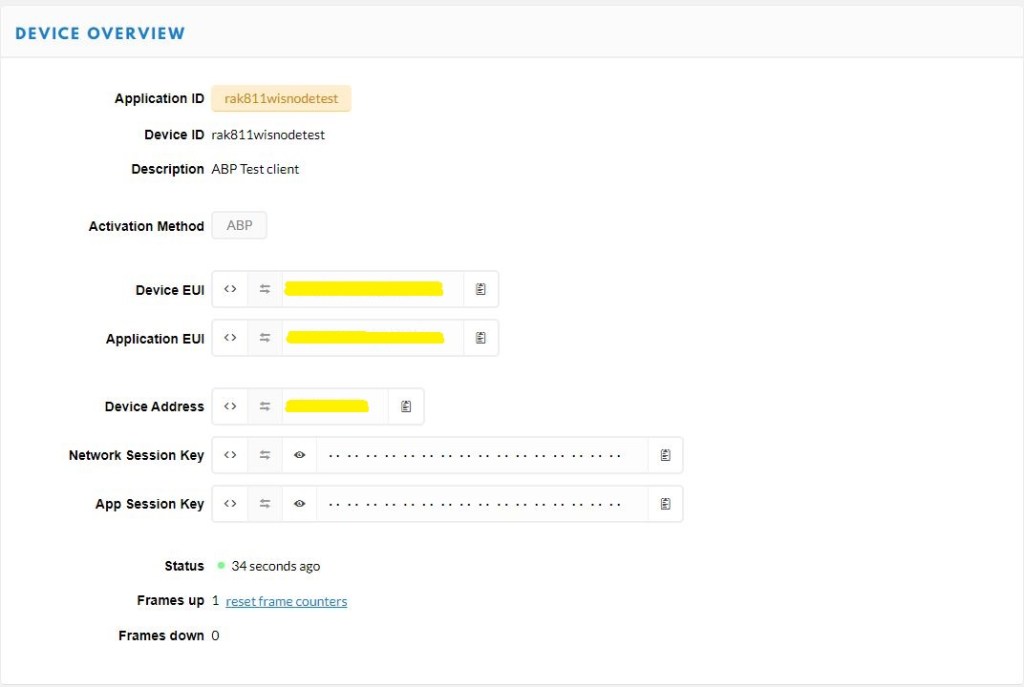
I created a new ABP device

Things Network ABP configuration

Then I configured the RAK811 module for LoRaWAN

// Set the Working mode to LoRaWAN
bytesWritten = outputDataWriter.WriteString("at+set_config=lora:work_mode:0rn");
Debug.WriteLine($"TX: work_mode {outputDataWriter.UnstoredBufferLength} bytes to output stream.");
txByteCount = outputDataWriter.Store();
Debug.WriteLine($"TX: {txByteCount} bytes via {serialDevice.PortName}");

// Read the response
bytesRead = inputDataReader.Load(128);
if (bytesRead > 0)
{
   string response = inputDataReader.ReadString(bytesRead);
   Debug.WriteLine($"RX sync:{response}");
}

Then sequentially stepped through the necessary configuration to join the The Things Network(TTN) network

// Set the JoinMode to ABP
bytesWritten = outputDataWriter.WriteString($"at+set_config=lora:join_mode:1\r\n");
Debug.WriteLine($"TX: join_mode {outputDataWriter.UnstoredBufferLength} bytes to output stream.");
txByteCount = outputDataWriter.Store();
Debug.WriteLine($"TX: {txByteCount} bytes via {serialDevice.PortName}");

// Read the response
bytesRead = inputDataReader.Load(128);
if (bytesRead > 0)
{
   String response = inputDataReader.ReadString(bytesRead);
   Debug.WriteLine($"RX :{response}");
}

// Set the device address
bytesWritten = outputDataWriter.WriteString($"at+set_config=lora:dev_addr:{devAddress}\r\n");
Debug.WriteLine($"TX: dev_addr {outputDataWriter.UnstoredBufferLength} bytes to output stream.");
txByteCount = outputDataWriter.Store();
Debug.WriteLine($"TX: {txByteCount} bytes via {serialDevice.PortName}");

// Read the response
bytesRead = inputDataReader.Load(128);
if (bytesRead > 0)
   {
   String response = inputDataReader.ReadString(bytesRead);
   Debug.WriteLine($"RX :{response}");
   }
...

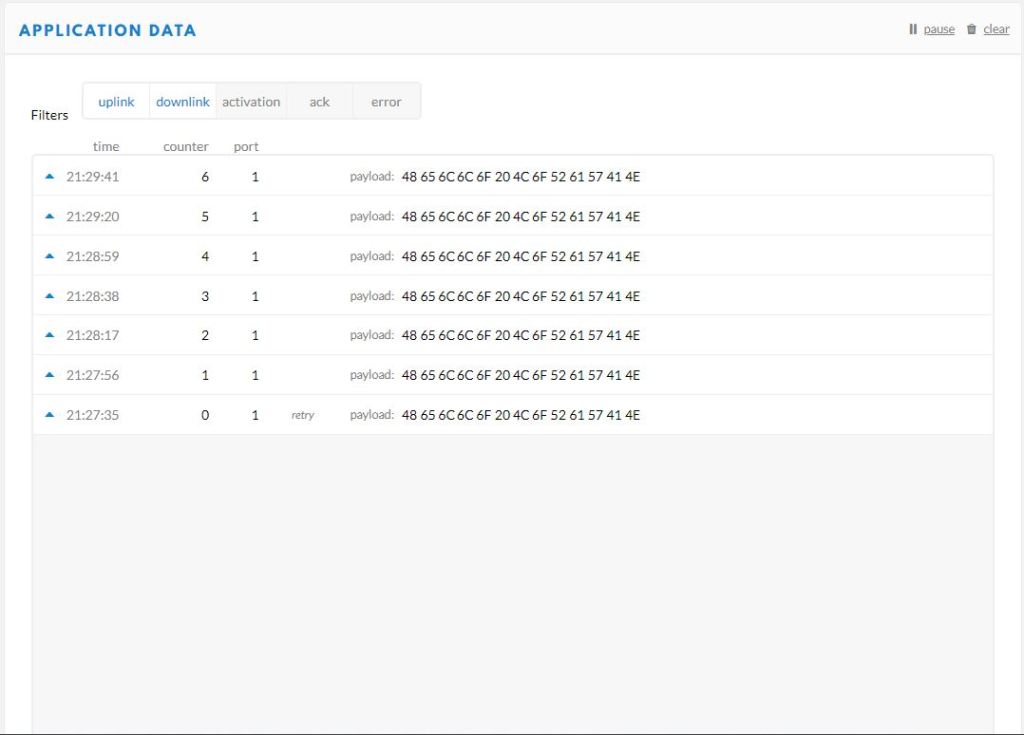
After making a few fixes to my code and tweaking some settings I could see data in the TTN Console.
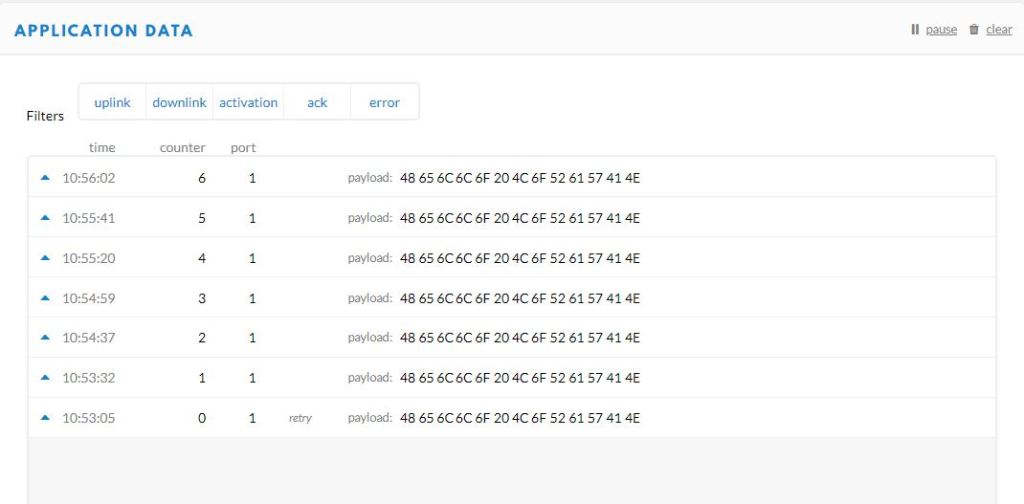
ABP Device data uplink

The code is not suitable for production but it confirmed my software and hardware configuration worked.

In the Visual Studio 2019 debug output I could see the AT Command responses from were getting truncated in odd ways so I need to be careful how they are processed.

The thread '<No Name>' (0x2) has exited with code 0 (0x0).
devMobile.IoT.Rak811.NetworkJoinABP starting
COM5,COM6
TX: work_mode 32 bytes to output stream.
TX: 32 bytes via COM6
RX :UART1 work mode: RUI_UART_NORAMAL
Current work_mode:LoRaWAN, join_mode:ABP, Class: A
Initialization OK 

TX: region 33 bytes to output stream.
TX: 33 bytes via COM6
RX :OK 

TX: join_mode 32 bytes to output stream.
TX: 32 bytes via COM6
RX :OK 

TX: dev_addr 38 bytes to output stream.
TX: 38 bytes via COM6
RX :OK 

TX: nwks_key 62 bytes to output stream.
TX: 62 bytes via COM6
RX :OK 

TX: apps_key 62 bytes to output stream.
TX: 62 bytes via COM6
RX :OK 

TX: confirm 30 bytes to output stream.
TX: 30 bytes via COM6
RX :OK 

TX: join 9 bytes to output stream.
TX: 9 bytes via COM6
TX: send 43 bytes to output stream.
TX: 43 bytes via COM6
TX: send 43 bytes to output stream.
TX: 43 bytes via COM6
RX :OK Jo
TX: send 43 bytes to output stream.
TX: 43 bytes via COM6
RX :in Su
TX: send 43 bytes to output stream.
TX: 43 bytes via COM6
RX :ccess
TX: send 43 bytes to output stream.
TX: 43 bytes via COM6
RX :
OK 
TX: send 43 bytes to output stream.
TX: 43 bytes via COM6
RX :
OK 

The next step is to get rework the code to process responses to the AT commands in a smarter way and extract error codes when an operation fails.
nanoFramework RAK811 LoRaWAN library Part4

Nasty OTAA connect

After getting basic connectivity for my RAK811 LPWAN Evaluation Board(EVB) and STM32F691DISCOVERY test rig sorted. I wanted to see if I could get the device connected to The Things Network(TTN) via the RAK7246G LPWAN Developer Gateway which was on my desk. I had got the EVB configuration sorted with an Arduino Uno R3 device so I was confident it should work.

STM32F691Discovery with EVB plugged into Arduino headers

My Over the Air Activation(OTAA) implementation is pretty “nasty” I assumed that there would be no timeouts or failures and I only send one BCD message “48656c6c6f204c6f526157414e” which is “hello LoRaWAN”

I configured the RAK811 module for LoRaWAN

// Set the Working mode to LoRaWAN
bytesWritten = outputDataWriter.WriteString("at+set_config=lora:work_mode:0\r\n");
Debug.WriteLine($"TX: work_mode {outputDataWriter.UnstoredBufferLength} bytes to output stream.");
txByteCount = outputDataWriter.Store();
Debug.WriteLine($"TX: {txByteCount} bytes via {serialDevice.PortName}");

// Read the response
bytesRead = inputDataReader.Load(128);
if (bytesRead > 0)
{
   string response = inputDataReader.ReadString(bytesRead);
   Debug.WriteLine($"RX sync:{response}");
}

Then just sequentially stepped through the necessary configuration to join the TTN network

// Set the Region to AS923
bytesWritten = outputDataWriter.WriteString("at+set_config=lora:region:AS923\r\n");
Debug.WriteLine($"TX: region {outputDataWriter.UnstoredBufferLength} bytes to output stream.");
txByteCount = outputDataWriter.Store();
Debug.WriteLine($"TX: {txByteCount} bytes via {serialDevice.PortName}");

// Read the response
bytesRead = inputDataReader.Load(128);
if (bytesRead > 0)
{
   String response = inputDataReader.ReadString(bytesRead);
   Debug.WriteLine($"RX sync:{response}");
}

// Set the JoinMode
bytesWritten = outputDataWriter.WriteString($"at+set_config=lora:join_mode:0\r\n");
Debug.WriteLine($"TX: join_mode {outputDataWriter.UnstoredBufferLength} bytes to output stream.");
txByteCount = outputDataWriter.Store();
Debug.WriteLine($"TX: {txByteCount} bytes via {serialDevice.PortName}");

// Read the response
bytesRead = inputDataReader.Load(128);
if (bytesRead > 0)
{
   String response = inputDataReader.ReadString(bytesRead);
   Debug.WriteLine($"RX sync:{response}");
}

// OTAA set the devEUI
bytesWritten = outputDataWriter.WriteString($"at+set_config=lora:dev_eui:{devEui}\r\n");
Debug.WriteLine($"TX: dev_eui {outputDataWriter.UnstoredBufferLength} bytes to output stream.");
txByteCount = outputDataWriter.Store();
Debug.WriteLine($"TX: {txByteCount} bytes via {serialDevice.PortName}");

// Read the response
bytesRead = inputDataReader.Load(128);
if (bytesRead > 0)
{
   String response = inputDataReader.ReadString(bytesRead);
   Debug.WriteLine($"RX sync:{response}");
}
...

The code is not suitable for production but it confirmed my software and hardware configuration worked.

The thread '<No Name>' (0x2) has exited with code 0 (0x0).
devMobile.IoT.Rak811.NetworkJoinOTAA starting
COM5,COM6
TX: work_mode 32 bytes to output stream.
TX: 32 bytes via COM6
RX sync:UART1 work mode: RUI_UART_NORAMAL
Current work_mode:LoRaWAN, join_mode:OTAA, Class: A
Initialization OK 

TX: region 33 bytes to output stream.
TX: 33 bytes via COM6
RX sync:OK 

TX: join_mode 32 bytes to output stream.
TX: 32 bytes via COM6
RX sync:OK 

TX: dev_eui 45 bytes to output stream.
TX: 45 bytes via COM6
RX sync:OK 

TX: app_eui 45 bytes to output stream.
TX: 45 bytes via COM6
RX sync:OK 

TX: app_key 61 bytes to output stream.
TX: 61 bytes via COM6
RX sync:OK 

TX: confirm 30 bytes to output stream.
TX: 30 bytes via COM6
RX sync:OK 

TX: join 9 bytes to output stream.
TX: 9 bytes via COM6
RX sync:
RX sync:
RX sync:
RX sync:
RX sync:OK Join Success

TX: send 43 bytes to output stream.
TX: 43 bytes via COM6
TX: send 43 bytes to output stream.
TX: 43 bytes via COM6
RX sync:OK 
at+recv=0,-59,9,0

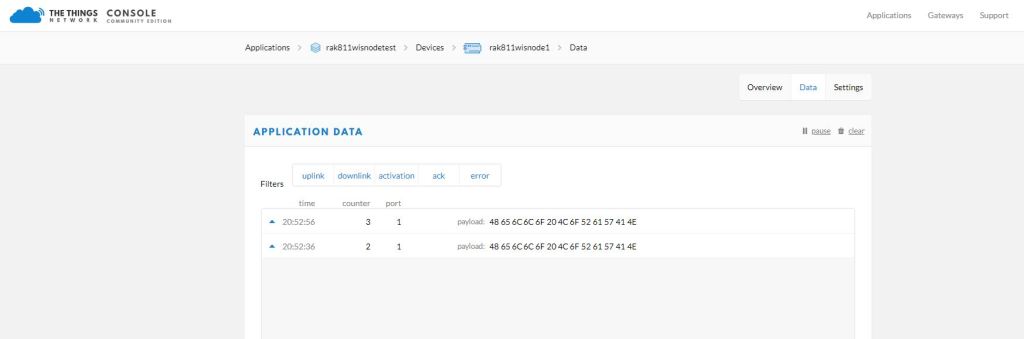
In the Visual Studio 2019 debug out put I could see messages getting sent and then after a short delay they were visible in the TTN console.

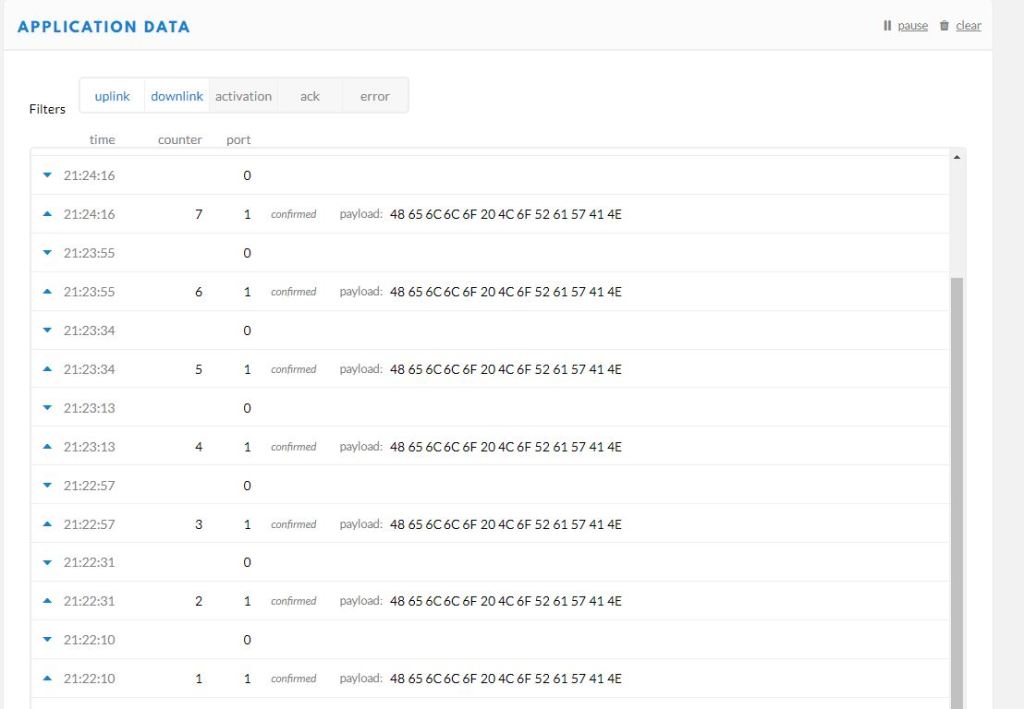
I then modified the confirmed flag and in the TTN console I could see how they were processed differently.

Confirmed messages
Unconfirmed messages

I could receive messages but as the RAK 811 module can be configured to be a Class C device there didn’t appear to be a way to receive a message without sending one which seemed a bit odd.

The next step is to get Authentication By Personalisation(ABP) working.

nanoFramework RAK811 LoRaWAN library Part3

Factory Reset

When writing communications libraries one of the first things I try and get working is a “factory reset”. At some stage I will misconfigure the device so badly that it won’t work anymore and having a way to return to the device to its original configuration is really useful.

The RAK811 LPWAN Evaluation Board(EVB) test rig was based on an STM32F691DISCOVERY board which supports hardware (using D8 as I haven’t removed R11) and software reset with an AT command.

//---------------------------------------------------------------------------------
// Copyright (c) June 2020, devMobile Software
//
// Licensed under the Apache License, Version 2.0 (the "License");
// you may not use this file except in compliance with the License.
// You may obtain a copy of the License at
//
//     http://www.apache.org/licenses/LICENSE-2.0
//
// Unless required by applicable law or agreed to in writing, software
// distributed under the License is distributed on an "AS IS" BASIS,
// WITHOUT WARRANTIES OR CONDITIONS OF ANY KIND, either express or implied.
// See the License for the specific language governing permissions and
// limitations under the License.
//
//---------------------------------------------------------------------------------
// nanoff --target ST_STM32F769I_DISCOVERY --update
//#define SERIAL_SYNC_READ
//#define HARDWARE_RESET
//#define SOFTWARE_RESTART
//#define DEVICE_STATUS
//#define LORA_STATUS
namespace devMobile.IoT.Rak811.FactoryReset
{
   using System;
   using System.Diagnostics;
   using System.Threading;
   using Windows.Devices.Gpio;
   using Windows.Devices.SerialCommunication;
   using Windows.Storage.Streams;
   
   public class Program
   {
      private const string SerialPortId = "COM6";

      public static void Main()
      {
         SerialDevice serialDevice;

         Debug.WriteLine("devMobile.IoT.Rak811.FactoryReset starting");

         Debug.WriteLine(Windows.Devices.SerialCommunication.SerialDevice.GetDeviceSelector());

         try
         {
#if HARDWARE_RESET
            GpioPin resetPin = GpioController.GetDefault().OpenPin(PinNumber('J', 4));
            resetPin.SetDriveMode(GpioPinDriveMode.Output);
            resetPin.Write(GpioPinValue.Low);
#endif
            serialDevice = SerialDevice.FromId(SerialPortId);

            // set parameters
            serialDevice.BaudRate = 9600;
            serialDevice.Parity = SerialParity.None;
            serialDevice.StopBits = SerialStopBitCount.One;
            serialDevice.Handshake = SerialHandshake.None;
            serialDevice.DataBits = 8;

            serialDevice.ReadTimeout = new TimeSpan(0, 0, 30);
            serialDevice.WriteTimeout = new TimeSpan(0, 0, 4);

            DataWriter outputDataWriter = new DataWriter(serialDevice.OutputStream);

#if SERIAL_SYNC_READ
            DataReader inputDataReader = new DataReader(serialDevice.InputStream);
#else
            serialDevice.DataReceived += SerialDevice_DataReceived;
#endif

            // set a watch char to be notified when it's available in the input stream
            serialDevice.WatchChar = '\n';

            while (true)
            {
#if HARDWARE_RESET
               resetPin.Write(GpioPinValue.High);
               Thread.Sleep(10);
               resetPin.Write(GpioPinValue.Low);
#endif

#if SOFTWARE_RESTART
               uint bytesWritten = outputDataWriter.WriteString("at+set_config=device:restart\r\n");
               Debug.WriteLine($"TX: {outputDataWriter.UnstoredBufferLength} bytes to output stream.");

               // calling the 'Store' method on the data writer actually sends the data
               uint txByteCount = outputDataWriter.Store();
               Debug.WriteLine($"TX: {txByteCount} bytes via {serialDevice.PortName}");
#endif

#if DEVICE_STATUS
               uint bytesWritten = outputDataWriter.WriteString("at+get_config=device:status\r\n");
               Debug.WriteLine($"TX: {outputDataWriter.UnstoredBufferLength} bytes to output stream.");

               // calling the 'Store' method on the data writer actually sends the data
               uint txByteCount = outputDataWriter.Store();
               Debug.WriteLine($"TX: {txByteCount} bytes via {serialDevice.PortName}");
#endif

#if LORA_STATUS
               uint bytesWritten = outputDataWriter.WriteString("at+get_config=lora:status\r\n");
               Debug.WriteLine($"TX: {outputDataWriter.UnstoredBufferLength} bytes to output stream.");

               // calling the 'Store' method on the data writer actually sends the data
               uint txByteCount = outputDataWriter.Store();
               Debug.WriteLine($"TX: {txByteCount} bytes via {serialDevice.PortName}");
#endif

#if SERIAL_SYNC_READ
               // June 2020 appears to be limited to 256 chars
               uint bytesRead = inputDataReader.Load(50);

               Debug.WriteLine($"RXs :{bytesRead} bytes read from {serialDevice.PortName}");

               if (bytesRead > 0)
               {
                  String response = inputDataReader.ReadString(bytesRead);
                  Debug.WriteLine($"RX sync:{response}");
               }
#endif

               Thread.Sleep(20000);
            }
         }
         catch (Exception ex)
         {
            Debug.WriteLine(ex.Message);
         }
      }

      private static void SerialDevice_DataReceived(object sender, SerialDataReceivedEventArgs e)
      {
         switch (e.EventType)
         {
            case SerialData.Chars:
               //Debug.WriteLine("RX SerialData.Chars");
               break;

            case SerialData.WatchChar:
               Debug.WriteLine("RX: SerialData.WatchChar");
               SerialDevice serialDevice = (SerialDevice)sender;

               using (DataReader inputDataReader = new DataReader(serialDevice.InputStream))
               {
                  inputDataReader.InputStreamOptions = InputStreamOptions.Partial;

                  // read all available bytes from the Serial Device input stream
                  uint bytesRead = inputDataReader.Load(serialDevice.BytesToRead);

                  Debug.WriteLine($"RXa: {bytesRead} bytes read from {serialDevice.PortName}");

                  if (bytesRead > 0)
                  {
                     String response = inputDataReader.ReadString(bytesRead);
                     Debug.WriteLine($"RX:{response}");
                  }
               }
               break;
            default:
               Debug.Assert(false, $"e.EventType {e.EventType} unknown");
               break;
         }
      }
      static int PinNumber(char port, byte pin)
      {
         if (port < 'A' || port > 'J')
            throw new ArgumentException();

         return ((port - 'A') * 16) + pin;
      }
   }
}

Initially I tried strobing D8 which is connected to the reset pin on the RAK811 module.

UART1 work mode: RUI_UART_NORAMAL
Current work_mode:LoRaWAN, join_mode:OTAA, Class: A
Initialization OK 

I then used the RAK Serial Port Tool to see if the configuration had changed

OK Work Mode: LoRaWAN
Region: AS923
Send_interval: 600s
Auto send status: false.
Join_mode: OTAA
DevEui: ...
AppEui: ...
AppKey: ...
Class: A
Joined Network:false
IsConfirm: false
AdrEnable: true
EnableRepeaterSupport: false
RX2_CHANNEL_FREQUENCY: 923200000, RX2_CHANNEL_DR:2
RX_WINDOW_DURATION: 3000ms
RECEIVE_DELAY_1: 1000ms
RECEIVE_DELAY_2: 2000ms
JOIN_ACCEPT_DELAY_1: 5000ms
JOIN_ACCEPT_DELAY_2: 6000ms
Current Datarate: 2
Primeval Datarate: 2
ChannelsTxPower: 0
UpLinkCounter: 0
DownLinkCounter: 0

The device reset but the settings appear not to have returned to factory.

I then tried the device:restart AT command

>>at+set_config=device:restart
UART1 work mode: RUI_UART_NORAMAL
Current work_mode:LoRaWAN, join_mode:OTAA, Class: A
Initialization OK 

>>at+get_config=lora:status
OK Work Mode: LoRaWAN
Region: AS923
Send_interval: 600s
Auto send status: false.
Join_mode: OTAA
DevEui: ...
AppEui: ...
AppKey: ...
Class: A
Joined Network:false
IsConfirm: false
AdrEnable: true
EnableRepeaterSupport: false
RX2_CHANNEL_FREQUENCY: 923200000, RX2_CHANNEL_DR:2
RX_WINDOW_DURATION: 3000ms
RECEIVE_DELAY_1: 1000ms
RECEIVE_DELAY_2: 2000ms
JOIN_ACCEPT_DELAY_1: 5000ms
JOIN_ACCEPT_DELAY_2: 6000ms
Current Datarate: 2
Primeval Datarate: 2
ChannelsTxPower: 0
UpLinkCounter: 0
DownLinkCounter: 0

The device settings appear not to have returned to factory.

After some experimentation it looks like the only way to get a factory reset maybe re-flashing the device.

nanoFramework RAK811 LoRaWAN library Part2

Shield Serial

My initial RAK811 LPWAN Evaluation Board(EVB) test rig was based on an STM32F7691DISCOVERY. I connected the EVB with jumper leads and sent the AT Command to request the LoRaWAN module version information

STM32F691Discovery with EVB connected with Jumpers

The STM32F691DISCOVERY board has an Arduino Uno R3 format socket which I wanted to be able to plug the EVB into. After removing R8,R17 & R19 I put the EVB on the STM32F691DISCOVERY and could still retrieve the RAK811 module version information.

STM32F691Discovery with EVB plugged into Arduino headers
The thread '<No Name>' (0x2) has exited with code 0 (0x0).
devMobile.IoT.Rfm9x.ShieldSerial starting
COM5,COM6
TX: 12 bytes to output stream.
TX: 12 bytes via COM6
RXs :19 bytes read from COM6
RX sync:OK V3.0.0.13.H.T3

TX: 12 bytes to output stream.
TX: 12 bytes via COM6
RXs :19 bytes read from COM6
RX sync:OK V3.0.0.13.H.T3

nanoFramework RAK811 LoRaWAN library Part1

Invalidating the warranty

Over the last couple of days I have been working on a nanoFramework C# library for my RAK811 LPWAN Evaluation Board(EVB) from RAK Wireless which I have been using with an Arduino Uno R3 device. My initial test rig is based on an STM32F691DISCOVERY board which has Arduino Uno R3 format socket for the EVB.

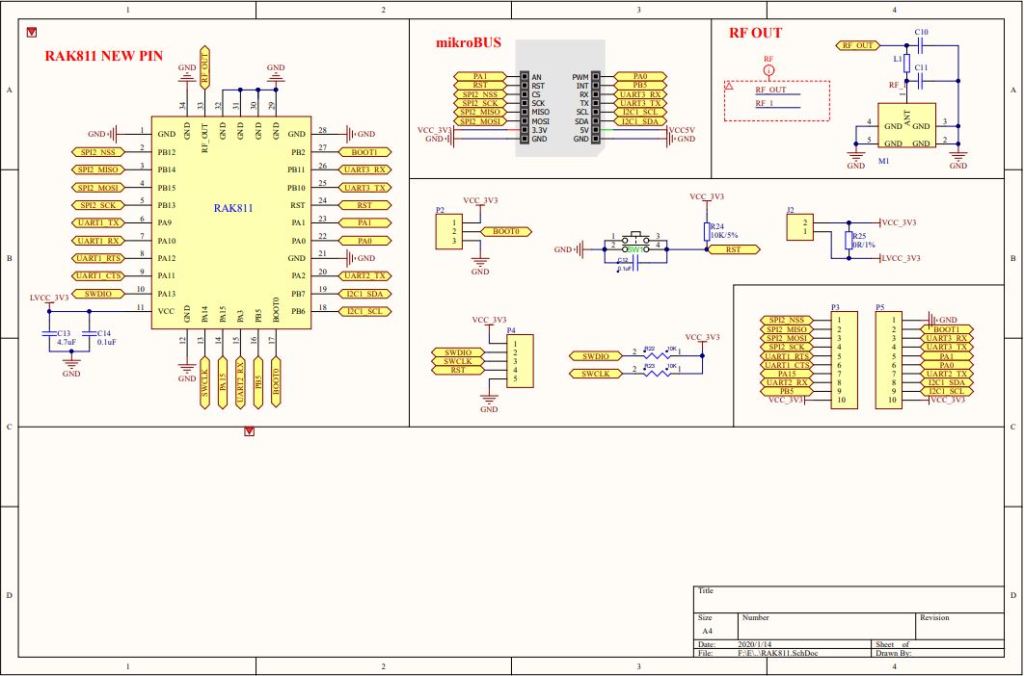
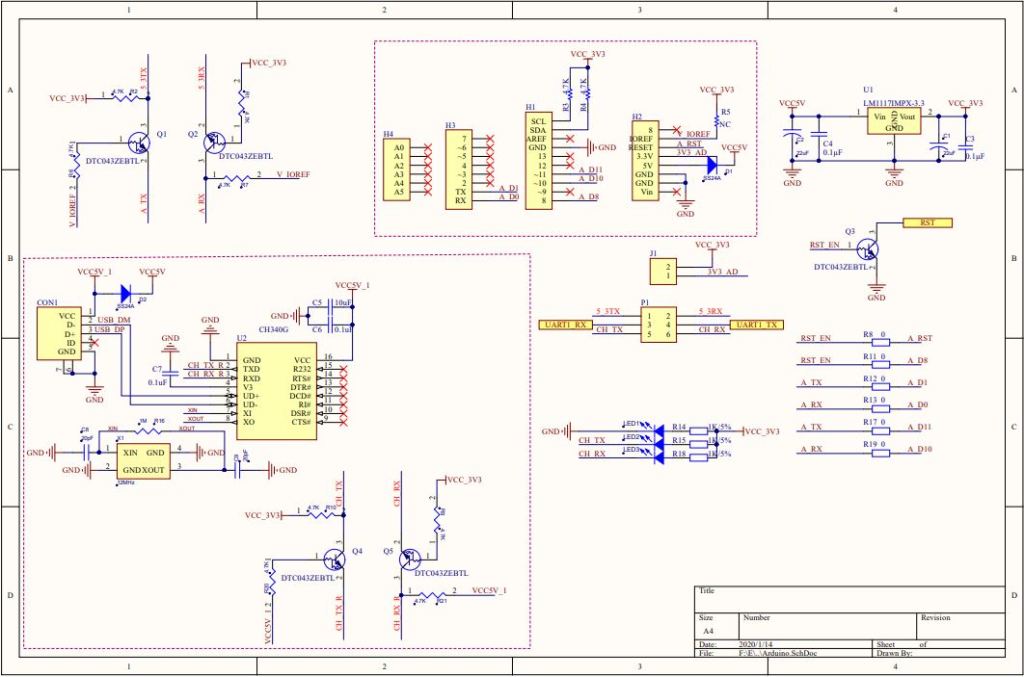
My first step was to check what serial ports were available (COM5 & COM6) on the STM32F691Discovery and what pins they were connected to. (COM6 Arduino D0 & D1). Then check that these would work with the EVB pin assignments.

RAK 811 EVB schematic pg1
RAK 811 EVB schematic pg2

My first test was was a simple loopback based on the nanoFramework samples Serial Communications example.

STM32F691Discovery with jumper loopback
//---------------------------------------------------------------------------------
// Copyright (c) June 2020, devMobile Software
//
// Licensed under the Apache License, Version 2.0 (the "License");
// you may not use this file except in compliance with the License.
// You may obtain a copy of the License at
//
//     http://www.apache.org/licenses/LICENSE-2.0
//
// Unless required by applicable law or agreed to in writing, software
// distributed under the License is distributed on an "AS IS" BASIS,
// WITHOUT WARRANTIES OR CONDITIONS OF ANY KIND, either express or implied.
// See the License for the specific language governing permissions and
// limitations under the License.
//
//---------------------------------------------------------------------------------
//#define ESP32_WROOM   //nanoff --target ESP32_WROOM_32 --serialport COM4 --update
//#define NETDUINO3_WIFI   // nanoff --target NETDUINO3_WIFI --update
//#define MBN_QUAIL // nanoff --target MBN_QUAIL --update
//#define ST_NUCLEO64_F091RC // nanoff --target ST_NUCLEO64_F091RC --update
//#define ST_NUCLEO144_F746ZG //nanoff --target ST_NUCLEO144_F746ZG --update
#define ST_STM32F769I_DISCOVERY      // nanoff --target ST_STM32F769I_DISCOVERY --update 
namespace devMobile.IoT.Rak811.ShieldSerial
{
   using System;
   using System.Diagnostics;
   using System.Threading;
   using Windows.Devices.SerialCommunication;
   using Windows.Storage.Streams;

#if ESP32_WROOM_32_LORA_1_CHANNEL
   using nanoFramework.Hardware.Esp32;
#endif

   public class Program
   {
#if ESP32_WROOM
      private const string SerialPortId = "";
#endif
#if NETDUINO3_WIFI
      private const string SpiBusId = "";
#endif
#if MBN_QUAIL
      private const string SpiBusId = "";
#endif
#if ST_NUCLEO64_F091RC
      private const string SpiBusId = "";
#endif
#if ST_NUCLEO144_F746ZG
      private const string SpiBusId = "";
#endif
#if ST_STM32F429I_DISCOVERY
      private const string SpiBusId = "";
#endif
#if ST_STM32F769I_DISCOVERY
      private const string SerialPortId = "COM6";
#endif

      public static void Main()
      {
         SerialDevice serialDevice;

         Debug.WriteLine("devMobile.IoT.Rfm9x.ShieldSerial starting");

         Debug.WriteLine(Windows.Devices.SerialCommunication.SerialDevice.GetDeviceSelector());

         try
         {
            // set GPIO functions for COM2 (this is UART1 on ESP32)
            #if ESP32_WROOM
               Configuration.SetPinFunction(Gpio.IO04, DeviceFunction.COM2_TX);
               Configuration.SetPinFunction(Gpio.IO05, DeviceFunction.COM2_RX);
            #endif
            serialDevice = SerialDevice.FromId(SerialPortId);

            // set parameters
            serialDevice.BaudRate = 9600;
            serialDevice.Parity = SerialParity.None;
            serialDevice.StopBits = SerialStopBitCount.One;
            serialDevice.Handshake = SerialHandshake.None;
            serialDevice.DataBits = 8;

            serialDevice.ReadTimeout = new TimeSpan(0, 0, 30);
            serialDevice.WriteTimeout = new TimeSpan(0, 0, 4);

            DataWriter outputDataWriter = new DataWriter(serialDevice.OutputStream);

            #if SERIAL_SYNC_READ
               DataReader inputDataReader = new DataReader(serialDevice.InputStream);
            #else
               serialDevice.DataReceived += SerialDevice_DataReceived;
            #endif

            // set a watch char to be notified when it's available in the input stream
            serialDevice.WatchChar = '\n';

            while (true)
            {
               uint bytesWritten = outputDataWriter.WriteString("at+version\r\n");
               Debug.WriteLine($"TX: {outputDataWriter.UnstoredBufferLength} bytes to output stream.");

               // calling the 'Store' method on the data writer actually sends the data
               uint txByteCount = outputDataWriter.Store();
               Debug.WriteLine($"TX: {txByteCount} bytes via {serialDevice.PortName}");

#if SERIAL_SYNC_READ
               uint bytesRead = inputDataReader.Load(50);

               Debug.WriteLine($"RXs :{bytesRead} bytes read from {serialDevice.PortName}");

               if (bytesRead > 0)
               {
                  String response = inputDataReader.ReadString(bytesRead);
                  Debug.WriteLine($"RX sync:{response}");
               }
#endif

               Thread.Sleep(20000);
            }
         }
         catch (Exception ex)
         {
            Debug.WriteLine(ex.Message);
         }
      }

      private static void SerialDevice_DataReceived(object sender, SerialDataReceivedEventArgs e)
      {
         switch(e.EventType)
         {
            case SerialData.Chars:
               //Debug.WriteLine("RX SerialData.Chars");
               break;

            case SerialData.WatchChar:
               Debug.WriteLine("RX: SerialData.WatchChar");
               SerialDevice serialDevice = (SerialDevice)sender;

               using (DataReader inputDataReader = new DataReader(serialDevice.InputStream))
               {
                  inputDataReader.InputStreamOptions = InputStreamOptions.Partial;

                  // read all available bytes from the Serial Device input stream
                  uint bytesRead = inputDataReader.Load(serialDevice.BytesToRead);

                  Debug.WriteLine($"RXa: {bytesRead} bytes read from {serialDevice.PortName}");

                  if (bytesRead > 0)
                  {
                     String response = inputDataReader.ReadString(bytesRead);
                     Debug.WriteLine($"RX:{response}");
                  }
               }
               break;
            default:
               Debug.Assert(false, $"e.EventType {e.EventType} unknown");
               break;
         }
      }
   }
}

After some tinkering I could successfully transmit and receive a string.

The next step was to connect my EVB and sent the AT Command to request the LoRaWAN module version information

STM32F691Discovery with EVB connected with Jumpers
The thread '<No Name>' (0x2) has exited with code 0 (0x0).
devMobile.IoT.Rfm9x.ShieldSerial starting
COM5,COM6
TX: 12 bytes to output stream.
TX: 12 bytes via COM6
RX: SerialData.WatchChar
RXa: 19 bytes read from COM6
RX:OK V3.0.0.13.H.T3

TX: 12 bytes to output stream.
TX: 12 bytes via COM6
RX: SerialData.WatchChar
RXa: 19 bytes read from COM6
RX:OK V3.0.0.13.H.T3

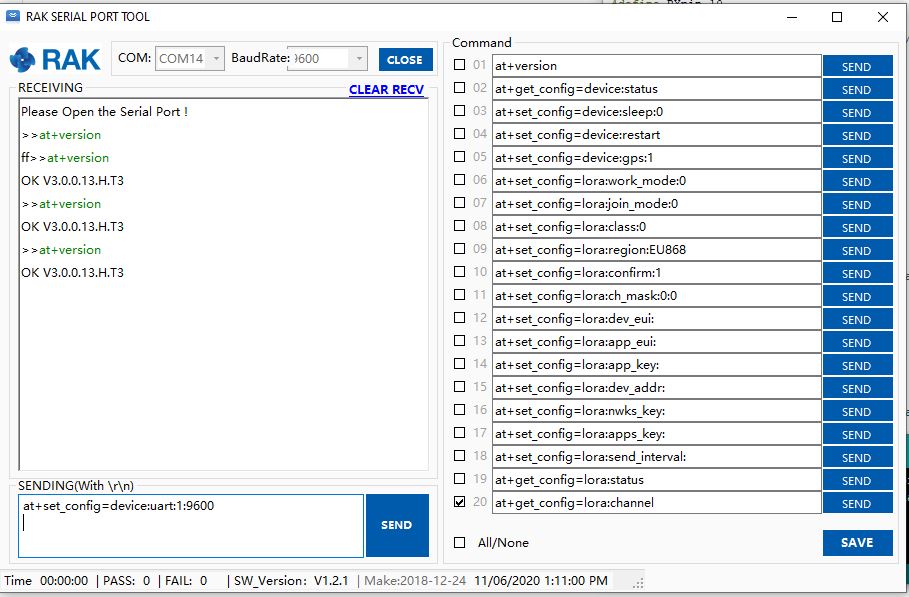
The response was the same as I got with the RAK Serial Port Tool which was positive.

Version number check with RAK Serial Port tool

I need to do some more digging into how serialDevice.WatchChar = ‘\n’ works for synchronous reads.

Plus removing R17 & R19 there is no interaction with D11 & D10 which are normally used by the Serial Peripheral Interface(SPI) port so I can plug the shield directly into the STM32F691Discovery board.

My plan was to get an initial version of the library working with the STM32F691Discovery, then port it to the Netduino 3 Wifi (possible serial port pin issues) , ST_NUCLEO144_F746ZG, and ST_NUCLEO64_F091RC (possible issues with available flash).