.NET nanoFramework RAK11200 – I2C SHT3C & SHT31

The RAKwireless RAK11200 WisBlock WiFi Module module is based on an Expressif ESP32 processor which is supported by the .NET nanoFramework and I wanted to explore the different ways Inter-Integrated Circuit(I2C) devices could be connected.

The RAK11200 WisBlock WiFi Module has two I2C ports and on the RAK5005 WisBlock Base Board the Wisblock Sensor, and RAK1920 WisBlock Sensor Adapter Module Grove Socket are connected to I2C1.

RAK11200 Schematic

The I2C1 the SDA(serial data) and SCL(serial clock line) have to be mapped to physical pins on the RAK11200 WisBlock WiFi Module using the nanoFramework ESP32 support NuGet. package

                Configuration.SetPinFunction(Gpio.IO04, DeviceFunction.I2C1_DATA);
                Configuration.SetPinFunction(Gpio.IO05, DeviceFunction.I2C1_CLOCK)

The first sample project uses a RAK1901 SHTC3 WisBlock Sensor because it plugs into the RAK5005 WisBlock Base Board.

RAK5005 Baseboard, RAK1901 Sensor and RAK11200 Core WisBlock modules
public static void Main()
{
    Debug.WriteLine("devMobile.IoT.RAK.Wisblock.SHTC3 starting");

    try
    {
        Configuration.SetPinFunction(Gpio.IO04, DeviceFunction.I2C1_DATA);
        Configuration.SetPinFunction(Gpio.IO05, DeviceFunction.I2C1_CLOCK);

        I2cConnectionSettings settings = new(1, Shtc3.DefaultI2cAddress);

        using (I2cDevice device = I2cDevice.Create(settings))
        using (Shtc3 shtc3 = new(device))
        {
            while (true)
            {
                if (shtc3.TryGetTemperatureAndHumidity(out var temperature, out var relativeHumidity))
                {
                    Debug.WriteLine($"Temperature {temperature.DegreesCelsius:F1}°C  Humidity {relativeHumidity.Value:F0}%");
                }

                Thread.Sleep(10000);
            }
        }
    }
    catch (Exception ex)
    {
        Debug.WriteLine($"SHTC3 initialisation or read failed {ex.Message}");

        Thread.Sleep(Timeout.Infinite);
    }
}
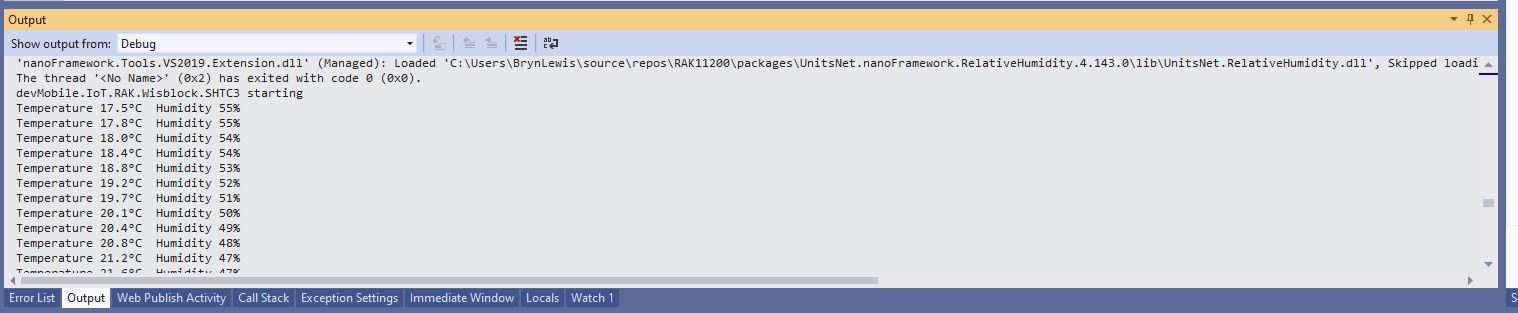
Visual Studio Output window displaying SHT3C temperature & humidity values

The second sample uses a Seeedstudio Grove – Temperature & Humidity Sensor (SHT31) pluged into a RAK1920 Sensor Adapter for Click, QWIIC and Grove Modules.
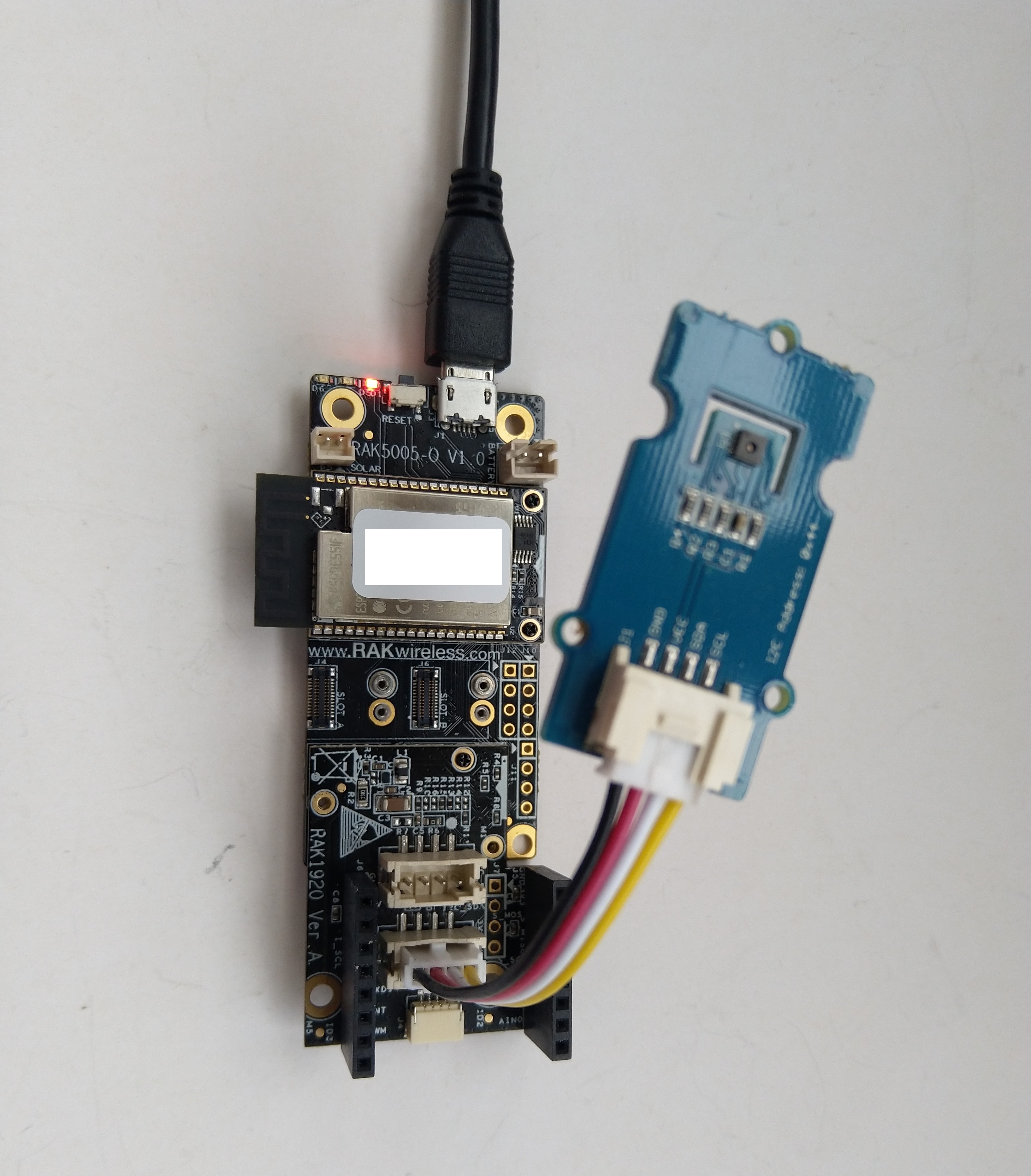
RAK5005 Baseboard, RAK1920 Sensor, RAK11200 Core WisBlock modules and Seeedstudio Grove SHT31
public static void Main()
{
    Debug.WriteLine("devMobile.IoT.RAK.Wisblock.SHT31 starting");

    try
    {
        Configuration.SetPinFunction(Gpio.IO04, DeviceFunction.I2C1_DATA);
        Configuration.SetPinFunction(Gpio.IO05, DeviceFunction.I2C1_CLOCK);

        I2cConnectionSettings settings = new(1, (byte)I2cAddress.AddrLow);

        using (I2cDevice device = I2cDevice.Create(settings))
        using (Sht3x sht31 = new(device))
        {

            while (true)
            {
                var temperature = sht31.Temperature;
                var relativeHumidity = sht31.Humidity;

                Debug.WriteLine($"Temperature {temperature.DegreesCelsius:F1}°C  Humidity {relativeHumidity.Value:F0}%");

                Thread.Sleep(10000);
            }
        }
    }
    catch (Exception ex)
    {
        Debug.WriteLine($"SHT31 initialisation or read failed {ex.Message}");

        Thread.Sleep(Timeout.Infinite);
     }
}
Visual Studio Output window displaying SHT31 temperature & humidity values

The SHTC3 and SHT31 sensors were used because they both have nanoFramework.IoTDevice library support.

.NET Core RAK811 LoRaWAN library Part3

The massive refactor

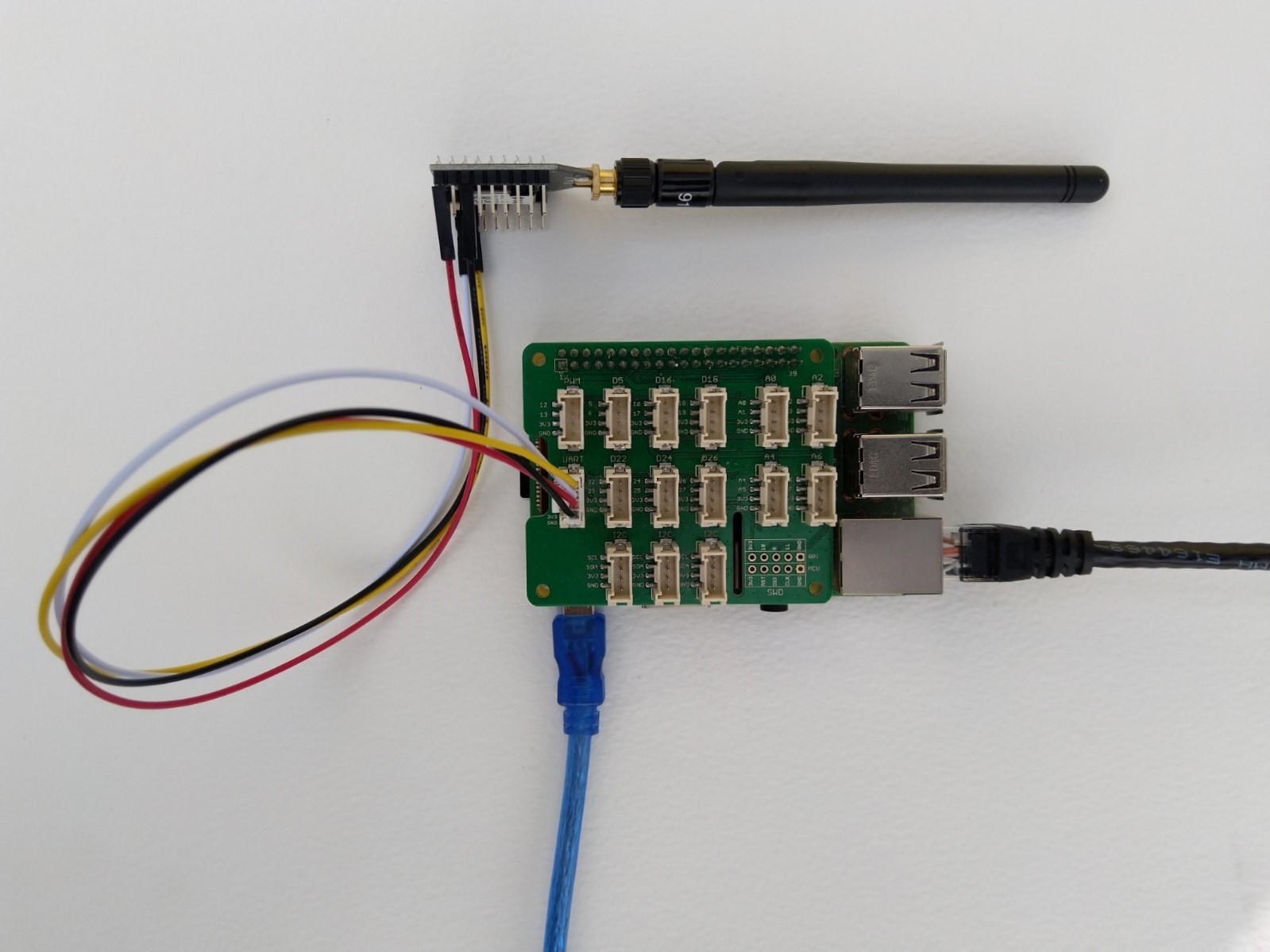
After refactoring my RAK3172 device library I have applied a similar approach to code on my RAK811 device library. My test-rig is a RaspberryPI 3B with a PI Supply RAK811 pHat and external antenna.

PI Supply RAK811 LoRaWAN pHat

In the new code a Thread reads lines of text from the SerialPort and processes them, checking for command responses, failures and downlink messages.

Unlike most of the devices I have worked with the RAK811 Join and Send commands are synchronous so return once the process has completed. The RAK811 responses also have quite a few empty, null prefixed or null suffixed lines which is a bit odd.

public void SerialPortProcessor()
{
	string line;

	while (CommandProcessResponses)
	{
		try
		{
#if DIAGNOSTICS
			Debug.WriteLine($" {DateTime.UtcNow:hh:mm:ss} ReadLine before");
#endif
			line = SerialDevice.ReadLine().Trim('\0').Trim();
#if DIAGNOSTICS
			Debug.WriteLine($" {DateTime.UtcNow:hh:mm:ss} ReadLine after:{line}");
#endif
			// consume empty lines
			if (String.IsNullOrWhiteSpace(line))
			{
				continue;
			}

			// Consume the response from set work mode
			if (line.StartsWith("?LoRa (R)") || line.StartsWith("RAK811 ") || line.StartsWith("UART1 ") || line.StartsWith("UART3 ") || line.StartsWith("LoRa work mode"))
			{
				continue;
			}

			// See if device successfully joined network
			if (line.StartsWith("OK Join Success"))
			{
				OnJoinCompletion?.Invoke(true);

				CommandResponseExpectedEvent.Set();

				continue;
			}

			if (line.StartsWith("at+recv="))
			{
				string[] payloadFields = line.Split("=,:".ToCharArray());

				byte port = byte.Parse(payloadFields[1]);
				int rssi = int.Parse(payloadFields[2]);
				int snr = int.Parse(payloadFields[3]);
				int length = int.Parse(payloadFields[4]);

				if (this.OnMessageConfirmation != null)
				{
					OnMessageConfirmation?.Invoke(rssi, snr);
				}
				if (length > 0)
				{
					string payload = payloadFields[5];

					if (this.OnReceiveMessage != null)
					{
						OnReceiveMessage.Invoke(port, rssi, snr, payload);
					}
				}
				continue;
			}

			switch (line)
			{
				case "OK":
				case "Initialization OK":
				case "OK Wake Up":
				case "OK Sleep":
					CommandResult = Result.Success;
					break;

				case "ERROR: 1":
					CommandResult = Result.ATCommandUnsuported;
					break;
				case "ERROR: 2":
					CommandResult = Result.ATCommandInvalidParameter;
					break;
				case "ERROR: 3": //There is an error when reading or writing flash.
				case "ERROR: 4": //There is an error when reading or writing through IIC.
					CommandResult = Result.ErrorReadingOrWritingFlash;
					break;
				case "ERROR: 5": //There is an error when sending through UART
					CommandResult = Result.ATCommandInvalidParameter;
					break;
				case "ERROR: 41": //The BLE works in an invalid state, so that it can’t be operated.
					CommandResult = Result.ResponseInvalid;
					break;
				case "ERROR: 80":
					CommandResult = Result.LoRaBusy;
					break;
				case "ERROR: 81":
					CommandResult = Result.LoRaServiceIsUnknown;
					break;
				case "ERROR: 82":
					CommandResult = Result.LoRaParameterInvalid;
					break;
				case "ERROR: 83":
					CommandResult = Result.LoRaFrequencyInvalid;
					break;
				case "ERROR: 84":
					CommandResult = Result.LoRaDataRateInvalid;
					break;
				case "ERROR: 85":
					CommandResult = Result.LoRaFrequencyAndDataRateInvalid;
					break;
				case "ERROR: 86":
					CommandResult = Result.LoRaDeviceNotJoinedNetwork;
					break;
				case "ERROR: 87":
					CommandResult = Result.LoRaPacketToLong;
					break;
				case "ERROR: 88":
					CommandResult = Result.LoRaServiceIsClosedByServer;
					break;
				case "ERROR: 89":
					CommandResult = Result.LoRaRegionUnsupported;
					break;
				case "ERROR: 90":
					CommandResult = Result.LoRaDutyCycleRestricted;
					break;
				case "ERROR: 91":
					CommandResult = Result.LoRaNoValidChannelFound;
					break;
				case "ERROR: 92":
					CommandResult = Result.LoRaNoFreeChannelFound;
					break;
				case "ERROR: 93":
					CommandResult = Result.StatusIsError;
					break;
				case "ERROR: 94":
					CommandResult = Result.LoRaTransmitTimeout;
					break;
				case "ERROR: 95":
					CommandResult = Result.LoRaRX1Timeout;
					break;
				case "ERROR: 96":
					CommandResult = Result.LoRaRX2Timeout;
					break;
				case "ERROR: 97":
					CommandResult = Result.LoRaRX1ReceiveError;
					break;
				case "ERROR: 98":
					CommandResult = Result.LoRaRX2ReceiveError;
					break;
				case "ERROR: 99":
					CommandResult = Result.LoRaJoinFailed;
					break;
				case "ERROR: 100":
					CommandResult = Result.LoRaDownlinkRepeated;
					break;
				case "ERROR: 101":
					CommandResult = Result.LoRaPayloadSizeNotValidForDataRate;
					break;
				case "ERROR: 102":
					CommandResult = Result.LoRaTooManyDownlinkFramesLost;
					break;
				case "ERROR: 103":
					CommandResult = Result.LoRaAddressFail;
					break;
				case "ERROR: 104":
					CommandResult = Result.LoRaMicVerifyError;
					break;
				default:
					CommandResult = Result.ResponseInvalid;
					break;
			}
		}
		catch (TimeoutException)
		{
			// Intentionally ignored, not certain this is a good idea
		}

		CommandResponseExpectedEvent.Set();
	}
}

After a lot of testing I think my thread based approach works reliably. Initially, I was having some signal strength issues because I had forgotten to configure the external antenna. I need to add some validation to the metrics and payload field unpacking (though I’m not certain what todo if they are the wrong format).

.NET Core RAK3172 LoRaWAN library Part5

The massive refactor

After getting Activation By Personalisation(ABP) and Over The Air Activation(OTAA) working on my RAK3172 test rig I was looking at the code and SerialDataReceivedEventHandler was really ugly.

Raspberry Pi3 with Grove Base Hat and RAK3172 Breakout (using UART2)

After some experimentation in the BreakOutSerial project I decided to reimplement the RAK3172 command processing. In the new code a Thread reads lines of text from the SerialPort and processes them. I have replaced the Join and Send(Confirmed) methods with ones that block only while the command are sent to the RAK3172. Then, when completed the OnJoinCompletion or OnMessagesConfirmation event handlers are called.

private Result SendCommand(string command)
{
	if (command == null)
	{
		throw new ArgumentNullException(nameof(command));
	}

	if (command == string.Empty)
	{
		throw new ArgumentException($"command cannot be empty", nameof(command));
	}

	serialDevice.WriteLine(command);

	this.CommandResponseExpectedEvent.Reset();

	if (!this.CommandResponseExpectedEvent.WaitOne(CommandTimeoutDefaultmSec, false))
	{
		return Result.Timeout;
	}

	return CommandResult;
}

private void SerialPortProcessor()
{
	string line;

	while (CommandProcessResponses)
	{
		try
		{
#if DIAGNOSTICS
			Debug.WriteLine($" {DateTime.UtcNow:hh:mm:ss} ReadLine before");
#endif
			line = serialDevice.ReadLine();
#if DIAGNOSTICS
			Debug.WriteLine($" {DateTime.UtcNow:hh:mm:ss} ReadLine after:{line}");
#endif

			// See if device successfully joined network
			if (line.StartsWith("+EVT:JOINED"))
			{
				OnJoinCompletion?.Invoke(true);

				continue;
			}

			// See if device failed ot join network
			if (line.StartsWith("+EVT:JOIN FAILED"))
			{
				OnJoinCompletion?.Invoke(false);

				continue;
			}

			// Applicable only if confirmed messages enabled 
			if (line.StartsWith("+EVT:SEND CONFIRMED OK"))
			{
				OnMessageConfirmation?.Invoke();

				continue;
			}

			// Check for A/B/C downlink message
			if (line.StartsWith("+EVT:RX_1") || line.StartsWith("+EVT:RX_2") || line.StartsWith("+EVT:RX_3") || line.StartsWith("+EVT:RX_C"))
			{
				// TODO beef up validation, nto certain what todo if borked
				string[] metricsFields= line.Split(' ', ',');

				int rssi = int.Parse(metricsFields[3]);
				int snr = int.Parse(metricsFields[6]);

				line = serialDevice.ReadLine();

#if DIAGNOSTICS
				Debug.WriteLine($" {DateTime.UtcNow:HH:mm:ss} UNICAST :{line}");
#endif
				line = serialDevice.ReadLine();
#if DIAGNOSTICS
				Debug.WriteLine($" {DateTime.UtcNow:HH:mm:ss} Payload:{line}");
#endif
				// TODO beef up validation, nto certain what todo if borked
				string[] payloadFields = line.Split(':');

				byte port = byte.Parse(payloadFields[1]);
				string payload = payloadFields[2];

				OnReceiveMessage?.Invoke(port, rssi, snr, payload);

				continue;
			}

#if DIAGNOSTICS
           Debug.WriteLine($" {DateTime.UtcNow:hh:mm:ss} ReadLine Result");
#endif
			line = serialDevice.ReadLine();
#if DIAGNOSTICS
             Debug.WriteLine($" {DateTime.UtcNow:hh:mm:ss} ReadLine Result:{line}");
#endif
			switch (line)
			{
				case "OK":
					CommandResult = Result.Success;
					break;
				case "AT_ERROR":
					CommandResult = Result.AtError;
					break;
				case "AT_PARAM_ERROR":
					CommandResult = Result.ParameterError;
					break;
				case "AT_BUSY_ERROR":
					CommandResult = Result.BusyError;
					break;
				case "AT_TEST_PARAM_OVERFLOW":
					CommandResult = Result.ParameterOverflow;
					break;
				case "AT_NO_NETWORK_JOINED":
					CommandResult = Result.NotJoined;
					break;
				case "AT_RX_ERROR":
					CommandResult = Result.ReceiveError;
					break;
				case "AT_DUTYCYLE_RESTRICTED":
					CommandResult = Result.DutyCycleRestricted;
					break;
				default:
					CommandResult = Result.Undefined;
					break;
			}

			CommandResponseExpectedEvent.Set();
		}
		catch (TimeoutException)
		{
			// Intentionally ignored, not certain this is a good idea
		}
	}
}

After a lot of testing I think my thread based approach works reliably. I also had to modify the code to shutdown the command processor thread and free any non managed resources.

/// <summary>
/// Ensures unmanaged serial port and thread resources are released in a "responsible" manner.
/// </summary>
public void Dispose()
{
	CommandProcessResponses = false;

	if (CommandResponsesProcessorThread != null)
	{
		CommandResponsesProcessorThread.Join();
		CommandResponsesProcessorThread = null;
	}

	if (serialDevice != null)
	{
		serialDevice.Dispose();
		serialDevice = null;
	}
}

I need to add some validation to the metrics and payload field unpacking (though I’m not certain what todo if they are the wrong format) and review the handling of multi-line event messages.

.NET Core RAK3172 LoRaWAN library Part4

Starting again with Threads

After getting Activation By Personalisation(ABP) and Over The Air Activation(OTAA) working on my RAK3172 test rig I was looking at the code and SerialDataReceivedEventHandler was really ugly.

Raspberry Pi3 with Grove Base Hat and RAK3172 Breakout (using UART2)

After some experimentation in the BreakOutSerial project I decided to reimplement the RAK3172 command processing. In the new code a Thread reads lines of text from the SerialPort and processes them. I have replaced the Join and Send(Confirmed) methods with ones that block only while the command are sent to the RAK3172. Then, when completed the OnJoinCompletion or OnMessagesConfirmation event handlers are called.

private Result SendCommand(string command)
{
   if (command == null)
   {
      throw new ArgumentNullException(nameof(command));
   }

   if (command == string.Empty)
   {
      throw new ArgumentException($"command invalid length cannot be empty", nameof(command));
    }

   serialDevice.ReadTimeout = (int)CommandTimeoutDefault.TotalMilliseconds;
   serialDevice.WriteLine(command);

   this.atExpectedEvent.Reset();

   if (!this.atExpectedEvent.WaitOne((int)CommandTimeoutDefault.TotalMilliseconds, false))
      return Result.Timeout;

   return result;
}

public void SerialPortProcessor()
{
   string line;

   while (true)
   {
      this.serialDevice.ReadTimeout = -1;

      Debug.WriteLine("ReadLine before");
      line = serialDevice.ReadLine();
      Debug.WriteLine($"ReadLine after:{line}");

            // check for +EVT:JOINED
      if (line.StartsWith("+EVT:JOINED"))
      {
            OnJoinCompletion?.Invoke(true);

            continue;
      }

      if (line.StartsWith("+EVT:JOIN FAILED"))
      {
	     OnJoinCompletion?.Invoke(false);

         continue;
      }

      if (line.StartsWith("+EVT:SEND CONFIRMED OK"))
      {
         OnMessageConfirmation?.Invoke();

         continue;
      }

      // Check for A/B/C downlink message
      if (line.StartsWith("+EVT:RX_1") || line.StartsWith("+EVT:RX_2") || line.StartsWith("+EVT:RX_3") || line.StartsWith("+EVT:RX_C"))
      {
         string[] fields1 = line.Split(' ', ',');

         int rssi = int.Parse(fields1[3]);
         int snr = int.Parse(fields1[6]);
 
         line = serialDevice.ReadLine();
         Console.WriteLine($"{DateTime.UtcNow:HH:mm:ss} UNICAST :{line}");

         line = serialDevice.ReadLine();
         Console.WriteLine($"{DateTime.UtcNow:HH:mm:ss} Payload:{line}");

         string[] fields2 = line.Split(':');

         int port = int.Parse(fields2[1]);
         string payload = fields2[2];

         OnReceiveMessage?.Invoke(port, rssi, snr, payload);

         continue;
      }

      try
      {
         this.serialDevice.ReadTimeout = 3000;

         Debug.WriteLine("ReadLine Result");
         line = serialDevice.ReadLine();
         Debug.WriteLine($"ReadLine Result after:{line}");

         switch (line)
         {
            case "OK":
               result = Result.Success;
               break;
         case "AT_ERROR":
               result = Result.Error;
               break;
         case "AT_PARAM_ERROR":
               result = Result.ParameterError;
               break;
         case "AT_BUSY_ERROR":
               result = Result.BusyError;
               break;
         case "AT_TEST_PARAM_OVERFLOW":
               result = Result.ParameterOverflow;
               break;
         case "AT_NO_NETWORK_JOINED":
               result = Result.NotJoined;
               break;
         case "AT_RX_ERROR":
               result = Result.ReceiveError;
               break;
         case "AT_DUTYCYLE_RESTRICTED":
               result = Result.DutyCycleRestricted;
               break;
         default:
               result = Result.Undefined;
               break;
         }
      }
      catch (TimeoutException) 
      {
         result = Result.Timeout;
      }
   atExpectedEvent.Set();
}

The code is not suitable for production but it confirmed my thread based approach works. I need to add code to shutdown the message processing thread in a controlled way, support for Class B & C devices, replace the OnJoinCompletionHandler timer magic numbers and soak test for 5-7 days.

Visual Studio Displaying RAK3172 device joining network then sending messages

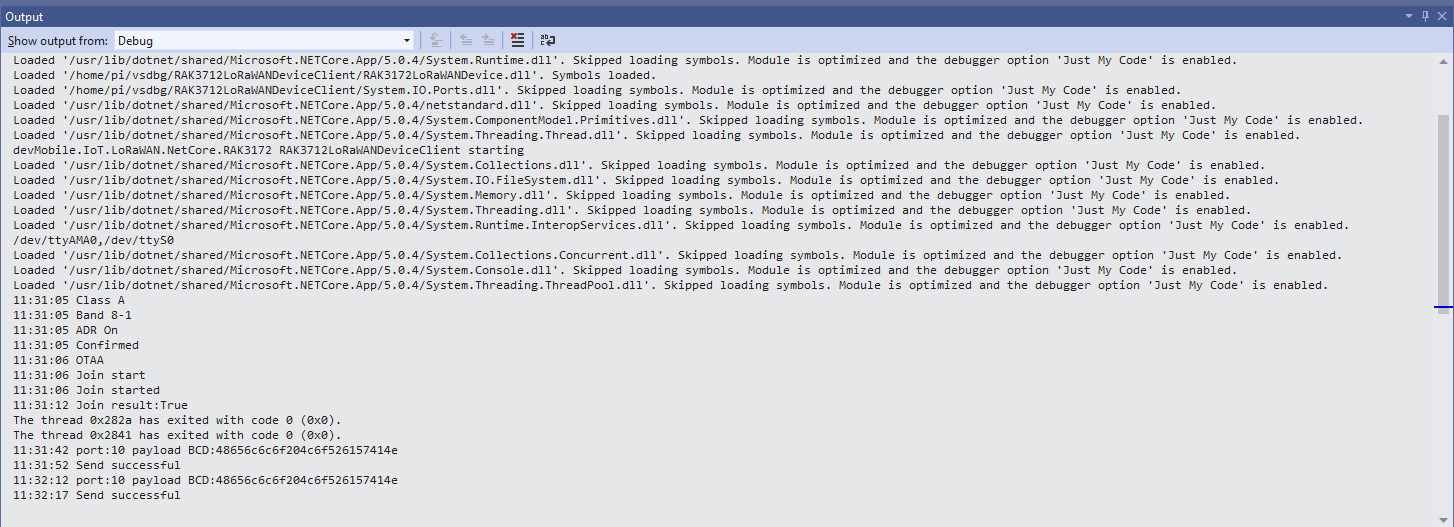
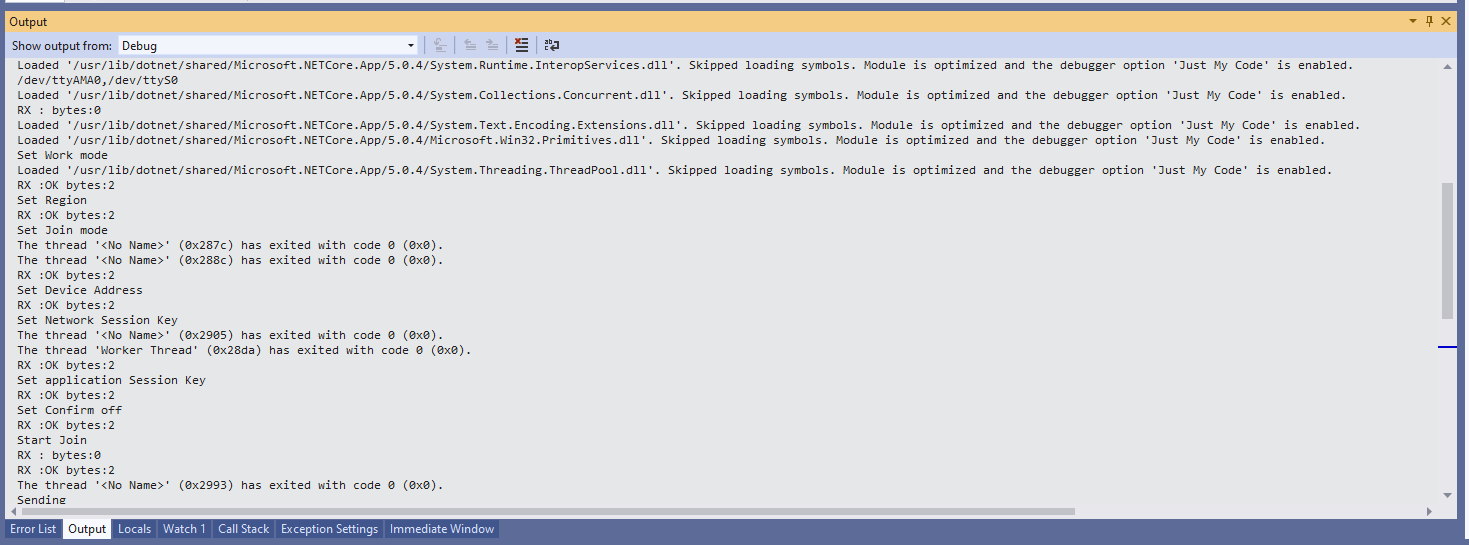
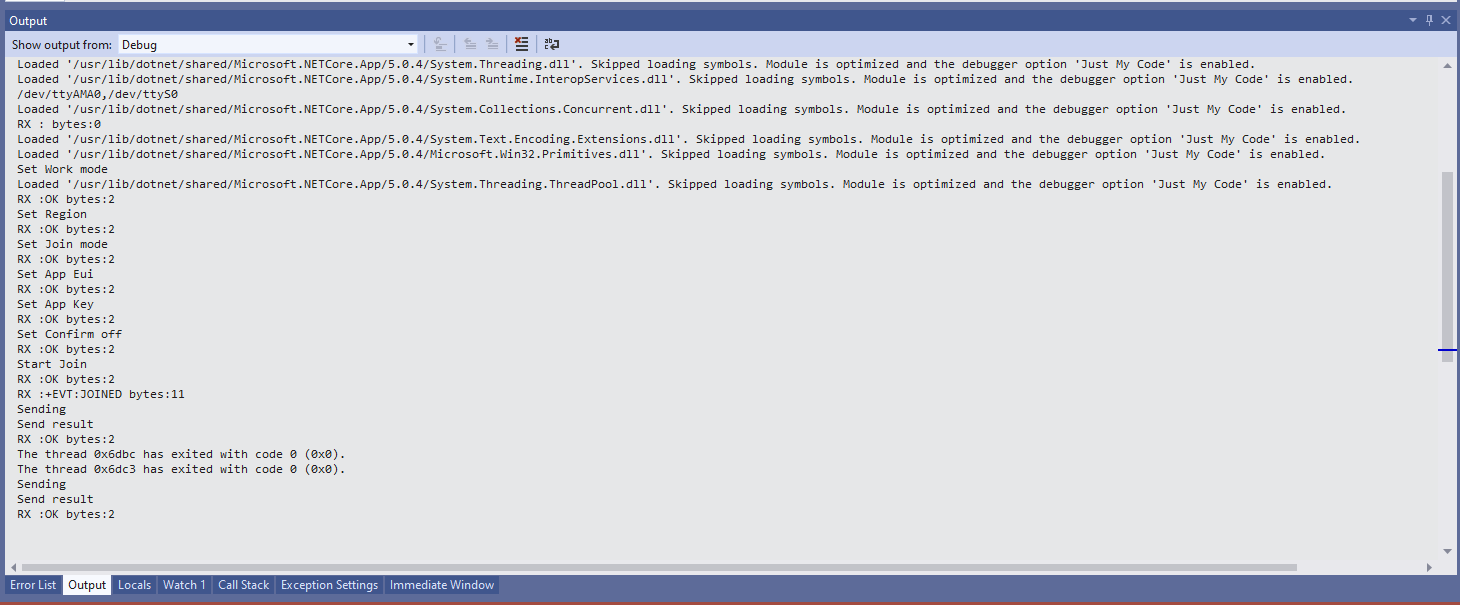
In the Visual Studio 2019 debug output I could see messages getting sent and then after a short delay they were visible in the TTN console.

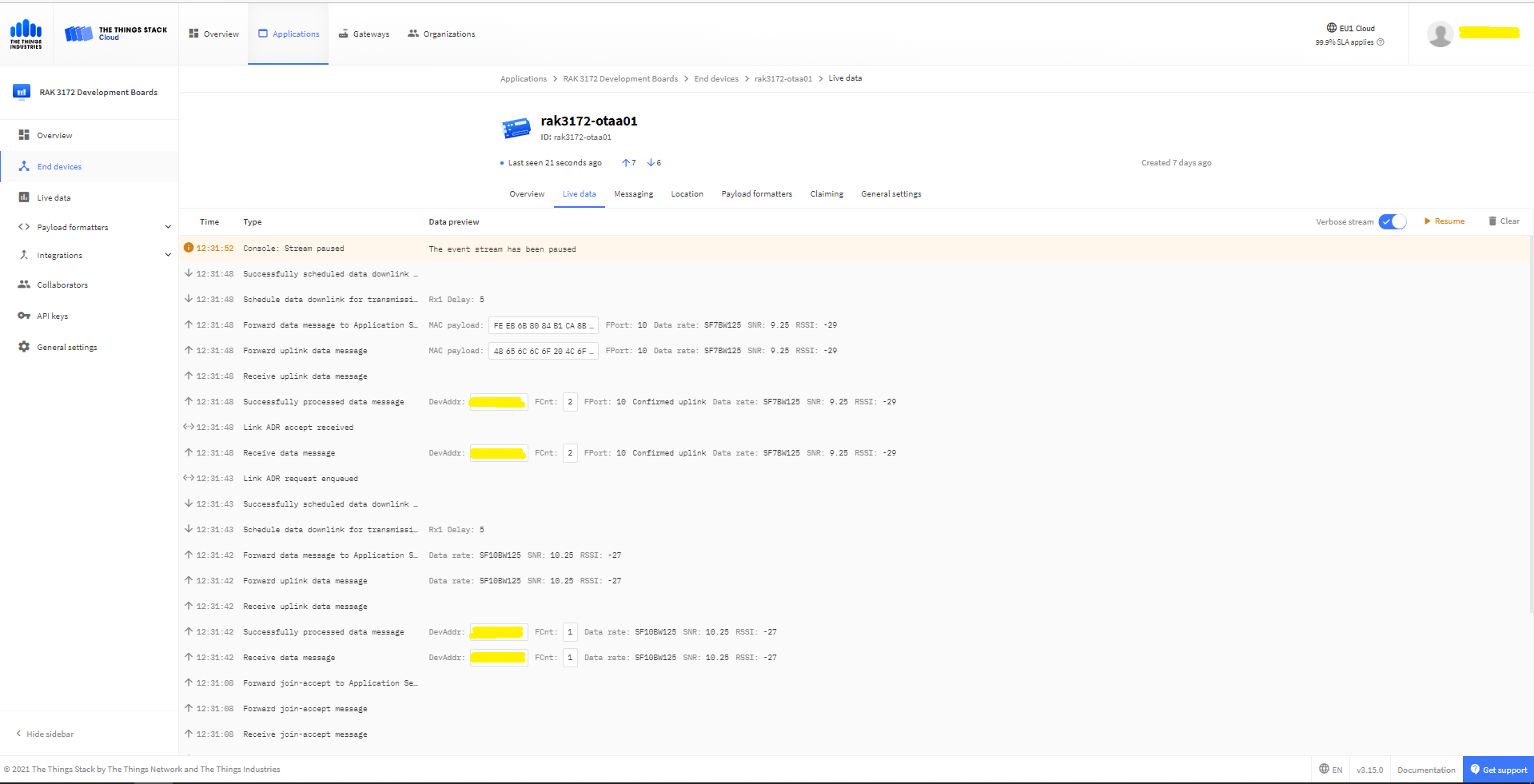
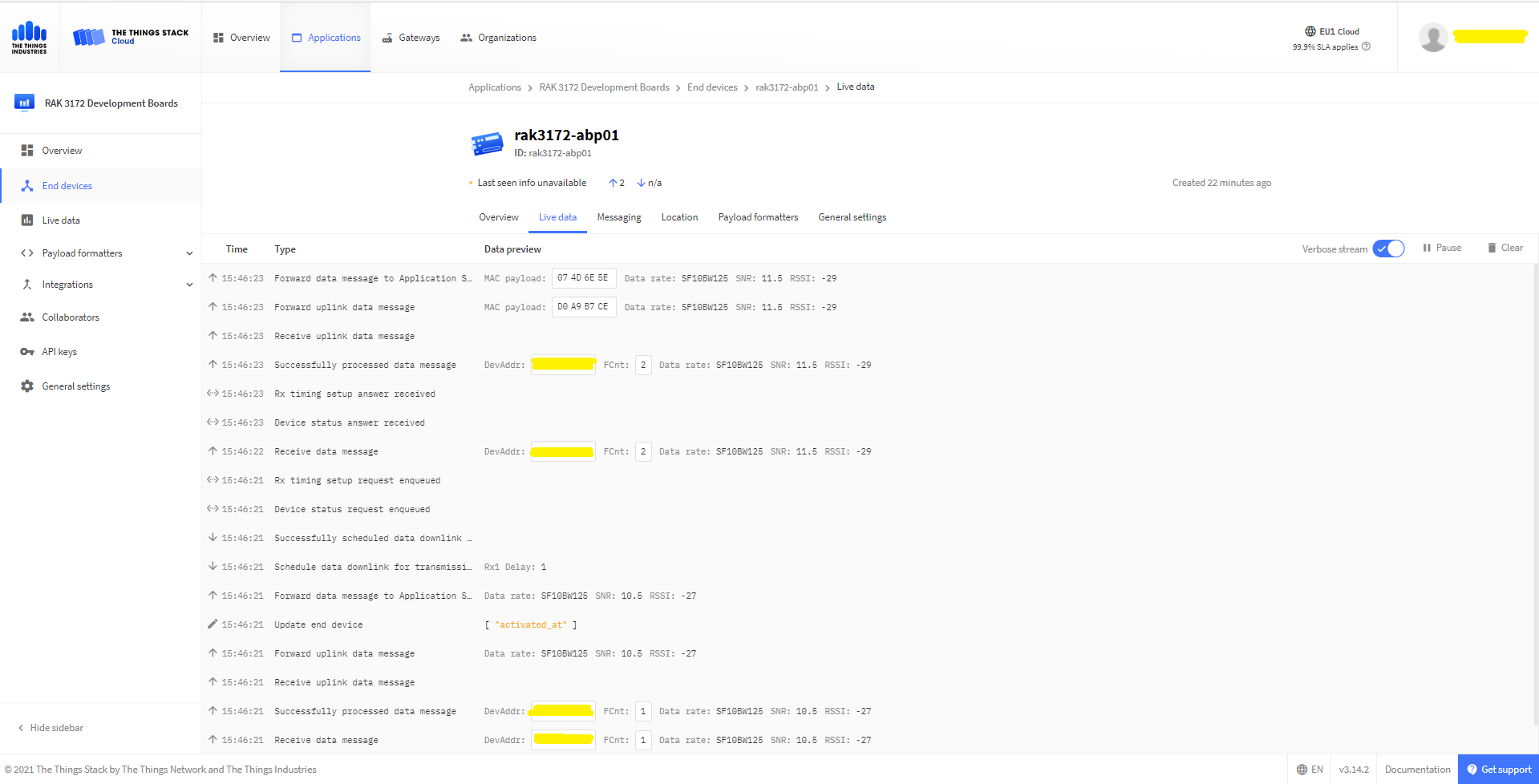
TTN Displaying RAK3172 device joining network then sending messages

.NET Core RAK3172 LoRaWAN library Part3

Nasty ABP connect

After getting basic connectivity for my RAK3172 test rig sorted I wanted to see if I could get the device connected to The Things Network(TTN) via the RAK7246G LPWAN Developer Gateway on my bookcase.

Raspberry Pi3 with Grove Base Hat and RAK3172 Breakout (using UART2)

My Activation By Personalisation (ABP) implementation is very “nasty” (just like the OTAA one) I have assumed that there would be no timeouts or failures and I only send one BCD message “48656c6c6f204c6f526157414e” which is “hello LoRaWAN”.

The code just sequentially steps through the necessary configuration to join the TTN network with a suitable delay after each command is sent.

//---------------------------------------------------------------------------------
// Copyright (c) September 2021, devMobile Software
//
// Licensed under the Apache License, Version 2.0 (the "License");
// you may not use this file except in compliance with the License.
// You may obtain a copy of the License at
//
//     http://www.apache.org/licenses/LICENSE-2.0
//
// Unless required by applicable law or agreed to in writing, software
// distributed under the License is distributed on an "AS IS" BASIS,
// WITHOUT WARRANTIES OR CONDITIONS OF ANY KIND, either express or implied.
// See the License for the specific language governing permissions and
// limitations under the License.
//
//---------------------------------------------------------------------------------
namespace devMobile.IoT.NetCore.RAK3172.NetworkJoinABP
{
	using System;
	using System.Diagnostics;
	using System.IO.Ports;
	using System.Threading;

	public class Program
	{
		private const string SerialPortId = "/dev/ttyS0";
		private const string DevAddress = "...";
		private const string NwksKey = "...";
		private const string AppsKey = "...";
		private const byte MessagePort = 1;
		private const string Payload = "A0EEE456D02AFF4AB8BAFD58101D2A2A"; // Hello LoRaWAN

		public static void Main()
		{
			string response;

			Debug.WriteLine("devMobile.IoT.NetCore.Rak3172.NetworkJoinOTAA starting");

			Debug.WriteLine(String.Join(",", SerialPort.GetPortNames()));

			try
			{
				using (SerialPort serialPort = new SerialPort(SerialPortId))
				{
					// set parameters
					serialPort.BaudRate = 9600;
					serialPort.DataBits = 8;
					serialPort.Parity = Parity.None;
					serialPort.StopBits = StopBits.One;
					serialPort.Handshake = Handshake.None;

					serialPort.ReadTimeout = 5000;

					serialPort.NewLine = "\r\n";

					serialPort.Open();

					// clear out the RX buffer
					response = serialPort.ReadExisting();
					Debug.WriteLine($"RX :{response.Trim()} bytes:{response.Length}");
					Thread.Sleep(500);

					// Set the Working mode to LoRaWAN
					Console.WriteLine("Set Work mode");
					serialPort.WriteLine("AT+NWM=1");
					// Read the blank line
					response = serialPort.ReadLine();
					// Read the response
					response = serialPort.ReadLine();
					Debug.WriteLine($"RX :{response.Trim()} bytes:{response.Length}");

					// Set the Region to AS923
					Console.WriteLine("Set Region");
					serialPort.WriteLine("AT+BAND=8-1");
					// Read the blank line
					response = serialPort.ReadLine();
					// Read the response
					response = serialPort.ReadLine();
					Debug.WriteLine($"RX :{response.Trim()} bytes:{response.Length}");

					// Set the JoinMode
					Console.WriteLine("Set Join mode");
					serialPort.WriteLine("AT+NJM=0");
					// Read the blank line
					response = serialPort.ReadLine();
					// Read the response
					response = serialPort.ReadLine();
					Debug.WriteLine($"RX :{response.Trim()} bytes:{response.Length}");

					// Set the device address
					Console.WriteLine("Set Device Address");
					serialPort.WriteLine($"AT+DEVADDR={DevAddress}");
					// Read the blank line
					response = serialPort.ReadLine();
					// Read the response
					response = serialPort.ReadLine();
					Debug.WriteLine($"RX :{response.Trim()} bytes:{response.Length}");

					// Set the network session key
					Console.WriteLine("Set Network Session Key");
					serialPort.WriteLine($"AT+NWKSKEY={NwksKey}");
					// Read the blank line
					response = serialPort.ReadLine();
					// Read the response
					response = serialPort.ReadLine();
					Debug.WriteLine($"RX :{response.Trim()} bytes:{response.Length}");

					// Set the application session key
					Console.WriteLine("Set application Session Key");
					serialPort.WriteLine($"AT+APPSKEY={AppsKey}");
					// Read the blank line
					response = serialPort.ReadLine();
					// Read the response
					response = serialPort.ReadLine();
					Debug.WriteLine($"RX :{response.Trim()} bytes:{response.Length}");

					// Set the Confirm flag
					Console.WriteLine("Set Confirm off");
					serialPort.WriteLine("AT+CFM=0");
					// Read the blank line
					response = serialPort.ReadLine();
					// Read the response
					response = serialPort.ReadLine();
					Debug.WriteLine($"RX :{response.Trim()} bytes:{response.Length}");

					// Join the network
					Console.WriteLine("Start Join");
					serialPort.WriteLine("AT+JOIN=1:0:10:2");

					// Read the blank line
					response = serialPort.ReadLine();

					// Read the Result
					response = serialPort.ReadLine();
					Debug.WriteLine($"RX :{response.Trim()} bytes:{response.Length}");

					Thread.Sleep(10000);

					// Read the +EVT:JOINED
					response = serialPort.ReadLine();
					Debug.WriteLine($"RX :{response.Trim()} bytes:{response.Length}");

					while (true)
					{
						Console.WriteLine("Sending");
						serialPort.WriteLine($"AT+SEND={MessagePort}:{Payload}");

						// Read the blank line
						response = serialPort.ReadLine();

						// Read the result
						Console.WriteLine("Send result");
						response = serialPort.ReadLine();
						Debug.WriteLine($"RX :{response.Trim()} bytes:{response.Length}");

						Thread.Sleep(300000);
					}
				}
			}
			catch (Exception ex)
			{
				Debug.WriteLine(ex.Message);
			}
		}
	}
}

The code is not suitable for production but it confirmed my software and hardware configuration worked.

In the Visual Studio 2019 debug output I could see messages getting sent and then after a short delay they were visible in the TTN console.

The RAK3172 command format is quite different from other modules I have used e.g. Requesting the firmware version information

  • TX- AT+VER=?
  • RX- Blank Line
  • RX- V1.0.2
  • RX- OK

Requesting the APPEUI

  • TX- AT+DEVADDR=?
  • RX- 11223344
  • RX- Blank line
  • RX- OK

I think the RAK3172 module ships with a default DEVEUI so in this code and my library I have assumed it will be configured as part of a “provisioning” process.

.NET Core RAK3172 LoRaWAN library Part2

Nasty OTAA connect

After getting basic connectivity for my RAK3172 test rig sorted I wanted to see if I could get the device connected to The Things Network(TTN) via the RAK7246G LPWAN Developer Gateway on my bookcase.

Raspberry Pi3 with Grove Base Hat and RAK3172 Breakout (using UART2)

My Over the Air Activation (OTAA) implementation is very “nasty” I have assumed that there would be no timeouts or failures and I only send one BCD message “48656c6c6f204c6f526157414e” which is “hello LoRaWAN”.

The code just sequentially steps through the necessary configuration to join the TTN network with a suitable delay after each command is sent.

//---------------------------------------------------------------------------------
// Copyright (c) September 2021, devMobile Software
//
// Licensed under the Apache License, Version 2.0 (the "License");
// you may not use this file except in compliance with the License.
// You may obtain a copy of the License at
//
//     http://www.apache.org/licenses/LICENSE-2.0
//
// Unless required by applicable law or agreed to in writing, software
// distributed under the License is distributed on an "AS IS" BASIS,
// WITHOUT WARRANTIES OR CONDITIONS OF ANY KIND, either express or implied.
// See the License for the specific language governing permissions and
// limitations under the License.
//
//---------------------------------------------------------------------------------
namespace devMobile.IoT.NetCore.RAK3172.NetworkJoinOTAA
{
	using System;
	using System.Diagnostics;
	using System.IO.Ports;
	using System.Threading;

	public class Program
	{
		private const string SerialPortId = "/dev/ttyS0";
		private const string AppEui = "...";
		private const string AppKey = "...";
		private const byte MessagePort = 1;
		private const string Payload = "A0EEE456D02AFF4AB8BAFD58101D2A2A"; // Hello LoRaWAN

		public static void Main()
		{
			string response;

			Debug.WriteLine("devMobile.IoT.NetCore.Rak3172.NetworkJoinOTAA starting");

			Debug.WriteLine(String.Join(",", SerialPort.GetPortNames()));

			try
			{
				using (SerialPort serialPort = new SerialPort(SerialPortId))
				{
					// set parameters
					serialPort.BaudRate = 9600;
					serialPort.DataBits = 8;
					serialPort.Parity = Parity.None;
					serialPort.StopBits = StopBits.One;
					serialPort.Handshake = Handshake.None;

					serialPort.ReadTimeout = 5000;

					serialPort.NewLine = "\r\n";

					serialPort.Open();

					// clear out the RX buffer
					response = serialPort.ReadExisting();
					Debug.WriteLine($"RX :{response.Trim()} bytes:{response.Length}");
					Thread.Sleep(500);


					// Set the Working mode to LoRaWAN
					Console.WriteLine("Set Work mode");
					serialPort.WriteLine("AT+NWM=1");
					// Read the blank line
					response = serialPort.ReadLine();
					// Read the response
					response = serialPort.ReadLine();
					Debug.WriteLine($"RX :{response.Trim()} bytes:{response.Length}");

					// Set the Region to AS923
					Console.WriteLine("Set Region");
					serialPort.WriteLine("AT+BAND=8-1");
					// Read the blank line
					response = serialPort.ReadLine();
					// Read the response
					response = serialPort.ReadLine();
					Debug.WriteLine($"RX :{response.Trim()} bytes:{response.Length}");

					// Set the JoinMode
					Console.WriteLine("Set Join mode");
					serialPort.WriteLine("AT+NJM=1");
					// Read the blank line
					response = serialPort.ReadLine();
					// Read the response
					response = serialPort.ReadLine();
					Debug.WriteLine($"RX :{response.Trim()} bytes:{response.Length}");

					// Set the appEUI
					Console.WriteLine("Set App Eui");
					serialPort.WriteLine($"AT+APPEUI={AppEui}");
					// Read the blank line
					response = serialPort.ReadLine();
					// Read the response
					response = serialPort.ReadLine();
					Debug.WriteLine($"RX :{response.Trim()} bytes:{response.Length}");

					// Set the appKey
					Console.WriteLine("Set App Key");
					serialPort.WriteLine($"AT+APPKEY={AppKey}");
					// Read the blank line
					response = serialPort.ReadLine();
					// Read the response
					response = serialPort.ReadLine();
					Debug.WriteLine($"RX :{response.Trim()} bytes:{response.Length}");

					// Set the Confirm flag
					Console.WriteLine("Set Confirm off");
					serialPort.WriteLine("AT+CFM=0");
					// Read the blank line
					response = serialPort.ReadLine();
					// Read the response
					response = serialPort.ReadLine(); 
					Debug.WriteLine($"RX :{response.Trim()} bytes:{response.Length}");

					// Join the network
					Console.WriteLine("Start Join");
					serialPort.WriteLine("AT+JOIN=1:0:10:2");

					// Read the blank line
					response = serialPort.ReadLine();

					// Read the Result
					response = serialPort.ReadLine();
					Debug.WriteLine($"RX :{response.Trim()} bytes:{response.Length}");

					Thread.Sleep(10000);

					// Read the +EVT:JOINED
					response = serialPort.ReadLine();
					Debug.WriteLine($"RX :{response.Trim()} bytes:{response.Length}");

					while (true)
					{
						Console.WriteLine("Sending");
						serialPort.WriteLine($"AT+SEND={MessagePort}:{Payload}");

						// Read the blank line
						response = serialPort.ReadLine();

						// Read the result
						Console.WriteLine("Send result");
						response = serialPort.ReadLine();
						Debug.WriteLine($"RX :{response.Trim()} bytes:{response.Length}");

						Thread.Sleep(300000);
					}
				}
			}
			catch (Exception ex)
			{
				Debug.WriteLine(ex.Message);
			}
		}
	}
}

The code is not suitable for production but it confirmed my software and hardware configuration worked.

In the Visual Studio 2019 debug output I could see messages getting sent and then after a short delay they were visible in the TTN console.

The RAK3172 command format is quite different from other modules I have used e.g. Requesting the firmware version information

  • TX- AT+VER=?
  • RX- Blank Line
  • RX- V1.0.2
  • RX- OK

Requesting the APPEUI

  • TX- AT+APPEUI=?
  • RX- 1122334455667788
  • RX- Blank line
  • RX- OK

I think the RAK3172 module ships with a default DEVEUI so in this code and my library I have assumed it will be configured as part of a “provisioning” process.

.NET Core Seeed LoRaE5 LoRaWAN library Part2

Nasty OTAA connect

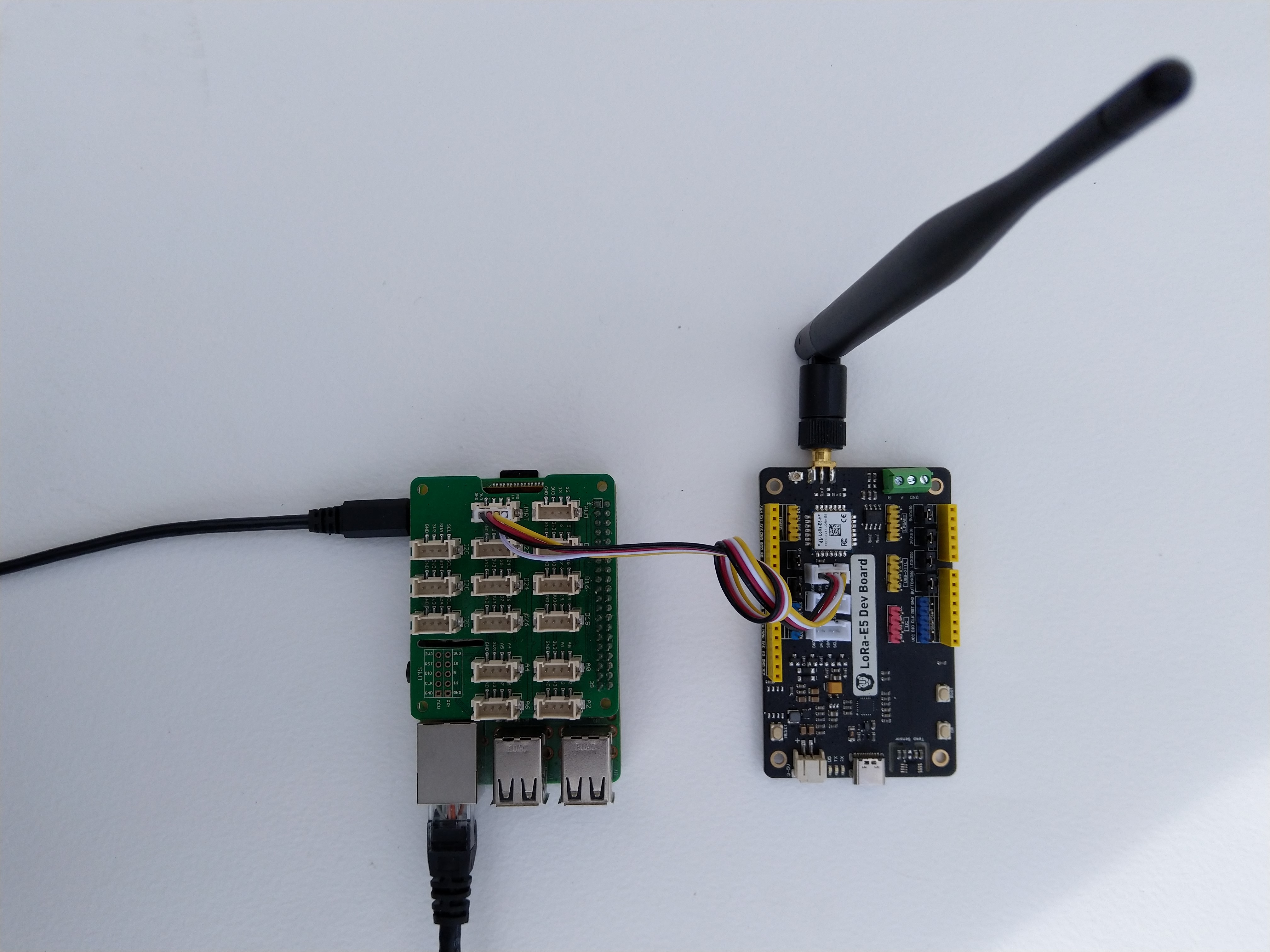
After getting basic connectivity for my Seeed LoRa-E5 test rig sorted I used RAK7246G LPWAN Developer Gateway on my bookcase to connect to The Things Network(TTN)

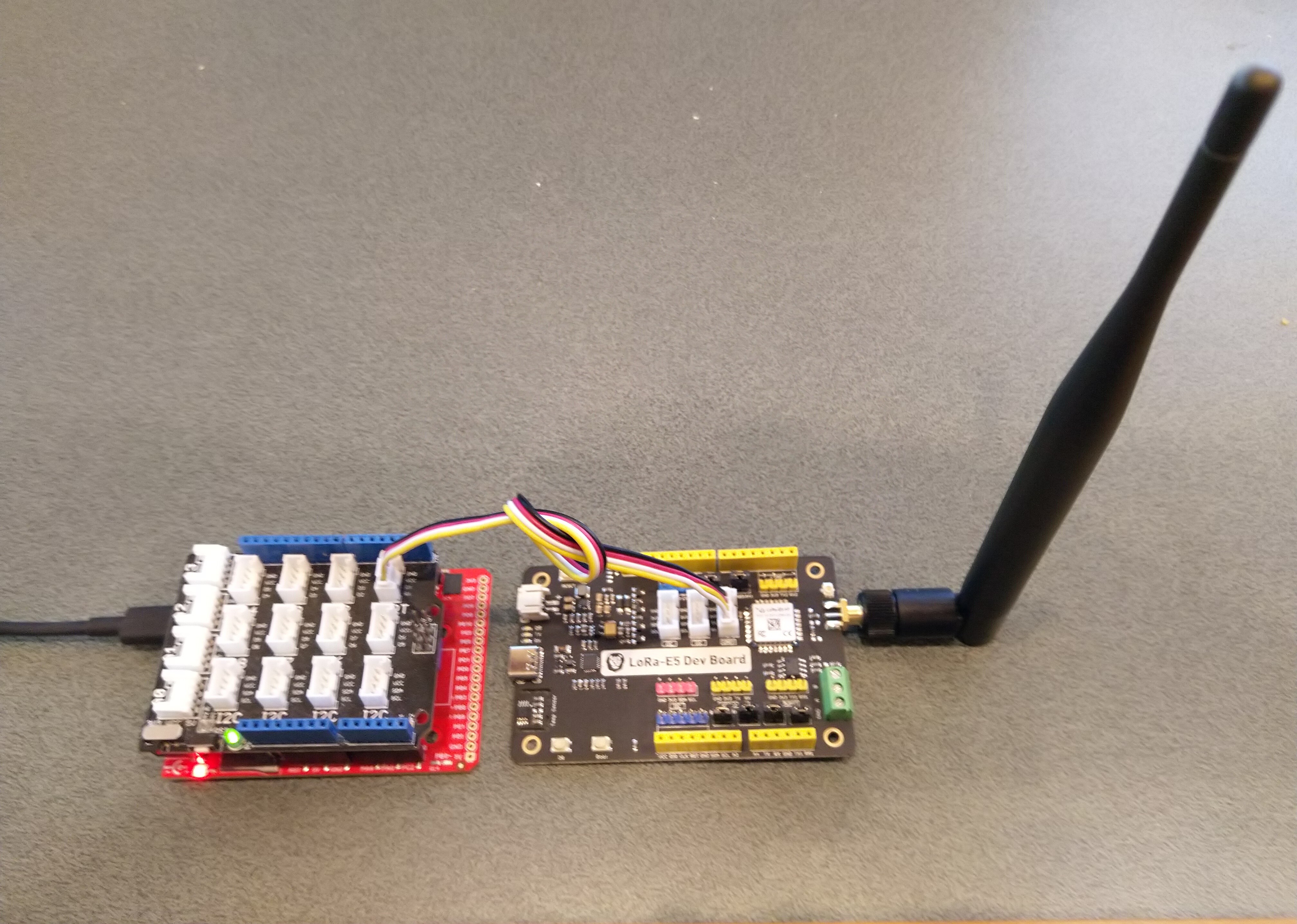
Seeed LoRa-E5 Development kit connected to Gove bas shield on a Raspberry PI3

My Over the Air Activation (OTAA) implementation is very “nasty” I have assumed that there would be no timeouts or failures and I only send one BCD message “48656c6c6f204c6f526157414e” which is “hello LoRaWAN”.

The code just sequentially steps through the necessary configuration to join the TTN network with a suitable delay after each command is sent. There also appeared to be quite a variation in response times, especially for joining the network(most probably network related) and the progress of sending a message.

//---------------------------------------------------------------------------------
// Copyright (c) September 2021, devMobile Software
//
// Licensed under the Apache License, Version 2.0 (the "License");
// you may not use this file except in compliance with the License.
// You may obtain a copy of the License at
//
//     http://www.apache.org/licenses/LICENSE-2.0
//
// Unless required by applicable law or agreed to in writing, software
// distributed under the License is distributed on an "AS IS" BASIS,
// WITHOUT WARRANTIES OR CONDITIONS OF ANY KIND, either express or implied.
// See the License for the specific language governing permissions and
// limitations under the License.
//
//---------------------------------------------------------------------------------
namespace devMobile.IoT.NetCore.SeeedLoRaE5.NetworkJoinOTAA
{
	using System;
	using System.Diagnostics;
	using System.IO.Ports;
	using System.Threading;

	class Program
	{
		private const string SerialPortId = "/dev/ttyS0";

		private const string AppKey = "................................";
		private const string AppEui = "................";

		private const byte MessagePort = 15;

		//private const string Payload = "48656c6c6f204c6f526157414e"; // Hello LoRaWAN
		private const string Payload = "01020304"; // AQIDBA==
		//private const string Payload = "04030201"; // BAMCAQ==

		public static void Main()
		{
			string response;

			Debug.WriteLine("devMobile.IoT.SeeedLoRaE5.NetworkJoinOTAA starting");

			Debug.WriteLine(String.Join(",", SerialPort.GetPortNames()));

			try
			{
				using (SerialPort serialDevice = new SerialPort(SerialPortId))
				{
					// set parameters
					serialDevice.BaudRate = 9600;
					serialDevice.Parity = Parity.None;
					serialDevice.StopBits = StopBits.One;
					serialDevice.Handshake = Handshake.None;
					serialDevice.DataBits = 8;

					serialDevice.ReadTimeout = 10000;

					serialDevice.NewLine = "\r\n";

					serialDevice.Open();

					// clear out the RX buffer
					serialDevice.ReadExisting();
					response = serialDevice.ReadExisting();
					Debug.WriteLine($"Response :{response.Trim()} bytes:{response.Length}");
					Thread.Sleep(500);

					// Set the Region to AS923
					serialDevice.WriteLine("AT+DR=AS923\r\n");
					response = serialDevice.ReadLine();
					Debug.WriteLine($"Response :{response.Trim()} bytes:{response.Length}");

					// Set the Join mode
					serialDevice.WriteLine("AT +MODE=LWOTAA\r\n");
					response = serialDevice.ReadLine();
					Debug.WriteLine($"Response :{response.Trim()} bytes:{response.Length}");

					// Set the appEUI
					serialDevice.WriteLine($"AT+ID=AppEui,\"{AppEui}\"\r\n");
					response = serialDevice.ReadLine();
					Debug.WriteLine($"Response :{response.Trim()} bytes:{response.Length}");

					// Set the appKey
					serialDevice.WriteLine($"AT+KEY=APPKEY,{AppKey}\r\n");
					response = serialDevice.ReadLine();
					Debug.WriteLine($"Response :{response.Trim()} bytes:{response.Length}");

					// Set the port number
					serialDevice.WriteLine($"AT+PORT={MessagePort}\r\n");
					response = serialDevice.ReadLine();
					Debug.WriteLine($"Response :{response.Trim()} bytes:{response.Length}");

					// Join the network
					serialDevice.WriteLine("AT+JOIN\r\n");

					// Join start
					response = serialDevice.ReadLine();
					Debug.WriteLine($"Response :{response.Trim()} bytes:{response.Length}");

					// JOIN normal
					response = serialDevice.ReadLine();
					Debug.WriteLine($"Response :{response.Trim()} bytes:{response.Length}");

					Thread.Sleep(5000);

					// network joined
					response = serialDevice.ReadLine();
					Debug.WriteLine($"Response :{response.Trim()} bytes:{response.Length}");

					// Net ID
					response = serialDevice.ReadLine();
					Debug.WriteLine($"Response :{response.Trim()} bytes:{response.Length}");

					// Join done
					response = serialDevice.ReadLine();
					Debug.WriteLine($"Response :{response.Trim()} bytes:{response.Length}");

					while (true)
					{
						Debug.WriteLine("Sending");

						serialDevice.WriteLine($"AT+MSGHEX=\"{Payload}\"\r\n");

						// Start
						response = serialDevice.ReadLine();
						Debug.WriteLine($"Response :{response.Trim()} bytes:{response.Length}");

						// Fpending
						response = serialDevice.ReadLine();
						Debug.WriteLine($"Response :{response.Trim()} bytes:{response.Length}");

						//Read metrics
						response = serialDevice.ReadLine();
						Debug.WriteLine($"Response :{response.Trim()} bytes:{response.Length}");

						//Done
						response = serialDevice.ReadLine();
						Debug.WriteLine($"Response :{response.Trim()} bytes:{response.Length}");

						Thread.Sleep(30000);
					}
				}
			}
			catch (Exception ex)
			{
				Debug.WriteLine(ex.Message);
			}
		}
	}
}

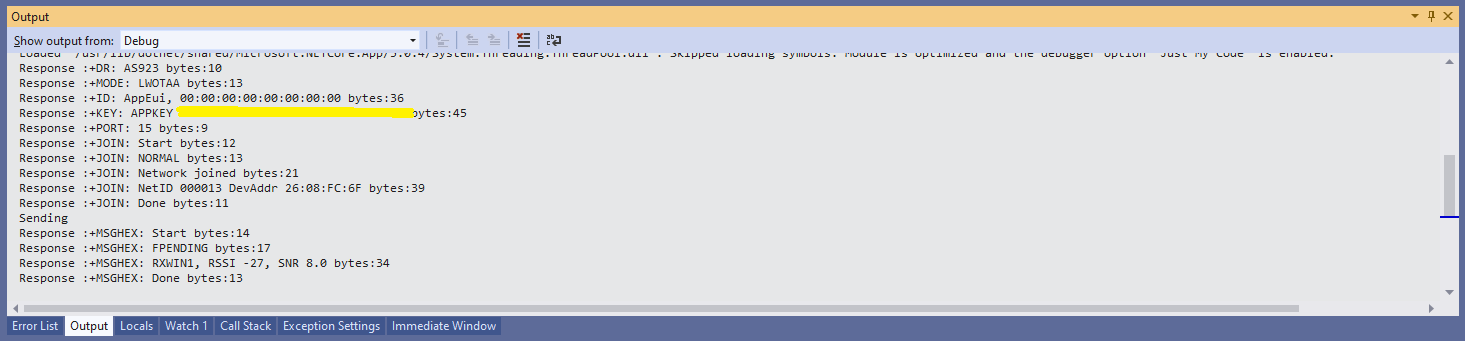
The code is not suitable for production but it confirmed my software and hardware configuration worked.

Visual Studio debugger output window showing network join and sensing a message

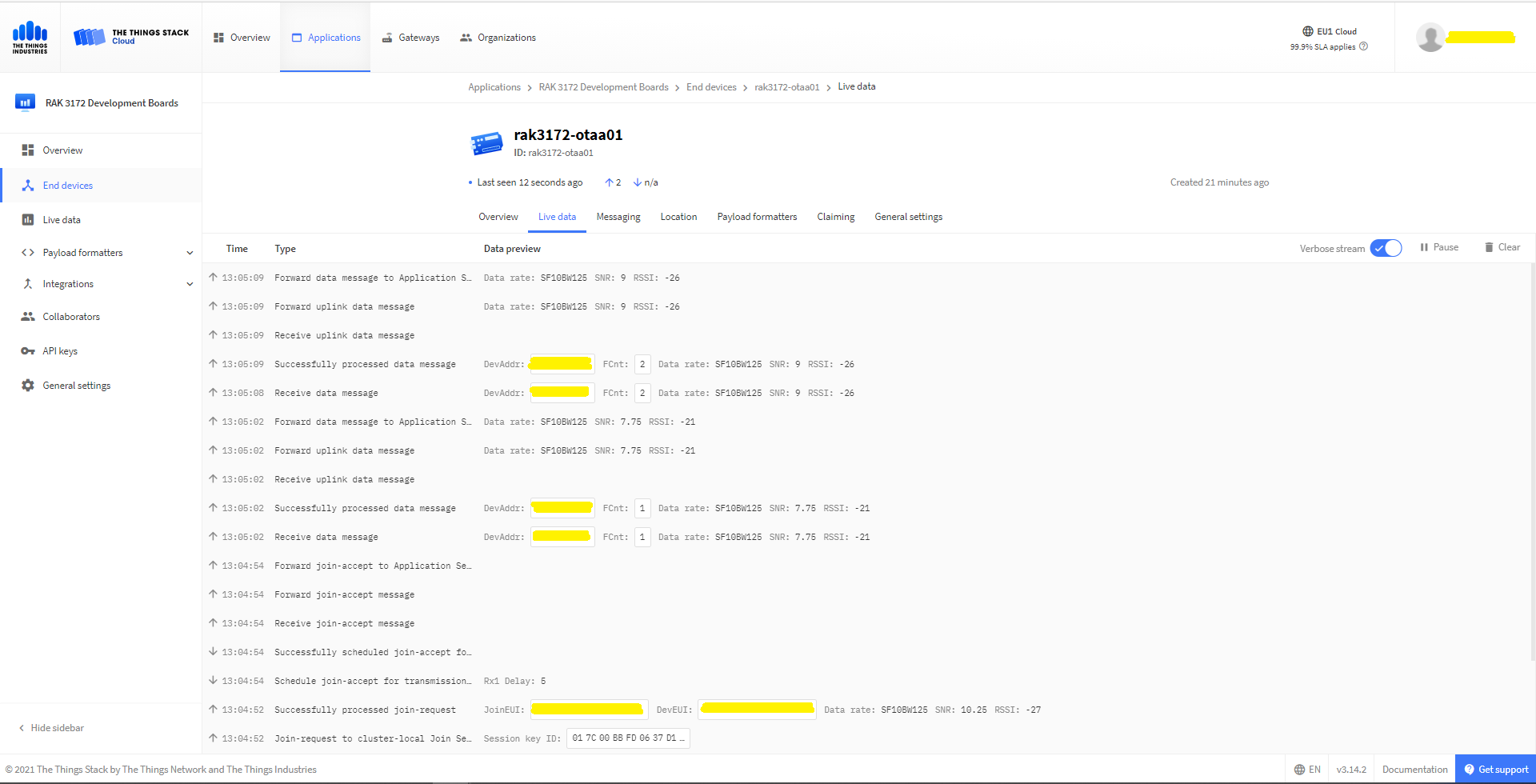
In the Visual Studio 2019 debug output I could see messages getting sent and then after a short delay they were visible in the TTN console.

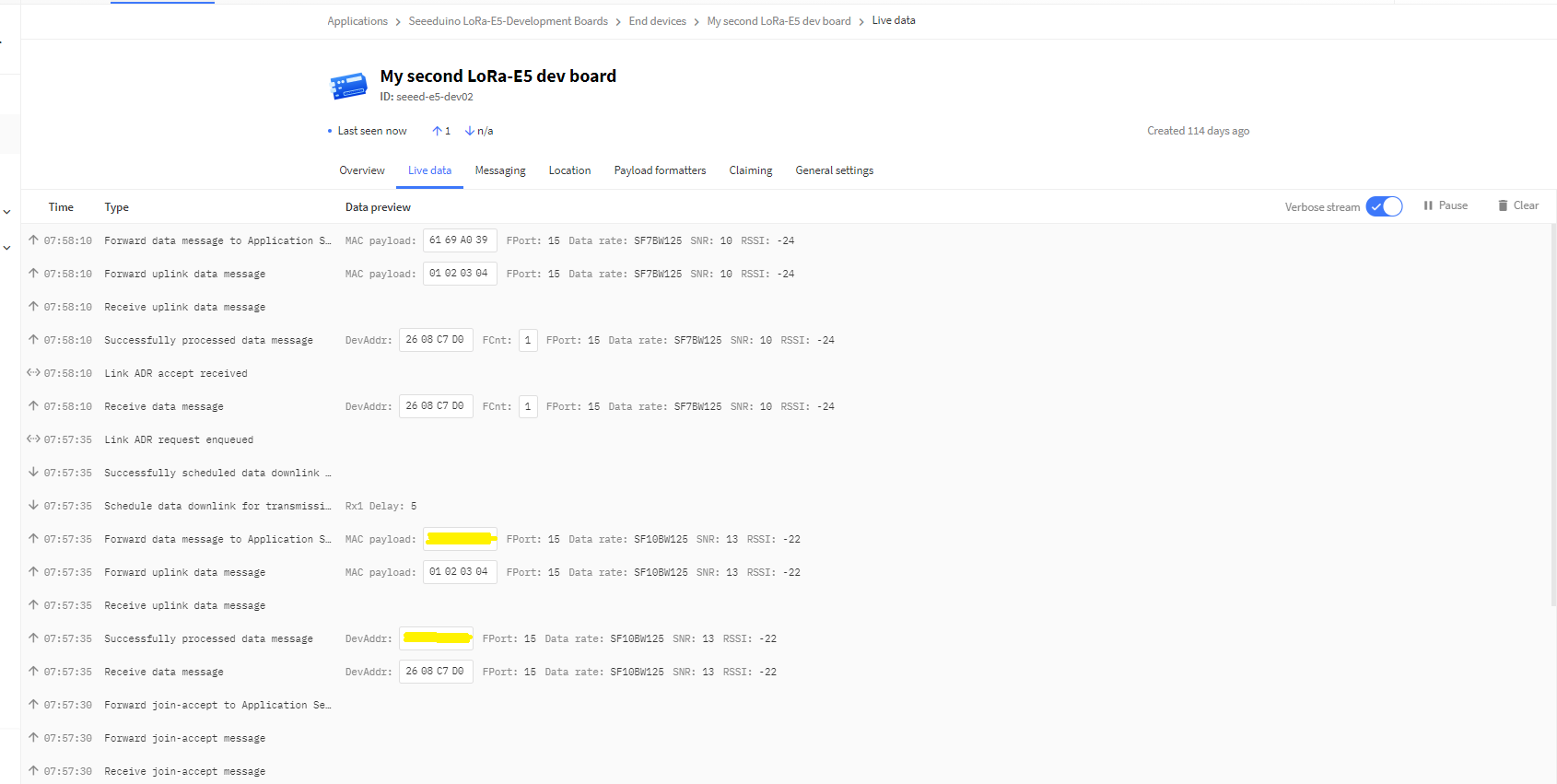
The Things Industries Live Data view showing network join and sensing a message

Most of the LoRaWAN modems I have worked with reply “OK” when a command is successful. The SeeedLoRa-E5 often returns the payload of the request in the response which makes the code a little bit more complex.

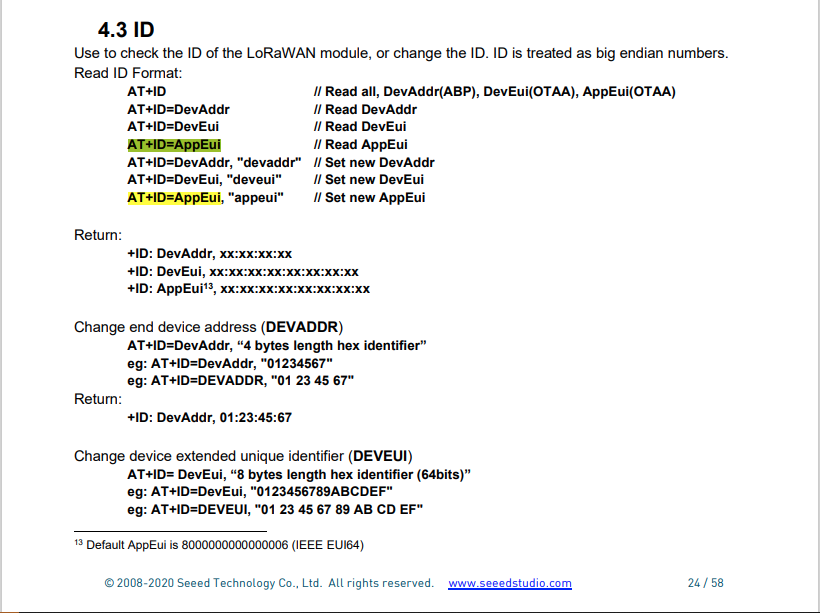
AppEui command structure in AT Command documentation

For example the AppEui can be passed in as “00:00:00:00:00:00:00:00” or “0000000000000000” but in the response the format is always “00:00:00:00:00:00:00:00”

.NET Core RAK811 LoRaWAN library Part2

Nasty OTAA connect

After getting basic connectivity for my IoT LoRa Node pHAT for Raspberry Pi test rig sorted I wanted to see if I could get the device connected to The Things Network(TTN) via the RAK7246G LPWAN Developer Gateway on my bookcase.

IoT LoRa Node pHAT for Raspberry Pi mounted on a Raspberry PI3

My Over the Air Activation (OTAA) implementation is very “nasty” I have assumed that there would be no timeouts or failures and I only send one BCD message “48656c6c6f204c6f526157414e” which is “hello LoRaWAN”.

The code just sequentially steps through the necessary configuration to join the TTN network with a suitable delay after each command is sent. I had some problems with re-opening the serial port if my application had previously failed with an uncaught exception. After some experimentation I added some code to ensure the port was closed when an exception occurred.

//---------------------------------------------------------------------------------
// Copyright (c) September 2021, devMobile Software
//
// Licensed under the Apache License, Version 2.0 (the "License");
// you may not use this file except in compliance with the License.
// You may obtain a copy of the License at
//
//     http://www.apache.org/licenses/LICENSE-2.0
//
// Unless required by applicable law or agreed to in writing, software
// distributed under the License is distributed on an "AS IS" BASIS,
// WITHOUT WARRANTIES OR CONDITIONS OF ANY KIND, either express or implied.
// See the License for the specific language governing permissions and
// limitations under the License.
//
//---------------------------------------------------------------------------------
namespace devMobile.IoT.NetCore.Rak811.NetworkJoinOTAA
{
	using System;
	using System.Diagnostics;
	using System.IO.Ports;
	using System.Threading;

	public class Program
	{
		private const string SerialPortId = "/dev/ttyS0";
		private const string AppEui = "...";
		private const string AppKey = "...";
		private const byte MessagePort = 1;
		private const string Payload = "A0EEE456D02AFF4AB8BAFD58101D2A2A"; // Hello LoRaWAN

		public static void Main()
		{
			string response;

			Debug.WriteLine("devMobile.IoT.NetCore.Rak811.NetworkJoinOTAA starting");

			Debug.WriteLine(String.Join(",", SerialPort.GetPortNames()));

			try
			{
				using (SerialPort serialPort = new SerialPort(SerialPortId))
				{
					// set parameters
					serialPort.BaudRate = 9600;
					serialPort.DataBits = 8;
					serialPort.Parity = Parity.None;
					serialPort.StopBits = StopBits.One;
					serialPort.Handshake = Handshake.None;

					serialPort.ReadTimeout = 5000;

					serialPort.NewLine = "\r\n";

					serialPort.Open();

					// clear out the RX buffer
					response = serialPort.ReadExisting();
					Debug.WriteLine($"RX :{response.Trim()} bytes:{response.Length}");
					Thread.Sleep(500);

					// Set the Working mode to LoRaWAN
					Console.WriteLine("Set Work mode");
					serialPort.WriteLine("at+set_config=lora:work_mode:0");
					Thread.Sleep(5000);
					response = serialPort.ReadExisting();
					response = response.Trim('\0');
					Debug.WriteLine($"RX :{response.Trim()} bytes:{response.Length}");

					// Set the Region to AS923
					Console.WriteLine("Set Region");
					serialPort.WriteLine("at+set_config=lora:region:AS923");
					response = serialPort.ReadLine();
					Debug.WriteLine($"RX :{response.Trim()} bytes:{response.Length}");

					// Set the JoinMode
					Console.WriteLine("Set Join mode");
					serialPort.WriteLine("at+set_config=lora:join_mode:0");
					response = serialPort.ReadLine();
					Debug.WriteLine($"RX :{response.Trim()} bytes:{response.Length}");

					// Set the appEUI
					Console.WriteLine("Set App Eui");
					serialPort.WriteLine($"at+set_config=lora:app_eui:{AppEui}");
					response = serialPort.ReadLine();
					Debug.WriteLine($"RX :{response.Trim()} bytes:{response.Length}");

					// Set the appKey
					Console.WriteLine("Set App Key");
					serialPort.WriteLine($"at+set_config=lora:app_key:{AppKey}");
					response = serialPort.ReadLine();
					Debug.WriteLine($"RX :{response.Trim()} bytes:{response.Length}");

					// Set the Confirm flag
					Console.WriteLine("Set Confirm off");
					serialPort.WriteLine("at+set_config=lora:confirm:0");
					response = serialPort.ReadLine();
					Debug.WriteLine($"RX :{response.Trim()} bytes:{response.Length}");
					
					// Join the network
					Console.WriteLine("Start Join");
					serialPort.WriteLine("at+join");
					Thread.Sleep(10000);
					response = serialPort.ReadLine();
					Debug.WriteLine($"RX :{response.Trim()} bytes:{response.Length}");

					while (true)
					{
						Console.WriteLine("Sending");
						serialPort.WriteLine($"at+send=lora:{MessagePort}:{Payload}");
						Thread.Sleep(1000);

						// The OK
						Console.WriteLine("Send result");
						response = serialPort.ReadLine();
						Debug.WriteLine($"RX :{response.Trim()} bytes:{response.Length}");

						// The Signal strength information etc.
						Console.WriteLine("Network confirmation");
						response = serialPort.ReadLine();
						Debug.WriteLine($"RX :{response.Trim()} bytes:{response.Length}");

						Thread.Sleep(20000);
					}
				}
			}
			catch (Exception ex)
			{
				Debug.WriteLine(ex.Message);
			}
		}
	}
}

The code is not suitable for production but it confirmed my software and hardware configuration worked.

In the Visual Studio 2019 debug output I could see messages getting sent and then after a short delay they were visible in the TTN console.

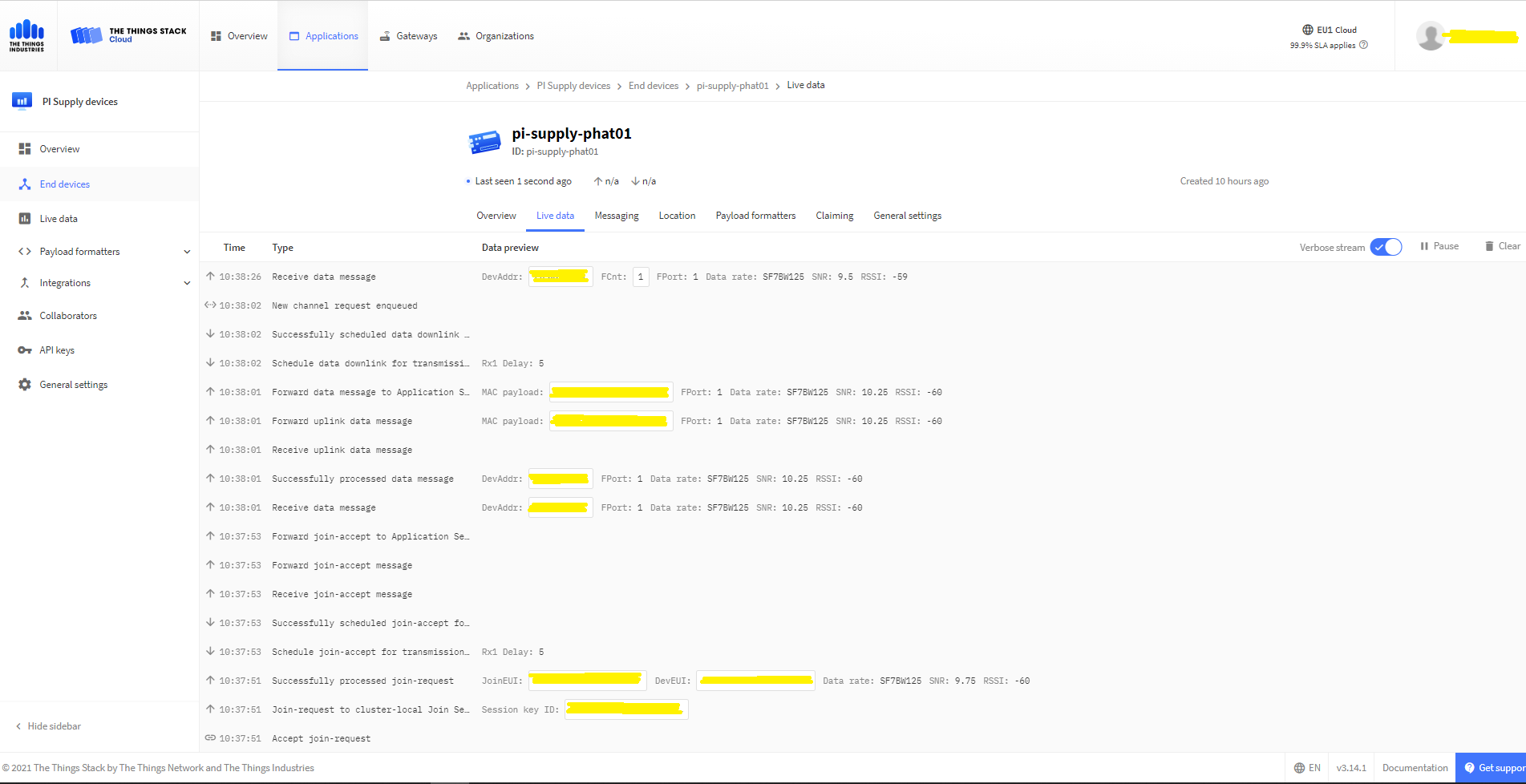
The Things Industries Live Data Tab showing my device connecting and sending messages

The RAK811 doesn’t fully implement the AS923 specification but I have a work around detailed in another post.

nanoFramework Seeed LoRa-E5 on Github

The source code of my nanoFramework C# Seeed LoRa-E5 library is live on GitHub. My initial test rig was based on an STM32F691DISCOVERY board which has an Arduino Uno R3 format socket for a Grove Base Shield V2.0. I then connected it to my LoRa-E5 Development Kit with a Grove – Universal 4 Pin 20cm Unbuckled Cable(TX/RX reversed)

STM32F769I test rig with Seeedstudio Grove Base shield V2 and LoRa-E5 Development Kit

So far the demo application has been running for a couple of weeks

The thread '<No Name>' (0x2) has exited with code 0 (0x0).
devMobile.IoT.SeeedE5LoRaWANDeviceClient starting
12:00:01 Join start Timeout:25 Seconds
12:00:07 Join finish
12:00:07 Send Timeout:10 Seconds payload BCD:010203040506070809
12:00:13 Sleep
12:05:13 Wakeup
12:05:13 Send Timeout:10 Seconds payload BCD:010203040506070809
12:05:20 Sleep
12:10:20 Wakeup
12:10:20 Send Timeout:10 Seconds payload BCD:010203040506070809
12:10:27 Sleep
12:15:27 Wakeup
12:15:27 Send Timeout:10 Seconds payload BCD:010203040506070809
12:15:34 Sleep
...
11:52:40 Wakeup
11:52:40 Send Timeout:10 Seconds payload BCD:010203040506070809
11:52:45 Sleep
11:57:45 Wakeup
11:57:45 Send Timeout:10 Seconds payload BCD:010203040506070809
11:57:52 Sleep
12:02:52 Wakeup
12:02:52 Send Timeout:10 Seconds payload BCD:010203040506070809
12:02:59 Sleep
12:07:59 Wakeup
12:07:59 Send Timeout:10 Seconds payload BCD:010203040506070809
12:08:07 Sleep
12:13:07 Wakeup
12:13:07 Send Timeout:10 Seconds payload BCD:010203040506070809
12:13:14 Sleep

I have tested the Over The Air Activation(OTAA) code and will work on testing the other functionality over the coming week,

public static void Main()
{
   Result result;

   Debug.WriteLine("devMobile.IoT.SeeedE5LoRaWANDeviceClient starting");

   try
   {
      using (SeeedE5LoRaWANDevice device = new SeeedE5LoRaWANDevice())
      {
         result = device.Initialise(SerialPortId, 9600, UartParity.None, 8, UartStopBitCount.One);
         if (result != Result.Success)
         {
            Debug.WriteLine($"Initialise failed {result}");
            return;
         }

#if CONFIRMED
         device.OnMessageConfirmation += OnMessageConfirmationHandler;
#endif
         device.OnReceiveMessage += OnReceiveMessageHandler;

#if RESET
         Debug.WriteLine($"{DateTime.UtcNow:hh:mm:ss} Reset");
         result = device.Reset();
         if (result != Result.Success)
         {
            Debug.WriteLine($"Reset failed {result}");
            return;
          }
#endif

         Debug.WriteLine($"{DateTime.UtcNow:hh:mm:ss} Region {Region}");
         result = device.Region(Region);
         if (result != Result.Success)
         {
            Debug.WriteLine($"Region failed {result}");
            return;
         }

         Debug.WriteLine($"{DateTime.UtcNow:hh:mm:ss} ADR On");
         result = device.AdrOn();
         if (result != Result.Success)
         {
            Debug.WriteLine($"ADR on failed {result}");
            return;
         }

               Debug.WriteLine($"{DateTime.UtcNow:hh:mm:ss} Port");
               result = device.Port(MessagePort);
               if (result != Result.Success)
               {
                  Debug.WriteLine($"Port on failed {result}");
                  return;
               }

#if OTAA
               Debug.WriteLine($"{DateTime.UtcNow:hh:mm:ss} OTAA");
               result = device.OtaaInitialise(Config.AppEui, Config.AppKey);
               if (result != Result.Success)
               {
                  Debug.WriteLine($"OTAA Initialise failed {result}");
                  return;
               }
#endif

#if ABP
               Debug.WriteLine($"{DateTime.UtcNow:hh:mm:ss} ABP");
               result = device.AbpInitialise(DevAddress, NwksKey, AppsKey);
               if (result != Result.Success)
               {
                  Debug.WriteLine($"ABP Initialise failed {result}");
                  return;
               }
#endif

               Debug.WriteLine($"{DateTime.UtcNow:hh:mm:ss} Join start Timeout:{JoinTimeOut.TotalSeconds} Seconds");
               result = device.Join(true, JoinTimeOut);
               if (result != Result.Success)
               {
                  Debug.WriteLine($"Join failed {result}");
                  return;
               }
               Debug.WriteLine($"{DateTime.UtcNow:hh:mm:ss} Join finish");

               while (true)
               {
#if PAYLOAD_BCD
                  Debug.WriteLine($"{DateTime.UtcNow:hh:mm:ss} Send Timeout:{SendTimeout.TotalSeconds} Seconds payload BCD:{PayloadBcd}");
#if CONFIRMED
                  result = device.Send(PayloadBcd, true, SendTimeout);
#else
                  result = device.Send(PayloadBcd, false, SendTimeout);
#endif
#endif

#if PAYLOAD_BYTES
                  Debug.WriteLine($"{DateTime.UtcNow:hh:mm:ss} Send Timeout:{SendTimeout.TotalSeconds} Seconds payload Bytes:{BitConverter.ToString(PayloadBytes)}");
#if CONFIRMED
                  result = device.Send(PayloadBytes, true, SendTimeout);
#else
                  result = device.Send(PayloadBytes, false, SendTimeout);
#endif
#endif
                  if (result != Result.Success)
                  {
                     Debug.WriteLine($"Send failed {result}");
                  }

                  Debug.WriteLine($"{DateTime.UtcNow:hh:mm:ss} Sleep");
                  result = device.Sleep();
                  if (result != Result.Success)
                  {
                     Debug.WriteLine($"Sleep failed {result}");
                     return;
                  }

                  Thread.Sleep(300000);

                  Debug.WriteLine($"{DateTime.UtcNow:hh:mm:ss} Wakeup");
                  result = device.Wakeup();
                  if (result != Result.Success)
                  {
                     Debug.WriteLine($"Wakeup failed {result}");
                     return;
                  }
               }
            }
         }
         catch (Exception ex)
         {
            Debug.WriteLine(ex.Message);
         }
      }

The Region, ADR and OtaaInitialise methods only need to be called when the device is first powered up and after a reset.

The library works but should be treated as late beta.

Seeed LoRa-E5 Wakeup

Over the last week I have been working on GHI Electronics TinyCLR-0SV2RC1 and nanoFramework and C# libraries for the LoRa-E5 module from Seeedstudio.

The initial test rigs were based on an Arduino Uno R3 format socket for a Grove Base Shield V2.0 which I then connected to my LoRa-E5 Development Kit with a Grove – Universal 4 Pin 20cm Unbuckled Cable(TX/RX reversed)

Fezduino device with Seeedstudio Grove base shield and LoRa-E5 development Kit

While testing I noticed that every so often that when I restarted the test application application, rebooted or power cycled the nanoFramework or Fezduino device the Seeed LoRa-E5 wouldn’t connect.

After some trial and error manually entering commands in Terraterm I found that if the LoRa-E5 had been put to sleep (AT+LOWPOWER) the response to the first command (usually setting the region with AT+DR=AS923) would be unexpected. The problem was more obvious when I used devices that were configured for “soak testing” because the gap between messages was much longer (5min vs. 30 seconds)

AT+VER
+VER: 4.0.11

AT+UART=TIMEOUT, 30000 
+UART: TIMEOUT, 30000

AT+LOWPOWER
+LOWPOWER: SLEEP

AT+DR=AS923
AT+LOWPOWER: WAKEUP

AT+DR=AS923
+DR: AS923

AT+JOIN FORCE
+JOIN: Start
+JOIN: FORCE
+JOIN: Network joined
+JOIN: NetID 000013 DevAddr 26:08:46:70
+JOIN: Done

AT+CMSGHEX="00 01 02 03 04"
+CMSGHEX: Start
+CMSGHEX: Wait ACK
+CMSGHEX: FPENDING
+CMSGHEX: ACK Received
+CMSGHEX: RXWIN1, RSSI -29, SNR 9.0
+CMSGHEX: Done

After trying several different approaches which weren’t very robust I settled on sending a wakeup command (AT+LOWPOWER: WAKEUP with an expected response of +LOWPOWER: WAKEUP) and ignoring the result.

public Result Initialise(string serialPortId, int baudRate, UartParity serialParity, int dataBits, UartStopBitCount stopBitCount)
{
    if ((serialPortId == null) || (serialPortId == ""))
    {
       throw new ArgumentException("Invalid SerialPortId", "serialPortId");
    }
    if ((baudRate < BaudRateMinimum) || (baudRate > BaudRateMaximum))
    {
       throw new ArgumentException("Invalid BaudRate", "baudRate");
    }

   serialDevice = UartController.FromName(serialPortId);

   // set parameters
   serialDevice.SetActiveSettings(new UartSetting()
   {
      BaudRate = baudRate,
      Parity = serialParity,
      StopBits = stopBitCount,
      Handshaking = UartHandshake.None,
      DataBits = dataBits
   });

   serialDevice.Enable();

   atCommandExpectedResponse = string.Empty;

   serialDevice.DataReceived += SerialDevice_DataReceived;

   // Ignoring the return from this is intentional
   this.SendCommand("+LOWPOWER: WAKEUP", "AT+LOWPOWER: WAKEUP", SendTimeoutMinimum);

   return Result.Success;
}

This modification has been applied to both libraries. I will also check that the RAK811 nanoFramework and TinyCLR libraries don’t have the same issue.