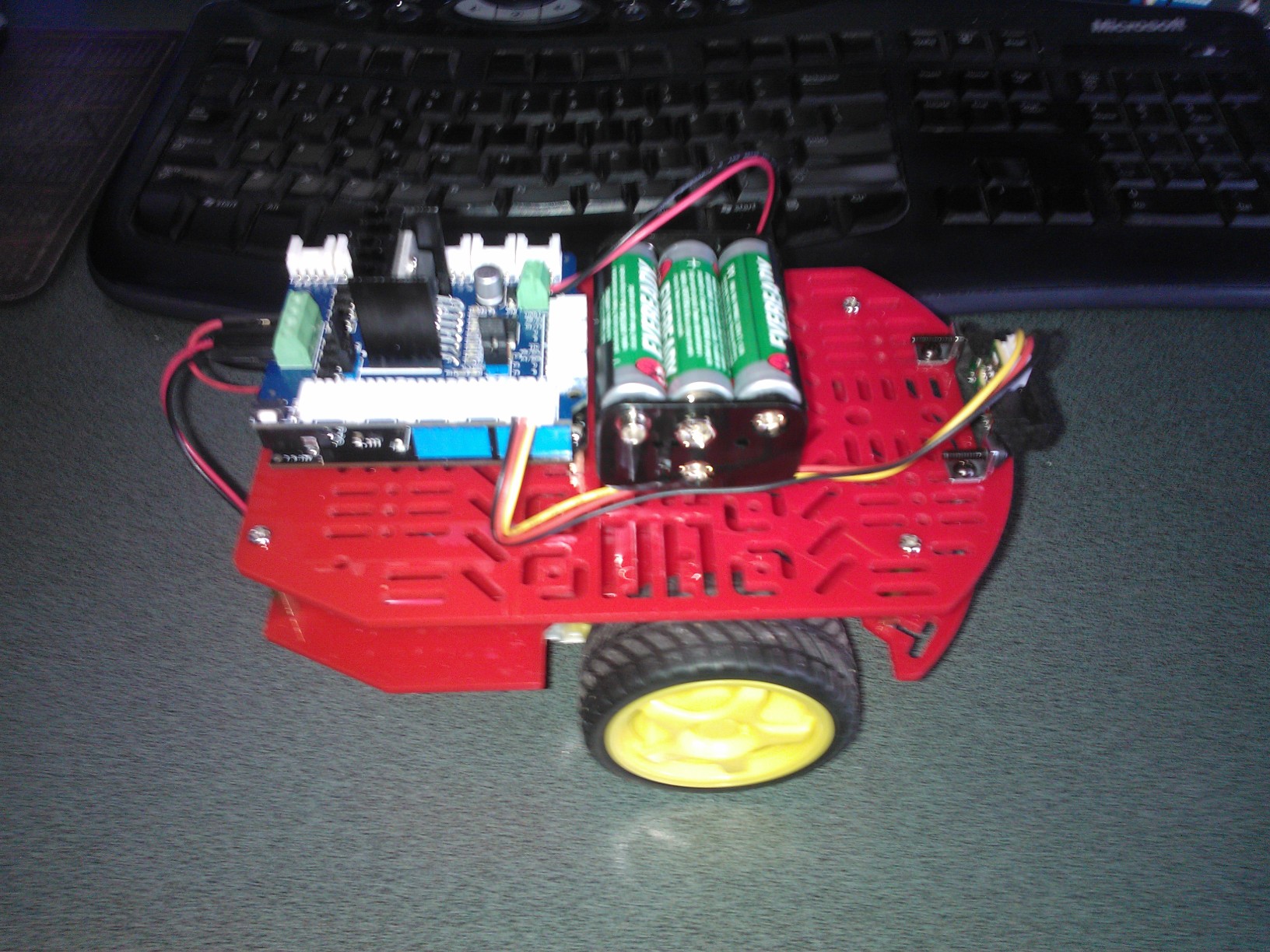
My Robot – No tools required

A few local people have asked for a BoM for my robot.  This is for the entry level version with no soldering or additional tools required. (There is a screw driver included with the robot chassis kit)

2WD Robot chassis from Mindkits – NZD25

Netduino from Mindkits – NZD58

IR Distance Sensor and cable from SeeedStudio– USD 14

Motor Controller from SeeedStudio – USD 20

Mountings for IR Sensor from Mindkits – NZD 5

bracket x 2

screws x4

nuts x 2

With the Seeedstudio motor controller I use a larger battery pack –

Battery holder 6xAA NZD2.25

Battery snap NZD0.75

If you don’t mind some soldering or crimping …

Short range ID Distance sensor from Mindkits NZD 25.50

I swapped the long range Sharp sensor for the short range one.

Magician robot

Robot on my desk

Make sure you upgrade Netduino to 4.2 or later for improved PWM

Meredith’s first .Net MF application

Meredith who is 8 wrote her first .Net MF program

public class Program

{

public static void Main()

{

OutputPort led = new OutputPort((Cpu.Pin)FEZ_Pin.Digital.Di9, ledState);

AnalogIn volume = new AnalogIn((AnalogIn.Pin)FEZ_Pin.AnalogIn.An1);

while (true)

{

Debug.Print("Volume = " + volume.Read().ToString());

Thread.Sleep(volume.Read());

led.Write(!led.Read());

}

}
She wants to hack the robot code next, small steps

GNS Introduction

Starting to get serious now, went to a presentation at the NZi3 on Friday afternoon.

UC Geospatial month seminar series.  This talk is called: “GeoNet: Earthquakes,
Sensor Networks and Geospatial Knowledge”.

Had a chat with the presenter from GNS, have emailed an elevator pitch…

Thanks to TomW from the Geology Department at Canterbury for the intro.

Microsoft TechEd NZ 2012

Spoke at TechEd this year. My topic was about the Internet of Things and Windows Azure

(http://channel9.msdn.com/Events/TechEd/NewZealand/TechEd-New-Zealand-2012/AZR302)

Presentation Abstract Ericsson CEO Hans Vestberg estimates 50 billion devices will be connected to the Web by 2020. That’s seven devices for each human on the planet. Writing embedded software which has to interface to data acquisition devices, and building scalable Internet of Things applications, has historically been hard. The .Net Micro Framework makes embedded development easy for .Net developers. Coupled with Windows Azure, developing a scalable Internet of Things application is much easier. Using Windows Azure and the .Net Micro Framework I will give a practical demonstration of how easily you can use the Microsoft stack to construct an Internet of Things application. The application will acquire data from a selection of sensors, upload it to Azure for processing, and keep users updated in close to real-time. Come and see what you can build with a GPS, an Accelerometer, a Netduino Plus, SignalR and Windows Azure.

The scenario was QuakeZure – Commodity Hardware and cloud computing for earthquake early warning.

My feedback scores out of 4

AZR302 Azure, the Platform for Internet of Things Applications 06/9/2012 16:30 Epsom Room Speaker(s): Bryn Lewis

Num. Submitted 34

Session Content 3.44

Session Presenter 3.82

Overall Session 3.59

Technical level of this session

Just Right 91.18%

Not Technical Enough 5.88%

Too Technical 2.94%