NetMF MP3 Player Part 1

For one of my class projects the students build an NetMF MP3 player using a Netduino, MP3 shield, MicroSD card and some code. The first step is to learn about files, and directories by enumerating the contents of the MicroSD card.

public static void Main()
 {
    string[] musicFiles = Directory.GetFiles(@"\SD");

    foreach (string musicFile in musicFiles)
    {
       Debug.Print(musicFile);
    }
}

The NetMF implementation of GetFiles doesn’t support wildcards (unlike the full .Net Framework) so the list of files has to be manually filtered.

public static void Main()
{
   string[] musicFiles = Directory.GetFiles(@"\SD");

   foreach (string musicFile in musicFiles)
   {
      if (filePath.IndexOf(".mp3") != -1)
      {
         Debug.Print(musicFile);
      }
   }
}

The code above displayed
\SD\01 Pride (In the Name of Love).mp3
\SD\02 New Year’s Day.mp3
\SD\03 With or Without You.mp3
\SD\04 I Still Haven’t Found What I’m Looking For.mp3
\SD\05 Sunday Bloody Sunday.mp3
\SD\06 Bad.mp3
\SD\07 Where the Streets Have No Name.mp3
\SD\08 I Will Follow.mp3
\SD\09 The Unforgettable Fire.mp3
\SD\10 Sweetest Thing [The Single Mix].mp3
\SD\11 Desire.mp3
\SD\12 When Love Comes to Town.mp3
\SD\13 Angel of Harlem.mp3
\SD\14 All I Want Is You.mp3

For this project Directory.GetFiles was used (rather than Directory.EnumerateFiles) because the list files on the MicroSD will be used in other parts of the application.

The parsing and processing of file paths is important and can if done wrong can introduce hard to find issues(e.g. directory traversal attacks)

Debug.Print(musicFile .Substring( 0, musicFile.LastIndexOf(".mp3")));

Updating the code to use the built in System.IO.Path functionality

public static void Main()
{
   string[] MusicFiles = Directory.GetFiles(@"\SD");

   foreach (string musicFile in MusicFiles)
   {
      if (Path.GetExtension(musicFile) == ".mp3" )
      {
         Debug.Print(Path.GetFileNameWithoutExtension(musicFile));
      }
   }
}

The next step is to load and play the MP3 files using a provided library.

Netduino + SeeedStudio Grove LCD RGB Backlight

For the last year I have been teaching introductory programing classes using Netduino devices and Seeedstudio sensors which were sponsored by Microsoft New Zealand. The kits are based on a Grove Starter Kit for Arduino/Genuino 101 which contain a Grove LCD RGB Backlight display.

Seeedstudio have published an Arduino driver for the display and it looks like Sirsnork used this as the basis for his Netduino NetMF Port. In class a few people have commented that they have had difficulty getting the driver to work on a Netduino 2 or Netduino Plus 2 device.

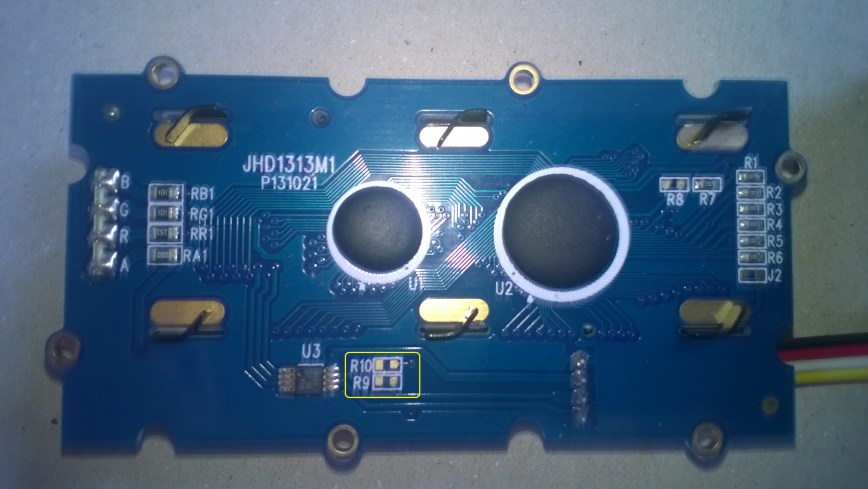
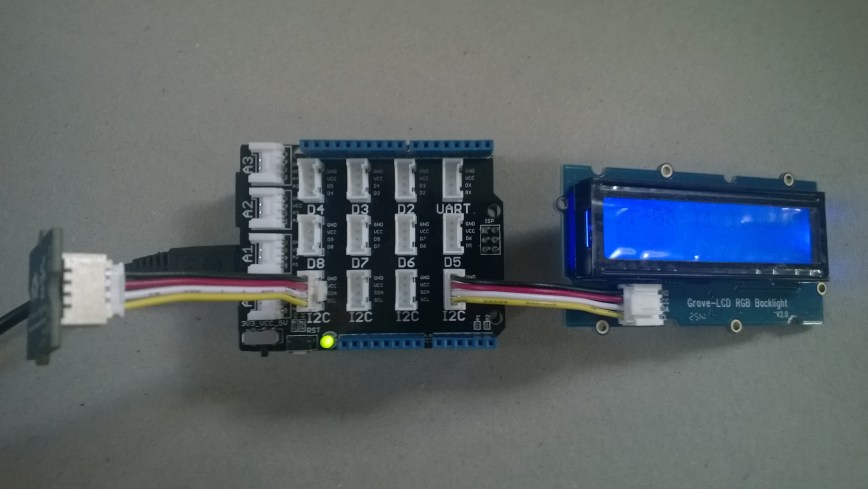
I think the two main issues are the lack of termination resistors on the Grove RGB Backlight. Possibly the missing R9 & R10 in the picture below?

SeeedStudioRGBLCDBack

I have found the easiest way to work around this issue is to have another I2C device (In this case it’s a Grove 3 Axis Accelerometer ±16G)

SeeedStudioNetduinoAndRGBLCD

The other is the need to strobe the Serial Data Line (SDA) of the I2C port on later Netduino devices to get it to work

using System;
using System.Threading;
using Microsoft.SPOT.Hardware;
using SecretLabs.NETMF.Hardware.Netduino;

namespace SeeedStudio.Grove.RGBLCD
{
   public class Program
   {
      public static void Main()
      {
         using (OutputPort i2cPort = new OutputPort(Pins.GPIO_PIN_SDA, true))
         {
            i2cPort.Write(false);
         }

.....

With the I2C bus terminated and the SDA port strobe I have found the Netduino and display work as expected.

Mikrobus.Net Quail Robot

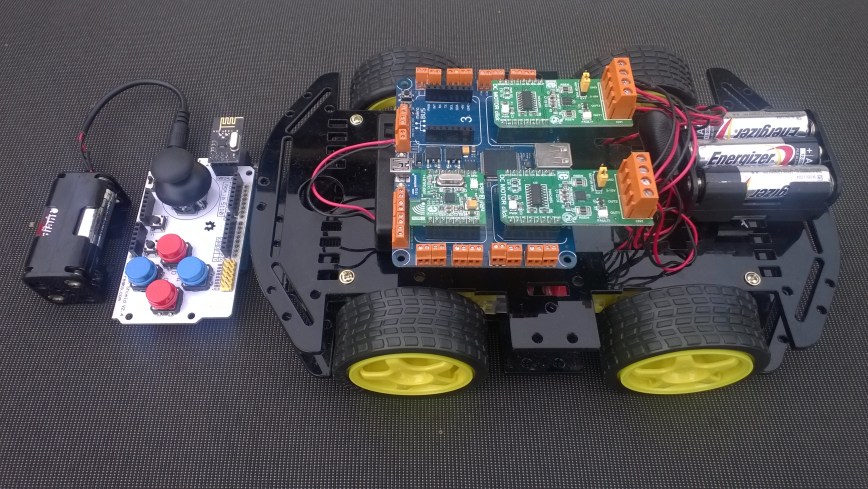
In a previous post I had replaced a Netduino and Elecfreaks Joystick shield based remote control with a MikrobusNet Quail, thumbstick click and an nRF-C click. The next step was to replace the Netduino on the robot chassis with a MikrobusNet Quail, a pair of DC Motor Clicks and an nRF-C click.

Bill of materials (prices in USD as at Feb 2016)

The first version of the robot uses a pair of battery packs one for the motors the other for the Quail board.

MikrobusNetQual4WDRobot

The drivers developed by MikroBUSNet team greatly reduced the amount of code I had to write to get the robot to work.

public class Program
{
   private static double Scale = 100.0;
   private static byte RobotControlChannel = 10;
   private static byte[] ControllerAddress = Encoding.UTF8.GetBytes("RC1");
   private static byte[] RobotAddress = Encoding.UTF8.GetBytes("RB1");
   private static TimeSpan MessageMaximumInterval = new TimeSpan(0, 0, 1);
   private static DateTime _MessageLastReceivedAt = DateTime.UtcNow;
   private static DCMotorClick motor1 = new DCMotorClick(Hardware.SocketOne);
   private static DCMotorClick motor2 = new DCMotorClick(Hardware.SocketTwo);

public static void Main()
{
   NRFC nrf = new NRFC(Hardware.SocketFour);
   nrf.Configure(RobotAddress, RobotControlChannel);
   nrf.OnTransmitFailed += nrf_OnTransmitFailed;
   nrf.OnTransmitSuccess += nrf_OnTransmitSuccess;
   nrf.OnDataReceived += nrf_OnDataReceived;
   nrf.Enable();

   Timer CommunicationsMonitorTimer = new Timer(CommunicationsMonitorTimerProc, null, 500, 500);

   Thread.Sleep(Timeout.Infinite);
}

static void nrf_OnDataReceived(byte[] data)
{
   Hardware.Led1.Write(true);
   _MessageLastReceivedAt = DateTime.UtcNow;

   if (data.Length != 5)
   {
   return;
   }

   Debug.Print("M1D=" + data[0].ToString() + " M2D=" + data[1].ToString() + " M1S=" + data[2].ToString() + " M2S=" + data[3].ToString());
   if (data[0] == 1)
   {
      motor1.Move(DCMotorClick.Directions.Forward, (data[2] / Scale ));
   }
   else
   {
     motor1.Move(DCMotorClick.Directions.Backward, (data[2] / Scale ));
   }

   if (data[1] == 1)
   {
      motor2.Move(DCMotorClick.Directions.Forward, (data[3] / Scale ));
   }
   else
   {
      motor2.Move(DCMotorClick.Directions.Backward, (data[3] / Scale ));
   }
}

private static void CommunicationsMonitorTimerProc(object status)
{
   if ((DateTime.UtcNow - _MessageLastReceivedAt) > MessageMaximumInterval)
   {
      Debug.Print("Communications timeout");

      motor1.Move(MBN.Modules.DCMotorClick.Directions.Forward, 0.0);
      motor2.Move(MBN.Modules.DCMotorClick.Directions.Forward, 0.0);
   }
}

I have kept the communications monitoring functionality which stops the motors when the robot gets out of range of the remote control software fails.


Mikrobus.Net Quail Robot Remote Control

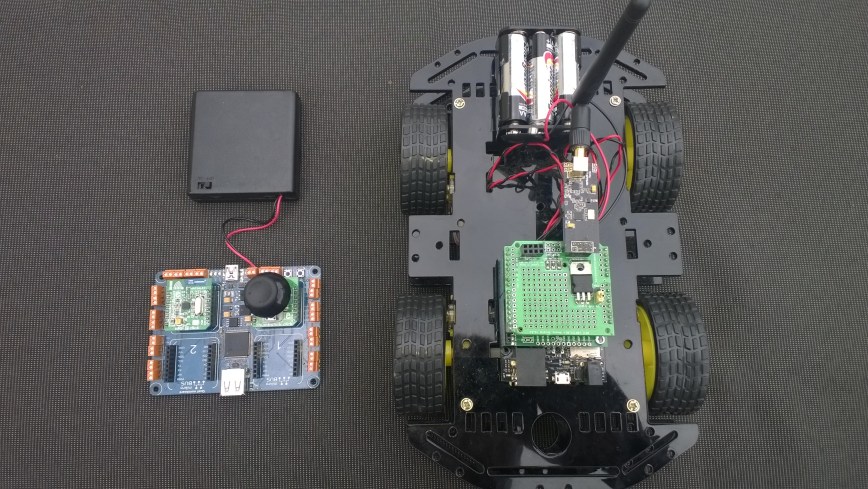
In a previous pair of posts  (part1 & part2) in February 2014 I built a 4WD Robot and remote control using a pair of Netduinos, an elecfreaks Smart Car Chassis 4WD, an elecfreaks joystick 2.4, an Embedded coolness nRF24Lo1 shield and a Pololu MC33926 motor shield.

My Quail device looked like a good platform for building a handheld control with a different form factor.

Bill of materials (prices in USD as at Jan 2016)

Quail4WDRobotController

The Quail device and battery pack aren’t quite small enough to work with one hand. A Mikrobus.Net Dalmatian or Tuatara based remote might be easier to use.

I tried using the thumbstick button pushed message for the horn functionality but it made the throttle and heading jump.

The first version of the code is just to test the wireless link, the motor speed code needs a little work.(Currently the device won’t rotate with motors going in opposite directions)

public class Program
{
   private const double Deadband = 0.1;
   private static double Scale = 100.0;
   private static byte RobotControlChannel = 10;
   private static byte[] ControllerAddress = Encoding.UTF8.GetBytes("RC1");
   private static byte[] RobotAddress = Encoding.UTF8.GetBytes("RB1");

   public static void Main()
   {
      ThumbstickClick thumbStick = new ThumbstickClick(Hardware.SocketThree);
      thumbStick.ThumbstickOrientation = ThumbstickClick.Orientation.RotateZeroDegrees;
      thumbStick.Calibrate();

      NRFC nrf = new NRFC(Hardware.SocketFour);
      nrf.Configure(ControllerAddress, RobotControlChannel );
      nrf.OnTransmitFailed += nrf_OnTransmitFailed;
      nrf.OnTransmitSuccess += nrf_OnTransmitSuccess;
      nrf.Enable();

      while (true)
      {
         byte motor1Direction, motor2Direction;
         byte motor1Speed, motor2Speed;
         double x = thumbStick.GetPosition().X;
         double y = thumbStick.GetPosition().Y;

         Debug.Print("X=: + x.ToString("F1") + " Y=" + y.ToString("F1") + " IsPressed=" + thumbStick.IsPressed);

         // See if joystick x or y is in centre deadband
         if (System.Math.Abs(x) < Deadband)
         {
            x = 0.0;
         }

         // See if joystick y is in centre deadband
         if (System.Math.Abs(y) < Deadband)
         {
            y = 0.0;
         }

         // Set direction of both motors, no swivel on spot yet
         if (y >= 0.0)
         {
            motor1Direction = (byte)1;
            motor2Direction = (byte)1;
         }
         else
         {
            motor1Direction = (byte)0;
            motor2Direction = (byte)0;
         }

         // Straight ahead/backward
         if (x == 0.0)
         {
            motor1Speed = (byte)(System.Math.Abs(y) * Scale);
            motor2Speed = (byte)(System.Math.Abs(y) * Scale);
         }
         // Turning right
         else if (x > 0.0)
         {
            motor1Speed = (byte)(System.Math.Abs(y) * Scale);
            motor2Speed = (byte)(System.Math.Abs(y) * (1.0 - System.Math.Abs(x)) * Scale);
         }
         // Turning left
         else
         {
            motor1Speed = (byte)(System.Math.Abs(y) * (1.0 - System.Math.Abs(x)) * Scale);
            motor2Speed = (byte)(System.Math.Abs(y) * Scale);
         }

         Debug.Print("X=" + x.ToString("F1") + " Y=" + y.ToString("F1") + " IsPressed=" + thumbStick.IsPressed + " M1D=" + motor1Direction.ToString() + " M2D=" + motor2Direction.ToString() + " M1S=" + motor1Speed.ToString() + " M2S=" + motor2Speed.ToString());

         byte[] command =
         {
            motor1Direction,
            motor2Direction,
            motor1Speed,
            motor2Speed,
            (byte)0)
         };
         nrf.SendTo(RobotAddress, command );

         MBN.Hardware.Led1.Write(true);

         Thread.Sleep(250);
      }
   }

   static void nrf_OnTransmitSuccess()
   {
     MBN.Hardware.Led1.Write(false);
     Debug.Print("nrf_OnTransmitSuccess");
   }

   static void nrf_OnTransmitFailed()
   {
      Debug.Print("nrf_OnTransmitFailed");
   }
}

The Mikrobus.Net team have done a great job with the number and quality of the drivers for the Mikroe click boards. The Mikroe click boards are individually packaged with professionally written click specific and handling instructions.

Mikrobus.Net Quail, Weather & nRF-C clicks and xively

My next proof of concept uses a Weather click and nRF C click to upload temperature and humidity data to a Xively gateway running on a spare Netduino 2 Plus. I have a couple of Azure Event hub gateways (direct & queued) which require a Netduino 3 Wifi (for TLS/AMQPS support) and I’ll build a client for them in a coming post.

I initially purchased an nRF T click but something wasn’t quite right with its interrupt output. The interrupt line wasn’t getting pulled low at all so there were no send success/failure events. If I disabled the pull up resistor and strobed the interrupt pin on start-up the device would work for a while.


using (OutputPort Int = new OutputPort(socket.Int, true))
{
 Int.Write(true);
};

...

_irqPin = new InterruptPort(socket.Int, false, Port.ResistorMode.Disabled, Port.InterruptMode.InterruptEdgeLow);

The code sends a reading every 10 seconds and has been running for a couple of days. It strobes Led1 for each successful send and turns on Led2 when a send fails.

private static readonly byte[] deviceAddress = Encoding.UTF8.GetBytes(&quot;Quail&quot;);
private static readonly byte[] gatewayAddress = Encoding.UTF8.GetBytes(&quot;12345&quot;);
private const byte gatewayChannel = 10;
private const NRFC.DataRate gatewayDataRate = NRFC.DataRate.DR1Mbps;
private const int XivelyUpdateDelay = 10000;
private const char XivelyGatewayChannelIdTemperature = 'J';
private const char XivelyGatewayChannelIdHumidity = 'K';

public static void Main()
{
   NRFC nRF24Click = new NRFC(Hardware.SocketFour);
   nRF24Click.Configure(deviceAddress, gatewayChannel, gatewayDataRate);
   nRF24Click.OnTransmitFailed += nRF24Click_OnTransmitFailed;
   nRF24Click.OnTransmitSuccess += nRF24Click_OnTransmitSuccess;
   nRF24Click.Enable();

   // Configure the weather click
   WeatherClick weatherClick = new WeatherClick(Hardware.SocketOne, WeatherClick.I2CAddresses.Address0);
   weatherClick.SetRecommendedMode(WeatherClick.RecommendedModes.WeatherMonitoring);

   Thread.Sleep(XivelyUpdateDelay);

   while (true)
   {
      string temperatureMessage = XivelyGatewayChannelIdTemperature + weatherClick.ReadTemperature().ToString("F1");
      Debug.Print(temperatureMessage);
      MBN.Hardware.Led1.Write(true);
      nRF24Click.SendTo(gatewayAddress, Encoding.UTF8.GetBytes(temperatureMessage));

      Thread.Sleep(XivelyUpdateDelay);

      string humidityMessage = XivelyGatewayChannelIdHumidity + weatherClick.ReadHumidity().ToString("F1");
      Debug.Print(humidityMessage);
      MBN.Hardware.Led1.Write(true);
      nRF24Click.SendTo(gatewayAddress, Encoding.UTF8.GetBytes(humidityMessage));

      Thread.Sleep(XivelyUpdateDelay);
   }
}

static void nRF24Click_OnTransmitSuccess()
{
   MBN.Hardware.Led1.Write(false);
   if (MBN.Hardware.Led2.Read())
   {
      MBN.Hardware.Led2.Write(false);
   }

   Debug.Print("nRF24Click_OnTransmitSuccess");
}

static void nRF24Click_OnTransmitFailed()
{
   MBN.Hardware.Led2.Write(true);

   Debug.Print("nRF24Click_OnTransmitFailed");
}

I need to have a look at interfacing some more sensors and soak testing the solution.

The MikroBus.Net team have done a great job with the number & quality of the drivers they have available.

Netduino 3 Wifi Queued Azure Event Hub Field Gateway V1.0

My ADSL connection had been a bit flaky which had meant I had lost some sensor data with my initial Azure Event Hub gateway. In attempt make the solution more robust this version of the gateway queues unsent messages using the on-board MicroSD card support.

The code assumes that a file move is an “atomic operation”, so it streams the events received from the devices into a temporary directory (configurable) then moves them to the upload directory (configurable).

This code is proof of concept and needs to be soak tested, improved error handling and some additional multi threading locking added plus the magic constants refactored.

This code is called in the nRF24 receive messages handler

private void OnReceive(byte[] data)
{
   activityLed.Write(!activityLed.Read());

   // Ensure that we have a payload
   if (data.Length < 1 )
   {
      Debug.Print( "ERROR - Message has no payload" ) ;
      return ;
   }

   string message = new String(Encoding.UTF8.GetChars(data));
   Debug.Print("+" + DateTime.UtcNow.ToString("HH:mm:ss") + " L=" + data.Length + " M=" + message);

   string filename = DateTime.UtcNow.ToString("yyyyMMddhhmmssff") + ".txt";

   string tempDirectory = Path.Combine("\\sd", "temp");
   string tempFilePath = Path.Combine(tempDirectory, filename);

   string queueDirectory = Path.Combine("\\sd", "data");
   string queueFilePath = Path.Combine(queueDirectory, filename);

   File.WriteAllBytes(tempFilePath, data);

   File.Move(tempFilePath, queueFilePath);

   new Microsoft.SPOT.IO.VolumeInfo("\\sd").FlushAll();
}

A timer initiates the upload process which uses the AMQPNetlite library

bool UploadInProgress = false;

      
void uploaderCallback(object state)
{
   Debug.Print("uploaderCallback - start");

   if (UploadInProgress)
   {
      return;
   }
   UploadInProgress = true;

   string[] eventFilesToSend = Directory.GetFiles(Path.Combine("\\sd", "data")) ;

   if ( eventFilesToSend.Length == 0 )
   {
      Debug.Print("uploaderCallback - no files");
      UploadInProgress = false;
      return ;
   }

   try
   {
      Debug.Print("uploaderCallback - Connect");
      Connection connection = new Connection(new Address(serviceBusHost, serviceBusPort, serviceBusSasKeyName, serviceBusSasKey));

      Session session = new Session(connection);

      SenderLink sender = new SenderLink(session, "send-link", eventHubName);

      for (int index = 0; index < System.Math.Min(eventUploadBatchSizeMaximum, eventFilesToSend.Length); index++)
      {
         string eventFile = eventFilesToSend[ index ] ;

         Debug.Print("-" + DateTime.UtcNow.ToString("HH:mm:ss") + " " + eventFile ); ;

         Message message = new Message()
         {
            BodySection = new Data()
            {
               Binary = File.ReadAllBytes(eventFile),
            },
         ApplicationProperties = new Amqp.Framing.ApplicationProperties(),
         };

         FileInfo fileInfo = new FileInfo(eventFile);

         message.ApplicationProperties["AcquiredAtUtc"] = fileInfo.CreationTimeUtc;
         message.ApplicationProperties["UploadedAtUtc"] = DateTime.UtcNow;
         message.ApplicationProperties["GatewayId"] = gatewayId;
         message.ApplicationProperties["DeviceId"] = deviceId;
         message.ApplicationProperties["EventId"] = Guid.NewGuid();

         sender.Send(message);

         File.Delete(eventFile);

         new Microsoft.SPOT.IO.VolumeInfo("\\sd").FlushAll();
      }

      sender.Close();
      session.Close();
      connection.Close();
   }
   catch (Exception ex)
   {
      Debug.Print("ERROR: Upload failed with error: " + ex.Message);
   }
   finally
   {
      Debug.Print("uploaderCallback - finally");
      UploadInProgress = false;
   }
}

The timer period and number of files uploaded in each batch is configurable. I need to test the application to see how it handles power outages and MicroSD card corruption. The source is Netduino NRF24L01 AMQPNetLite Queued Azure EventHub Gatewaywith all the usual caveats.

This project wouldn’t have been possible without

Netduino 3 AnalogInput read rates

At CodeClub some of the students build a power consumption meter and as part of that project we measure the AnalogInput sample rates to check they are sufficient for our application.

Earlier this term when we measured the sampling rates in a CodeClub session we had a mix of Netduino 2 and Netduino 3 devices and some of the results differed from my previous observations. I used the same code on all the devices

int value;
AnalogInput x1 = new AnalogInput(Cpu.AnalogChannel.ANALOG_0);
stopwatch.Start();
for (int i = 0; i < SampleCount; i++)
{
value = x1.ReadRaw();
}
stopwatch.Stop();

Netduino Plus 2

Duration = 2081 mSec 48053/sec
Duration = 2082 mSec 48030/sec
Duration = 2081 mSec 48053/sec
Duration = 2082 mSec 48030/sec
Duration = 2081 mSec 48053/sec

Netduino 3

Duration = 2071 mSec 48285/sec
Duration = 2069 mSec 48332/sec
Duration = 2070 mSec 48309/sec
Duration = 2071 mSec 48285/sec
Duration = 2070 mSec 48309/sec
Duration = 2071 mSec 48285/sec

Netduino 3 Ethernet
Duration = 2136 mSec 46816/sec
Duration = 2137 mSec 46794/sec
Duration = 2136 mSec 46816/sec
Duration = 2135 mSec 46838/sec
Duration = 2137 mSec 46794/sec
Duration = 2135 mSec 46838/sec
Duration = 2136 mSec 46816/sec
Duration = 2135 mSec 46838/sec

Netduino 3 Wifii
Duration = 3902 mSec 25627/sec
Duration = 3901 mSec 25634/sec
Duration = 3902 mSec 25627/sec
Duration = 3901 mSec 25634/sec
Duration = 3903 mSec 25621/sec
Duration = 3902 mSec 25627/sec
Duration = 3903 mSec 25621/sec

The results for the Netduino 3 & Netduino 3 Ethernet were comparable with the Netduino Plus 2 in my earlier post. The reduction in the sampling rate of the Netduino 3 Wifi warrants some further investigation.

Netduino 3 Wifi pollution Sensor Part 2

In a previous post I had started building a driver for the Seeedstudio Grove Dust Sensor. It was a proof of concept and it didn’t handle some edge cases well.

While building the pollution monitor with a student we started by simulating the negative occupancy of the Shinyei PPD42NJ Particle sensor with the Netduino’s on-board button. This worked and reduced initial complexity. But it also made it harder to simulate the button being pressed as the program launches (the on-board button is also the reset button), or simulate if the button was pressed at the start or end of the period.
Dust sensor simulation with button

Netduino 3 Wifi Test Harness

The first sample code processes button press interrupts and displays the values of the data1 & data2 parameters

public class Program
{
   public static void Main()
   {
      InterruptPort button = new InterruptPort(Pins.GPIO_PIN_D5, false, Port.ResistorMode.Disabled, Port.InterruptMode.InterruptEdgeBoth);
      button.OnInterrupt += button_OnInterrupt;

      Thread.Sleep(Timeout.Infinite);
   }

   static void button_OnInterrupt(uint data1, uint data2, DateTime time)
   {
      Debug.Print(time.ToString("hh:mm:ss.fff") + " data1 =" + data1.ToString() + " data2 = " + data2.ToString());
   }
}

Using the debugging output from this application we worked out that data1 was the Microcontroller Pin number and data2 was the button state.

12:00:14.389 data1 =24 data2 = 0
12:00:14.389 data1 =24 data2 = 1
12:00:14.389 data1 =24 data2 = 0
12:00:15.851 data1 =24 data2 = 1
12:00:16.078 data1 =24 data2 = 0

We then extended the code to record the duration of each button press.

public class Program
{
   static DateTime buttonLastPressedAtUtc = DateTime.UtcNow;

   public static void Main()
   {
      InterruptPort button = new InterruptPort(Pins.ONBOARD_BTN, false, Port.ResistorMode.Disabled, Port.InterruptMode.InterruptEdgeBoth);
      button.OnInterrupt += button_OnInterrupt;

      Thread.Sleep(Timeout.Infinite);
   }

   static void button_OnInterrupt(uint data1, uint data2, DateTime time)
   {
      if (data2 == 0)
      {
         TimeSpan duration = time - buttonLastPressedAtUtc;

         Debug.Print(duration.ToString());
      }
      else
      {
         buttonLastPressedAtUtc = time;
      }
   }
}

The thread ” (0x4) has exited with code 0 (0x0).
00:00:00.2031790
00:00:00.1954150
00:00:00.1962350

The next step was to keep track of the total duration of the button presses since the program started executing.

public class Program
{
   static DateTime buttonLastPressedAtUtc = DateTime.UtcNow;
   static TimeSpan buttonPressedDurationTotal;

   public static void Main()
   {
      InterruptPort button = new InterruptPort(Pins.ONBOARD_BTN, false, Port.ResistorMode.Disabled, Port.InterruptMode.InterruptEdgeBoth);
      button.OnInterrupt += button_OnInterrupt;

      Thread.Sleep(Timeout.Infinite);
   }

   static void button_OnInterrupt(uint data1, uint data2, DateTime time)
   {
      if (data2 == 0)
      {
         TimeSpan duration = time - buttonLastPressedAtUtc;

         buttonPressedDurationTotal += duration;
          Debug.Print(duration.ToString() + " " + buttonPressedDurationTotal.ToString());
      }
      else
      {
         buttonLastPressedAtUtc = time;
      }
   }
}

The thread ” (0x4) has exited with code 0 (0x0).
00:00:00.2476460 00:00:00.2476460
00:00:00.2193600 00:00:00.4670060
00:00:00.2631400 00:00:00.7301460
00:00:00.0001870 00:00:00.7303330

We then added a timer to display the amount of time the button was pressed in the configured period.

public class Program
{
   static TimeSpan measurementDueTime = new TimeSpan(0, 0, 30);
   static TimeSpan measurementperiodTime = new TimeSpan(0, 0, 30);
   static DateTime buttonLastPressedAtUtc = DateTime.UtcNow;
   static TimeSpan buttonPressedDurationTotal;


   public static void Main()
   {
      InterruptPort button = new InterruptPort(Pins.GPIO_PIN_D5, false, Port.ResistorMode.Disabled, Port.InterruptMode.InterruptEdgeBoth);
      button.OnInterrupt += button_OnInterrupt;

      Timer periodTimer = new Timer(periodTimerProc, button, measurementDueTime, measurementperiodTime);

      Thread.Sleep(Timeout.Infinite);
   }

   static void periodTimerProc(object status)
   {
      InterruptPort button = (InterruptPort)status;

      if (button.Read())
      {
         TimeSpan duration = DateTime.UtcNow - buttonLastPressedAtUtc;

         buttonPressedDurationTotal += duration; 
      }

      Debug.Print(buttonPressedDurationTotal.ToString());

      buttonPressedDurationTotal = new TimeSpan(0, 0, 0);
      buttonLastPressedAtUtc = DateTime.UtcNow;
   }

   static void button_OnInterrupt(uint data1, uint data2, DateTime time)
   {
      if (data2 == 0)
      {
         TimeSpan duration = time - buttonLastPressedAtUtc;

         buttonPressedDurationTotal += duration;

         Debug.Print(duration.ToString() + " " + buttonPressedDurationTotal.ToString());
      }
      else
      {
         buttonLastPressedAtUtc = time;
      }
   }
}

The thread ” (0x4) has exited with code 0 (0x0).
00:00:00
00:00:00
00:00:00.2299050 00:00:00.2299050
00:00:00.1956980 00:00:00.4256030
00:00:00.1693190 00:00:00.5949220
00:00:00.5949220

After some testing we identified that the handling of button presses at the period boundaries was problematic and revised the code some more. We added a timer for the startup period to simplify the interrupt handling code.

public class Program
{
   static TimeSpan measurementDueTime = new TimeSpan(0, 0, 60);
   static TimeSpan measurementperiodTime = new TimeSpan(0, 0, 30);
   static DateTime buttonLastPressedAtUtc = DateTime.UtcNow;
   static TimeSpan buttonPressedDurationTotal;

   public static void Main()
   {
      InterruptPort button = new InterruptPort(Pins.GPIO_PIN_D5, false, Port.ResistorMode.Disabled, Port.InterruptMode.InterruptEdgeBoth);
      button.OnInterrupt += button_OnInterrupt;

      Timer periodTimer = new Timer(periodTimerProc, button, Timeout.Infinite, Timeout.Infinite);

      Timer startUpTImer = new Timer(startUpTimerProc, periodTimer, measurementDueTime.Milliseconds, Timeout.Infinite);

      Thread.Sleep(Timeout.Infinite);
   }

   static void startUpTimerProc(object status)
   {
      Timer periodTimer = (Timer)status;

      Debug.Print( DateTime.UtcNow.ToString("hh:mm:ss") + " -Startup complete");

      buttonLastPressedAtUtc = DateTime.UtcNow;
      periodTimer.Change(measurementDueTime, measurementperiodTime);
   }

   static void periodTimerProc(object status)
   {
      InterruptPort button = (InterruptPort)status;
      Debug.Print(DateTime.UtcNow.ToString("hh:mm:ss") + " -Period timer");

      if (button.Read())
      {
         TimeSpan duration = DateTime.UtcNow - buttonLastPressedAtUtc;

         buttonPressedDurationTotal += duration;
      }

      Debug.Print(buttonPressedDurationTotal.ToString());

      buttonPressedDurationTotal = new TimeSpan(0, 0, 0);
      buttonLastPressedAtUtc = DateTime.UtcNow;
   }

   static void button_OnInterrupt(uint data1, uint data2, DateTime time)
   {
      Debug.Print(DateTime.UtcNow.ToString("hh:mm:ss") + " -OnInterrupt");

      if (data2 == 0)
      {
         TimeSpan duration = time - buttonLastPressedAtUtc;

         buttonPressedDurationTotal += duration;

         Debug.Print(duration.ToString() + " " + buttonPressedDurationTotal.ToString());
      }
      else
      {
         buttonLastPressedAtUtc = time;
      }
   }
}

The debugging output looked positive, but more testing is required.

The thread ” (0x2) has exited with code 0 (0x0).
12:00:13 -Startup complete
12:01:13 -Period timer
00:00:00
12:01:43 -Period timer
00:00:00
12:01:46 -OnInterrupt
12:01:48 -OnInterrupt
00:00:01.2132510 00:00:01.2132510
12:01:49 -OnInterrupt
12:01:50 -OnInterrupt
00:00:01.3001240 00:00:02.5133750
12:01:53 -OnInterrupt
12:01:54 -OnInterrupt
00:00:01.1216510 00:00:03.6350260
12:02:13 -Period timer
00:00:03.6350260

Next steps – multi threading, extract code into a device driver and extend to support sensors like the SeeedStudio Smart dust Sensor which has two digital outputs, one for small particles (e.g. smoke) the other for larger particles (e.g. dust).
Netduino 3 Wifi pollution Sensor Part 1

I am working on a Netduino 3 Wifi based version for my original concept as a STEM project for high school students. I wanted to be able to upload data to a Microsoft Azure Eventhub or other HTTPS secured RESTful endpoint (e.g. xivelyIOT) to show how to build a securable solution. This meant a Netduino 3 Wifi device with the TI C3100 which does all the crypto processing was necessary.

The aim was to (over a number of blog posts) build a plug ‘n play box that initially was for measuring airborne particulates and then overtime add more sensors e.g. atmospheric gas concentrations, (Grove multichannel gas sensor), an accelerometer for earthquake early warning/monitoring (Grove 3-Axis Digital Accelerometer) etc.

Netduino 3 Wifi based pollution sensor

Bill of materials for prototype as at (October 2015)

  • Netduino 3 Wifi USD69.95
  • Seeedstudio Grove base shield V2 USD8.90
  • Seeedstudio Grove smart dust sensor USD16.95
  • Seeedstudio Grove Temperature & Humidity Sensor pro USD14.90
  • Seeedstudio ABS outdoor waterproof case USD1.65
  • Seeedstudio Grove 4 pin female to Grove 4 pin conversion cable USD3.90
  • Seeedstudio Grove 4 pin buckled 5CM cabed USD1.90

After the first assembly I have realised the box is a bit small. There is not a lot of clearance around the Netduino board (largely due to the go!bus connectors on the end making it a bit larger than a standard *duino board) and the space for additional sensors is limited so I will need to source a larger enclosure.

The dust sensor doesn’t come with a cable so I used the conversion cable instead. NOTE – The pins on the sensor are numbered right->Left rather than left->right.

The first step is to get the temperature and humidity sensor working with my driver code, then adapt the Seeedstudio Grove-Dust sensor code for the dual outputs of the SM-PWM-01 device.

According to the SM-PWM-01A device datasheet The P1 output is for small particles < 1uM (smoke) and P2 output is for large particles > 2uM (dust). The temperature & humidity sensor is included in the first iteration as other researchers have indicated that humidity levels can impact on the accuracy of optical particle counters.

Then, once the sensors are working as expected I will integrate a cut back version of the AMQPNetLite code and configuration storage code I wrote for my Netduino 3 wifi Azure EventHub Field Gateway.

Netduino Silicon Labs Si7005 Device Driver

A while back I wrote a post about some problems I was having with a Silicon Labs Si7005 device and now I have had some time to package up the code.

My code strobes the I2C SDA line and then initiates a request that will always fail, from there on everything works as expected.

public SiliconLabsSI7005(byte deviceId = DeviceIdDefault, int clockRateKHz = ClockRateKHzDefault, int transactionTimeoutmSec = TransactionTimeoutmSecDefault)
{
   this.deviceId = deviceId;
   this.clockRateKHz = clockRateKHz;
   this.transactionTimeoutmSec = transactionTimeoutmSec;

   using (OutputPort i2cPort = new OutputPort(Pins.GPIO_PIN_SDA, true))
   {
      i2cPort.Write(false);
      Thread.Sleep(250);
   }

   using (I2CDevice device = new I2CDevice(new I2CDevice.Configuration(deviceId, clockRateKHz)))
   {
      byte[] writeBuffer = { RegisterIdDeviceId };
      byte[] readBuffer = new byte[1];

      // The first request always fails
      I2CDevice.I2CTransaction[] action = new I2CDevice.I2CTransaction[] 
      { 
         I2CDevice.CreateWriteTransaction(writeBuffer),
         I2CDevice.CreateReadTransaction(readBuffer)
      };

      if( device.Execute(action, transactionTimeoutmSec) == 0 )
      {
         //   throw new ApplicationException("Unable to send get device id command");
      }
   }
}

This is how the driver should be used in an application

public static void Main()
{
   SiliconLabsSI7005 sensor = new SiliconLabsSI7005();

   while (true)
   {
      double temperature = sensor.Temperature();

      double humidity = sensor.Humidity();

      Debug.Print("T:" + temperature.ToString("F1") + " H:" + humidity.ToString("F1"));

      Thread.Sleep(5000);
      }
   }

I have added code to catch failures and there is a sample application in the project. For a project I’m working on I will modify the code to use one of the I2C sharing libraries so I can have a number of devices on the bus