Back in 1986 in my second first year at the University of Canterbury I did “MATH131 Numerical Methods” which was a year of looking at why mathematics in FORTRAN, C, and Pascal sometimes didn’t return the result you were expecting…
public void TemperatureAdd(byte channel, float celsius)
{
if ((index + TemperatureSize) > buffer.Length)
{
throw new ApplicationException("TemperatureAdd insufficent buffer capacity");
}
short val = (short)(celsius * 10);
buffer[index++] = channel;
buffer[index++] = (byte)DataType.Temperature;
buffer[index++] = (byte)(val >> 8);
buffer[index++] = (byte)val;
}
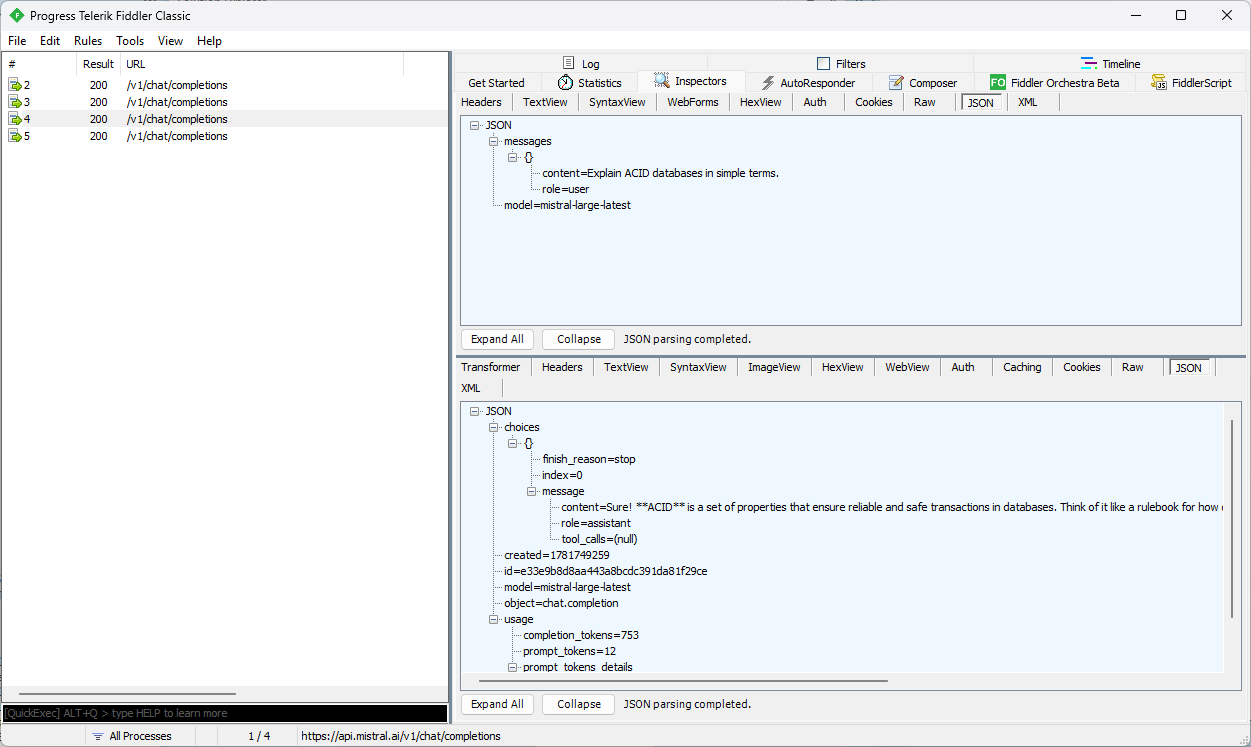
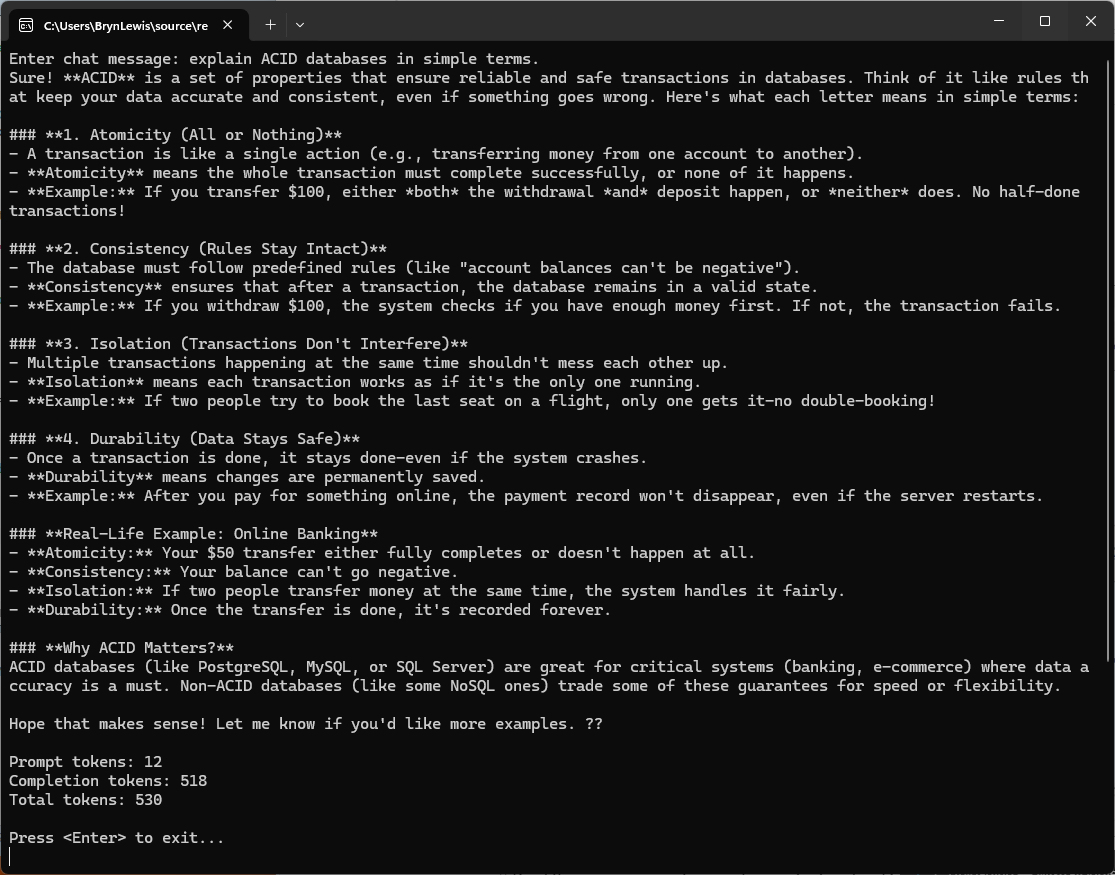
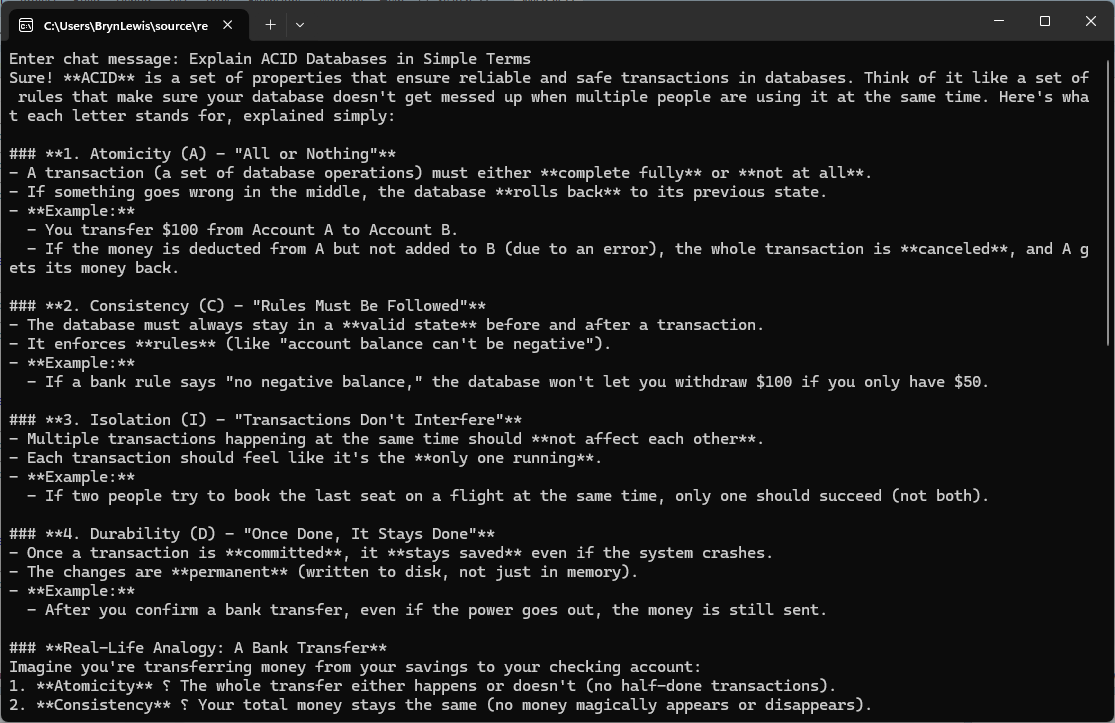
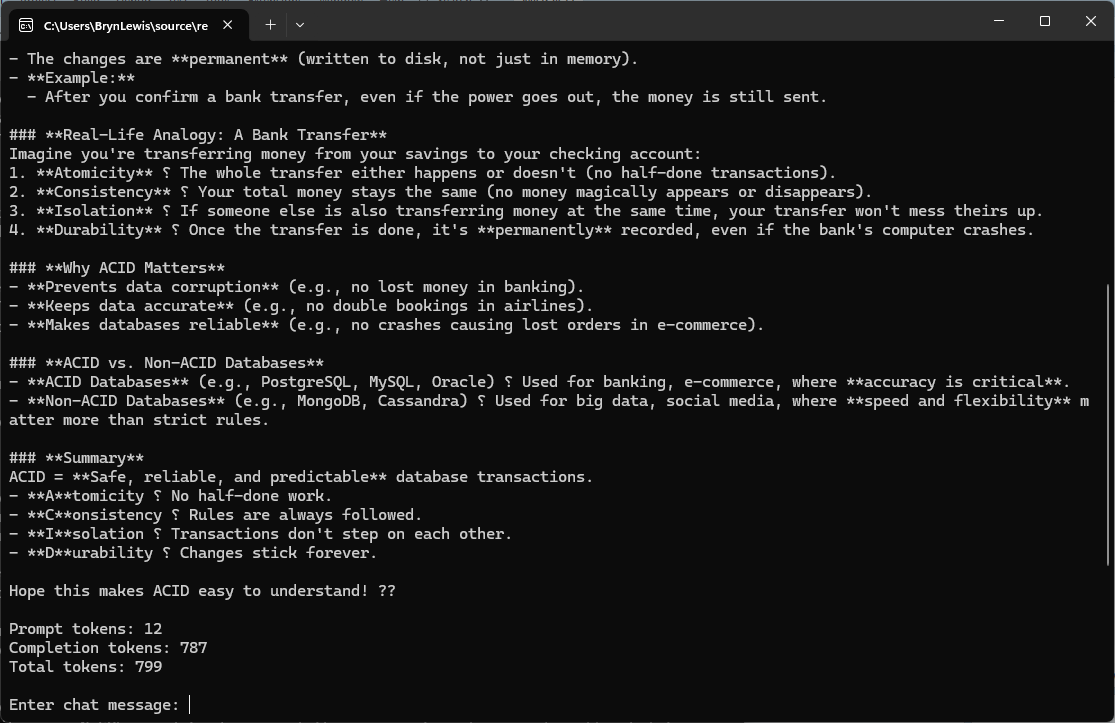
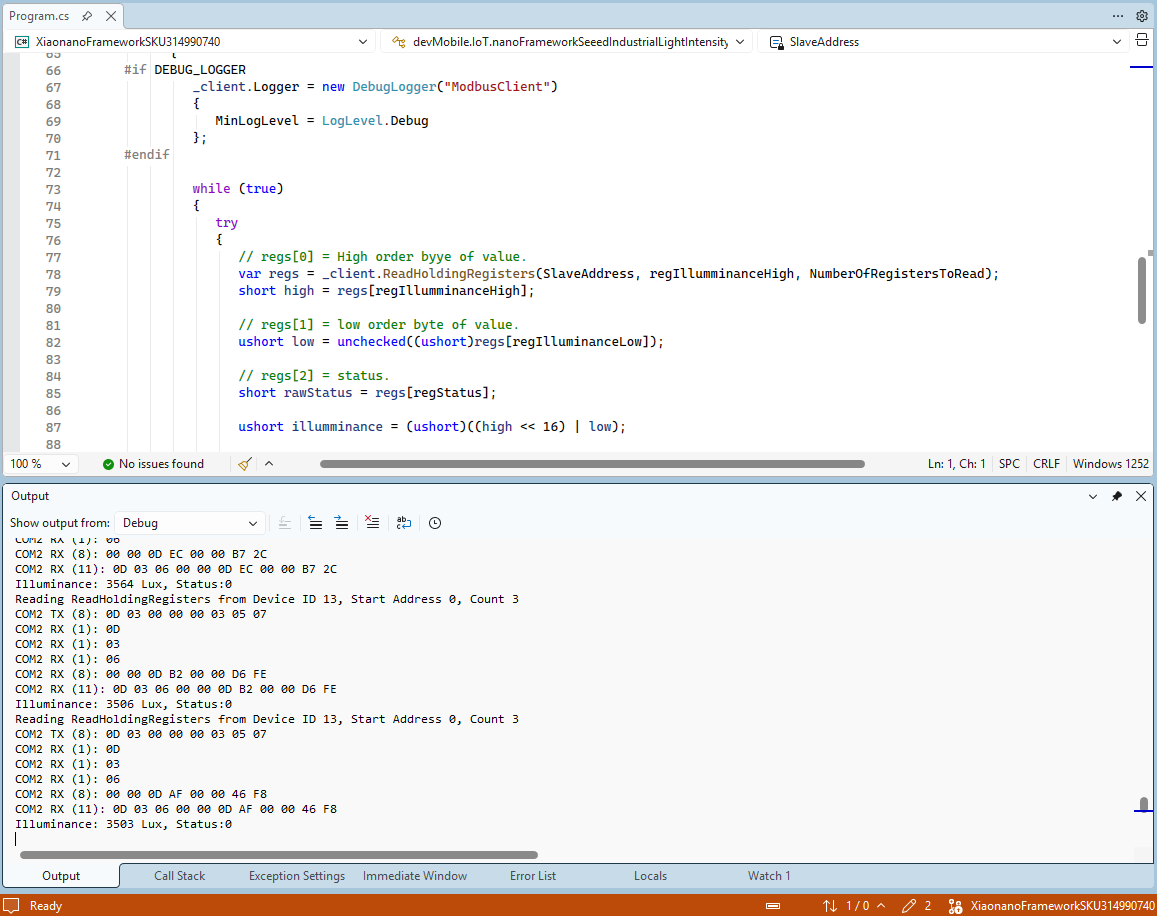
After looking at the code I think the issues was most probably due to the representation of the constant 10(int32), 10.0(double), and 10.0f(single) . To confirm my theory I modified the client to send the temperature with the calculation done with three different constants.
Visual Studio 2019 Debug output windowThe Things Network(TTN) Message Queue Telemetry Transport(MQTT) client
After some trial and error I settled on this C# code for my decoder
public void TemperatureAdd(byte channel, float celsius)
{
if ((index + TemperatureSize) > buffer.Length)
{
throw new ApplicationException("TemperatureAdd insufficent buffer capacity");
}
short val = (short)(celsius * 10.0f);
buffer[index++] = channel;
buffer[index++] = (byte)DataType.Temperature;
buffer[index++] = (byte)(val >> 8);
buffer[index++] = (byte)val;
}
I don’t think this is specifically an issue with the TinyCLR V2 just with number type used for the constant.
This code was written to solve a problem I had debugging and testing an application which processed data from sensors attached to The Things Network(TTN) and I figured others might find it useful.
As part of my series of TTN projects I wanted to verify that the data from a number of LoRaWAN sensors connected to TTN was reasonable and complete. I’m familiar with Microsoft SQL Server so I built a .Net Core console application which uses the TTN Message Queue Telemetry Transport(MQTT) Data API (so it can run alongside my existing TTN integration) to receive messages from the all devices in a TTN application and store them in a database for post processing.
The console application uses MQTTNet to connect to TTN MQTT Data API. It subscribes to an application device uplink topic, then uses a combination of Stackoverflow Dapper with Microsoft SQL Server tables and stored procedures to store the device data points. I re-generated the classes I had used in my other projects, added any obvious missing fields and fine tuned the data types by delving into the TTN V2GO code.
The core of the application is in the MQTTNet application message received handler.
private static void MqttClient_ApplicationMessageReceived(MqttApplicationMessageReceivedEventArgs e)
{
PayloadUplinkV2 payload;
log.InfoFormat($"Receive Start Topic:{e.ApplicationMessage.Topic}");
string connectionString = configuration.GetSection("TTNDatabase").Value;
try
{
payload = JsonConvert.DeserializeObject<PayloadUplinkV2>(e.ApplicationMessage.ConvertPayloadToString());
}
catch (Exception ex)
{
log.Error("DeserializeObject failed", ex);
return;
}
try
{
if (payload.PayloadFields != null)
{
var parameters = new DynamicParameters();
EnumerateChildren(parameters, payload.PayloadFields);
log.Debug($"Parameters:{parameters.ParameterNames.Aggregate((i, j) => i + ',' + j)}");
foreach (string storedProcedure in storedProcedureMappings.Keys)
{
if (Enumerable.SequenceEqual(parameters.ParameterNames, storedProcedureMappings[storedProcedure].Split(',', StringSplitOptions.RemoveEmptyEntries), StringComparer.InvariantCultureIgnoreCase))
{
log.Info($"Payload fields processing with:{storedProcedure}");
using (SqlConnection db = new SqlConnection(connectionString))
{
parameters.Add("@ReceivedAtUtc", payload.Metadata.ReceivedAtUtc);
parameters.Add("@DeviceID", payload.DeviceId);
parameters.Add("@DeviceEui", payload.DeviceEui);
parameters.Add("@ApplicationID", payload.ApplicationId);
parameters.Add("@IsConfirmed", payload.IsConfirmed);
parameters.Add("@IsRetry", payload.IsRetry);
parameters.Add("@Port", payload.Port);
db.Execute(sql: storedProcedure, param: parameters, commandType: CommandType.StoredProcedure);
}
}
}
}
else
{
foreach (string storedProcedure in storedProcedureMappings.Keys)
{
if (string.Compare(storedProcedureMappings[storedProcedure], "payload_raw", true) == 0)
{
log.Info($"Payload raw processing with:{storedProcedure}");
using (SqlConnection db = new SqlConnection(connectionString))
{
var parameters = new DynamicParameters();
parameters.Add("@ReceivedAtUtc", payload.Metadata.ReceivedAtUtc);
parameters.Add("@DeviceID", payload.DeviceId);
parameters.Add("@DeviceEui", payload.DeviceEui);
parameters.Add("@ApplicationID", payload.ApplicationId);
parameters.Add("@IsConfirmed", payload.IsConfirmed);
parameters.Add("@IsRetry", payload.IsRetry);
parameters.Add("@Port", payload.Port);
parameters.Add("@Payload", payload.PayloadRaw);
db.Execute(sql: storedProcedure, param: parameters, commandType: CommandType.StoredProcedure);
}
}
}
}
}
catch (Exception ex)
{
log.Error("Message processing failed", ex);
}
}
For messages with payload fields the code attempts to match the list of field names (there maybe more than one match) with the parameter list for stored procedures in the AppSettings.json file. The Enumerable.SequenceEqual uses a case insensitive comparison but order is important. I did consider sorting the two lists of parameters but wasn’t certain the added complexity was worth it.
I created a database table to store the temperature and humidity values.
CREATE TABLE [dbo].[EnvironmentalSensorReport](
[WeatherSensorReportUID] [UNIQUEIDENTIFIER] NOT NULL,
[ReceivedAtUtC] [DATETIME] NOT NULL,
[DeviceID] [NVARCHAR](32) NOT NULL,
[DeviceEui] [NVARCHAR](32) NOT NULL,
[ApplicationID] [NVARCHAR](32) NOT NULL,
[IsConfirmed] [BIT] NOT NULL,
[IsRetry] [BIT] NOT NULL,
[Port] [SMALLINT] NOT NULL,
[Temperature] [FLOAT] NOT NULL,
[Humidity] [FLOAT] NOT NULL,
CONSTRAINT [PK_EnvironmentalSensorReport] PRIMARY KEY CLUSTERED
(
[WeatherSensorReportUID] ASC
)WITH (PAD_INDEX = OFF, STATISTICS_NORECOMPUTE = OFF, IGNORE_DUP_KEY = OFF, ALLOW_ROW_LOCKS = ON, ALLOW_PAGE_LOCKS = ON) ON [PRIMARY]
) ON [PRIMARY]
GO
ALTER TABLE [dbo].[EnvironmentalSensorReport] ADD CONSTRAINT [DF_EnvironmentalSensorReport_EnvironmentalSensorReporttUID] DEFAULT (NEWID()) FOR [WeatherSensorReportUID]
GO
The stored procedure must have the parameters @ReceivedAtUtc, @DeviceID, @DeviceEui, @ApplicationID, @IsRetry, @IsConfirmed and @Port. In this example the payload specific fields generated by the Cayenne Low Power Protocol(LPP) decoder are @Temperature_0 and @relative_humidity_0
CREATE PROCEDURE [dbo].[EnvironmentalSensorProcess]
@ReceivedAtUtc AS DATETIME,
@DeviceID AS NVARCHAR(32),
@DeviceEui AS NVARCHAR(32),
@ApplicationID AS NVARCHAR(32),
@IsRetry AS BIT,
@IsConfirmed AS BIT,
@Port AS SMALLINT,
@Temperature_0 AS FLOAT,
@relative_humidity_0 AS FLOAT
AS
BEGIN
SET NOCOUNT ON;
INSERT INTO [dbo].[EnvironmentalSensorReport]
([PositionReportUID]
.[ReceivedAtUtc]
,[DeviceID]
,[DeviceEui]
,[ApplicationID]
,[IsConfirmed]
,[IsRetry]
,[Port]
,Temperature
,Humidity)
VALUES
(
@ReceivedAtUtc,
@DeviceID,
@DeviceEui,
@ApplicationID,
@IsConfirmed,
@IsRetry,
@port,
@Temperature_0,
@relative_humidity_0)
END
Environmental sensor data displayed in SQL Server Management Studio(SSMS)
To store more complex nest payload fields (e.g. latitude, longitude and altitude values), I flattened the the hierarchy.
private static void EnumerateChildren(DynamicParameters parameters, JToken token, string prefix ="")
{
if (token is JProperty)
if (token.First is JValue)
{
JProperty property = (JProperty)token;
parameters.Add($"@{prefix}{property.Name}", property.Value.ToString());
}
else
{
JProperty property = (JProperty)token;
prefix += property.Name;
}
foreach (JToken token2 in token.Children())
{
EnumerateChildren(parameters,token2, prefix);
}
}
Unpacked LPP payload from GPS tracker displayed in TTN application data viewFlattened location, acceleration and rotation information
CREATE TABLE [dbo].[PositionReport](
[PositionReportUID] [UNIQUEIDENTIFIER] NOT NULL,
[ReceivedAtUtC] [DATETIME] NOT NULL,
[DeviceID] [NVARCHAR](32) NOT NULL,
[DeviceEui] [NVARCHAR](32) NOT NULL,
[ApplicationID] [NVARCHAR](32) NOT NULL,
[IsConfirmed] [BIT] NOT NULL,
[IsRetry] [BIT] NOT NULL,
[Port] [SMALLINT] NOT NULL,
[Latitude] [FLOAT] NOT NULL,
[Longitude] [FLOAT] NOT NULL,
[Altitude] [FLOAT] NOT NULL,
CONSTRAINT [PK_PositionReport] PRIMARY KEY CLUSTERED
(
[PositionReportUID] ASC
)WITH (PAD_INDEX = OFF, STATISTICS_NORECOMPUTE = OFF, IGNORE_DUP_KEY = OFF, ALLOW_ROW_LOCKS = ON, ALLOW_PAGE_LOCKS = ON) ON [PRIMARY]
) ON [PRIMARY]
GO
I created a database table to store values of only the fields I cared about.
CREATE PROCEDURE [dbo].[PositionReportProcess]
@ReceivedAtUtc AS DATETIME,
@DeviceID AS NVARCHAR(32),
@DeviceEui AS NVARCHAR(32),
@ApplicationID AS NVARCHAR(32),
@IsRetry AS Bit,
@IsConfirmed AS BIT,
@Port AS SMALLINT,
@accelerometer_3x AS FLOAT,
@accelerometer_3y AS FLOAT,
@accelerometer_3z AS FLOAT,
@analog_in_8 AS FLOAT,
@analog_in_9 AS FLOAT,
@analog_in_10 AS FLOAT,
@analog_in_11 AS FLOAT,
@gps_1Latitude AS FLOAT,
@gps_1Longitude AS FLOAT,
@gps_1Altitude AS FLOAT,
@gyrometer_5x AS FLOAT,
@gyrometer_5y AS FLOAT,
@gyrometer_5z AS FLOAT
AS
BEGIN
SET NOCOUNT ON;
INSERT INTO [dbo].[PositionReport]
([PositionReportUID]
.[ReceivedAtUtc]
,[DeviceID]
,[DeviceEui]
,[ApplicationID]
,[IsConfirmed]
,[IsRetry]
,[Port]
,Latitude
,Longitude
,Altitude)
VALUES
(
@ReceivedAtUtc,
@DeviceID,
@DeviceEui,
@ApplicationID,
@IsConfirmed,
@IsRetry,
@port,
@gps_1Latitude,
@gps_1Longitude,
@gps_1Altitude)
END
The stored procedure for storing the GPS tracker payload has to have parameters matching each payload field but some of the fields are not used.
Location data displayed in SQL Server Management Studio(SSMS)
For uplink messages with no payload fields the message processor looks for a stored procedure with a single parameter called “payload_raw”.(there maybe more than one match)
CREATE TABLE [dbo].[PayloadReport](
[PayloadReportUID] [UNIQUEIDENTIFIER] NOT NULL,
[ReceivedAtUtC] [DATETIME] NOT NULL,
[DeviceID] [NVARCHAR](32) NOT NULL,
[DeviceEui] [NVARCHAR](32) NOT NULL,
[ApplicationID] [NVARCHAR](32) NOT NULL,
[IsConfirmed] [BIT] NOT NULL,
[IsRetry] [BIT] NOT NULL,
[Port] [SMALLINT] NOT NULL,
[Payload] [NVARCHAR](128) NOT NULL,
CONSTRAINT [PK_PayloadReport] PRIMARY KEY CLUSTERED
(
[PayloadReportUID] ASC
)WITH (PAD_INDEX = OFF, STATISTICS_NORECOMPUTE = OFF, IGNORE_DUP_KEY = OFF, ALLOW_ROW_LOCKS = ON, ALLOW_PAGE_LOCKS = ON) ON [PRIMARY]
) ON [PRIMARY]
GO
ALTER TABLE [dbo].[PayloadReport] ADD CONSTRAINT [DF_PayloadReport_PositionReportUID] DEFAULT (NEWID()) FOR [PayloadReportUID]
GO
ALTER PROCEDURE [dbo].[PayloadRawProcess]
@ReceivedAtUtc AS DATETIME,
@DeviceID AS NVARCHAR(32),
@DeviceEui AS NVARCHAR(32),
@ApplicationID AS NVARCHAR(32),
@IsRetry AS Bit,
@IsConfirmed AS BIT,
@Port AS SMALLINT,
@Payload AS NVARCHAR(128)
AS
BEGIN
SET NOCOUNT ON;
INSERT INTO [dbo].[PayloadReport]
([PositionReportUID]
.[ReceivedAtUtc]
,[DeviceID]
,[DeviceEui]
,[ApplicationID]
,[IsConfirmed]
,[IsRetry]
,[Port]
,[Payload])
VALUES(@ReceivedAtUtc,
@DeviceID,
@DeviceEui,
@ApplicationID,
@IsConfirmed,
@IsRetry,
@port,
@Payload)
END
Raw payload data displayed in SQL Server Management Studio(SSMS)
Initially the application just used Console.Writeline for logging, then I added Log4Net because it would be useful to persist information about failures and so I could copy n paste parameter lists to the appSettings.json file.
The console application uses MQTTNet to connect to TTN. It subscribes to to the TTN application device uplink topic (did try subscribing to the uplink messages for all the devices in the application, and the downlink message scheduled, sent and acknowledged topics.
I tried a lot of topic formats with and without wildcards to see which worked best
I generated new classes from the ones provided in the documentation then added any obvious missing fields and fine tuned the data types by delving into the TTN V3GO code.
The new messages payloads have significant differences to the V2 ones. I have refactored the generated classes to reduce the duplication of code and fix up datatypes e.g. int32 vs. ulong where JSON2Charp couldn’t infer the size of the number.
namespace devMobile.TheThingsNetwork.Models
{
public class ApplicationIds
{
public string application_id { get; set; }
}
public class EndDeviceIds
{
public string device_id { get; set; }
public ApplicationIds application_ids { get; set; }
public string dev_eui { get; set; }
public string join_eui { get; set; }
public string dev_addr { get; set; }
}
}
I wonder about the naming of the applicationIds class as it appears that it could only ever contain single applicationId.
I installed the tooling for GO support into Visual Studio Code and went looking for the uplink message definition which I think is in messages.pb.go (still learning go and how the TTN GO source is structured).
type ApplicationUplink struct {
// Join Server issued identifier for the session keys used by this uplink.
SessionKeyID []byte `protobuf:"bytes,1,opt,name=session_key_id,json=sessionKeyId,proto3" json:"session_key_id,omitempty"`
FPort uint32 `protobuf:"varint,2,opt,name=f_port,json=fPort,proto3" json:"f_port,omitempty"`
FCnt uint32 `protobuf:"varint,3,opt,name=f_cnt,json=fCnt,proto3" json:"f_cnt,omitempty"`
// The frame payload of the uplink message.
// The payload is still encrypted if the skip_payload_crypto field of the EndDevice
// is true, which is indicated by the presence of the app_s_key field.
FRMPayload []byte `protobuf:"bytes,4,opt,name=frm_payload,json=frmPayload,proto3" json:"frm_payload,omitempty"`
// The decoded frame payload of the uplink message.
// This field is set by the message processor that is configured for the end device (see formatters) or application (see default_formatters).
DecodedPayload *types.Struct `protobuf:"bytes,5,opt,name=decoded_payload,json=decodedPayload,proto3" json:"decoded_payload,omitempty"`
// Warnings generated by the message processor while decoding the frm_payload.
DecodedPayloadWarnings []string `protobuf:"bytes,12,rep,name=decoded_payload_warnings,json=decodedPayloadWarnings,proto3" json:"decoded_payload_warnings,omitempty"`
// A list of metadata for each antenna of each gateway that received this message.
RxMetadata []*RxMetadata `protobuf:"bytes,6,rep,name=rx_metadata,json=rxMetadata,proto3" json:"rx_metadata,omitempty"`
// Settings for the transmission.
Settings TxSettings `protobuf:"bytes,7,opt,name=settings,proto3" json:"settings"`
// Server time when the Network Server received the message.
ReceivedAt time.Time `protobuf:"bytes,8,opt,name=received_at,json=receivedAt,proto3,stdtime" json:"received_at"`
// The AppSKey of the current session.
// This field is only present if the skip_payload_crypto field of the EndDevice
// is true.
// Can be used to decrypt uplink payloads and encrypt downlink payloads.
AppSKey *KeyEnvelope `protobuf:"bytes,9,opt,name=app_s_key,json=appSKey,proto3" json:"app_s_key,omitempty"`
// The last AFCntDown of the current session.
// This field is only present if the skip_payload_crypto field of the EndDevice
// is true.
// Can be used with app_s_key to encrypt downlink payloads.
LastAFCntDown uint32 `protobuf:"varint,10,opt,name=last_a_f_cnt_down,json=lastAFCntDown,proto3" json:"last_a_f_cnt_down,omitempty"`
Confirmed bool `protobuf:"varint,11,opt,name=confirmed,proto3" json:"confirmed,omitempty"`
// Consumed airtime for the transmission of the uplink message. Calculated by Network Server using the RawPayload size and the transmission settings.
ConsumedAirtime *time.Duration `protobuf:"bytes,13,opt,name=consumed_airtime,json=consumedAirtime,proto3,stdduration" json:"consumed_airtime,omitempty"`
// End device location metadata, set by the Application Server while handling the message.
Locations map[string]*Location `protobuf:"bytes,14,rep,name=locations,proto3" json:"locations,omitempty" protobuf_key:"bytes,1,opt,name=key,proto3" protobuf_val:"bytes,2,opt,name=value,proto3"`
XXX_NoUnkeyedLiteral struct{} `json:"-"`
XXX_sizecache int32 `json:"-"`
}
I also need to deploy some more gateways and devices to check that I haven’t missed any fields available in more realistic environments.
TTN V3 MQTT Console client
In the TTN Device data tab I could see messages being sent, to and received from from the simulated device.
TTN V3 MQTT Device Live Data
The next step is to get downlink messages working, then connect up a couple of gateways and trial with some real devices.
The next step was to enumerate all the EndDevices of a The Things Network(TTN) Application and display their attributes. I have to establish an Azure DeviceClient connection to an Azure IoT Hub for each TTN EndDevice to get downlink messages. To do this I will have to enumerate the TTN Applications in the instance then enumerate the LoRaWAN EndDevices.
using (HttpClient httpClient = new HttpClient())
{
EndDeviceRegistryClient endDeviceRegistryClient = new EndDeviceRegistryClient(baseUrl, httpClient)
{
ApiKey = apiKey
};
try
{
#if FIELDS_MINIMUM
string[] fieldMaskPathsDevice = { "attributes" }; // think this is the bare minimum required for integration
#else
string[] fieldMaskPathsDevice = { "name", "description", "attributes" };
#endif
V3EndDevices endDevices = await endDeviceRegistryClient.ListAsync(applicationID, field_mask_paths:fieldMaskPathsDevice);
if ((endDevices != null) && (endDevices.End_devices != null)) // If there are no devices returns null rather than empty list
{
foreach (V3EndDevice endDevice in endDevices.End_devices)
{
#if FIELDS_MINIMUM
Console.WriteLine($"EndDevice ID:{endDevice.Ids.Device_id}");
#else
Console.WriteLine($"Device ID:{endDevice.Ids.Device_id} Name:{endDevice.Name} Description:{endDevice.Description}");
Console.WriteLine($" CreatedAt: {endDevice.Created_at:dd-MM-yy HH:mm:ss} UpdatedAt: {endDevice.Updated_at:dd-MM-yy HH:mm:ss}");
#endif
if (endDevice.Attributes != null)
{
Console.WriteLine(" EndDevice attributes");
foreach (KeyValuePair<string, string> attribute in endDevice.Attributes)
{
Console.WriteLine($" Key: {attribute.Key} Value: {attribute.Value}");
}
}
Console.WriteLine();
}
}
}
catch (Exception ex)
{
Console.WriteLine(ex.Message);
}
Console.WriteLine("Press <enter> to exit");
Console.ReadLine();
}
Like the applicationRegistryClient.ListAsync call the endDeviceRegistryClient.ListAsync also returns null rather than an empty list.
The next step was to enumerate The Things Network(TTN) Applications so I could connect only to the required Azure IoT hub(s). There would also be a single configuration setting for the client (establish a connection for every TTN application, or don’t establish a connection for any) and this could be overridden with a TTN application attribute
long pageSize = long.Parse(args[3]);
Console.WriteLine($"Page size: {pageSize}");
Console.WriteLine();
using (HttpClient httpClient = new HttpClient())
{
ApplicationRegistryClient applicationRegistryClient = new ApplicationRegistryClient(baseUrl, httpClient)
{
ApiKey = apiKey
};
try
{
int page = 1;
string[] fieldMaskPathsApplication = { "attributes" }; // think this is the bare minimum required for integration
V3Applications applications = await applicationRegistryClient.ListAsync(collaborator, field_mask_paths: fieldMaskPathsApplication, limit: pageSize, page: page);
while ((applications != null) && (applications.Applications != null))
{
Console.WriteLine($"Applications:{applications.Applications.Count} Page:{page} Page size:{pageSize}");
foreach (V3Application application in applications.Applications)
{
bool applicationIntegration = ApplicationAzureintegrationDefault;
Console.WriteLine($"Application ID:{application.Ids.Application_id}");
if (application.Attributes != null)
{
string ApplicationAzureIntegrationValue = string.Empty;
if (application.Attributes.TryGetValue(ApplicationAzureIntegrationField, out ApplicationAzureIntegrationValue))
{
bool.TryParse(ApplicationAzureIntegrationValue, out applicationIntegration);
}
if (applicationIntegration)
{
Console.WriteLine(" Application attributes");
foreach (KeyValuePair<string, string> attribute in application.Attributes)
{
Console.WriteLine($" Key: {attribute.Key} Value: {attribute.Value}");
}
}
}
Console.WriteLine();
}
page += 1;
applications = await applicationRegistryClient.ListAsync(collaborator, field_mask_paths: fieldMaskPathsApplication, limit: pageSize, page: page);
};
}
catch (Exception ex)
{
Console.WriteLine(ex.Message);
}
Console.WriteLine("Press <enter> to exit");
Console.ReadLine();
}
I Used the field_mask_paths parameter (don’t need created_at, updated_at, name etc.) to minimise the data returned to my client.
I was hoping that there would be a away to further “shape” the returned data, but in the NSwag generated code the construction of the URL with field_mask_paths, order, limit, and page parameters meant this appears not to be possible.
For each LoraWAN client I have to have an open connection to the Azure IoT hub to get Cloud to Device (C2D) messages so I’m looking at using connection pooling to reduce the overall number of connections.
I think the Azure ClientDevice library supports up to 995 devices per connection and has quiet a lot of additional functionality.
/// <summary>
/// contains Amqp Connection Pool settings for DeviceClient
/// </summary>
public sealed class AmqpConnectionPoolSettings
{
private static readonly TimeSpan s_defaultConnectionIdleTimeout = TimeSpan.FromMinutes(2);
private uint _maxPoolSize;
internal const uint MaxDevicesPerConnection = 995; // IotHub allows upto 999 tokens per connection. Setting the threshold just below that.
/// <summary>
/// The default size of the pool
/// </summary>
/// <remarks>
/// Allows up to 100,000 devices
/// </remarks>
private const uint DefaultPoolSize = 100;
/// <summary>
/// The maximum value that can be used for the MaxPoolSize property
/// </summary>
public const uint AbsoluteMaxPoolSize = ushort.MaxValue;
/// <summary>
/// Creates an instance of AmqpConnecitonPoolSettings with default properties
/// </summary>
public AmqpConnectionPoolSettings()
{
_maxPoolSize = DefaultPoolSize;
Pooling = false;
}
Whereas I think AMQPNetLite may support more, but will require me to implement more of the Azure IoT client interface
/// <summary>
/// The default maximum frame size used by the library.
/// </summary>
public const uint DefaultMaxFrameSize = 64 * 1024;
internal const ushort DefaultMaxConcurrentChannels = 8 * 1024;
internal const uint DefaultMaxLinkHandles = 256 * 1024;
internal const uint DefaultHeartBeatInterval = 90000;
internal const uint MinimumHeartBeatIntervalMs = 5 * 1000;
I have got todo some more research to see which library is easier/requires more code/complex/scales better.
After reviewing the initial implementation I found I had to have one connection per The Things Network(TTN) device. Todo this I first have to enumerate the LoRaWAN Devices for each Application in my instance. First I had to add the TTN APIKey to the application and device registry requests.
namespace devMobile.TheThingsNetwork.API
{
public partial class EndDeviceRegistryClient
{
public string ApiKey { set; get; }
partial void PrepareRequest(System.Net.Http.HttpClient client, System.Net.Http.HttpRequestMessage request, string url)
{
if (!client.DefaultRequestHeaders.Contains("Authorization"))
{
client.DefaultRequestHeaders.Add("Authorization", $"Bearer {ApiKey}");
}
}
}
public partial class ApplicationRegistryClient
{
public string ApiKey { set; get; }
partial void PrepareRequest(System.Net.Http.HttpClient client, System.Net.Http.HttpRequestMessage request, string url)
{
if (!client.DefaultRequestHeaders.Contains("Authorization"))
{
client.DefaultRequestHeaders.Add("Authorization", $"Bearer {ApiKey}");
}
}
}
}
The first step was to enumerate Applications and their attributes
#if FIELDS_MINIMUM
string[] fieldMaskPathsApplication = { "attributes" }; // think this is the bare minimum required for integration
#else
string[] fieldMaskPathsApplication = { "name", "description", "attributes" };
#endif
V3Applications applications = await applicationRegistryClient.ListAsync(collaborator, field_mask_paths: fieldMaskPathsApplication);
if ((applications != null) && (applications.Applications != null)) // If there are no applications returns null rather than empty list
{
foreach (V3Application application in applications.Applications)
{
#if FIELDS_MINIMUM
Console.WriteLine($"Application ID:{application.Ids.Application_id}");
#else
Console.WriteLine($"Application ID:{application.Ids.Application_id} Name:{application.Name} Description:{application.Description}");
Console.WriteLine($" CreatedAt: {application.Created_at:dd-MM-yy HH:mm:ss} UpdatedAt: {application.Updated_at:dd-MM-yy HH:mm:ss}");
#endif
if (application.Attributes != null)
{
Console.WriteLine(" Application attributes");
foreach (KeyValuePair<string, string> attribute in application.Attributes)
{
Console.WriteLine($" Key: {attribute.Key} Value: {attribute.Value}");
}
}
Console.WriteLine();
}
}
}
The applicationRegistryClient.ListAsync call returns null rather than an empty list which tripped me up. I only found this when I deleted all the applications in my instance and started from scratch.
I could successfully download raw data to the device but I found that manually unpacking it on the device was painful.
Raw data
I really want to send LPP formatted messages to my devices so I could use a standard LPP library. I initially populated the payload fields in the downlink message JSON. The TTN documentation appeared to indicate this was possible.
Download JSON payload format
Initially I tried a more complex data type because I was looking at downloading a location to the device.
Complex data type
I could see nicely formatted values in the device data view but they didn’t arrive at the device. I then tried simpler data type to see if the complex data type was an issue.
Simple Data Types
At this point I asked a few questions on the TTN forums and started to dig into the TTN source code.
Learning Go on demand
I had a look at the TTB Go code and learnt a lot as I figured out how the “baked in “encoder/decoder worked. I haven’t done any Go coding so it took a while to get comfortable with the syntax. The code my look a bit odd as a Pascal formatter was the closest I could get to Go.
At this point I started to hit the limits of my Go skills but with some trial and error I figured it out…
Executive Summary
The downlink payload values are sent as 2 byte floats with a sign bit, 100 multiplier. The fields have to be named “value_X” where X is is a byte value.
I could see these arrive on my TinyCLR plus RAK811 device and could manually unpack them
The stream of bytes can be decoded on an Arduino using the electronic cats library (needs a small modification) with code this
byte data[] = {0xff,0x38} ; // bytes which represent -2
float value = lpp.getValue( data, 2, 100, 1);
Serial.print("value:");
Serial.println(value);
It is possible to use the “baked” in Cayenne Encoder/Decoder to send payload fields to a device but I’m not certain is this is quite what myDevices/TTN intended.
return DeviceClient.Create(result.AssignedHub,
authentication,
new ITransportSettings[]
{
new AmqpTransportSettings(TransportType.Amqp_Tcp_Only)
{
PrefetchCount = 0,
AmqpConnectionPoolSettings = new AmqpConnectionPoolSettings()
{
Pooling = true,
}
}
}
);
My first attempt failed as I hadn’t configured “TransportType.Amqp_Tcp_Only” which would have allowed the AMQP implementation to fallback to other protocols which don’t support pooling.
Exception caused by not using TransportType.Amqp_Tcp_Only
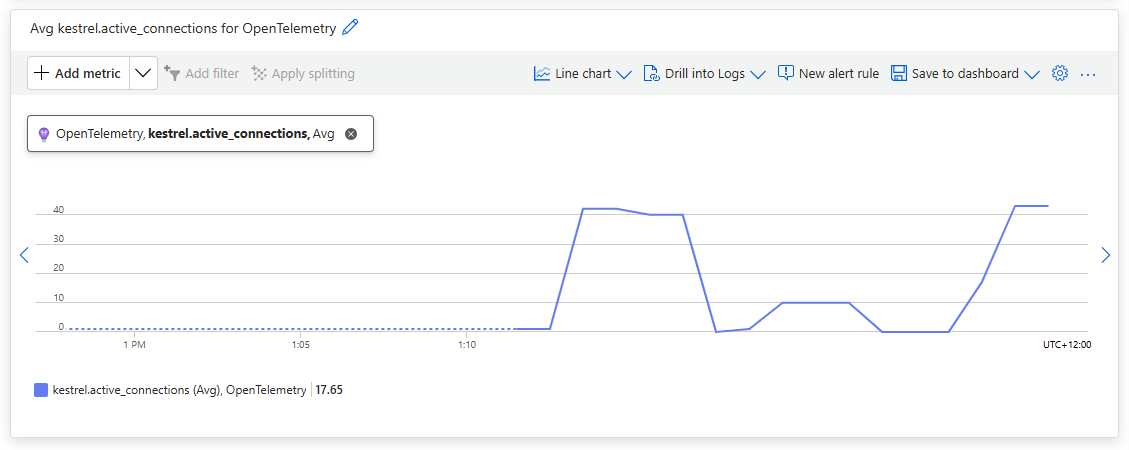
I then deployed the updated code and ran my 1000 device stress test (note the different x axis scales)
Number of connections with pooling
This confirmed what I found in the Azure.AMQP source code
/// <summary>
/// The default size of the pool
/// </summary>
/// <remarks>
/// Allows up to 100,000 devices
/// </remarks>
/// private const uint DefaultPoolSize = 100;
The console application uses MQTTNet to connect to TTN. It subscribes to to the TTN application device uplink topic (did try subscribing to the uplink messages for all the devices in the application but this was to noisy), and the downlink message scheduled, sent and acknowledged topics. To send messages to the device I published them on the device downlink topic.