Swarm Space – Replacing the OpenAPI Client

At the start of this project I used NSwag and Open API Swagger definition file (provided by Swarm Space technical support) to generate a Swarm Space Bumble bee hive client and the core of a simulator.

Swarm Space Bumble hive classes in Visual Studio 2022

My SwarmSpaceAzureIoTConnector project only needed to login, get a list of devices and send messages so all the additional functionality was never going to be used. The method to send a message didn’t work, the class used for the payload (UserMessage) appears to be wrong.

OpenAPI Swagger docs for sending a message

The Open API Swagger definition for sending a message to a device

"post": {
        "tags": [ "messages" ],
        "summary": "POST user messages",
        "description": "<p>This endpoint submits a JSON formatted UserMessage object for delivery to a Swarm device. A JSON object is returned with a newly assigned <code>packetId</code> and <code>status</code> of<code>OK</code> on success, or <code>ERROR</code> (with a description of the error) on failure.</p><p>The current user must have access to the <code>userApplicationId</code> and <code>device</code> given inside the UserMessage JSON. The device must also have the ability to receive messages from the Hive (\"two-way communication\") enabled. If these conditions are not met, a response with status code 403 (Forbidden) will be returned.</p><p>Note that the <code>data</code> field is the <b>Base64-encoded</b> version of the data to be sent. This allows the sending of binary, as well as text, data.</p>",
        "operationId": "addApplicationMessage",
        "requestBody": {
          "content": { "application/json": { "schema": { "$ref": "#/components/schemas/UserMessage" } } },
          "required": true
        },
        "responses": {
          "401": {
            "description": "Unauthorized",
            "content": { "*/*": { "schema": { "$ref": "#/components/schemas/ApiError" } } }
          },
          "403": {
            "description": "Forbidden",
            "content": { "*/*": { "schema": { "$ref": "#/components/schemas/ApiError" } } }
          },
          "400": {
            "description": "Bad Request",
            "content": { "*/*": { "schema": { "$ref": "#/components/schemas/ApiError" } } }
          },
          "200": {
            "description": "OK",
            "content": { "application/json": { "schema": { "$ref": "#/components/schemas/PacketPostReturn" } } }
          }
        }
      }
    },

The Open API Swagger definition for a UserMessage

[System.CodeDom.Compiler.GeneratedCode("NJsonSchema", "13.17.0.0 (NJsonSchema v10.8.0.0 (Newtonsoft.Json v13.0.0.0))")]
    public partial class UserMessage
    {
        /// <summary>
        /// Swarm packet ID
        /// </summary>
        [Newtonsoft.Json.JsonProperty("packetId", Required = Newtonsoft.Json.Required.Always)]
        public long PacketId { get; set; }

        /// <summary>
        /// Swarm message ID. There may be multiple messages for a single message ID. A message ID represents an intent to send a message, but there may be multiple Swarm packets that are required to fulfill that intent. For example, if a Hive -&gt; device message fails to reach its destination, automatic retry attempts to send that message will have the same message ID.
        /// </summary>
        [Newtonsoft.Json.JsonProperty("messageId", Required = Newtonsoft.Json.Required.DisallowNull, NullValueHandling = Newtonsoft.Json.NullValueHandling.Ignore)]
        public long MessageId { get; set; }

        /// <summary>
        /// Swarm device type
        /// </summary>
        [Newtonsoft.Json.JsonProperty("deviceType", Required = Newtonsoft.Json.Required.Always)]
        public int DeviceType { get; set; }

        /// <summary>
        /// Swarm device ID
        /// </summary>
        [Newtonsoft.Json.JsonProperty("deviceId", Required = Newtonsoft.Json.Required.Always)]
        public int DeviceId { get; set; }

        /// <summary>
        /// Swarm device name
        /// </summary>
        [Newtonsoft.Json.JsonProperty("deviceName", Required = Newtonsoft.Json.Required.DisallowNull, NullValueHandling = Newtonsoft.Json.NullValueHandling.Ignore)]
        public string DeviceName { get; set; }

        /// <summary>
        /// Direction of message
        /// </summary>
        [Newtonsoft.Json.JsonProperty("direction", Required = Newtonsoft.Json.Required.Always)]
        public int Direction { get; set; }

        /// <summary>
        /// Message data type, always = 6
        /// </summary>
        [Newtonsoft.Json.JsonProperty("dataType", Required = Newtonsoft.Json.Required.Always)]
        public int DataType { get; set; }

        /// <summary>
        /// Application ID
        /// </summary>
        [Newtonsoft.Json.JsonProperty("userApplicationId", Required = Newtonsoft.Json.Required.Always)]
        public int UserApplicationId { get; set; }

        /// <summary>
        /// Organization ID
        /// </summary>
        [Newtonsoft.Json.JsonProperty("organizationId", Required = Newtonsoft.Json.Required.Always)]
        public int OrganizationId { get; set; }

        /// <summary>
        /// Length of data (in bytes) before base64 encoding
        /// </summary>
        [Newtonsoft.Json.JsonProperty("len", Required = Newtonsoft.Json.Required.DisallowNull, NullValueHandling = Newtonsoft.Json.NullValueHandling.Ignore)]
        public int Len { get; set; }

        /// <summary>
        /// Base64 encoded data string
        /// </summary>
        [Newtonsoft.Json.JsonProperty("data", Required = Newtonsoft.Json.Required.Always)]
        [System.ComponentModel.DataAnnotations.Required(AllowEmptyStrings = true)]
        public byte[] Data { get; set; }

        /// <summary>
        /// Swarm packet ID of acknowledging packet from device
        /// </summary>
        [Newtonsoft.Json.JsonProperty("ackPacketId", Required = Newtonsoft.Json.Required.DisallowNull, NullValueHandling = Newtonsoft.Json.NullValueHandling.Ignore)]
        public long AckPacketId { get; set; }

        /// <summary>
        /// Message status. Possible values:
        /// <br/>0 = incoming message (from a device)
        /// <br/>1 = outgoing message (to a device)
        /// <br/>2 = incoming message, acknowledged as seen by customer. OR a outgoing message packet is on groundstation
        /// <br/>3 = outgoing message, packet is on satellite
        /// <br/>-1 = error
        /// <br/>-3 = failed to deliver, retrying
        /// <br/>-4 = failed to deliver, will not re-attempt
        /// <br/>
        /// </summary>
        [Newtonsoft.Json.JsonProperty("status", Required = Newtonsoft.Json.Required.DisallowNull, NullValueHandling = Newtonsoft.Json.NullValueHandling.Ignore)]
        public int Status { get; set; }

        /// <summary>
        /// Time that the message was received by the Hive
        /// </summary>
        [Newtonsoft.Json.JsonProperty("hiveRxTime", Required = Newtonsoft.Json.Required.Always)]
        [System.ComponentModel.DataAnnotations.Required(AllowEmptyStrings = true)]
        public System.DateTimeOffset HiveRxTime { get; set; }

        private System.Collections.Generic.IDictionary<string, object> _additionalProperties;

        [Newtonsoft.Json.JsonExtensionData]
        public System.Collections.Generic.IDictionary<string, object> AdditionalProperties
        {
            get { return _additionalProperties ?? (_additionalProperties = new System.Collections.Generic.Dictionary<string, object>()); }
            set { _additionalProperties = value; }
        }

    }

After several attempts I gave up and have rebuilt the required Bumble bee hive integration with RestSharp

public async Task SendAsync(uint organisationId, uint deviceId, byte deviceType, ushort userApplicationId, byte[] data, CancellationToken cancellationToken)
{
    await TokenRefresh(cancellationToken);

    _logger.LogInformation("SendAsync: OrganizationId:{0} DeviceType:{1} DeviceId:{2} UserApplicationId:{3} Data:{4} Enabled:{5}", organisationId, deviceType, deviceId, userApplicationId, Convert.ToBase64String(data), _bumblebeeHiveSettings.DownlinkEnabled);

    Models.MessageSendRequest message = new Models.MessageSendRequest()
    {
        OrganizationId = (int)organisationId,
        DeviceType = deviceType,
        DeviceId = (int)deviceId,
        UserApplicationId = userApplicationId,
        Data = data,
    };

    RestClientOptions restClientOptions = new RestClientOptions()
    {
        BaseUrl = new Uri(_bumblebeeHiveSettings.BaseUrl),
        ThrowOnAnyError = true,
    };

    using (RestClient client = new RestClient(restClientOptions))
    {
        RestRequest request = new RestRequest("api/v1/messages", Method.Post);

        request.AddBody(message);

        request.AddHeader("Authorization", $"bearer {_token}");

        // To save the limited monthly allocation of mesages downlinks can be disabled
        if (_bumblebeeHiveSettings.DownlinkEnabled)
        {
           var response = await client.PostAsync<Models.MessageSendResponse>(request, cancellationToken);

            _logger.LogInformation("SendAsync-Result:{Status} PacketId:{PacketId}", response.Status, response.PacketId);
        }
    }
}

The new Data Transfer Objects(DTOs) were “inspired” by the NSwag generated ones.

public partial class MessageSendRequest
{
    /// <summary>
    /// Swarm device type
    /// </summary>
    [Newtonsoft.Json.JsonProperty("deviceType", Required = Newtonsoft.Json.Required.Always)]
    public int DeviceType { get; set; }

    /// <summary>
    /// Swarm device ID
    /// </summary>
    [Newtonsoft.Json.JsonProperty("deviceId", Required = Newtonsoft.Json.Required.Always)]
    public int DeviceId { get; set; }

    /// <summary>
    /// Application ID
    /// </summary>
    [Newtonsoft.Json.JsonProperty("userApplicationId", Required = Newtonsoft.Json.Required.Always)]
    public int UserApplicationId { get; set; }

    /// <summary>
    /// Organization ID
    /// </summary>
    [Newtonsoft.Json.JsonProperty("organizationId", Required = Newtonsoft.Json.Required.Always)]
    public int OrganizationId { get; set; }

    /// <summary>
    /// Base64 encoded data string
    /// </summary>
    [Newtonsoft.Json.JsonProperty("data", Required = Newtonsoft.Json.Required.Always)]
    [System.ComponentModel.DataAnnotations.Required(AllowEmptyStrings = true)]
    public byte[] Data { get; set; }
}

public class MessageSendResponse
{
    /// <summary>
    /// Swarm packet ID.
    /// </summary>
    [Newtonsoft.Json.JsonProperty("packetId", Required = Newtonsoft.Json.Required.Always)]
    public long PacketId { get; set; }

    /// <summary>
    /// Submission status, "OK" or "ERROR" with a description of the error.
    /// </summary>
    [Newtonsoft.Json.JsonProperty("status", Required = Newtonsoft.Json.Required.Always)]
    [System.ComponentModel.DataAnnotations.Required(AllowEmptyStrings = true)]
    public string Status { get; set; }
}

The RestSharp based approach is significantly smaller and less complex….

Swarm Space – Bumblebee Hive Basic Emulator

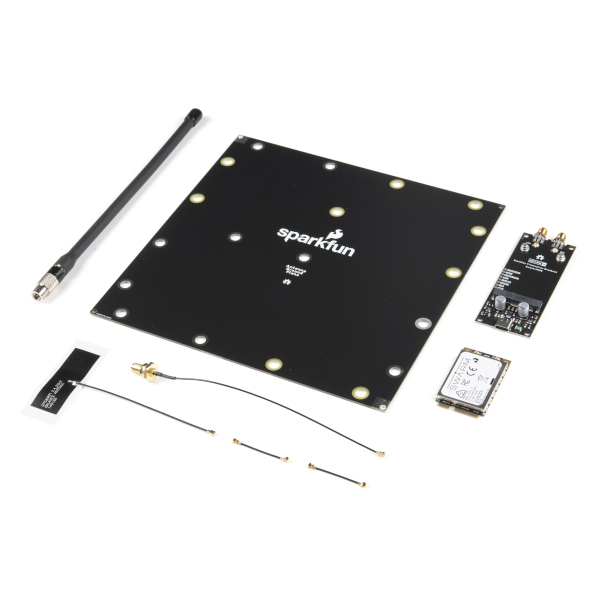
One of the main problems building a Cloud Identity Translation Gateway (like my TTIV3AzureIoTConnector) is getting enough devices to make testing (esp. scalability) realistic. This is a problem because I have only got two devices, a Sparkfun Satellite Transceiver Breakout – Swarm M138 and a Swarm Asset Tracker. (Considering buying a Swarm Eval Kit)

Satellite Transceiver Breakout – Swarm M138
Swarm Asset Tracker

So, I can simulate lots of devices and test more complex configurations I have started build a Swarm Bumble Bee Hive emulator based on the API and Delivery-API OpenAPI files.

NSwagStudio configuration for generating ASP.NET Core web API

As well as generating clients NSwagStudio can also generate ASP.NET Core web APIs. To test my approach, I built the simplest possible client I could which calls the generated PostLoginAsync and GetDeviceCountAsync.

Swagger UI for NSwagStudio generated ASP.NET Core web API

Initially the BumblebeeHiveBasicClientConsole login method would fail with an HTTP 415 Unsupported Media Type error.

BumblebeeHiveBasicClientConsole application 415 Unsupported Media Type error

After some trial and error, I modified the HiveController.cs and HiveControllerImplementation.cs Login method signatures so the payload was “application/x-www-form-urlencoded” rather than “application/json” by changing FromBody to FromForm

Task<Response> IAuthController.PostLoginAsync([FromForm] LoginForm body)
{
     return Task.FromResult(new Response()
    {
        Token = Guid.NewGuid().ToString()
    });
}

Modifying code generated by a tool like NSwagStudio should be avoided but I couldn’t work out a simpler solution

/// <summary>
/// POST login
/// </summary>
/// <remarks>
/// &lt;p&gt;Use username and password to log in.&lt;/p&gt;&lt;p&gt;On success: returns status code 200. The response body is the JSON &lt;code&gt;{"token": "&amp;lt;token&amp;gt;"}&lt;/code&gt;, along with the header &lt;code&gt;Set-Cookie: JSESSIONID=&amp;lt;token&amp;gt;; Path=/; Secure; HttpOnly;&lt;/code&gt;. The tokens in the return value and the &lt;code&gt;Set-Cookie&lt;/code&gt; header are the same. The token is a long string of letters, numbers, and punctuation.&lt;/p&gt;&lt;p&gt;On failure: returns status code 401.&lt;/p&gt;&lt;p&gt;To make authenticated requests, there are two ways: &lt;ul&gt;&lt;li&gt;(Preferred) Use the token as a Bearer Authentication token by including the HTTP header &lt;code&gt;Authorization: Bearer &amp;lt;token&amp;gt;&lt;/code&gt; in further requests.&lt;/li&gt;&lt;li&gt;(Deprecated) Use the token as the JSESSIONID cookie in further requests.&lt;/li&gt;&lt;/ul&gt;&lt;/p&gt;
/// </remarks>
/// <returns>Login success</returns>
[Microsoft.AspNetCore.Mvc.HttpPost, Microsoft.AspNetCore.Mvc.Route("login")]
public System.Threading.Tasks.Task<Response> PostLogin([Microsoft.AspNetCore.Mvc.FromForm] LoginForm body)
{

    return _implementation.PostLoginAsync(body);
}

BumblebeeHiveBasicCLientConsole application calling the simulator
BumblebeeHiveBasicClientConsole application calling the production system

After some initial problems with content-types the Swarm Hive API (not tried the Delivery-API yet) appears to be documented and easy to use. Though, some of the variable type choices do seem a bit odd.

public virtual async System.Threading.Tasks.Task<string> GetDeviceCountAsync(int? devicetype, System.Threading.CancellationToken cancellationToken)

Swarm Space – Bumblebee Hive API Basic client

Back in July I purchased a Satellite Transceiver Breakout – Swarm M138 from SparkFun and it has been sitting on the shelf since then. I want to get telemetry from a sensor to an Azure IoT Hub or Azure IoT Central over a Swarm Space link for a project I am working on.

I’ll need to solder on some headers and cut a couple of tracks on the breakout board so my device (most probably a SparkFun – ESP32-S2 WROOM) can connect to the Swarm-M1138 modem. The NET nanoFramework team have an IoT.Device Swarm Tile NuGet package which I will use to interface the device to the modem.

I have started with a “nasty” Proof of Concept(PoC) to figure out how to connect to the Swarm Hive API.

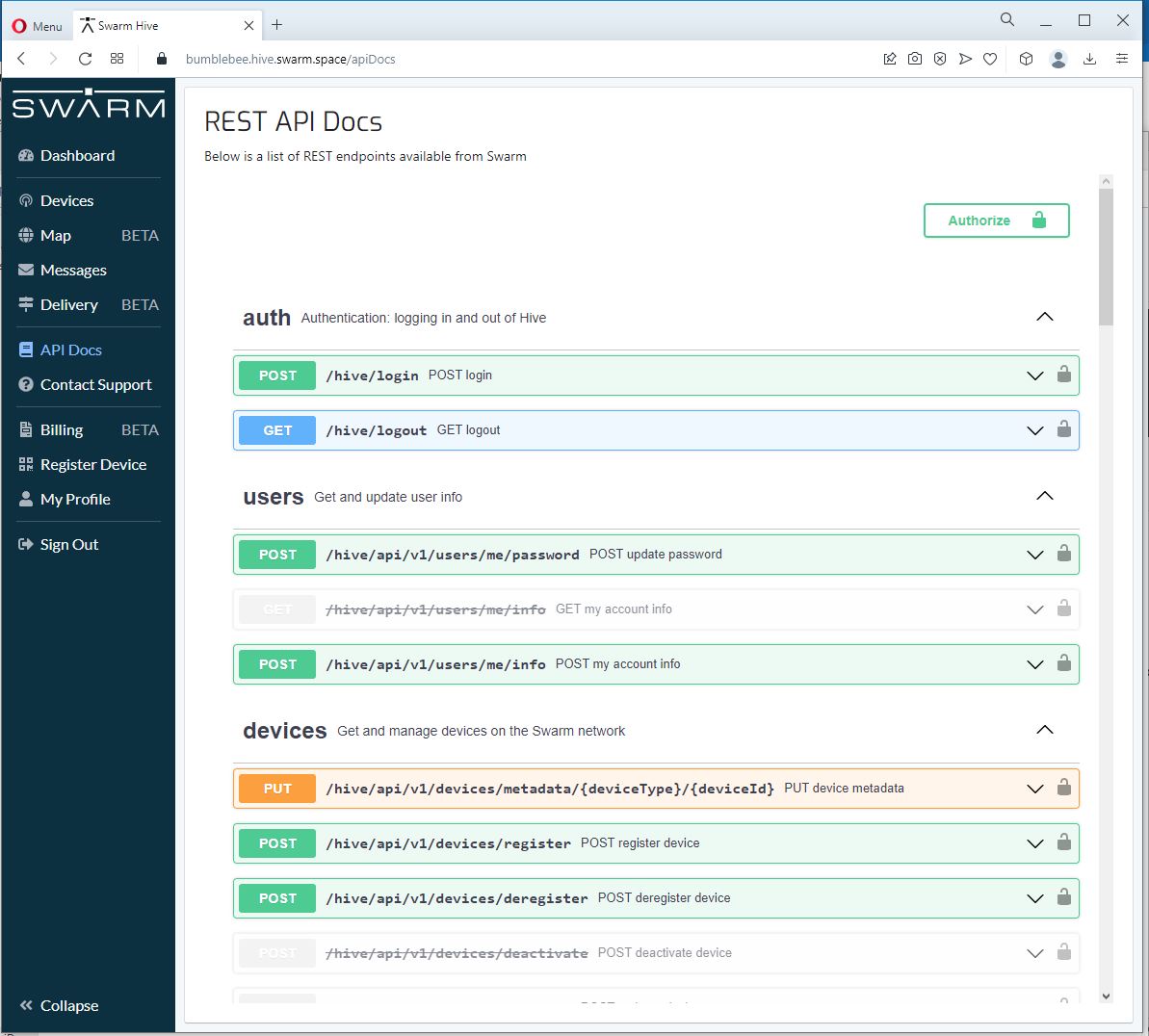
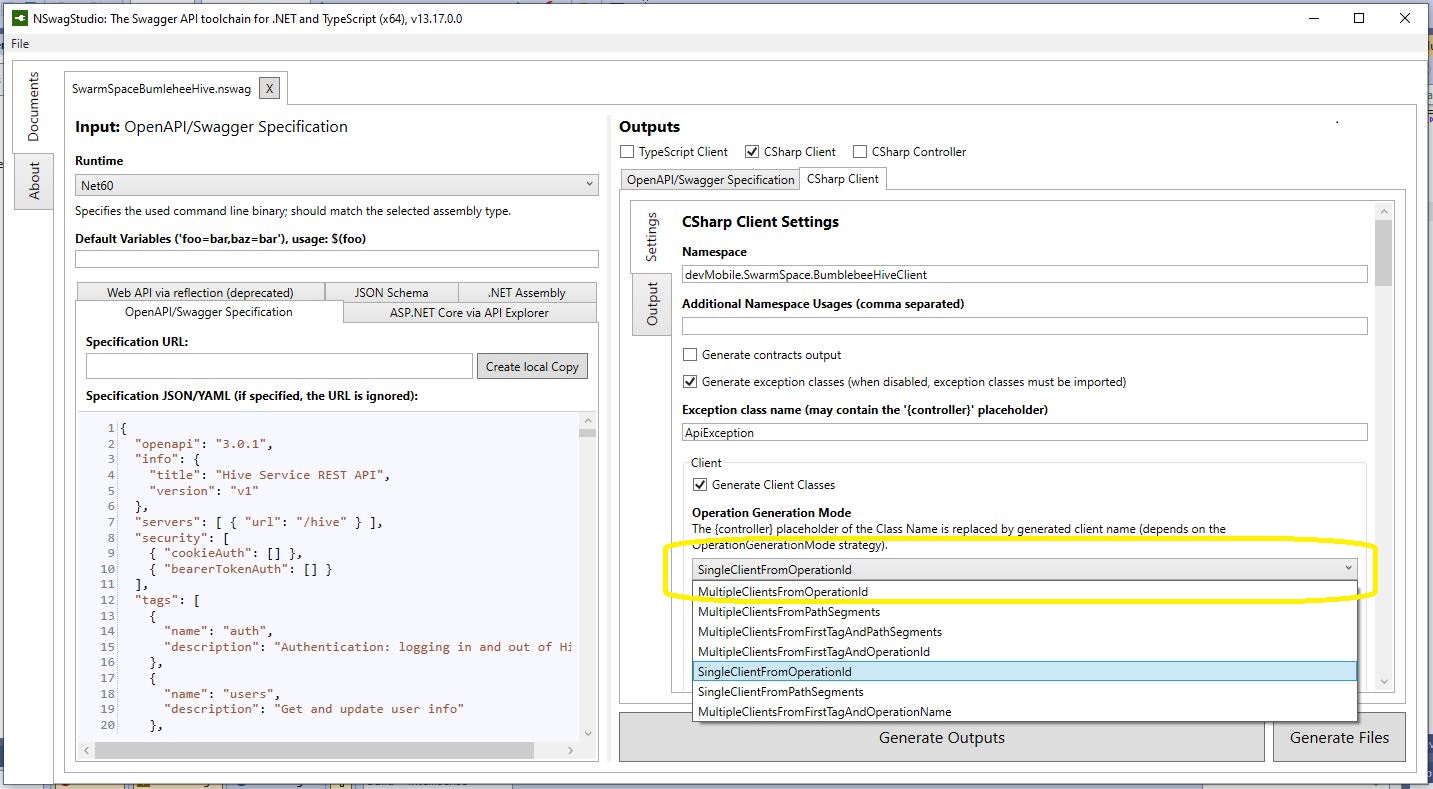
The Swarm Hive API has been published with Swagger/OpenAPI which is really simple to use. I used NSwagStudio to generate a C# client to I didn’t have to “handcraft” one.

Initially the code would compile but I found a clue in a Github Issue from September 2017 which was to change the “Operation Generation Model” to SingleClientFromOperationId.(The setting is highlighted above).

static async Task Main(string[] args)
{
    using (HttpClient httpClient = new HttpClient())
    {
        BumblebeeHiveClient.Client client = new BumblebeeHiveClient.Client(httpClient);

        client.BaseUrl = "https://bumblebee.hive.swarm.space/hive/";

        BumblebeeHiveClient.LoginForm loginForm = new BumblebeeHiveClient.LoginForm();

        // https://bumblebee.hive.swarm.space/login/
        loginForm.Username = "...";
        loginForm.Password = "...";

        Console.WriteLine($"devMobile SwarmSpace Bumblebee Hive Console Client");
        Console.WriteLine("");

        Console.WriteLine($"Login POST");
        BumblebeeHiveClient.Response response = await client.PostLoginAsync(loginForm);

        Console.WriteLine($"Token :{response.Token[..5]}.....{response.Token[^5..]}");
        Console.WriteLine($"Press <enter> to continue");
        Console.ReadLine();

        string apiKey = "bearer " + response.Token;

        httpClient.DefaultRequestHeaders.Add("Authorization", apiKey);


        Console.WriteLine($"Device count GET");

        string count = await client.GetDeviceCountAsync(1);

        Console.WriteLine($"Device count :{count}");
        Console.WriteLine($"Press <enter> to continue");
        Console.ReadLine();

        Console.WriteLine($"Device(s) information GET");

        var devices = await client.GetDevicesAsync(1, null, null, null, null, null, null, null, null);

        foreach (var device in devices)
        {
            Console.WriteLine($" Id:{device.DeviceId} Name:{device.DeviceName} Type:{device.DeviceType} Organisation:{device.OrganizationId}");
        }

        Console.WriteLine($"Press <enter> to continue");
        Console.ReadLine();

        Console.WriteLine($"User Context GET");
        var userContext = await client.GetUserContextAsync();

        Console.WriteLine($" Id:{userContext.UserId} Name:{userContext.Username} Country:{userContext.Country}");

        Console.WriteLine("Additional properties");
        foreach ( var additionalProperty in userContext.AdditionalProperties)
        {
            Console.WriteLine($" Id:{additionalProperty.Key} Value:{additionalProperty.Value}");
        }

        Console.WriteLine($"Press <enter> to exit");
        Console.ReadLine();
    }
}

I tried a couple of ways to attach the Swarm Hive API authorisation token (returned by the Login method) to client requests. After a couple for failed attempts, I “realised” that adding the “Authorization” header to the HttpClient defaultRequestHeaders was by far the simplest approach.

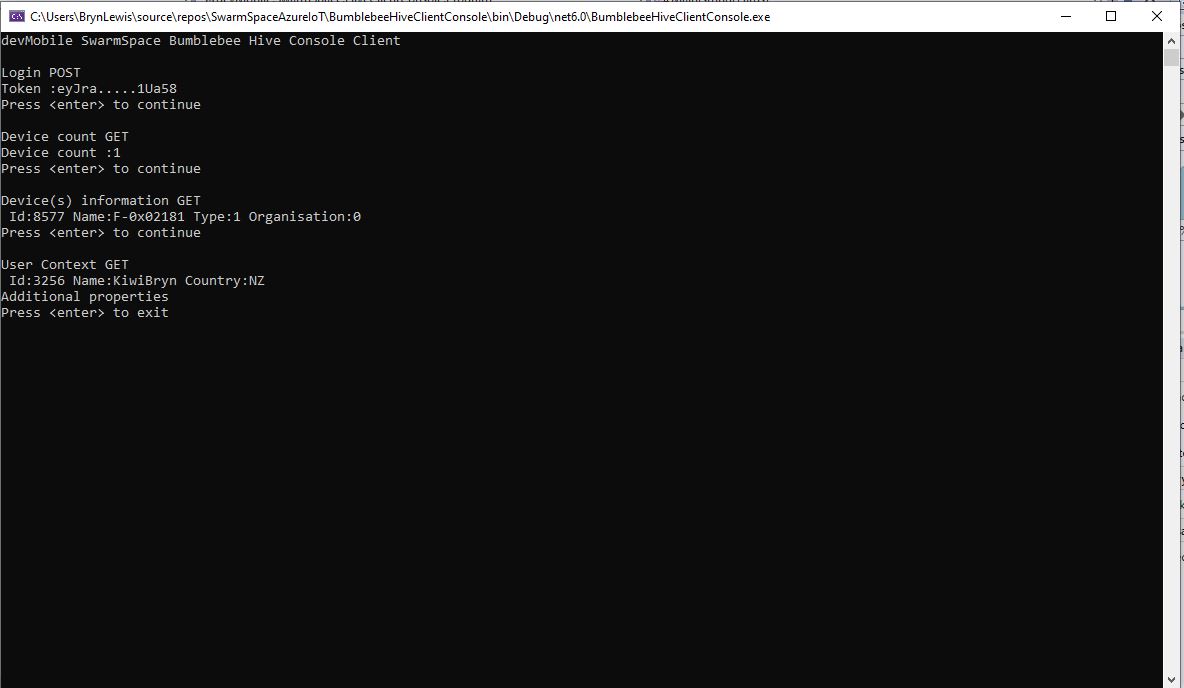
My “nasty” console application calls the Login method, then requests the number of devices (I only have one), gets a list of the properties of all the devices(very short list) then gets the User Context and displays their ID, Name and Country.

TTN V3 Application API Basic Paging and Filtering Client

The next step was to enumerate The Things Network(TTN) Applications so I could connect only to the required Azure IoT hub(s). There would also be a single configuration setting for the client (establish a connection for every TTN application, or don’t establish a connection for any) and this could be overridden with a TTN application attribute

long pageSize = long.Parse(args[3]);
Console.WriteLine($"Page size: {pageSize}");

Console.WriteLine();

using (HttpClient httpClient = new HttpClient())
{
	ApplicationRegistryClient applicationRegistryClient = new ApplicationRegistryClient(baseUrl, httpClient)
	{
		ApiKey = apiKey
	};

	try
	{
		int page = 1;

		string[] fieldMaskPathsApplication = { "attributes" }; // think this is the bare minimum required for integration

		V3Applications applications = await applicationRegistryClient.ListAsync(collaborator, field_mask_paths: fieldMaskPathsApplication, limit: pageSize, page: page);
		while ((applications != null) && (applications.Applications != null)) 
		{
			Console.WriteLine($"Applications:{applications.Applications.Count} Page:{page} Page size:{pageSize}");
			foreach (V3Application application in applications.Applications)
			{
				bool applicationIntegration = ApplicationAzureintegrationDefault;

				Console.WriteLine($"Application ID:{application.Ids.Application_id}");
				if (application.Attributes != null)
				{
					string ApplicationAzureIntegrationValue = string.Empty;
					if (application.Attributes.TryGetValue(ApplicationAzureIntegrationField, out ApplicationAzureIntegrationValue))
					{
						bool.TryParse(ApplicationAzureIntegrationValue, out applicationIntegration);
					}

					if (applicationIntegration)
					{
						Console.WriteLine("  Application attributes");

						foreach (KeyValuePair<string, string> attribute in application.Attributes)
						{
							Console.WriteLine($"   Key: {attribute.Key} Value: {attribute.Value}");
						}
					}
				}
				Console.WriteLine();
			}
			page += 1;
			applications = await applicationRegistryClient.ListAsync(collaborator, field_mask_paths: fieldMaskPathsApplication, limit: pageSize, page: page);
		};
	}
	catch (Exception ex)
	{
		Console.WriteLine(ex.Message);
	}

	Console.WriteLine("Press <enter> to exit");
	Console.ReadLine();
}

I Used the field_mask_paths parameter (don’t need created_at, updated_at, name etc.) to minimise the data returned to my client.

public async System.Threading.Tasks.Task<V3Applications> ListAsync(string collaborator_organization_ids_organization_id = null, string collaborator_user_ids_user_id = null, string collaborator_user_ids_email = null, System.Collections.Generic.IEnumerable<string> field_mask_paths = null, string order = null, long? limit = null, long? page = null, System.Threading.CancellationToken cancellationToken = default(System.Threading.CancellationToken))
{
   var urlBuilder_ = new System.Text.StringBuilder();
   urlBuilder_.Append(BaseUrl != null ? BaseUrl.TrimEnd('/') : "").Append("/applications?");
   if (collaborator_organization_ids_organization_id != null) 
   {
         urlBuilder_.Append(System.Uri.EscapeDataString("collaborator.organization_ids.organization_id") + "=").Append(System.Uri.EscapeDataString(ConvertToString(collaborator_organization_ids_organization_id, System.Globalization.CultureInfo.InvariantCulture))).Append("&");
   }
   if (collaborator_user_ids_user_id != null) 
   {
         urlBuilder_.Append(System.Uri.EscapeDataString("collaborator.user_ids.user_id") + "=").Append(System.Uri.EscapeDataString(ConvertToString(collaborator_user_ids_user_id, System.Globalization.CultureInfo.InvariantCulture))).Append("&");
   }
   if (collaborator_user_ids_email != null) 
   {
         urlBuilder_.Append(System.Uri.EscapeDataString("collaborator.user_ids.email") + "=").Append(System.Uri.EscapeDataString(ConvertToString(collaborator_user_ids_email, System.Globalization.CultureInfo.InvariantCulture))).Append("&");
   }
   if (field_mask_paths != null) 
   {
         foreach (var item_ in field_mask_paths) { urlBuilder_.Append(System.Uri.EscapeDataString("field_mask.paths") + "=").Append(System.Uri.EscapeDataString(ConvertToString(item_, System.Globalization.CultureInfo.InvariantCulture))).Append("&"); }
   }
   if (order != null) 
   {
         urlBuilder_.Append(System.Uri.EscapeDataString("order") + "=").Append(System.Uri.EscapeDataString(ConvertToString(order, System.Globalization.CultureInfo.InvariantCulture))).Append("&");
   }
   if (limit != null) 
   {
         urlBuilder_.Append(System.Uri.EscapeDataString("limit") + "=").Append(System.Uri.EscapeDataString(ConvertToString(limit, System.Globalization.CultureInfo.InvariantCulture))).Append("&");
   }
   if (page != null) 
   {
         urlBuilder_.Append(System.Uri.EscapeDataString("page") + "=").Append(System.Uri.EscapeDataString(ConvertToString(page, System.Globalization.CultureInfo.InvariantCulture))).Append("&");
   }
}

I was hoping that there would be a away to further “shape” the returned data, but in the NSwag generated code the construction of the URL with field_mask_paths, order, limit, and page parameters meant this appears not to be possible.

AdaFruit IO Swagger based desktop HTTP client

Manually building clients for complex RESTful APIs (like AdaFruit.IO) can be a bit tedious so I figured I would try generating a C# http client from the Swagger OpenAPI specification(OAS) metadata.

My initial attempts using the Swagger Editor and NSwag on the AdaFruit.IO public API description didn’t go so well. (for more info see this AdaFruit.IO support forum thread) You may need to manually modify the type of the id field in Data & DataResponse, plus possibly other responses.

After figuring out how to set the API key, my code which uploads simulates three individual feeds and one feed group appears to work reliably.

/*

Copyright ® 2018 Jan devMobile Software, All Rights Reserved

THIS CODE AND INFORMATION IS PROVIDED "AS IS" WITHOUT WARRANTY OF ANY
KIND, EITHER EXPRESSED OR IMPLIED, INCLUDING BUT NOT LIMITED TO THE
IMPLIED WARRANTIES OF MERCHANTABILITY AND/OR FITNESS FOR A PARTICULAR
PURPOSE.

http://www.devmobile.co.nz

*/
using System;
using System.Diagnostics;
using System.Threading.Tasks;
using AdaFruit.IO;

namespace AdaFruit.IO
{
public partial class Client
{
string adaFruitIOApiKey = "yourAPIKey";

partial void PrepareRequest(System.Net.Http.HttpClient client, System.Net.Http.HttpRequestMessage request, string url)
{
client.DefaultRequestHeaders.Add("X-AIO-Key", adaFruitIOApiKey);
}
}
}

namespace devMobile.IoT.Adafruit.IO.Desktop
{
class Program
{
static void Main(string[] args)
{
string userName = "YourUserName"; // This is mixed case & case sensitive
// The feed group and feed key are forced to lower case by UI
const string feedGroup = "devduinov2-dot-2";
const string temperatureKey = "t";
const double temperatureBase = 20.0;
const double temperatureRange = 10.0;
const string humidityKey = "h";
const double humidityBase = 70.0;
const double humidityRange = 20.0;
const string batteryVoltageKey = "v";
const double batteryVoltageBase = 3.00;
const double batteryVoltageRange = -1.00;
TimeSpan feedUpdateDelay = new TimeSpan(0, 0, 15);
TimeSpan groupUpdateDelay = new TimeSpan(0, 0, 30);
Random random = new Random();

while (true)
{
Client client = new Client();
double temperature = temperatureBase + random.NextDouble() * temperatureRange;
double humidity = humidityBase + random.NextDouble() * humidityRange;
double batteryVoltage = batteryVoltageBase + random.NextDouble() * batteryVoltageRange;

Debug.WriteLine("Temperature {0}°C  Humidity {1}%  Battery Voltage {2}V", temperature.ToString("F1"), humidity.ToString("F0"), batteryVoltage.ToString("F2"));

// First Update the 3 feeds individually
// Temperature
Datum temperatureDatum = new Datum()
{
Value = temperature.ToString("F1"),
};
client.CreateDataAsync(userName, temperatureKey, temperatureDatum).Wait();
Task.Delay(feedUpdateDelay).Wait();

// Humidity
Datum humidityDatum = new Datum()
{
Value = humidity.ToString("F0"),
};
client.CreateDataAsync(userName, humidityKey, humidityDatum).Wait();
Task.Delay(feedUpdateDelay).Wait();

// Battery
Datum batteryDatum = new Datum()
{
Value = batteryVoltage.ToString("F2"),
};
client.CreateDataAsync(userName, batteryVoltageKey, batteryDatum).Wait();
Task.Delay(feedUpdateDelay).Wait();

// Then update a feed in a group
Group_feed_data devDuinoData = new Group_feed_data();

devDuinoData.Feeds.Add(new Anonymous2() { Key = temperatureKey, Value = temperature.ToString("F1")});
devDuinoData.Feeds.Add(new Anonymous2() { Key = humidityKey, Value = humidity.ToString("F0")});
devDuinoData.Feeds.Add(new Anonymous2() { Key = batteryVoltageKey, Value = batteryVoltage.ToString("F2")});

client.CreateGroupDataAsync(userName, feedGroup, devDuinoData).Wait();
Task.Delay(groupUpdateDelay).Wait();
}
}
}
}