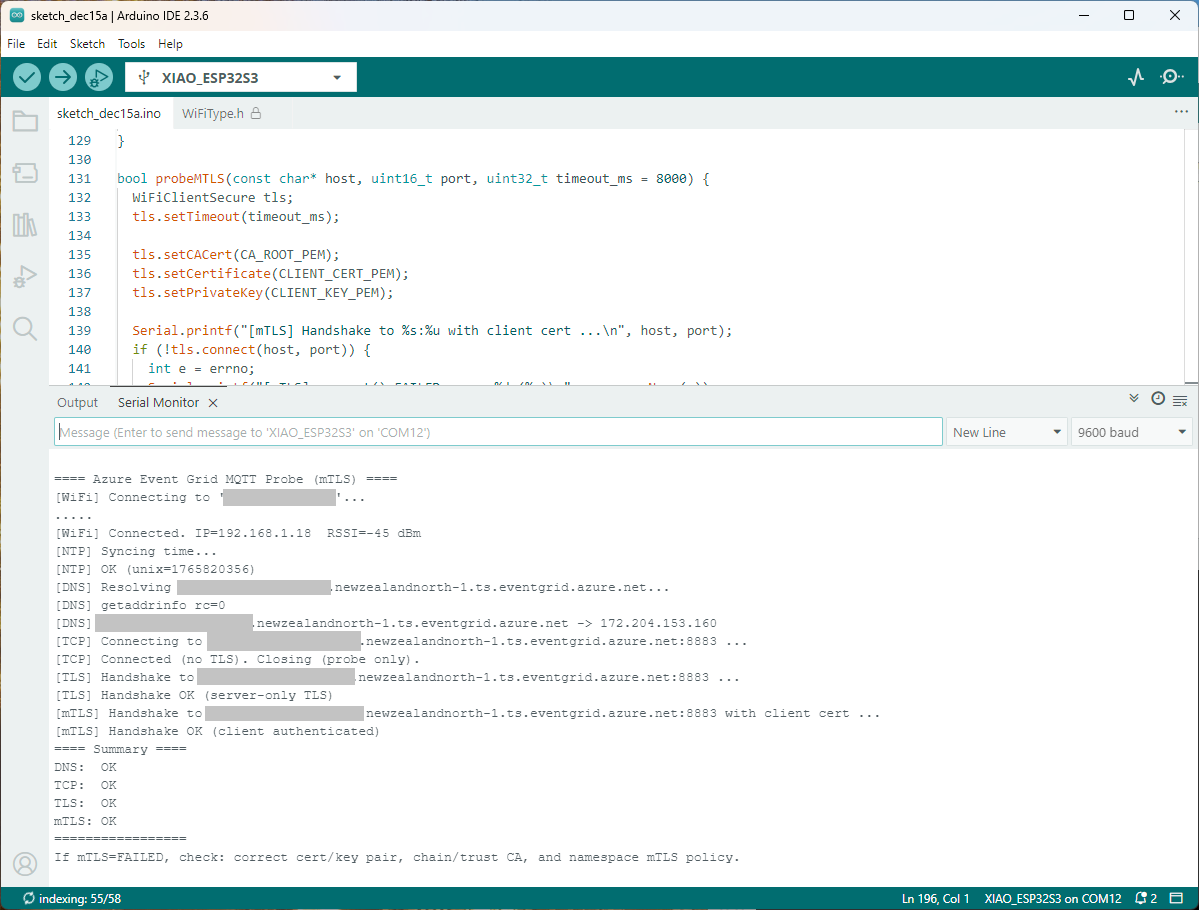
Still couldn’t figure out why my code was failing so I built a test harness which connected to the wifi, set the time with the Network Time Protocol(NTP), established a Transport Layer Security(TLS) connection with the Azure Event Grid MQTT Broker then finally Authenticated (using Client Certificate authentication). Basically, it was The joy of certs without the Arduino PubSubClient library and with authentication
/*
  Azure Event Grid MQTT Endpoint Probe with mTLS
  - Wi-Fi connect
  - SNTP time sync
  - DNS resolve
  - TCP reachability (port 8883)
  - TLS (server-only) handshake using CRT bundle (or custom CA)
  - TLS (mTLS) handshake with client certificate & private key

  Notes:
    - Client certificate must be PEM and match private key.
    - Private key must be PEM and UNENCRYPTED (no passphrase).
    - SNI uses HOSTNAME automatically; do NOT use raw IP.
*/
#include <Arduino.h>
#include <WiFi.h>
#include <WiFiClient.h>
#include <WiFiClientSecure.h>

#include <../constants.h>
#include <../secrets.h>

extern "C" {
  #include <lwip/netdb.h>
  #include <lwip/sockets.h>
  #include <lwip/inet.h>
  #include <lwip/errno.h>
  #include <time.h>
}
static const char* HOSTNAME  = "ThisIsNotTheMQTTBrokerYouAreLookingFor.newzealandnorth-1.ts.eventgrid.azure.net";
static const uint16_t PORT   = 8883;

// Time servers (for TLS validity window)
static const char* NTP_1 = "pool.ntp.org";
static const char* NTP_2 = "time.cloudflare.com";

static const char* errnoName(int e) {
  switch (e) {
    case 5:   return "EIO";
    case 101: return "ENETUNREACH";
    case 104: return "ECONNRESET";
    case 110: return "ETIMEDOUT";
    case 111: return "ECONNREFUSED";
    case 113: return "EHOSTUNREACH";
    default:  return "?";
  }
}


bool waitForWifi(uint32_t timeout_ms = 20000) {
  uint32_t start = millis();
  Serial.printf("[WiFi] Connecting to '%s'...\n", WIFI_SSID);
  WiFi.begin(WIFI_SSID, WIFI_PASSWORD);
  while (WiFi.status() != WL_CONNECTED && (millis() - start) < timeout_ms) {
    delay(250);
    Serial.print(".");
  }
  Serial.println();
  return WiFi.status() == WL_CONNECTED;
}


void syncTime() {
  configTime(0, 0, NTP_1, NTP_2);
  Serial.println("[NTP] Syncing time...");
  for (int i = 0; i < 20; ++i) {
    time_t now = time(nullptr);
    if (now > 1609459200) { // > Jan 1, 2021
      Serial.printf("[NTP] OK (unix=%ld)\n", (long)now);
      return;
    }
    delay(500);
  }
  Serial.println("[NTP] Time sync may have failed; continuing.");
}

bool probeDNS(const char* host, char outIp[16]) {
  struct addrinfo hints = {};
  hints.ai_family = AF_INET; // IPv4
  struct addrinfo* res = nullptr;

  Serial.printf("[DNS] Resolving %s...\n", host);
  int rc = getaddrinfo(host, NULL, &hints, &res);
  Serial.printf("[DNS] getaddrinfo rc=%d\n", rc);
  if (rc != 0 || !res) {
    Serial.println("[DNS] FAILED");
    return false;
  }
  struct sockaddr_in* sin = (struct sockaddr_in*)res->ai_addr;
  inet_ntop(AF_INET, &sin->sin_addr, outIp, 16);
  Serial.printf("[DNS] %s -> %s\n", host, outIp);
  freeaddrinfo(res);
  return true;
}


bool probeTCP(const char* host, uint16_t port, uint32_t timeout_ms = 5000) {
  WiFiClient cli;
  cli.setTimeout(timeout_ms);
  Serial.printf("[TCP] Connecting to %s:%u ...\n", host, port);
  if (!cli.connect(host, port)) {
    Serial.printf("[TCP] connect() FAILED\n");
    return false;
  }
  Serial.println("[TCP] Connected (no TLS). Closing (probe only).");
  cli.stop();
  return true;
}


bool probeTLS(const char* host, uint16_t port, uint32_t timeout_ms = 7000) {
  WiFiClientSecure tls;
  tls.setTimeout(timeout_ms);

  tls.setCACert(CA_ROOT_PEM);

  Serial.printf("[TLS] Handshake to %s:%u ...\n", host, port);
  if (!tls.connect(host, port)) {
    int e = errno;
    Serial.printf("[TLS] connect() FAILED errno=%d (%s)\n", e, errnoName(e));
    return false;
  }
  Serial.println("[TLS] Handshake OK (server-only TLS)");
  tls.stop();
  return true;
}

bool probeMTLS(const char* host, uint16_t port, uint32_t timeout_ms = 8000) {
  WiFiClientSecure tls;
  tls.setTimeout(timeout_ms);

  tls.setCACert(CA_ROOT_PEM);
  tls.setCertificate(CLIENT_CERT_PEM);
  tls.setPrivateKey(CLIENT_KEY_PEM);

  Serial.printf("[mTLS] Handshake to %s:%u with client cert ...\n", host, port);
  if (!tls.connect(host, port)) {
    int e = errno;
    Serial.printf("[mTLS] connect() FAILED errno=%d (%s)\n", e, errnoName(e));
    Serial.println("[mTLS] If errno=ETIMEDOUT/ECONNRESET, server may be closing due to cert policy mismatch.");
    return false;
  }
  Serial.println("[mTLS] Handshake OK (client authenticated)");
  tls.stop();
  return true;
}

void setup() {
  Serial.begin(9600);
  delay(5000);
  Serial.println();
  Serial.println("==== Azure Event Grid MQTT Probe (mTLS) ====");

  WiFi.mode(WIFI_STA);

  if (!waitForWifi()) {
    Serial.println("[WiFi] FAILED to connect within timeout");
  } else {
    Serial.printf("[WiFi] Connected. IP=%s  RSSI=%d dBm\n",
                  WiFi.localIP().toString().c_str(), WiFi.RSSI());
  }

  // TLS sanity: time
  syncTime();

  // DNS
  char ip[16] = {0};
  bool dnsOk = probeDNS(HOSTNAME, ip);

  // TCP reachability
  bool tcpOk = probeTCP(HOSTNAME, PORT);

  // TLS (server-only)
  bool tlsOk = probeTLS(HOSTNAME, PORT);

  // TLS (mTLS with client cert/key)
  bool mtlsOk = probeMTLS(HOSTNAME, PORT);

  Serial.println("==== Summary ====");
  Serial.printf("DNS:  %s\n", dnsOk  ? "OK" : "FAILED");
  Serial.printf("TCP:  %s\n", tcpOk  ? "OK" : "FAILED");
  Serial.printf("TLS:  %s\n", tlsOk  ? "OK" : "FAILED");
  Serial.printf("mTLS: %s\n", mtlsOk ? "OK" : "FAILED");
  Serial.println("=================");

  Serial.println("If mTLS=FAILED, check: correct cert/key pair, chain/trust CA, and namespace mTLS policy.");
}

void loop() {
  delay(1000);
}
The test harness worked which meant the issue was with my “re-factoring” of the BasicMqtt5_cert example.
 devMobile's blog